
Giovanni Bignami tra gli illustri del Famedio
 La Commissione comunale di Milano per le onoranze ha deciso all’unanimità i nomi delle 15 personalità che il prossimo 2 novembre saranno iscritte nel Pantheon all’interno del Cimitero Monumentale. Fra di essi anche quello del celebre astrofisico scomparso il 24 maggio scorso, presidente dell'Inaf fino al 2015 Continue reading
Il Poliedrico – La notte europea dei ricercatori 2017
Aaa-alb.blogspot.it – #ENR17: La #notte della #ricerca
Astrocometal.blogspot.it – #ENR17: Che #notte, quella notte!
Tuttidentro.eu – Una notte per amare la Scienza
Raffiche di luce dalla pulsar al millisecondo
 Si chiama Psr J1023+0038 ed emette 590 impulsi di luce visibile ogni secondo. Scoperta da un team di ricercatori in gran parte dell'Istituto nazionale di astrofisica, emette impulsi periodici, come un potentissimo faro cosmico, non solo nella banda dei raggi X, ma anche nella luce visibile Continue reading
New Reading Room Enhances Access to IAEA Archives
Nobel recognizes gravitational wave discovery
Scientists Rainer Weiss, Kip Thorne and Barry Barish won the 2017 Nobel Prize in Physics for their roles in creating the LIGO experiment.
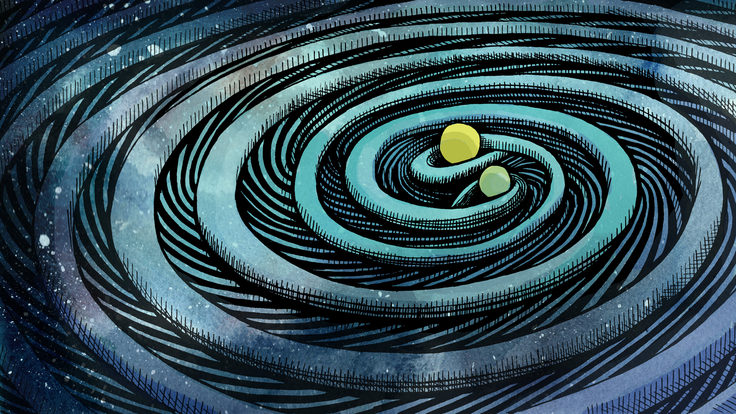
After being passed up for the honor last year, three scientists who made essential contributions to the LIGO collaboration have been awarded the 2017 Nobel Prize in Physics.
Rainer Weiss will share the prize with Kip Thorne and Barry Barish for their roles in the discovery of gravitational waves, ripples in space-time predicted by Albert Einstein. Weiss and Thorne conceived of the experiment, and project manager Barish is credited with reviving the struggling experiment and making it happen.
“I view this more as a thing that recognizes the work of about 1000 people,” Weiss said during a Q&A after the announcement this morning. “It’s really a dedicated effort that has been going on, I hate to tell you, for as long as 40 years, people trying to make a detection in the early days and then slowly but surely getting the technology together to do it.”
A third founder of LIGO, scientist Ronald Drever, died in March. Nobel Prizes are not awarded posthumously.
According to Einstein’s general theory of relativity, powerful cosmic events release energy in the form of waves traveling through the fabric of existence at the speed of light. LIGO detects these disturbances when they disrupt the symmetry between the passages of identical laser beams traveling identical distances.
The setup for the LIGO experiment looks like a giant L, with each side stretching about 2.5 miles long. Scientists split a laser beam and shine the two halves down the two sides of the L. When each half of the beam reaches the end, it reflects off a mirror and heads back to the place where its journey began.
Normally, the two halves of the beam return at the same time. When there’s a mismatch, scientists know something is going on. Gravitational waves compress space-time in one direction and stretch it in another, giving one half of the beam a shortcut and sending the other on a longer trip. LIGO is sensitive enough to notice a difference between the arms as small as 1000th the diameter of an atomic nucleus.
Scientists on LIGO and their partner collaboration, called Virgo, reported the first detection of gravitational waves in February 2016. The waves were generated in the collision of two black holes with 29 and 36 times the mass of the sun 1.3 billion years ago. They reached the LIGO experiment as scientists were conducting an engineering test.
“It took us a long time, something like two months, to convince ourselves that we had seen something from outside that was truly a gravitational wave,” Weiss said.
LIGO, which stands for Laser Interferometer Gravitational-Wave Observatory, consists of two of these pieces of equipment, one located in Louisiana and another in Washington state. The experiment is operated jointly by MIT, Weiss’s home institution, and Caltech, home institution for Barish and Thorne. The experiment has collaborators from more than 80 institutions from more than 20 countries. A third interferometer, operated by Virgo, recently joined LIGO to make the first joint observation of gravitational waves.

 Frascati Scienza
 Buco Nero
 Io Non Faccio Niente
 Tommaso Dorigo
 Giovanni Mazzitelli
 Barbara Gallavotti
 Keplero Blog
 Research Gate