
30 years of inter-American collaboration
Three decades ago this month, scientists from Latin America came to do research at Fermilab, forming the ties of a lasting collaboration.

In 1983, Fermilab Director Leon Lederman put his money on the table at the second Pan American Symposium on Elementary Particles and Technology in Rio de Janeiro. His daring proposition: If the Brazilian Research Council would not at the time fund that nation’s physicists to do research at Fermilab, he would pay the salaries himself.
His parlay worked. A year later, 30 years ago this month, four physicists from Brazil took paid leave to work on the E691 fixed-target experiment at Fermilab. They were Fermilab’s first Latin American scientists and the beginning of its relationship with the region.
“Lederman made the bold offer in that meeting,” says Carlos Escobar, one of the four trailblazing Brazilians who crossed over the Equator to Fermilab. “That was the deciding factor.”
Mexico soon followed, spearheaded by then Universidad Nacional Autónoma de México professor Clicerio Avilez. The university sent two scientists and a graduate student, the first Latin American student to get his PhD for work done at Fermilab.
Since then, the collaboration between Fermilab and Latin American institutions has grown to also include Argentina, Chile, Colombia, Ecuador and Peru. Twenty-one Latin American institutions participate in the collaboration, which consists of theorists and members of eight experiments: CMS, DAMIC, DZero, LBNE, MINERvA and MINOS, as well as on the Dark Energy Survey and the Pierre Auger Observatory—both of which reside in South America. That’s in addition to the nine fixed-target experiments that completed their runs in the 1990s.
Lederman began planting the seeds of collaboration in 1979, noting that Latin American nations boasted strong scientific groups and an impressive history of innovation.
“Latin America represented a huge potential treasure of human resources which would, I was sure, eventually be devoted to scientific research to the benefit of the nations of South and Central America and, indeed, the world,” he wrote in a 2006 paper.
Since those days, the collaboration with Fermilab, as well as steadily gaining economic strength and higher publicity for science, have placed particle physics research south of the Rio Grande on firmer ground. Fermilab not only provided scientists with particle physics experiments to work on, it also hosted workshops that were attended by Latin American engineers, physicists, technicians and students.
“When I first started, there were only two groups in Mexico cultivating theoretical high-energy physics, and none tilling the field of experimental high-energy physics,” says Julian Felix Valdez, a University of Guanajuato professor whose connection with Fermilab began in 1990, when he was a graduate student. Then, he says, things changed as Universidad Nacional Autónoma de México and Instituto Politécnico Nacional began sending students to Fermilab.
“Thirty years later, there are groups in experimental high-energy physics at eight Mexican universities, as well as other groups emerging at other Mexican universities,” Felix Valdez says. He estimates about 100 Mexican scientists work on particle physics at home and an additional 30 abroad.
The flow of students hasn’t abated, and most now come to Fermilab to work on neutrino research. For future generations, it could mean working on Fermilab’s Long-Baseline Neutrino Experiment.
“There’s a good stream of people. Once the connection’s established, it doesn’t sever. It keeps flowing,” says Pontificia Universidad Católica del Perú master’s student Maria Jose Bustamante, who is on the MINERvA neutrino experiment. “Of course you need an institution to do that.”
Enlisting more institutions to invigorate the flow is perhaps still the biggest challenge facing the collaboration today. To that end, Fermilab’s fifth director, Pier Oddone, and his deputy, Young-Kee Kim, picked up where Lederman left off, says MINERvA scientist Jorge Morfin, one of the founding members of the Latin American collaboration. Oddone and Kim helped formalize the Latin American Initiative in 2010, suggesting more written agreements between Fermilab and Latin American institutions and funding agencies.
“No one on MINERvA would doubt that the contribution of these Latin American students has been significant. This has been a real working benefit for the experiment here at Fermilab,” Morfin says. The number of students that work or have worked on MINERvA totals 24 master’s students, nine doctoral students and two postdocs. “Now they can work on experiments throughout the world. It’s been a nice return, a give and take,” he says.
Collaboration also provides opportunities for visiting scientists to bring technologies from their home countries to Fermilab. Escobar notes that Brazilian companies provided several pieces of instrumentation for Fermilab experiments, including drift chambers and detectors for DZero. It goes the other way, too: Scientists take new technologies developed at Fermilab back to industries at home.
“People see the local industries benefit from this kind of collaboration with a place that does fundamental research,” Morfin says. “It translates into actual progress for local industries and local technology.”
To see another 30 years of flourishing high-energy physics in the western hemisphere requires an investment in physics from both sides of the Equator, Felix Valdez says.
“Physics—especially high-energy physics—is an international task,” he says.
Particle detector connects two generations
Work on Fermilab's CDF detector during the more than two decades of its lifetime has been a family affair.
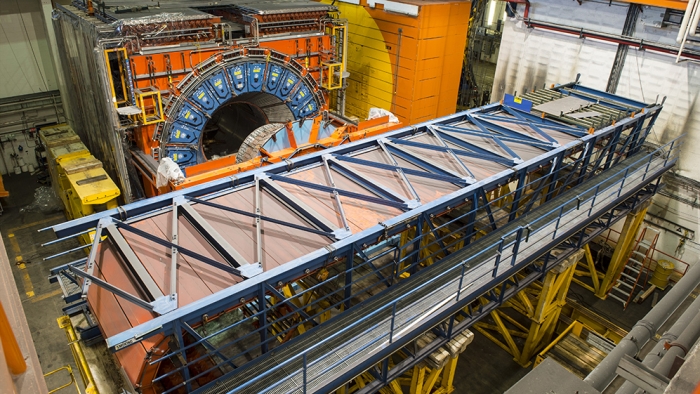
One day when Tom Wicks was a child, he biked over to see his mom, Lois Anderson, working at an office in Aurora, Illinois. She was at the top of the building, welding and torching as ironworkers do.
“That’s when my son told me, ‘I want to do that,’” Anderson says.
Both mother and son have worked as ironworkers on Fermilab experiments throughout their careers. Anderson, known as “Sarge” during business hours and the only female on her crew for decades, began ironworking at CDF—one of two detectors located on the Tevatron ring—when it was “a hole in the ground” in the early 1980s. Anderson and Wicks, rigging superintendent at Joliet Steel & Construction, worked together on the last upgrade of the detector in 2001.
Now Wicks is dismantling much of the roughly 4000-ton particle detector that he, his mother and his stepfather helped build.
“She likes to tease me about it. ‘All that work we’ve put into it, and now you’re tearing it apart?’“ Wicks says.
CDF ran for more than two decades, collecting data from proton-antiproton collisions from 1985 until the Tevatron shut down in 2011. Scientists at CDF and its sister detector DZero discovered the last quark predicted by the Standard Model, the top quark. Both collaborations still analyze valuable data collected from the detectors.
In its heyday, the large orange and blue CDF detector (pictured above) drew crowds when upgrades required rolling the machine from the collision tunnel to an open assembly hall.
“During the last upgrade, it was like a football game,” Wicks says. “There were so many people watching, you couldn’t get a space along the rail to watch us do it.”
Wicks and his crew began working with Fermilab staff to remove equipment from the CDF detector in March 2013. They will likely finish next month, leaving intact the multimillion-dollar solenoid magnet at the core of the detector.
John Wackerlin, a fellow ironworker and foreman at Walbridge, led one of the teams tasked with decommissioning the experiment. Like Wicks, he’s laying to rest something his family helped build. His father, Bob Wackerlin, welded together the structure that houses the 30-foot-tall detector.
The elder Wackerlin’s work at Fermilab started even before CDF. When his wife was pregnant with John, Bob Wackerlin worked underground in the 4-mile Tevatron tunnel while it was still being dug. He retired after 42 years as an ironworker and said he’s proud of his family’s connection to the laboratory.
“I’ve worked in just about every building on this site,” Bob Wackerlin says. “Fermilab projects are some of the best jobs that come across our ironworkers union. It’s employed a lot of people over the years.”
His son adds, “Working with physicists and the talent and brainpower here—it’s unreal.”
Although CDF is turned off and its many wires and cables have been scrapped, much of the detector will find a home in future experiments. The solenoid magnet, for example, could be reused in another particle experiment, says Fermilab scientist Jonathan Lewis. Scientists are recycling parts of the detector for other high-energy physics projects at Fermilab, and electronics, phototubes and assorted pieces of CDF have also been shipped to other labs and universities in the United States, Europe and Japan.
Both families see this as progress.
“Once you’ve learned something from one experiment, it makes way for new experiments,” John Wackerlin says. “So now we can go on to even bigger and better things. I’m excited about it.”
A version of this article appeared in Fermilab Today.
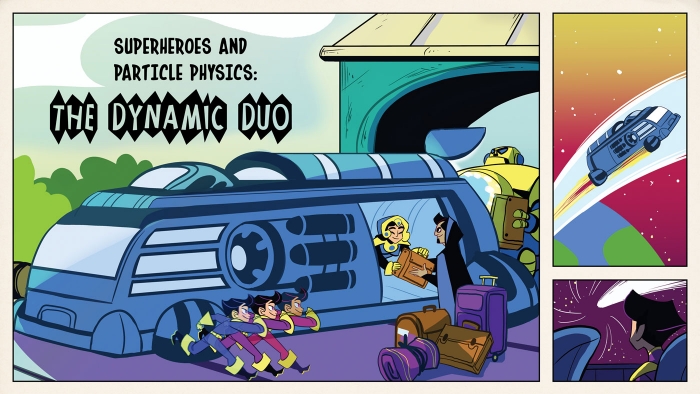
Superheroes and particle physics: the dynamic duo
From Iron Man to The Flash and astrophysicists to particle physicists, superheroes and physicists help shape each other's worlds.
Iron Man 2, the second installment in the Iron Man movie franchise, finds the hero Tony Stark in a bit of a pickle: The “arc reactor” in Stark’s chest (which generates magnetic fields to halt the movement of shrapnel in his body) is powered by palladium, which is slowly poisoning him. Stark must find a different material to run the reactor if he hopes to survive. But the only non-toxic element that will work is one that does not exist on Earth. A brilliant engineer and scientist, Stark builds a small cyclotron and uses it to create the new element he needs.
In the magic world of movies, Stark builds his cyclotron in about a day, whereas real cyclotrons usually take months or years to come together. But the story is built on at least one scientifically accurate fact: It is true that particle accelerators can be used to create “new” elements—those that aren’t found in nature. It’s a wonder Stark didn’t just put on his Iron Man suit and fly to Lawrence Livermore National Laboratory, where scientists have already been involved in the creation of new elements 113, 114, 115, 116, 117 and 118.
Throughout the comic book canon, sprinkled amongst fictional science like Tony Stark’s in vivo arc reactor, one can also find examples of genuine particle physics. Talking to comic book writers reveals that particle physics is frequently an inspiration for new and interesting storylines—and the presence of particle physics in superhero comics and movies fuels curiosity and imagination in its audience. It may surprise some people to find that superheroes and particle physicists inspire each other—but unlikely duos often make great stories.
The spark of possibility
Comic book writer and self-described “science junkie” Mark Waid authored many issues of the comic book series JLA—a modern reboot of the Justice League of America, which places more than a dozen DC superheroes onto the same crime-fighting team.
In 1997, Waid read about an experiment at the University of Geneva, where physicists were testing quantum entanglement: a phenomenon wherein two particles, theoretically separated by any distance, share a mysterious connection. The Swiss physicists split a single photon into two entangled photons, separated them by 10.9 kilometers, and showed that a change to one photon caused a nearly instantaneous change to the other. This “spooky action at a distance” was first conceptualized in the 1930s, but no experiment had ever demonstrated it over such a long expanse.
Waid was intrigued by the counter-intuitiveness of entanglement and the confounding world of quantum mechanics, which reveals that the physical properties of subatomic particles, including their location, exist as probabilities and not as definitive values. The concept inspired a JLA storyline: Issues 17 and 18 of the comic portray the heroes dealing with a series of highly improbable occurrences. They eventually deduce that a group of seven photons, split in an entanglement experiment, have altered the probabilities that govern the universe.
To finally solve the problem, the JLAers call on the veteran DC hero The Atom, who can shrink himself and the other team members down to sub-atomic size and repair the split photons.
Waid, who minored in physics in college, says he frequently looks to science—and particle physics in particular—for inspiration.
“I think that the more science you can inject into a story about superheroes, the more real it feels, the more verisimilitude it has—which I think is very important for readers who want to invest in your characters,” he says.
Like Waid, comic book writer James Asmus, who has authored a number of X-Men comics, frequently uses modern science as inspiration. In 2013, Asmus began writing a reboot of a 1990s comic series called Quantum and Woody, which follows two brothers who get caught in a laboratory explosion and suddenly find themselves with superpowers. To solve the mystery of their newfound abilities, they investigate a mysterious machine that might run on dark matter or energy from another dimension.
“For me, that space where we have exciting new knowledge, and we don’t yet know what the possible outcomes and applications could be—that feels a lot like when I was a kid and I was running around a playground pretending I was a superhero. There's a promise that something incredible might actually be achievable," Asmus says.
It’s a bird, it’s a plane… it’s a physics lesson!
Like Asmus, James Kakalios was probably one of those kids who liked to pretend he was a superhero. A life-long fan of comics, Kakalios is now a professor of physics at the University of Minnesota and the author of The Physics of Superheroes, a book inspired by a class he taught for incoming freshman and non-physics majors. In the book, Kakalios demonstrates that superhero comics can be used to teach physics.
Take, for example, Kakalios’ lesson on Schrödinger’s equation. This is a notoriously difficult subject, usually explained in terms of dead and not-dead cats. Kakalios takes a different approach and explores the powers of the classic superhero The Flash, who possesses the ability to run at nearly the speed of light.
Over time, The Flash realizes that he can pass through walls when he runs at top speed. Schrödinger’s equation partly explains this phenomenon. Through quantum tunneling, a particle may unexpectedly go from one side of a physical barrier to the other. While the amount of energy needed to accelerate a human body to nearly the speed of light would be tremendous, it is true that the increase in kinetic energy would increase the probability of The Flash experiencing a quantum tunneling event and passing through a wall.
Kakalios has said that superpowers are almost always impossible, but what a character does with those powers often adheres to the laws of physics, like The Flash passing through walls, or running on water, or catching a bullet in midair—all of which would be physically possible if he could move at immense speeds. Kakalios follows up by telling his students about the many amazing things physicists can do with this fundamental knowledge—for example, quantum tunneling is used in touch-screen technologies and is the basis for scanning tunneling microscopes. The stories act as bait to get students to pay attention to tough physics lessons, but they also demonstrate the truly fantastic power of real physics.
Dreaming the impossible
Comic book superheroes can hook the most reluctant physics students—or inspire those with a penchant for science. Brian Nord is a post-doctoral researcher on the Dark Energy Survey at Fermilab and a long-time comic book fan. He says that, as a kid, he was always drawn to comics that featured scientist heroes, and that comic books fueled his curiosity about the universe.
“I think as we go through cycles in our growth as people, we have different needs. So sometimes we have a need to sit down and get things done, and move forward with what we have learned and what other people have learned,” Nord says. “But before that, you need to dream. You have to find or create your own inspiration. We’re inspired by dreaming about what we can do in the future and dreaming the impossible. It’s sort of a simple jump to say that seeing people in comic books do amazing things that you didn’t think were possible is a great way to subconsciously be inspired.”
It’s not such a far stretch to assume that most kids who like superheroes will also like science. At a fundamental level, scientists are like superheroes—armed with an ever-growing knowledge about the most fundamental components and laws of our universe. Like a superpower, that knowledge is exciting by itself. But solving problems requires the clever application of that knowledge. So The Flash learns how to pass through walls, while particle physicists find new ways to treat cancer and monitor nuclear waste proliferation, develop new drugs and improve the world’s computing capabilities; all while fighting to understand the ultimate nature of reality. Both superheroes and scientists ask the world to reconsider what is possible.
“Science and comic books are all about ‘what ifs,” Nord says. “What if we could do this now, or what if this were the future, or what if in another distant solar system there are people wearing spandex, running around and trying to fight an evil that we’ve never heard of? What if?”

Click on image for larger version.
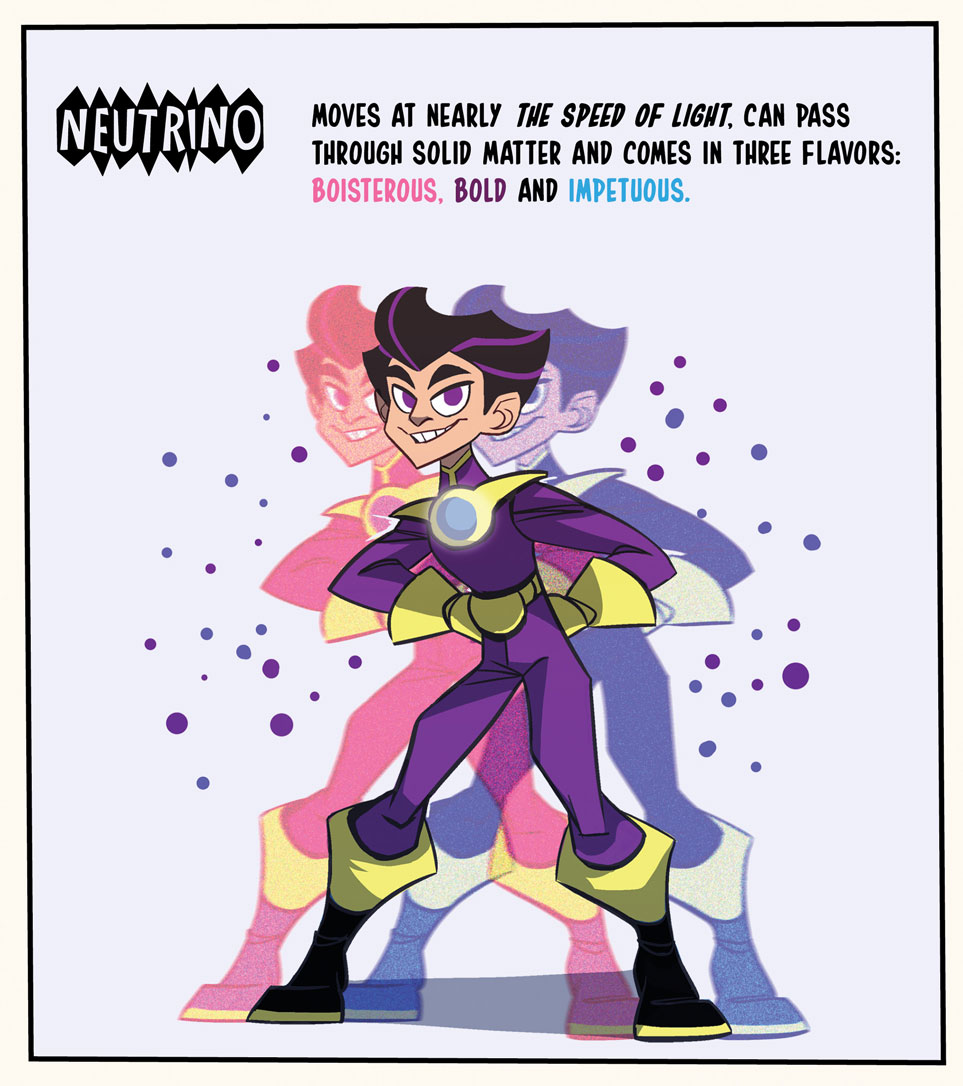
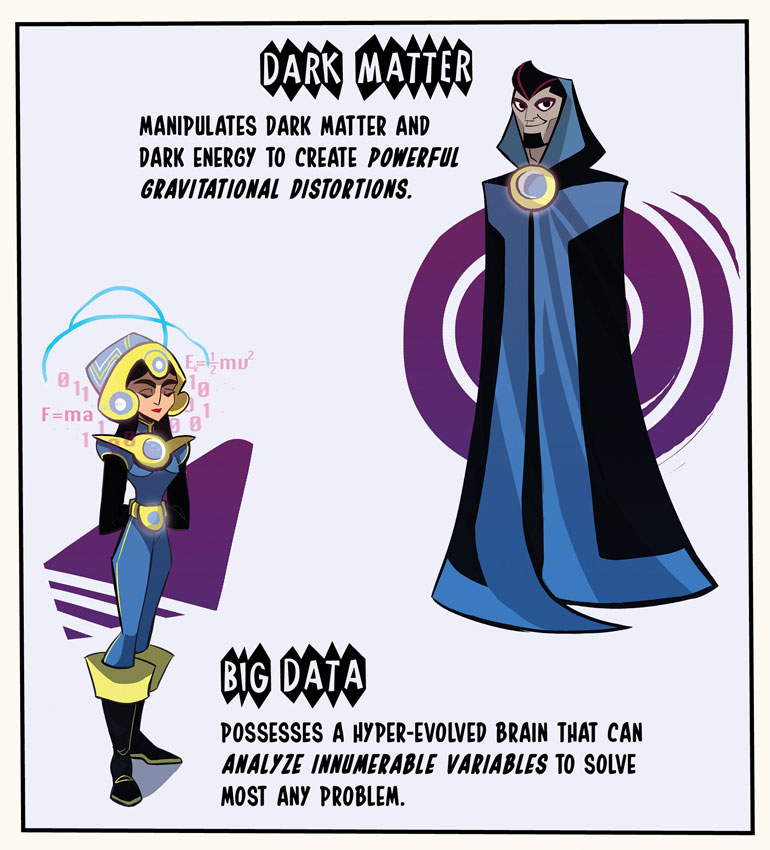
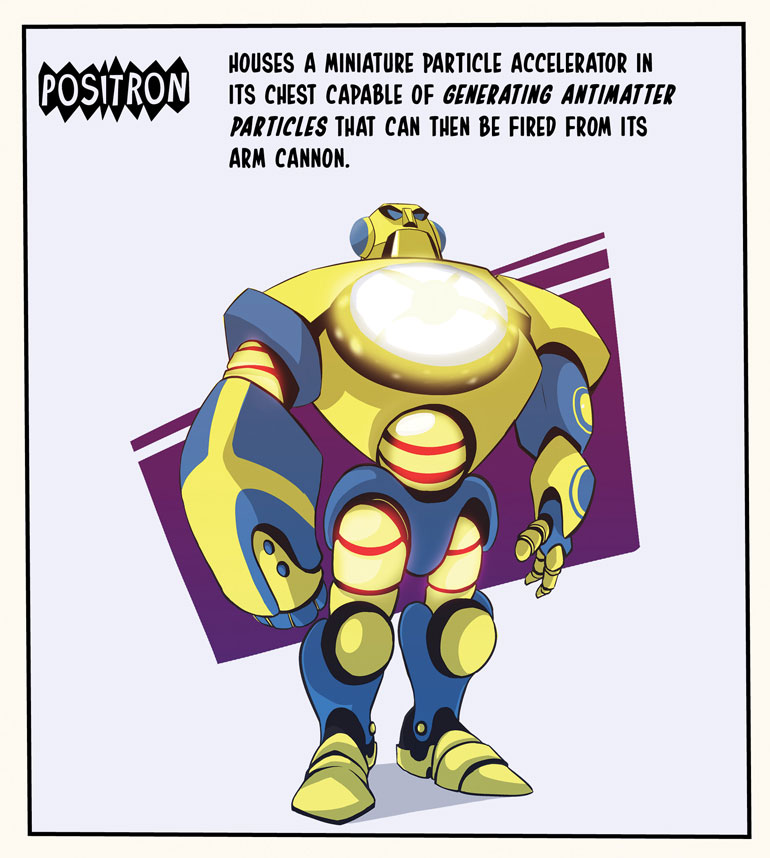
For this article honoring the connection between physics and superheroes, symmetry brought in comic author Josh Elder and comic artist Brittney Williams to create a cast of original characters with physics-related powers. Elder writes for DC Comics; founded the visual literacy non-profit Reading with Pictures; and co-created the comic strip and graphic novel series Mail Order Ninja. Williams trained with Walt Disney Studios and is now a freelance comic artist and illustrator who has done work for the comic Samurai Jack.
Accelerator, stonewashed
Taking a page out of the jeans manufacturers' playbook, researchers use stonewashing machines to perfect equipment for a future International Linear Collider.
Quite often it’s basic research that pioneers new technology. But in one case, researchers might very well have benefited from a little inspirational snoop at Levi’s or another jeans manufacturer.
Scientists at the German laboratory DESY are currently using stonewashing equipment to surface-treat specialized superconducting cavities used to accelerate particles: accelerators stonewashed, so to say. This technique originated at KEK in Japan. It has been further developed at laboratories around the world, including Fermilab, Jefferson Lab, and Cornell University in the United States, DESY in Germany, and the Raja Ramanna Centre for Advanced Technology in India.
While jeans are only stonewashed for show, there is a fundamental scientific reason to do this with the accelerator cavities. The cavities, which create electromagnetic fields used to accelerate particles, work best when their interiors are as smooth as a mirror. One way to achieve this is to repeatedly polish the cavities' insides.
In this way, a group of scientists from DESY and the University of Hamburg is working to produce test cavities for the proposed International Linear Collider.
“We want to reach gradients of 35 megavolts per meter and more for the ILC. This requires a surface that is very clean and smooth up to a few nanometers,” says Aliaksandr Navitski, who conducts the testing.
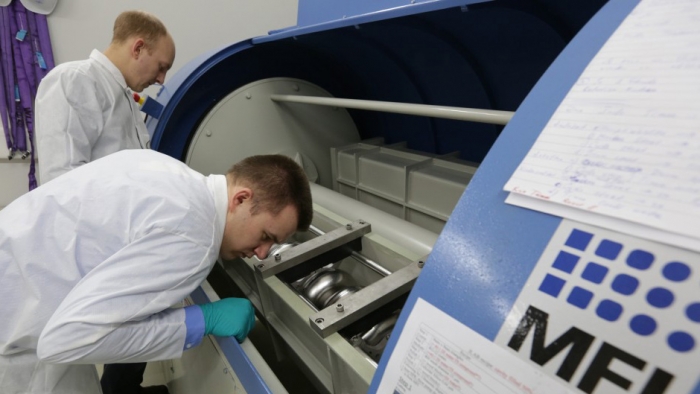
The stonewashing treatment has four stages. The cavities are filled with different polishing granules and rotate on two axes—a bit like the Earth rotating around the Sun and also around itself—for hours in a type of cement mixer. The first filling, a mixture of stones and water, eliminates impurities that develop mainly in areas where individual half cells were welded together. It removes ten micrometers per hour from the surface. After eight hours, the mixture is exchanged: Fine stone granules melted into synthetic material provide an increased degree of fineness. A fine sanding is achieved in the final two stages of stonewashing: The cavity is filled with small hardwood blocks and fine-grained aluminum oxide and water, and in the last stage with colloidal silicon oxide, and mixed for 30 to 40 hours before the highly polished cavity is finished.

Using polishing materials ranging from centimetres to millimetres in size, the cavities are refined in a tumbler (pictured at top of page).
After each “wash cycle,” the cavities are precisely measured in DESY's ILC HiGrade laboratory. “We want to analyze the systematics of stonewashing,” Navitski says. “The evenly distributed filling of the cavity with the appropriate mixture of abrasives and liquid is as important as the tumbling time at each polishing stage.”
For the construction of the ILC, this technology could replace the current method of electropolishing with fluoric acid. This would not only mean getting rid of the undesirable acid, but also has the advantage of removing traces of other metals such as aluminum—something not possible with electropolishing.
A version of this article originally appeared in DESY inForm.
LHC and Tevatron share first joint result
An international team of scientists from Fermilab’s Tevatron and CERN’s Large Hadron Collider has produced the world’s best value for the mass of the top quark.
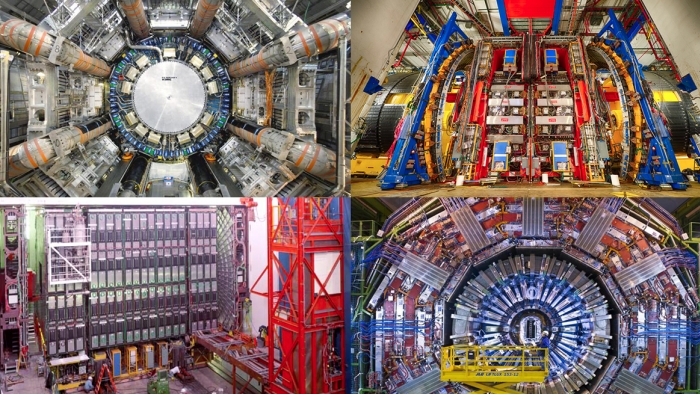
Scientists working on the world’s leading particle collider experiments have joined forces, combined their data and produced the first joint result from Fermilab’s Tevatron and CERN’s Large Hadron Collider. These machines are the past and current holders of the record for most powerful particle collider on Earth.
Scientists from the four experiments involved—ATLAS, CDF, CMS and DZero—announced their joint findings on the mass of the top quark today at the Rencontres de Moriond international physics conference in Italy.
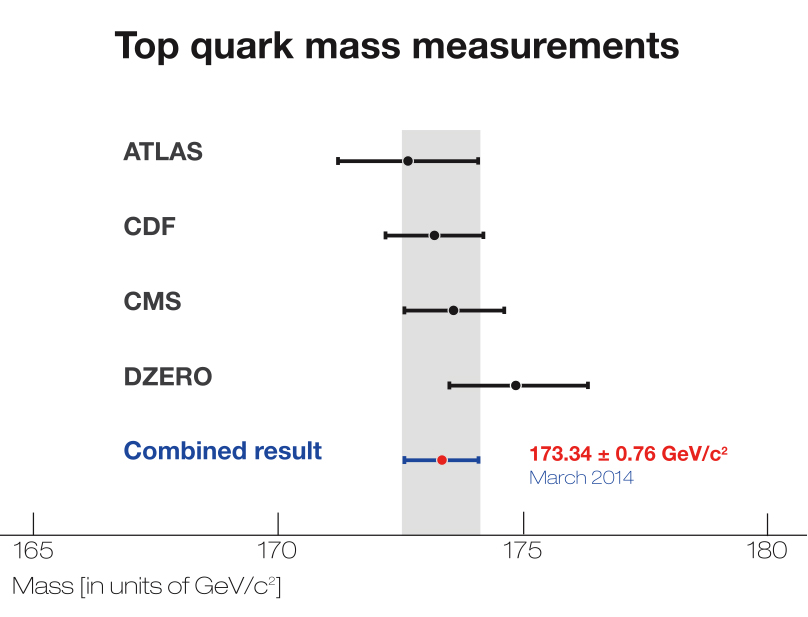
Together the four experiments pooled their data analysis power to arrive at a new world’s best value for the mass of the top quark of 173.34 ± 0.76 GeV/c2.
Experiments at the LHC at the CERN laboratory in Geneva, Switzerland and the Tevatron collider at Fermilab in Illinois, USA are the only ones that have ever seen top quarks—the heaviest elementary particles ever observed. The top quark’s huge mass (more than 100 times that of the proton) makes it one of the most important tools in the physicists’ quest to understand the nature of the universe.
The new precise value of the top-quark mass will allow scientists to test further the mathematical framework that describes the quantum connections between the top quark, the Higgs particle and the carrier of the electroweak force, the W boson. Theorists will explore how the new, more precise value will change predictions regarding the stability of the Higgs field and its effects on the evolution of the universe. It will also allow scientists to look for inconsistencies in the Standard Model of particle physics—searching for hints of new physics that will lead to a better understanding of the nature of the universe.
"The combining together of data from CERN and Fermilab to make a precision top quark mass result is a strong indication of its importance to understanding nature," says Fermilab director Nigel Lockyer. “It’s a great example of the international collaboration in our field.”
A total of more than six thousand scientists from more than 50 countries participate in the four experimental collaborations. The CDF and DZero experiments discovered the top quark in 1995, and the Tevatron produced about 300,000 top quark events during its 25-year lifetime, completed in 2011. Since it started collider physics operations in 2009, the LHC has produced close to 18 million events with top quarks, making it the world’s leading top quark factory.
“Collaborative competition is the name of the game,” says CERN’s Director General Rolf Heuer. “Competition between experimental collaborations and labs spurs us on, but collaboration such as this underpins the global particle physics endeavor and is essential in advancing our knowledge of the universe we live in.”
Each of the four collaborations previously released their individual top-quark mass measurements. Combining them together required close collaboration between the four experiments, understanding in detail each other’s techniques and uncertainties. Each experiment measured the top-quark mass using several different methods by analyzing different top quark decay channels, using sophisticated analysis techniques developed and improved over more than 20 years of top quark research beginning at the Tevatron and continuing at the LHC. The joint measurement has been submitted to the arXiv.
A version of this article was originally issued by Fermilab and CERN as a press release.
Particle physics in the United States
More than 150 US universities and laboratories are engaged in particle physics research and technology innovation, playing important roles in the Higgs boson and cosmic inflation discoveries—and the many more revelations still to come.

Particle physics research in the United States is a distributed effort involving researchers across the country. In 2013, more than 150 universities and laboratories in 43 states (plus Washington DC and Puerto Rico) received funding from the Department of Energy and the National Science Foundation to explore the nature of matter, energy, space and time.
DOE’s national laboratories serve as hubs of innovation, places where scientists and engineers from around the country—and from around the globe—come together to develop technologies and tools, build unique instruments and machines, and run complex experiments.
Together with scientists and students from universities across the country and around the world, this web of researchers is revolutionizing our view of the universe, making significant advances in how we understand, predict and ultimately control matter and energy while training the next generation of scientists. They create tools and applications that help other fields of science and improve the nation's health, wealth and security.
A poster highlighting US universities and laboratories engaged in particle physics is available here. In addition, a larger version of the illustration at the top of this page is available in symmetry's image bank.
 Continue reading
Physicists find evidence of cosmic inflation
The BICEP2 experiment has detected signs of gravitational waves in the cosmic microwave background radiation, with big implications for the theory of cosmic inflation. Symmetry also published Alan Guth's notes on cosmic inflation and a detailed explanation of the theory behind it.
Almost 14 billion years ago, the universe we inhabit burst into existence in an extraordinary event that initiated the big bang. In the first fleeting fraction of a second, the universe expanded exponentially, stretching far beyond the view of today's best telescopes. All this, of course, has just been theory.
Continue reading
 Frascati Scienza
 Buco Nero
 Io Non Faccio Niente
 Tommaso Dorigo
 Giovanni Mazzitelli
 Barbara Gallavotti
 Keplero Blog
 Research Gate