
CERN’s LHCb experiment sees exotic particle
Tufte’s Feynman sculptures come to Fermilab
Edward Tufte, celebrated statistician and master of informational graphics, transforms physics notations into works of art.

If you ask a physicist how particles interact and you have a drawing surface handy, the explanation will likely come in the form of a series of lines, arrows, squiggles and loops.
These drawings, called Feynman diagrams, help organize a calculation. They represent the mathematical formulas of how particles interact, beginning to end, and also the rate at which the interaction happens.
A new exhibit at Fermi National Accelerator Laboratory examines the beauty and simplicity of this shorthand.
“For all of us, experimentalists and theorists alike, the way we think about things really is embedded in Feynman diagrams,” says Chris Quigg, a Fermilab theoretical physicist. “They’re wonderful shorthand for getting to the essence of what’s going on.”
“The Cognitive Art of Feynman Diagrams” by Edward Tufte celebrates the work of Richard Feynman, the Nobel Prize-winning physicist who developed the eponymous diagrams. Tufte is a Yale professor, statistician and artist who has written four books on analytical design. In his search for the effective data visualizations, Tufte was inspired by Feynman's book QED: The Strange Theory of Light and Matter.
“Feynman diagrams are among the most important and best information visualizations ever made,” Tufte says. “They replace some hairy math, visualize nature at extremely small scales and have direct empirical relevance.”
The exhibit also gives a new perspective of physics to non-physicists, says Georgia Schwender, Fermilab’s visual art coordinator.
Someone unfamiliar with the concept of quantum uncertainty might, for example, appreciate its visual representation in the piece “All Possible Photons” (pictured above). It depicts in Feynman diagrams the 120 possible outcomes of a meeting of six discrete units of light.
The steel wire sculptures are mounted inches from a wall and illuminated with light sources of varying qualities to create a three-dimensional appearance. The piece is composed of both the sculptures and the shadows they create. Tufte debuted a similar exhibit in New York City in 2012.
The 120 diagrams Tufte used are derived from an academic paper published 20 years ago titled “One Loop Multiphoton Helicity Amplitudes” by Greg Mahlon, who began the project as a doctoral student at Cornell University. Mahlon, who published the paper while he was a postdoc at Fermilab and now works as an associate professor of physics at the Mont Alto Campus of the Pennsylvania State University, appreciates Tufte’s aesthetic interpretation.
“I think it’s a brilliant idea to create sculptures that play with how light and matter interact by using diagrams that depict how light and matter interact,” Mahlon says.
The immaterial shadows cast by the steel sculptures truly reflect the action at the subatomic scale, Quigg says. “We draw straight lines representing electrons, but our minds see each line with the frothiness of quantum theory’s uncertainties and probabilities.”
In addition to the sculptures, the exhibit features two diagram-decorated vehicles: one a yellow and tan Dodge van once driven by Feynman himself and the other an Airstream trailer dubbed the “Airstream Interplanetary Explorer.”
Fermilab will host “The Cognitive Art of Feynman Diagrams” from April 12 to June 26. Public tours will be offered every Wednesday and every other Saturday between April 26 and June 21.
From quark soup to ordinary matter
Scientists have gained new insight into how matter can change from a hot soup of particles to the matter we know today.
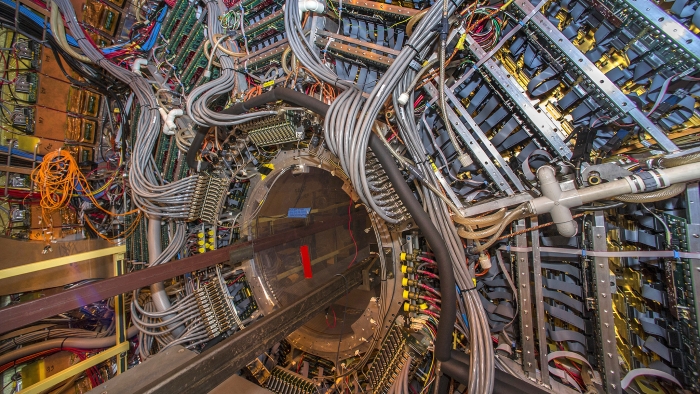
The early universe was a trillion-degree soup of subatomic particles that eventually cooled into matter as it is today.
This process is called “freezing out.” In the early universe, it was a smooth transition. But a group of scientists at Brookhaven National Laboratory recently found that, under the right conditions, it can occur differently.
The new research may offer valuable insight into the strong force, which accounts for 99.9 percent of the mass of visible matter in today’s world.
Scientists have known for years that at the superhot temps of the early universe, matter is able to move in and out of its particle-soup state smoothly, without a clear dividing line between the phases. (Think of how honey stored in a refrigerator gradually softens and liquefies once it's placed on a countertop, with no distinct melting point.)
But after nuclear physicists on the STAR experiment (pictured above) at the Relativistic Heavy Ion Collider, or RHIC, dialed down the temperature and cranked up the density, they observed a telltale sign of a transition more like water turning to ice—with two distinct phases with a clear dividing line between. They announced this result in a paper to be published in Physical Review Letters.
The Brookhaven team investigated the transition by crashing gold nuclei into one another with enough energy to create quark-gluon plasma, the form of matter thought to have dominated the early universe.
Quarks are fundamental particles that make up protons and neutrons. Normally they exist bound to other quarks via the strong force. In the chaos of the quark-gluon plasma, however, they break apart.
The physicists created collisions at RHIC with a range of different energies in order to study how normal matter transitions in and out of this state.
At the highest temperatures, around 4 trillion degrees Celsius, matter followed the honey model.
But at lower temperatures and with a greater concentration of quarks, it acted more like water.
Under those conditions, a sharper border existed between matter in a normal state and matter as quark-gluon plasma—what is called a first-order phase transition.
The defining characteristic of a first-order phase transition is “latent heat,” a large amount of energy going into or being released as molecules or particles transform from one phase to another at particular combinations of temperature and density.
“If you think of a pot of water on a burner,” says STAR physicist Jamie Dunlop, “the temperature goes up until you reach the boiling point, 100 degrees Celsius under normal atmospheric pressure. The liquid water will stay at exactly that temperature as long as there’s water to boil.”
Even though the stove continues to add heat, the energy goes into moving molecules from a liquid into a gaseous state until all of the molecules have gone through the transition. In the case of the matter at RHIC, the first-order phase change shows up as a temporary disappearance of a particular kind of particle flow.
Though this first-order phase transition is unlike what happened in the universe during the cooling period after the big bang, it tells scientists more about the force that holds together the constituent parts of the atoms that make up our world.
A related article was published by Brookhaven National Laboratory.
Searching for the holographic universe
Physicist Aaron Chou keeps the Holometer experiment—which looks for a phenomenon whose implications border on the unreal—grounded in the realities of day-to-day operations.
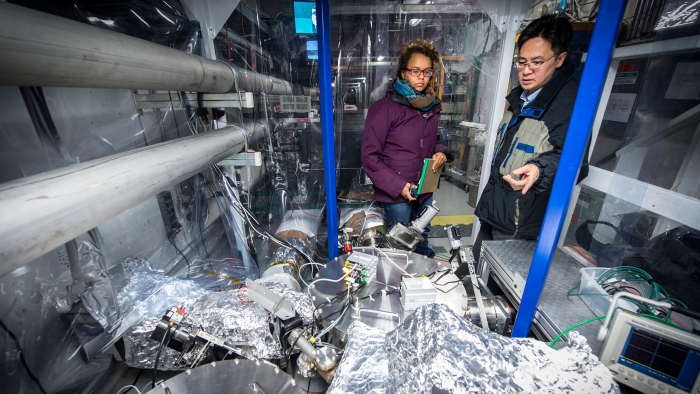
The beauty of the small operation—the mom-and-pop restaurant or the do-it-yourself home repair—is that pragmatism begets creativity. The industrious individual who makes do with limited resources is compelled onto paths of ingenuity, inventing rather than following rules to address the project’s peculiarities.
As project manager for the Holometer experiment at Fermilab, physicist Aaron Chou runs a show that, though grandiose in goal, is remarkably humble in setup. Operated out of a trailer by a small team with a small budget, it has the feel more of a scrappy startup than of an undertaking that could make humanity completely rethink our universe.
The experiment is based on the proposition that our familiar, three-dimensional universe is a manifestation of a two-dimensional, digitized space-time. In other words, all that we see around us is no more than a hologram of a more fundamental, lower-dimensional reality.
If this were the case, then space-time would not be smooth; instead, if you zoomed in on it far enough, you would begin to see the smallest quantum bits—much as a digital photo eventually reveals its fundamental pixels.
In 2009, the GEO600 experiment, which searches for gravitational waves emanating from black holes, was plagued by unaccountable noise. This noise could, in theory, be a telltale sign of the universe’s smallest quantum bits. The Holometer experiment seeks to measure space-time with far more precision than any experiment before—and potentially observe effects from those fundamental bits.
Such an endeavor is thrilling—but also risky. Discovery would change the most basic assumptions we make about the universe. But there also might not be any holographic noise to find. So for Chou, managing the Holometer means building and operating the apparatus on the cheap—not shoddily, but with utmost economy.
Thus Chou and his team take every opportunity to make rather than purchase, to pick up rather than wait for delivery, to seize the opportunity and take that measurement when all the right people are available.
“It’s kind of like solving a Rubik’s cube,” Chou says. “You have an overview of every aspect of the measurement that you’re trying to make. You have to be able to tell the instant something doesn’t look right, and tell that it conflicts with some other assumption you had. And the instant you have a conflict, you have to figure out a way to resolve it. It’s a lot of fun.”
Chou is one of the experiment’s 1.5 full-time staff members; a complement of students rounds out a team of 10. Although Chou is essentially the overseer, he runs the experiment from down in the trenches.
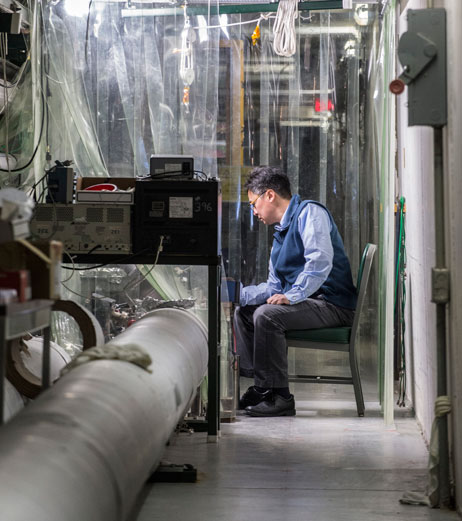
Aaron Chou, project manager for Fermilab’s Holometer, tests the experiment’s instrumentation.
The Holometer experimental area, for example, is a couple of aboveground, dirt-covered tunnels whose walls don’t altogether keep out the water after a heavy rain. So any time the area needs the attention of a wet-dry vacuum, he and his team are down on the ground, cheerfully squeegeeing, mopping and vacuuming away.
“That’s why I wear such shabby clothes,” he says. “This is not the type of experiment where you sit behind the computer and analyze data or control things remotely all day long. It’s really crawling-around-on-the-floor kind of work, which I actually find to be kind of a relief, because I spent more than a decade sitting in front of a computer for more well-established experiments where the installation took 10 years and most of the resulting experiment is done from behind a keyboard.”
As a graduate student at Stanford University, Chou worked on the SLD experiment at SLAC National Accelerator Laboratory, writing software to help look for parity violation in Z bosons. As a Fermilab postdoc on the Pierre Auger experiment, he analyzed data on ultra-high-energy cosmic rays.
Now Chou and his team are down in the dirt, hunting for the universe’s quantum bits. In length terms, these bits are expected to be on the smallest scale of the universe, the Planck scale: 1.6 x 10⁻³⁵ meters. That’s roughly 10 trillion trillion times smaller than an atom; no existing instrument can directly probe objects that small. If humanity could build a particle collider the size of the Milky Way, we might be able to investigate Planck-scale bits directly.
The Holometer instead will look for a jitter arising from the cosmos’ minuscule quanta. In the experiment’s dimly lit tunnels, the team built two interferometers, L-shaped configurations of tubes. Beginning at the L’s vertex, a laser beam travels down each of the L’s 40-meter arms simultaneously, bounces off the mirrors at the ends and recombines at the starting point. Since the laser beam’s paths down each arm of the L are the same length, absent a holographic jitter, the beam should cancel itself out as it recombines. If it doesn’t, it could be evidence of the jitter, a disruption in the laser beam’s flight.
And why are there two interferometers? The two beam spots’ particular brightening and dimming will match if it’s the looked-for signal.
“Real signals have to be in sync,” Chou says. “Random fluctuations won’t be heard by both instruments.”
Should the humble Holometer find a jitter when it looks for the signal—researchers will soon begin the initial search and expect results by 2015—the reward to physics would be extraordinarily high, especially given the scrimping behind the experiment and the fact that no one had to build an impossibly high-energy, Milky Way-sized collider. The data would support the idea that the universe we see around us is only a hologram. It would also help bring together the two thus-far-irreconcilable principles of quantum mechanics and relativity.
“Right now, so little experimental data exists about this high-energy scale that theorists are unable to construct any meaningful models other than those based on speculation,” Chou says. “Our experiment is really a mission of exploration—to obtain data about an extremely high-energy scale that is otherwise inaccessible.”
What’s more, when the Holometer is up and running, it will be able to look for other phenomena that manifest themselves in the form of high-frequency gravitational waves, including topological defects in our cosmos—areas of tension between large regions in space-time that were formed by the big bang.
“Whenever you design a new apparatus, what you’re doing is building something that’s more sensitive to some aspect of nature than anything that has ever been built before,” Chou says. “We may discover evidence of holographic jitter. But even if we don’t, if we’re smart about how we use our newly built apparatus, we may still be able to discover new aspects of our universe.”
Expanding universe measured with precision
The Sloan Digital Sky Survey has made the most precise measurement of the expansion rate of the universe over a period of time, an important step toward understanding dark energy.
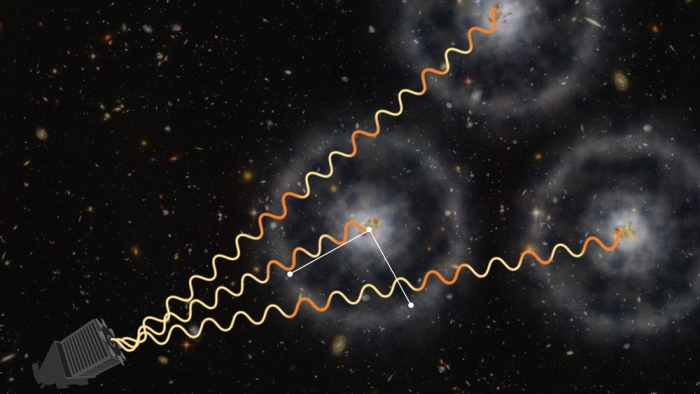
Astronomers on the Sloan Digital Sky Survey announced today they have determined the rate at which the universe was expanding at a quarter of its present age with an unprecedented precision of 2 percent. This is the best measurement yet of the universe's expansion rate at any epoch in the last 13 billion years.
Scientists presented the measurement at the April 2014 meeting of the American Physical Society in Savannah, Georgia.
Astronomers on the Baryon Oscillation Spectroscopic Survey, or BOSS, the largest component of the third Sloan Digital Sky Survey, made the new measurement by studying 140,000 bright extragalactic objects called quasars. In a technique they pioneered, they used the quasars to map the distribution of intergalactic hydrogen gas, which gave them insight into the expansion rate of the universe.
This rate has changed over history. Scientists once thought that, over time, the force of gravity might cause it to slow. Over the past 6 billion years, however, it has actually sped up. Scientists think dark energy is the cause of this mysterious acceleration. Measuring changes in the expansion rate of the universe over time is key to understanding their cause.
“By probing the universe when it was only a quarter of its present age, BOSS has placed a key anchor to compare to more recent expansion measurements as dark energy has taken hold,” says Timothée Delubac of Centre de Saclay in France, who led one of the BOSS teams that cooperated to make the measurement.
Hydrogen gas is distributed in the universe in a rippled pattern. As light from distant quasars traverses the universe, the denser patches of hydrogen gas absorb some of it at a characteristic wavelength. As the universe expands, the light traveling through it is stretched, and each subsequent patch of hydrogen gas leaves its absorption mark at a different wavelength. When the light reaches Earth, astronomers observe its spectrum to find signatures of the patches of hydrogen gas it encountered on the way.
Delubac's team studied patterns in hydrogen gas to measure the distribution of mass in the young universe. The other team, led by Andreu Font-Ribera of Lawrence Berkeley National Laboratory, compared the distribution of quasars to the distribution of hydrogen gas to measure distances. Together the two analyses established that 10.8 billion years ago, the universe was expanding by 1 percent every 44 million years.
In other words, Font-Ribera says, “If we look back to the universe when galaxies were three times closer together than they are today, we'd see that a pair of galaxies separated by a million light-years would be drifting apart at a speed of 68 kilometers per second as the universe expands.”
This article is based on a press release issued by the Sloan Digital Sky Survey.
LHC begins long road to restart
Possible hints of dark matter in Fermi data
Scientists say collisions between dark matter particles might be the cause of a curious excess of gamma-ray light coming from the center of our galaxy.
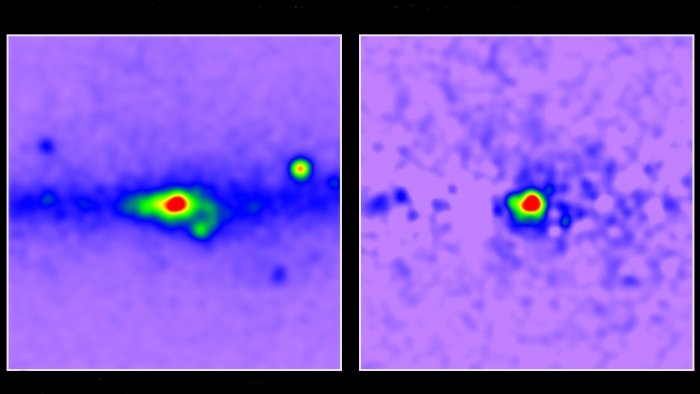
A new study of gamma-ray light from the center of our galaxy makes the strongest case to date that some of this emission may arise from dark matter, an unknown substance making up most of the material universe.
Using publicly available data from NASA's Fermi Gamma-ray Space Telescope, independent scientists at the Fermi National Accelerator Laboratory, the Harvard-Smithsonian Center for Astrophysics, the Massachusetts Institute of Technology and the University of Chicago have developed new maps showing that the galactic center produces more high-energy gamma rays than can be explained by known sources and that this excess emission is consistent with some forms of dark matter.
“The new maps allow us to analyze the excess and test whether more conventional explanations, such as the presence of undiscovered pulsars or cosmic-ray collisions on gas clouds, can account for it,” says Dan Hooper, an astrophysicist at Fermilab and a lead author of the study. “The signal we find cannot be explained by currently proposed alternatives and is in close agreement with the predictions of very simple dark matter models.”
The galactic center (shown above) teems with gamma-ray sources, from interacting binary systems and isolated pulsars to supernova remnants and particles colliding with interstellar gas. It's also where astronomers expect to find the galaxy's highest density of dark matter, which only affects normal matter and radiation through its gravity. Large amounts of dark matter attract normal matter, forming a foundation upon which visible structures, like galaxies, are built.
No one knows the true nature of dark matter, but WIMPs, or Weakly Interacting Massive Particles, represent a leading class of candidates. Theorists have envisioned a wide range of WIMP types, some of which may either mutually annihilate or produce an intermediate, quickly decaying particle when they collide. Both of these pathways end with the production of gamma rays—the most energetic form of light—at energies within the detection range of Fermi's Large Area Telescope, or LAT.
When astronomers carefully subtract all known gamma-ray sources from LAT observations of the galactic center, a patch of leftover emission remains (shown above, on right). This excess appears most prominent at energies between 1 and 3 billion electron volts—roughly a billion times greater than that of visible light—and extends outward at least 5000 light-years from the galactic center.
Hooper and his colleagues conclude that annihilations of dark matter particles with a mass between 31 and 40 GeV provide a remarkable fit for the excess based on its gamma-ray spectrum, its symmetry around the galactic center, and its overall brightness. Writing in a paper submitted to the journal Physical Review D, the researchers say that these features are difficult to reconcile with other explanations proposed so far, although they note that plausible alternatives not requiring dark matter may yet materialize.
“Dark matter in this mass range can be probed by direct detection and by the Large Hadron Collider, so if this is dark matter, we're already learning about its interactions from the lack of detection so far,” says co-author Tracy Slatyer, a theoretical physicist at MIT in Cambridge, Massachusetts. “This is a very exciting signal, and while the case is not yet closed, in the future we might well look back and say this was where we saw dark matter annihilation for the first time.”
The researchers caution that it will take multiple sightings—in other astronomical objects, the LHC or in some of the direct-detection experiments now being conducted around the world—to validate their dark matter interpretation.
“Our case is very much a process-of-elimination argument. We made a list, scratched off things that didn't work, and ended up with dark matter,” says co-author Douglas Finkbeiner, a professor of astronomy and physics at the CfA, also in Cambridge.
“This study is an example of innovative techniques applied to Fermi data by the science community,” says Peter Michelson, a professor of physics at Stanford University in California and the LAT principal investigator. “The Fermi LAT Collaboration continues to examine the extraordinarily complex central region of the galaxy, but until this study is complete we can neither confirm nor refute this interesting analysis.”
While the great amount of dark matter expected at the galactic center should produce a strong signal, competition from many other gamma-ray sources complicates any case for a detection. But turning the problem on its head provides another way to attack it. Instead of looking at the largest nearby collection of dark matter, look where the signal has fewer challenges.
Dwarf galaxies orbiting the Milky Way lack other types of gamma-ray emitters and contain large amounts of dark matter for their size – in fact, they're the most dark-matter-dominated sources known. But there's a tradeoff. Because they lie much farther away and contain much less total dark matter than the center of the Milky Way, dwarf galaxies produce a much weaker signal and require many years of observations to establish a secure detection.
For the past four years, the LAT team has been searching dwarf galaxies for hints of dark matter. The published results of these studies have set stringent limits on the mass ranges and interaction rates for many proposed WIMPs, even eliminating some models. In the study's most recent results, published in Physical Review D on February 11, the Fermi team took note of a small but provocative gamma-ray excess.
“There's about a one-in-12 chance that what we're seeing in the dwarf galaxies is not even a signal at all, just a fluctuation in the gamma-ray background,” explained Elliott Bloom, a member of the LAT Collaboration at the Kavli Institute for Particle Astrophysics and Cosmology, jointly located at the SLAC National Accelerator Laboratory and Stanford University. If it's real, the signal should grow stronger as Fermi acquires additional years of observations and as wide-field astronomical surveys discover new dwarfs. “If we ultimately see a significant signal,” he added, “it could be a very strong confirmation of the dark matter signal claimed in the galactic center.”
A version of this article was originally published by NASA.

 Frascati Scienza
 Buco Nero
 Io Non Faccio Niente
 Tommaso Dorigo
 Giovanni Mazzitelli
 Barbara Gallavotti
 Keplero Blog
 Research Gate