
Massive thoughts
A ‘crack in the cosmic egg’
Documenting the development of discovery
Tracking particles faster at the LHC
A new trigger system will expand what ATLAS scientists can look for during high-energy collisions at the Large Hadron Collider.
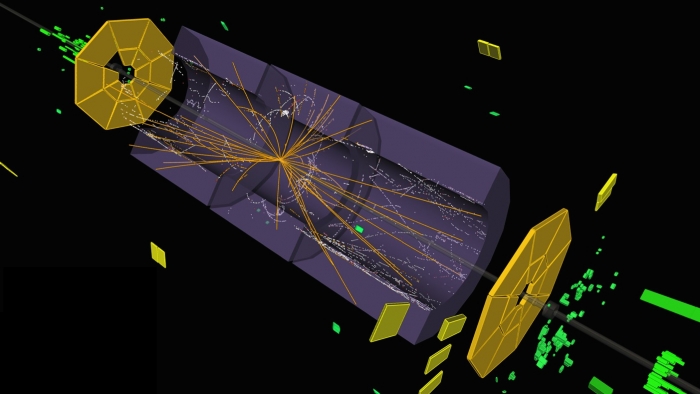
For its next big performance, the Large Hadron Collider will restart in 2015 with twice its previous collision energy and a much higher rate of particle collisions per second.
Scientists have been scurrying to prepare their detectors for the new particle onslaught. As part of this preparation, a group that includes physicists from laboratories and universities in the Chicago area are designing a new system that will allow them to examine collisions faster than ever before.
When the Large Hadron Collider is running, billions of particle collisions occur every second. Of these, only a few are the kind of direct hits that scientists are looking for. These high-impact collisions convert large amounts of pure energy into mass, temporarily producing new particles such as Higgs bosons for physicists to study.
In order to separate these rare and interesting events from the billions of less exciting collisions, scientists create complex processing systems called triggers. Trigger systems look for the most interesting collisions and record them for further analysis. Now, an international collaboration of scientists on the ATLAS experiment are creating a unique upgrade to their trigger system called the Fast Tracker, which will revolutionize how they sort collision events. Currently, scientists at Fermilab, Argonne, the University of Illinois and the University of Chicago are manufacturing and testing prototypes of several component parts of the ATLAS Fast Tracker.
Fermilab’s CDF detector, which ran from 1985 to 2011, employed a system based on the same idea as the Fast Tracker, says University of Chicago postdoctoral fellow John Alison. However, thanks to advancements in technology over the past two decades, the new ATLAS system is about 10,000 times more powerful.
Alison says this new component of the trigger system will help the ATLAS detector handle the upgraded LHC. It could even allow scientists to see things they might have missed during its first run.
“In a sense, if you change the trigger in a collider experiment, you really change the whole experiment,” Alison says. “By changing how the trigger system decides which events are interesting, we will be able to ask different questions and look for things we might have been blind to before. The next run of the LHC will be very interesting.”
The higher rate of particle collisions per second planned for the next and future runs of the LHC requires a more powerful, more discerning trigger system, says Yasuyuki Okumura, a postdoctoral fellow at the University of Chicago and Fermilab.
"Maintaining an efficient trigger in a high luminosity environment is incredibly challenging,” Okumura says. "The technology used in the system will help lead future high-energy hadron collider experiments.”
The ATLAS trigger system used during the first run of the LHC weeded out uninteresting collisions in three stages. Stage one looked for interesting particles in the detector, such as high-energy muons or photons, or large clusters of energy in the calorimeters. If a set of collisions passed this first stage of the trigger system, then all the data from that batch was passed to the second trigger. The second and third triggers then ran series of algorithms to whittle down the collision data even more.
The Fast Tracker will be an intermediate step between the first and second triggers. Using parallel processing and a series of custom-designed computer chips, the Fast Tracker will do something never before possible: simultaneously reconstruct the tracks of all of the particles in every region of the detector.
The coming runs of the LHC could shed light on some of the lingering questions left by our best understanding of the nature of matter, the Standard Model of particle physics, Alison says.
“The real interest in run two of the LHC is the unknown,” Alison says. “The Fast Tracker will give us more flexibility to save the interesting signals that we don't yet know we're interested in."
Is the universe balanced on a pinhead?
Not just old codgers
Letter to the editor: Oldest light?
Reader Bill Principe raises an interesting question about the headline of a recent symmetry article.

Dear symmetry,
I am not a physicist, so forgive me if I get my physics wrong.
The most recent issue has an article called “The oldest light in the universe.”
But I thought that Einstein’s [Special] Theory of Relativity says that, as an object moves faster and faster, time slows relative to everything else. If that is true, doesn’t that mean that time has stopped for light, traveling at the speed of light?
In other words, for all photons, has not time stopped? For photons, is it not, right now, the time of the big bang? If so, there is no such thing as the oldest light in the universe. All light is 13.8 billion years old, and all light is brand new.
I understand the point of the article. It is the information that the light carries that is old, so I am essentially mincing words. But I think my observation might make a fun counterpoint.
Bill Principe
Ayer, Massachusetts
Editor’s note: The reader is correct! According to theorist Lance Dixon at SLAC National Accelerator Laboratory: If a clock could somehow travel with a photon at the speed of light, it would show that no time had elapsed during the photon's journey.
Ten things you might not know about particle accelerators
From accelerators unexpectedly beneath your feet to a ferret that once cleaned accelerator components, symmetry shares some lesser-known facts about particle accelerators.

The Large Hadron Collider at CERN laboratory has made its way into popular culture: Comedian Jon Stewart jokes about it on The Daily Show, character Sheldon Cooper dreams about it on The Big Bang Theory and fictional villains steal fictional antimatter from it in Angels & Demons.
Despite their uptick in popularity, particle accelerators still have secrets to share. With input from scientists at laboratories and institutions worldwide, symmetry has compiled a list of 10 things you might not know about particle accelerators.

There are more than 30,000 accelerators in operation around the world.
Accelerators are all over the place, doing a variety of jobs. They may be best known for their role in particle physics research, but their other talents include: creating tumor-destroying beams to fight cancer; killing bacteria to prevent food-borne illnesses; developing better materials to produce more effective diapers and shrink wrap; and helping scientists improve fuel injection to make more efficient vehicles.
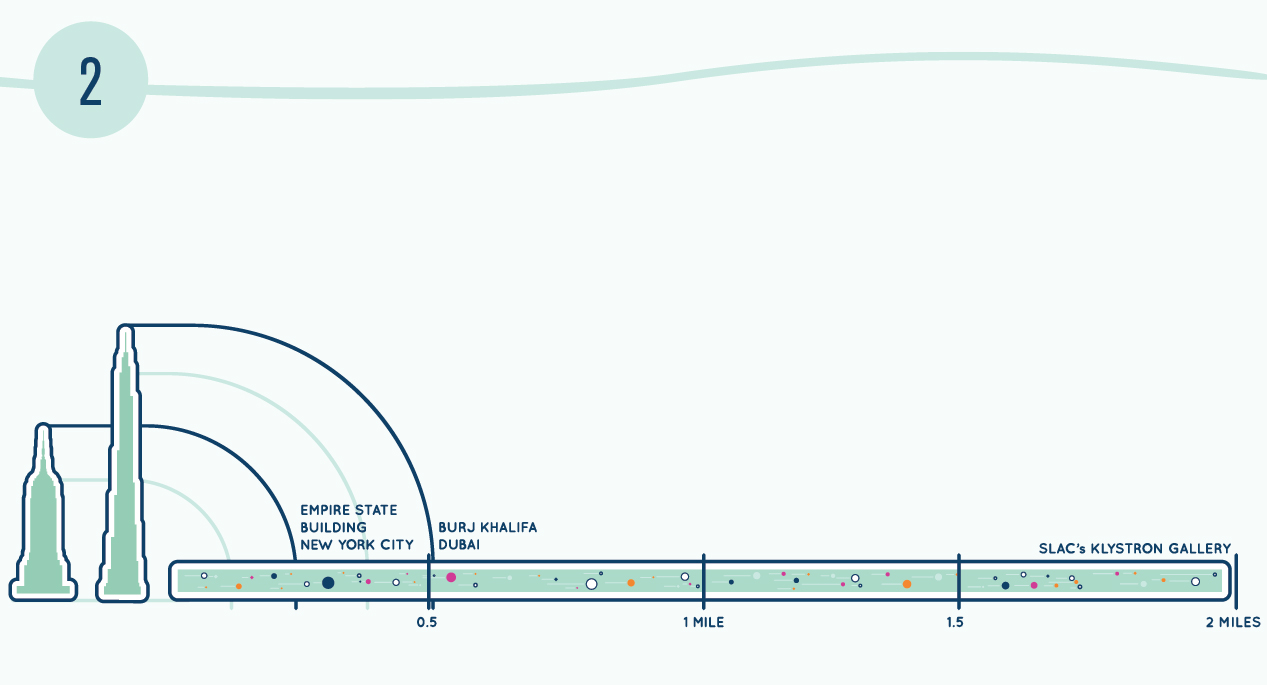
One of the longest modern buildings in the world was built for a particle accelerator.
Linear accelerators, or linacs for short, are designed to hurl a beam of particles in a straight line. In general, the longer the linac, the more powerful the particle punch. The linear accelerator at SLAC National Accelerator Laboratory, near San Francisco, is the largest on the planet.
SLAC’s klystron gallery, a building that houses components that power the accelerator, sits atop the accelerator. It’s one of the world’s longest modern buildings. Overall, it’s a little less than 2 miles long, a feature that prompts laboratory employees to hold an annual footrace around its perimeter.
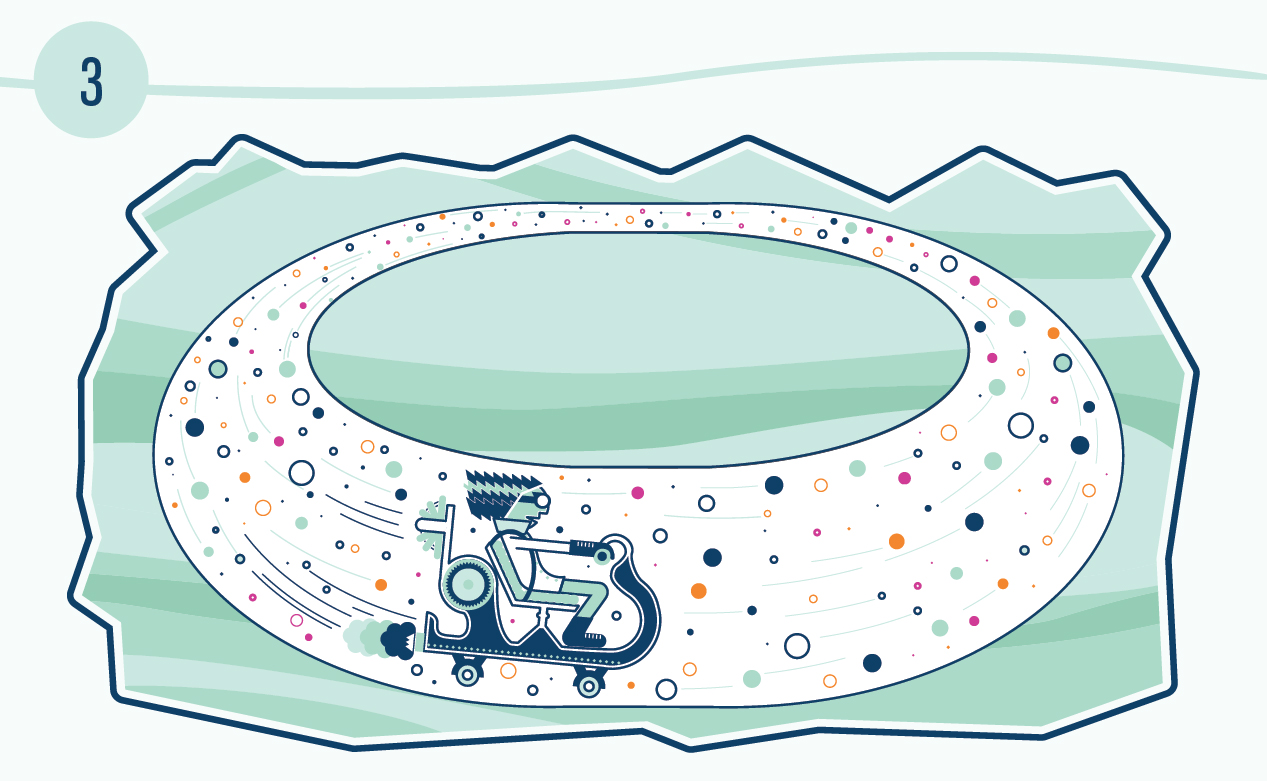
Particle accelerators are the closest things we have to time machines, according to Stephen Hawking.
In 2010, physicist Stephen Hawking wrote an article for the UK paper the Daily Mail explaining how it might be possible to travel through time. We would just need a particle accelerator large enough to accelerate humans the way we accelerate particles, he said.
A person-accelerator with the capabilities of the Large Hadron Collider would move its passengers at close to the speed of light. Because of the effects of special relativity, a period of time that would appear to someone outside the machine to last several years would seem to the accelerating passengers to last only a few days. By the time they stepped off the LHC ride, they would be younger than the rest of us.
Hawking wasn’t actually proposing we try to build such a machine. But he was pointing out a way that time travel already happens today. For example, particles called pi mesons are normally short-lived; they disintegrate after mere millionths of a second. But when they are accelerated to nearly the speed of light, their lifetimes expand dramatically. It seems that these particles are traveling in time, or at least experiencing time more slowly relative to other particles.
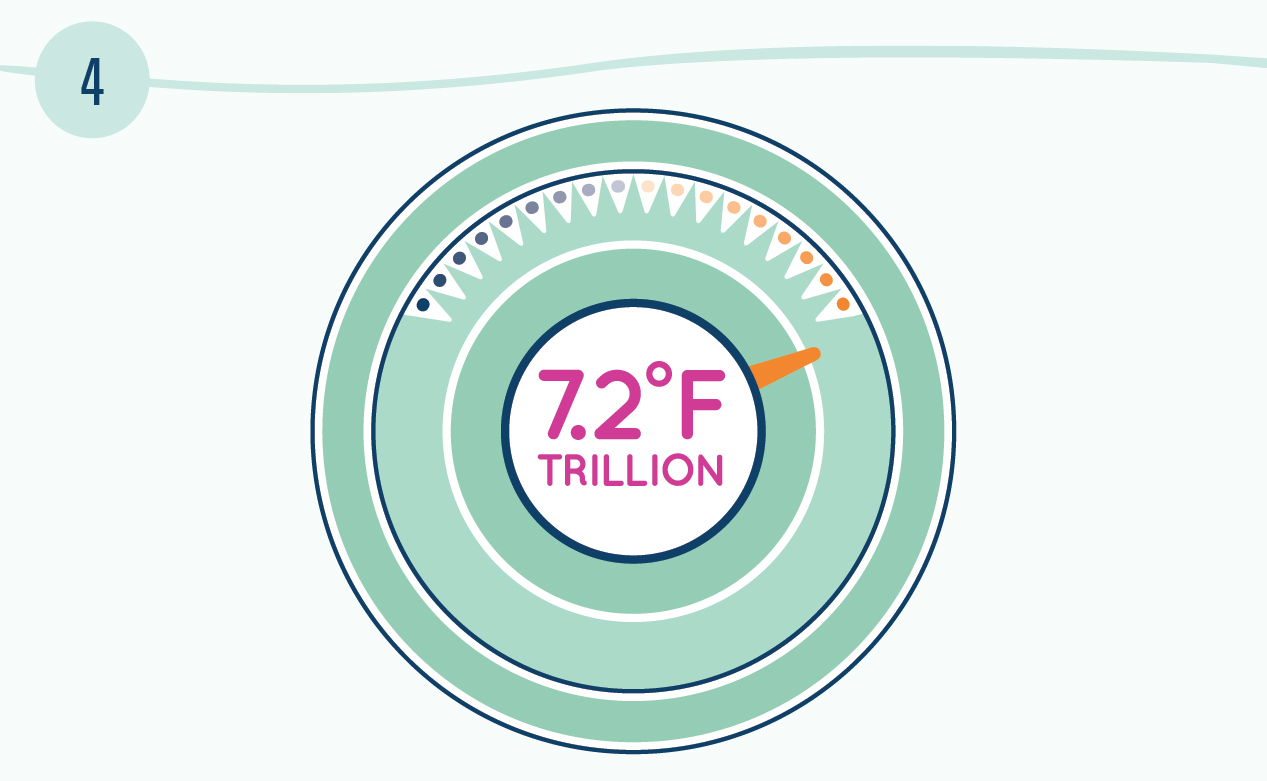
The highest temperature recorded by a manmade device was achieved in a particle accelerator.
In 2012, Brookhaven National Laboratory’s Relativistic Heavy Ion Collider achieved a Guinness World Record for producing the world’s hottest manmade temperature, a blazing 7.2 trillion degrees Fahrenheit. But the Long Island-based lab did more than heat things up. It created a small amount of quark-gluon plasma, a state of matter thought to have dominated the universe’s earliest moments. This plasma is so hot that it causes elementary particles called quarks, which generally exist in nature only bound to other quarks, to break apart from one another.
Scientists at CERN have since also created quark-gluon plasma, at an even higher temperature, in the Large Hadron Collider.

The inside of the Large Hadron Collider is colder than outer space.
In order to conduct electricity without resistance, the Large Hadron Collider’s electromagnets are cooled down to cryogenic temperatures. The LHC is the largest cryogenic system in the world, and it operates at a frosty minus 456.3 degrees Fahrenheit. It is one of the coldest places on Earth, and it’s even a few degrees colder than outer space, which tends to rest at about minus 454.9 degrees Fahrenheit.

Nature produces particle accelerators much more powerful than anything made on Earth.
We can build some pretty impressive particle accelerators on Earth, but when it comes to achieving high energies, we’ve got nothing on particle accelerators that exist naturally in space.
The most energetic cosmic ray ever observed was a proton accelerated to an energy of 300 million trillion electronvolts. No known source within our galaxy is powerful enough to have caused such an acceleration. Even the shockwave from the explosion of a star, which can send particles flying much more forcefully than a manmade accelerator, doesn’t quite have enough oomph. Scientists are still investigating the source of such ultra-high-energy cosmic rays.

Particle accelerators don’t just accelerate particles; they also make them more massive.
As Einstein predicted in his theory of relativity, no particle that has mass can travel as fast as the speed of light—about 186,000 miles per second. No matter how much energy one adds to an object with mass, its speed cannot reach that limit.
In modern accelerators, particles are sped up to very nearly the speed of light. For example, the main injector at Fermi National Accelerator Laboratory accelerates protons to 0.99997 times the speed of light. As the speed of a particle gets closer and closer to the speed of light, an accelerator gives more and more of its boost to the particle’s kinetic energy.
Since, as Einstein told us, an object’s energy is equal to its mass times the speed of light squared (E=mc2), adding energy is, in effect, also increasing the particles’ mass. Said another way: Where there is more “E,” there must be more “m.” As an object with mass approaches, but never reaches, the speed of light, its effective mass gets larger and larger.

The diameter of the first circular accelerator was shorter than 5 inches; the diameter of the Large Hadron Collider is more than 5 miles.
In 1930, inspired by the ideas of Norwegian engineer Rolf Widerøe, 27-year-old physicist Ernest Lawrence created the first circular particle accelerator at the University of California, Berkeley, with graduate student M. Stanley Livingston. It accelerated hydrogen ions up to energies of 80,000 electronvolts within a chamber less than 5 inches across.
In 1931, Lawrence and Livingston set to work on an 11-inch accelerator. The machine managed to accelerate protons to just over 1 million electronvolts, a fact that Livingston reported to Lawrence by telegram with the added comment, “Whoopee!” Lawrence went on to build even larger accelerators—and to found Lawrence Berkeley and Lawrence Livermore laboratories.
Particle accelerators have come a long way since then, creating brighter beams of particles with greater energies than previously imagined possible. The Large Hadron Collider at CERN is more than 5 miles in diameter (17 miles in circumference). After this year’s upgrades, the LHC will be able to accelerate protons to 6.5 trillion electronvolts.

In the 1970s, scientists at Fermi National Accelerator Laboratory employed a ferret named Felicia to clean accelerator parts.
From 1971 until 1999, Fermilab’s Meson Laboratory was a key part of high-energy physics experiments at the laboratory. To learn more about the forces that hold our universe together, scientists there studied subatomic particles called mesons and protons. Operators would send beams of particles from an accelerator to the Meson Lab via a miles-long underground beam line.
To ensure hundreds of feet of vacuum piping were clear of debris before connecting them and turning on the particle beam, the laboratory enlisted the help of one Felicia the ferret.
Ferrets have an affinity for burrowing and clambering through holes, making them the perfect species for this job. Felicia’s task was to pull a rag dipped in cleaning solution on a string through long sections of pipe.
Although Felicia’s work was eventually taken over by a specially designed robot, she played a unique and vital role in the construction process—and in return asked only for a steady diet of chicken livers, fish heads and hamburger meat.
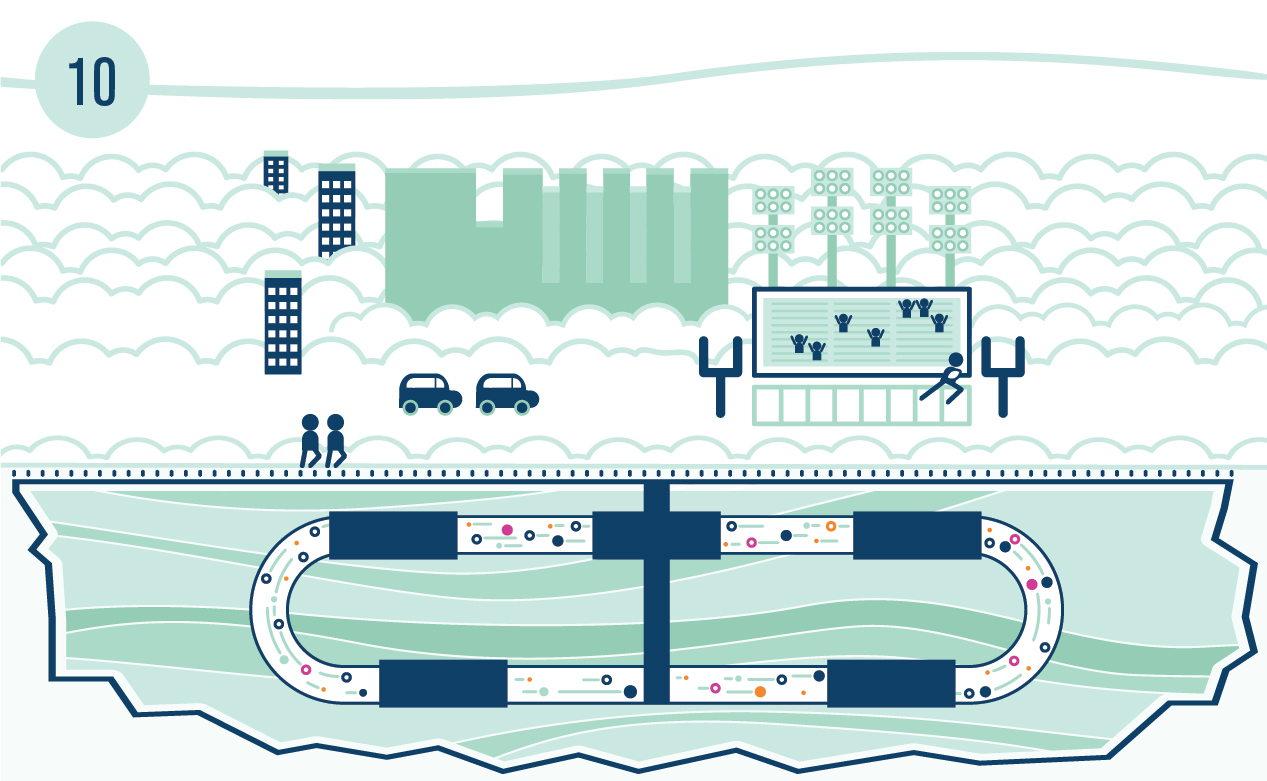
Particle accelerators show up in unlikely places.
Scientists tend to construct large particle accelerators underground. This protects them from being bumped and destabilized, but can also make them a little harder to find.
For example, motorists driving down Interstate 280 in northern California may not notice it, but the main accelerator at SLAC National Accelerator Laboratory runs underground just beneath their wheels.
Residents in villages in the Swiss-French countryside live atop the highest-energy particle collider in the world, the Large Hadron Collider.
And for decades, teams at Cornell University have played soccer, football and lacrosse on Robison Alumni Fields 40 feet above the Cornell Electron Storage Ring, or CESR. Scientists use the circular particle accelerator to study compact particle beams and to produce X-ray light for experiments in biology, materials science and physics.

 Frascati Scienza
 Buco Nero
 Io Non Faccio Niente
 Tommaso Dorigo
 Giovanni Mazzitelli
 Barbara Gallavotti
 Keplero Blog
 Research Gate