
Coming soon: Plan for the future of US particle physics
The Particle Physics Project Prioritization Panel’s recommendations will set the course for the future of particle physics in the United States.
This week marks the end of a multi-stage community planning process that will shape the coming decades of particle physics in the United States.
On Thursday, the Particle Physics Project Prioritization Panel, or P5, will present its report—which provides the strategic plan for the next 10 years in the context of a 20-year global vision for the field—to the High Energy Physics Advisory Panel. HEPAP advises the Department of Energy’s Office of Science and the National Science Foundation's Directorate of Mathematical and Physical Sciences.
The plan will have major implications for the future of US research into the Higgs boson, neutrinos, dark matter, dark energy and inflation, and as yet undiscovered particles, interactions and physical principles.
The US particle physics community has been holding workshops and meetings to gather input on what the focus of the next decade of particle physics should be.
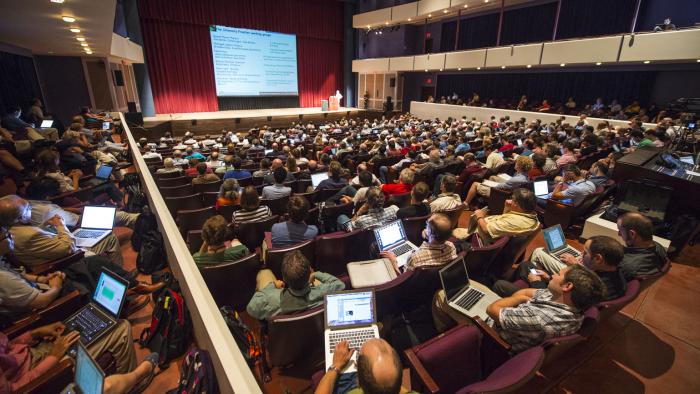
Most notably, physicists organized a yearlong community planning exercise called “Snowmass,” which culminated in a nine-day workshop (pictured above) in July and August 2013. Physicists put together a several-thousand-page report detailing the questions, challenges and ideas discussed in the areas of experiment, instrumentation, computing, education and outreach, and theory.
Building on this community effort, the 25-member P5 panel is tasked with developing strategic advice for the funding agencies and has continued extensive community interactions while working to shape the best paths forward under three possible budget scenarios. The panel is made up of 20 members from universities and laboratories across the United States plus five members from Canada, Europe and Japan.
The High Energy Physics Advisory Panel will, upon accepting the report, submit it to the Department of Energy and the National Science Foundation.
Information about the meeting and how to join via webcast are available on the HEPAP website.
The search for dark matter at the LHC
Long-distance neutrino search
For some physicists, remote operations centers bring neutrino experiments closer to home.
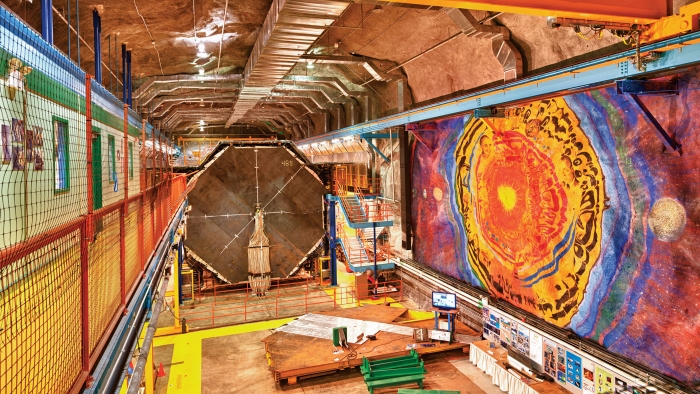
Physicist Ruth Toner sits facing five computer screens and a TV monitor in a room in Medford, Massachusetts. She’s watching an experiment in action: Tiny particles fly through a pair of detectors hundreds of miles away, one at a laboratory in Illinois and the other in a former iron ore mine near the Canadian border of Minnesota.
“Nothing’s turned red yet, so it’s going okay,” Toner says as she glances at the largest screen, which glows green.
Toner, a postdoc at Harvard University, has been taking shifts here in the new control room at Tufts University since January 20, when she was the first to try it out independently. The room allows particle physicists at the two Boston-area schools to observe detectors of the Main Injector Neutrino Oscillation Search, or MINOS, experiment at Fermilab in Illinois and in Soudan Underground Laboratory in Minnesota. The MINOS experiment is on its second iteration, called MINOS+ (pronounced Mee-nohs-plus).
The experiment studies a beam of neutrinos produced at Fermilab and propelled toward the detectors. Neutrinos interact so rarely with other matter that they are able to travel straight through the earth.
Posters from previous experiments hang on the control room wall, along with images overlaid with mnemonic devices for the MINOS+ detectors’ component names. There’s also a webcam that connects the room to the distant detectors. It’s switched off, but as Toner watches the other screens display data, she discusses what she sees with a coordinator onsite at Fermilab through the MINOS+ electronic logbook.
“Fermilab neutrino experiments are bringing far-flung people together to do some really exciting science,” Toner says. “Neutrino physics is a very fast-moving field right now, with the potential for some really interesting future discoveries.”
Scientists on the MINOS+ experiment aim to learn more about how the perplexing particles oscillate, or change form, and also hunt for new particles such as sterile neutrinos.
The Boston-area researchers learned how to construct and run the control room from physicists at the University of Rochester, who set up a similar remote operations center for another Fermilab neutrino experiment called MINERνA. Academic institutions in the United States and abroad, including The College of William and Mary and the University of Warsaw, have developed similar centers.
Patricia Vahle, a physics professor at The College of William and Mary, sees a local control room as a tool with trade-offs.
“A remote control room definitely saves money, removes travel hassles and also creates a simpler way to expose students to particle physics research,” she says. “But you do lose something. Coming to Fermilab for shifts gives you a chance to connect face-to-face with your colleagues.”
The Tufts crew has been involved with MINOS since the project was first proposed in the mid-1990s. Tony Mann, a physics professor at Tufts University and co-leader of MINOS+, manages a group currently working on three Fermilab neutrino experiments: MINOS+, MINERνA and the latest addition, NOνA.
“There’s no way we could participate in all three experiments without local control room capabilities,” Mann says. “I think remote control rooms are a positive development for the particle physics community.”
Building artificial body parts with particle beams
Science fiction or science fact?
In a new class at Duke University, professors from different realms explore the intersection of literature and physics.
Duke University professor Mark Kruse grew up reading science fiction, but his fascination with dystopian futures and quantum jumping waned once he started studying particle physics.
“I think reality is always more bizarre than anything we can come up with,” Kruse says. “Even gifted authors and writers can't imagine how crazy reality is beyond our current understanding. Real science gives us greater surprises by taking our understanding even further.”
But when he was asked to co-advise a Duke graduate student whose dissertation spanned both the literature and physics departments, Kruse decided to give science fiction a second look. He teamed up with Duke literary professor and science fiction specialist Katherine Hayles to design a class that is the first of its kind at the university—one that explores the intersection of science fiction and science fact.
Hayles and Kruse originally structured the class to play to their separate realms of expertise. Hayles discussed the literary elements of science fiction stories and their social, political and philosophical implications, while Kruse, who is a member of the ATLAS experiment at the Large Hadron Collider, examined and evaluated their scientific accuracy. But as the class progressed, these roles started to blur.
“What actually happened is we started to discuss some of the ideas that are pushing the very frontier at which Mark is working,” Hayles says. “At some points, Mark had to admit that he didn’t know the answer, which led into some very interesting discussions.”
John Un, a literature major at Duke, took the class because he has always been fascinated with quantum mechanics. He says learning about scientific research made him think critically about how he approaches the humanities.
“From a literary perspective, I am inclined to take the position there is always subjectivity in everything,” Un says. But Kruse’s explanations of the scientific method made him rethink his approach to evaluating fiction.
“What am I basing my points on?” he says. “Is it just theory and jargon, or can I ground my arguments in evidence?”
Stefan Cafaro, an engineering major at Duke, was drawn to the class because he had spent a summer working with Kruse on a project to upgrade the ATLAS detector. For him, the best part of it was being able to branch out from the typical engineering track while remaining within the realm of the sciences.
“If you take just pure engineering classes, you miss out on developing important skills like critical reading, discussion and presentation,” Cafaro says. “Especially as an engineer, you will be doing that sort of thing throughout your entire career. If you don’t have any social or verbal skills, it is going to hurt you.”
Kruse and Hayles were both impressed with the performance of their students and their willingness to step outside their comfort zones.
“We had amazing questions from the humanities students that really probed the scientific concepts we were discussing,” Kruse says. “I was really impressed that they were taking the science so seriously.”
For their final projects, the students wrote short science fiction stories based on the scientific concepts discussed in class. These stories explore topics like quantum mechanics, black holes, the Large Hadron Collider and the Higgs field. You can read their work on the class website.
Planck reveals galactic fingerprint
Saving the Feynman van
A team of Richard Feynman’s friends and fans banded together to restore the Nobel laureate’s most famous vehicle.
“The game I play is a very interesting one,” says Nobel Laureate Richard Feynman in a low-resolution video posted to YouTube. “It’s imagination in a tight straitjacket.”
Feynman is describing his job as a theoretical physicist: to lay out what humanity knows about how the world works, and to search the spaces in between for what we might have missed.
The video shows more than Feynman's way with words. It shows his approachability. One of the greatest minds that particle physics has ever known stands barefoot, lecturing in a distinct Queens, New York, accent for an audience lounging casually on the floor at the new-age Esalen Institute in Big Sur, California.
In a way, Feynman remains approachable to this day for all of the snippets of his personality left behind in books, letters and recordings of formal and informal lectures and interviews.
Recently, a more concrete bit of Feynman history came out of retirement: A small team has brought back to life the so-called “Feynman van.”
One camper, special order
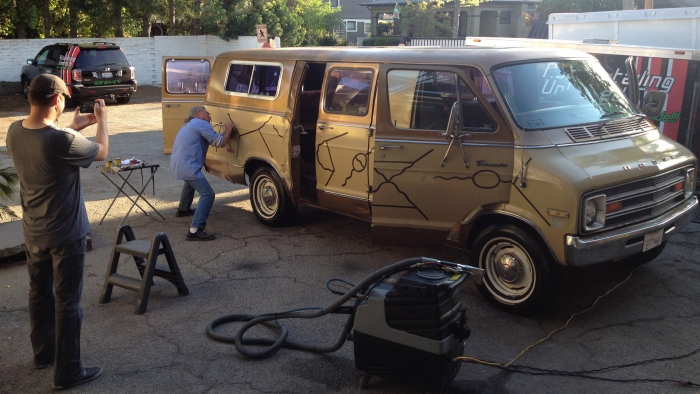
In 1975, Feynman and his wife, Gweneth Howarth, bought a Dodge Tradesman Maxivan and had it painted with Feynman diagrams, symbols Feynman had invented to express complicated particle interactions through simple lines and loops.
It might seem arrogant to drive around in a van covered in reminders of one’s own intellectual prowess. But Feynman's daughter, Michelle, thinks the decorations represented something else: a love of physics.
“My dad was pretty low-key about himself,” she says. “I think decorating the van was more to celebrate the diagrams than to celebrate himself.”
Michelle's parents put a lot of thought into the design of the vehicle, which they primarily used for camping, Michelle says. It was outfitted with a small hammock for Michelle to use in case the family of four needed to sleep inside during inclement weather.
“I don’t think that they had ever done anything like that with a car purchase before,” Michelle says. “It was always: Go to the dealer and find something—it doesn’t really matter what color it is—and you’ll have it for a million years.”
The Feynman family took the van to Canada, Mexico and dozens of US campsites in between, often traveling with a couple of other families, often leaving the paved road for the unknown.
Michelle began driving the van to school after she turned 16.
“I thought it was kind of embarrassing,” she says. “But at a certain point I kind of got over it. If you want to drive at that age, you’ll drive anything.”
After Michelle’s first couple of years in college, one of her father’s friends, film producer Ralph Leighton—Feynman’s drumming partner in another famous fuzzy YouTube clip—bought the van and put it into storage, where it began to rust and fade.
Saving the Feynman van
When video game designer Seamus Blackley, known as the father of the Xbox, got ahold of the van in 2012, “it was just about too late,” Blackley says.
Blackley has a history with particle physics. He was in his early 20s, working on his PhD thesis at Tufts University and Fermi National Accelerator Laboratory, when he saw his plans for the future disintegrate with the defunding of the planned Superconducting Super Collider.
“I found out on CNN,” he says.
He changed course and wound up taking a job working on some of the first computer games with 3D graphics. He designed the physics of the game environments, “keeping things from going into other things.” He has helped shape the world of video games in a variety of different roles since.
Game design takes the same type of thinking Feynman described in his talk at the Esalen Institute, Blackley says. A designer must creatively solve problems without breaking the rules that keep the environment realistic—“and then you have to have a lot of intuition about how to make it fun.”
In 2005, Blackley moved to Pasadena, California, just miles from where Leighton was keeping Feynman’s van. Oblivious to his proximity to the famous camper, Blackley nonetheless began to make a hobby of restoring classic Italian cars.
It was fellow Pasadena resident Michael Shermer, founder of the Skeptics Society, who told him about the van in 2012. Blackley knew right away that he had to help save it.
“The universe is telling me I’ve gotta do this,” he says.
With the help of Leighton and Shermer, along with a donation from Feynman fan and world-class designer Edward Tufte, Blackley registered the van as a historic vehicle and brought it to his preferred restoration specialists in Los Angeles.
The van’s Feynman diagrams, which were painted poorly in the first place, turned out to be too degraded for restoration. So a pinstriper re-painted them, taking care to replicate the quality of the original work.
“It looks like this crappy job again,” Blackley says with a smile. “You see the brush marks and everything.”
After the restoration, Blackley prepared to ship the van across the country for a Feynman-themed exhibit by Tufte, held at Fermilab.
Keeping the Feynman spirit alive
The test of whether the specialists had stayed true to the original came when Blackley invited Michelle to come see the van before its next big trip. She came with her 11- and 13-year-old children.
It didn’t look brand new, Michelle says, but it was as if it had been rewound 30 years, back to the days when her father was still in the driver’s seat. She told Blackley and her kids about the times her father slept on the floor below her hammock.
“As a father now, you appreciate what that means,” says Blackley, who has an 11-year-old son.
A camping van incongruously covered in physics notations seems to be a fitting symbol for a man who couldn’t seem to help thinking about particle physics, Michelle says.
“I think it was impossible for him to turn it off,” she says. “I remember in the car there was a Kleenex box, and the back of it had been used for equations. Every little piece of paper and every waking moment was fair game.”
Richard Feynman died of cancer in 1988 at the age of 69. But projects like the van restoration keep his memory alive, Michelle says.
“He would’ve been an amazing grandfather, and he never had the opportunity,” she says. “So I’m thrilled that there are so many people around who want to share his spirit and his life so my kids can get a sense of who he is.”

 Frascati Scienza
 Buco Nero
 Io Non Faccio Niente
 Tommaso Dorigo
 Giovanni Mazzitelli
 Barbara Gallavotti
 Keplero Blog
 Research Gate