
MINOS result narrows field for sterile neutrinos
Data collected at the long-running MINOS experiment stacks evidence against the existence of these theoretical particles.
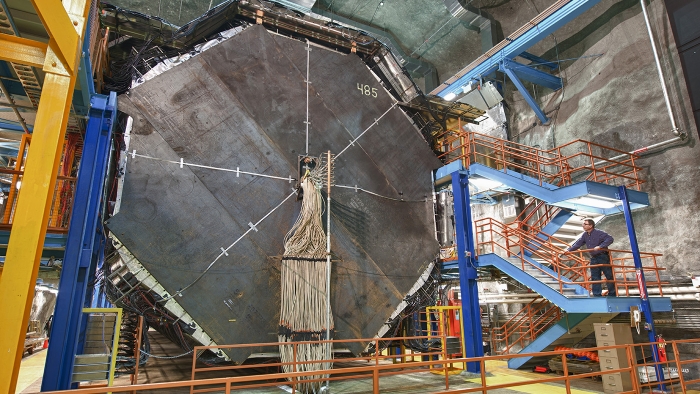
If you’re searching for something that may not exist, and can pass right through matter if it does, then knowing where to look is essential.
That’s why the search for so-called sterile neutrinos is a process of elimination. Experiments like Fermilab’s MiniBooNE and the Liquid Scintillator Neutrino Detector (LSND) at Los Alamos National Laboratory have published results consistent with the existence of these theoretical particles. But a new result from the long-running MINOS experiment announced this week severely limits the area in which they could be found and casts more doubt on whether they exist at all.
Scientists have observed three types or “flavors” of neutrinos—muon, electron and tau neutrinos—through their interactions with matter. If there are other types, as some scientists have theorized, they do not interact with matter, and the search for them has become one of the hottest and most contentious topics in neutrino physics. MINOS, located at Fermilab with a far detector in northern Minnesota, has been studying neutrinos since 2005, with an eye toward collecting data on neutrino oscillation over long distances.
MINOS uses a beam of muon neutrinos generated at Fermilab. As that beam travels 500 miles through the earth to Minnesota, those muon neutrinos can change into other flavors.
MINOS looks at two types of neutrino interactions: neutral current and charged current. Since MINOS can see the neutral current interactions of all three known flavors of neutrino, scientists can tell if fewer of those interactions occur than they should, which would be evidence that the muon neutrinos have changed into a particle that does not interact. In addition, through charged current interactions, MINOS looks specifically at muon neutrino disappearance, which allows for a much more precise measurement of neutrino energies, according to João Coelho of Tufts University.
“Disappearance with an energy profile not described by the standard three-neutrino model would be evidence for the existence of an additional sterile neutrino,” Coelho says.
The new MINOS result, announced today at the Neutrino 2014 conference in Boston, excludes a large and previously unexplored region for sterile neutrinos. To directly compare the new results with previous results from LSND and MiniBooNE, MINOS combined its data with previous measurements of electron antineutrinos from the Bugey nuclear reactor in France. The combined result, says Justin Evans of the University of Manchester, “provides a strong constraint on the existence of sterile neutrinos.”
“The case for sterile neutrinos is still not closed,” Evans says, “but there is now a lot less space left for them to hide.”
Beam on: My father’s fight with cancer
After working with particle accelerators his entire professional career, Heather Rock Woods’ father placed himself in the path of a beam to fight cancer.
More than math
MIT teaches physics students about another side of scientific life—communication.
Most undergraduate physics classes are heavy on the problem sets. But there’s more to being a scientist than solving equations.
At the Massachusetts Institute of Technology, physicist Janet Conrad teaches physics majors about another side of the job: communication.
“In most technical classes, there is one correct answer to a problem,” says MIT graduating senior Arunima Balan.
Not so in Conrad’s communications intensive class. There, students practice writing grants, debating policy and even researching and writing articles for the general public.
“It turns out you can’t get away with not writing in a physics career,” says MIT alumna Fangfei Shen, who has been a teaching assistant for the class since it first began in 2010.
Throughout the class, Conrad introduces students to physicists with jobs inside and outside academia. She also teaches them about particle physics, a topic most of them might only study in graduate school, if ever.
In the latest class, students interviewed researchers and wrote articles about the many ways to study invisible particles called neutrinos.
“To write an article, you have to have the guts to pick up the phone and call someone you don’t know and ask questions about something that’s not your area of expertise,” Conrad says. Even if in the future the students wind up spending more time as interviewees than interviewers, she says, “I think it’s important for them to get on the other end of the process.”
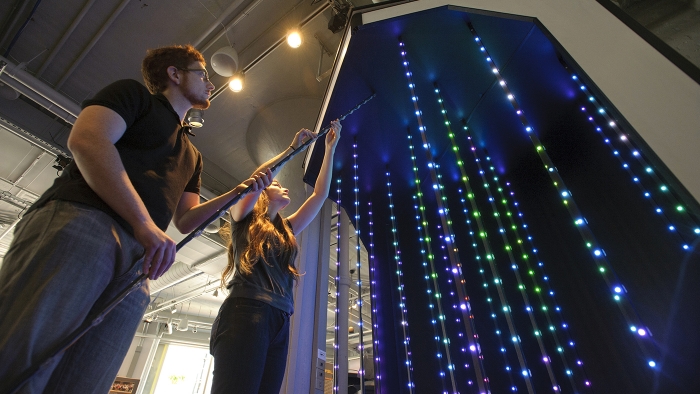
Several of the students’ articles are collected on a website and in a booklet that will be used for public outreach in conjunction with Neutrino 2014, a conference that begins today in Boston. They also helped set up a neutrino-themed exhibit at the MIT Museum (pictured above).
As the students learned and as the articles illustrate, there are many ways to be a particle physicist. A day in the life of a particle physicist might involve hiking through an abandoned mine, drilling through Antarctic ice, setting up a particle detector at a nuclear power plant, discussing a theory at a blackboard, or discussing policy in Washington, DC.
“Physics is not just done in the lab,” says physics major and math minor Alexandra Day, who attends nearby Wellesley College, which allows students to cross-register for classes at MIT.
Conrad’s class seems to have left an impression on Day. Inspired by the experience, and with the help of a mentor and Wellesley's Albright Institute for Global Affairs, she secured a summer internship in CERN laboratory’s international relations office. In the fall, she will continue to learn about particle physics as Conrad’s student on the DAEδALUS neutrino experiment.

 Frascati Scienza
 Buco Nero
 Io Non Faccio Niente
 Tommaso Dorigo
 Giovanni Mazzitelli
 Barbara Gallavotti
 Keplero Blog
 Research Gate