
Science and nature
Although the view has changed, Lucy de Barbaro still looks at life through the lens of physics.

Working at Fermilab expanded physicist Lucyna “Lucy” de Barbaro’s horizons. In addition to cultivating her research capabilities and surveying the subatomic realm, she honed an affinity for the natural world.
“At Fermilab you get cutting-edge technology surrounded by prairie. It was so romantic to me,” de Barbaro says. “I love nature and wanted to be involved in sustainability initiatives.”
In 2000, after a decade in experimental physics, she changed directions, bringing her physics mindset with her. At work for telecommunications company Alcatel-Lucent in Naperville, Illinois, she helped develop a reliable computing and networking platform for processing cell phone calls. And in her off hours, she’s become an expert on design and standards for exceptionally energy-efficient homes.
In the beginning
De Barbaro’s affinity for physics began in her hometown of Krakow, Poland—in church. The priest was an accomplished cosmologist who brought together transcendental and scientific ideas in the quest for understanding the universe.
“It was a unique time and inspiration,” de Barbaro says. In the 1980s, “an intellectual stir happened in Poland in conjunction with the Solidarity movement. The church played a big role in raising society.”
It also played an important role in de Barbaro’s decision to undertake a master's degree in theoretical physics. After receiving her degree in 1989, she and her first husband, also a physicist, came to the United States with their two daughters for graduate school.
Enrolled at the University of Rochester, de Barbaro soon joined the E706 experiment at Fermilab probing the structure of gluons, the “glue” of the strong force that clasps quarks together in pairs or trios (the latter are the core of protons and neutrons).
With PhD in hand, de Barbaro became a Northwestern University postdoctoral researcher and joined Fermilab’s NuTeV experiment, which scrutinized millions of neutrino interactions to make precise measurements of a parameter of the Standard Model of particles and interactions.
“Experiments prepared me well for my technical position at Alcatel-Lucent,” she says. “I have no fear of getting my hands dirty, pulling hardware components out of the telecom chassis, examining and swapping them, and so on. Not many software developers are comfortable with that. I found a good niche.”
At Alcatel-Lucent, she first worked on software-hardware integration and system tests that were very complex and rigorous, making the job satisfying. Unlike in particle physics, the telecom equipment and systems need built-in redundancy to ensure 99.999 percent reliability. Their platform for cell phone calls has been set up in the United States, Asia and South America.
“Lucy's background working on problems of high complexity in particle physics has prepared her to quickly define strategy and solutions for software integration challenges that we face in new product introductions,” says Abhay Raj, de Barbaro’s supervisor of 10 years and now director of LTE network design at Alcatel-Lucent.
On her own initiative, de Barbaro collected and analyzed heating and cooling systems data at Alcatel-Lucent’s 1000-person Naperville location and recommended ways to save on energy and costs. Another proposal of hers to improve energy efficiency in company labs advanced to the finalist stage for Bell Lab’s Entrepreneurial Bootcamp in 2012. (Bell Labs is an R&D arm of Alcatel-Lucent.)
Passive homes, passionate advocate
In addition, de Barbaro’s physics training gives her the ability to take on consuming calculations and evaluate data and evidence in her volunteer work on passive homes. Passive House design harnesses fuel-free ways to keep buildings at comfortable temperatures, such as retaining heat through good insulation and air tightness, and orienting windows and overhangs to let in the sun’s heat at the right times.
She’s currently designing a duplex that, like other passive buildings, will use 80 percent less energy than a typical US home and achieve the world’s most stringent building energy standard. As co-founder and board member of the western Pennsylvania chapter of the Passive House Alliance, de Barbaro aims to make the concept and technology more widely known.
The standard is performance-based rather than prescriptive, which means “the solutions are not given, there’s a lot to figure out,” de Barbaro says. “I’m so grateful my husband is a physicist, too, and we can use the same line of thinking—linear, logical—about our house project.”
The couple met through Fermilab friends and married in 2011, with their wedding photos taken at the lab. They now live in Pittsburgh, where he is a professor and she works from home as an Alcatel-Lucent engineer for platform support and vendor management.
“We share the same outlook on climate change and the need to act in areas where we can accomplish something,” she says.

The supersymmetric bet
Researchers imagine the accelerators of the future
Wave-particle duality
Science and diplomacy: Q&A with William Colglazier
CERN announces winners of student research competition
LHCb glimpses possible sign of new physics
EXO experiment searches for exotic decay
The search for neutrinoless double-beta decay could reveal valuable information about neutrinos.
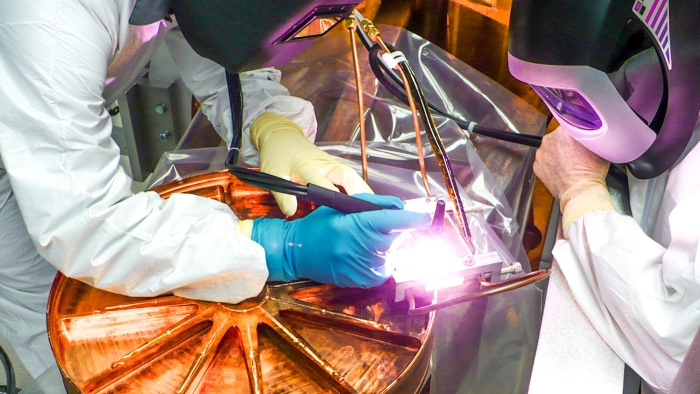
Two years ago researchers began using a tank of liquid xenon installed more than 2000 feet deep in a salt formation in the southeastern corner of New Mexico to study neutrinos.
They're looking for clues to one of the biggest puzzles about the tiny particles: What is their mass? Finding the mass of the neutrino can help answer big questions such as how the universe grew into its present form.
This tank of liquid xenon, located near Carlsbad, New Mexico in the Waste Isolation Pilot Plant (WIPP), is the Enriched Xenon Observatory—200 (EXO-200), the most sensitive instrument of its kind in the world. In a progress report published in the journal Nature, the scientists of the EXO-200 experiment shared what two years of data tell them about the phenomenon they're searching for: neutrinoless double-beta decay, one of the rarest processes in the universe. If this decay takes place, it can give scientists valuable information about neutrino mass.
As the experiment is in the data-gathering phase, “It's far too soon to tell the ultimate outcome of our search,” says Giorgio Gratta, Stanford physics professor and principal investigator for EXO-200. However, the experiment has achieved an almost threefold increase in sensitivity over their initial neutrinoless beta-decay search, the result of which was published in Physical Review Letters in 2012. Some of this increase can be attributed to having more data, but the team can also point to upgrades to the EXO-200 detector and software.
Particle and antiparticle: one and the same?
The clues to neutrino mass the EXO-200 researchers are looking for are hidden in the way xenon transforms into the element barium. The isotope of xenon used by EXO-200, xenon-136, follows a rare variant of a well-known natural process called beta decay in which two neutrons decay simultaneously, emitting two electrons and two anti-neutrinos to create two protons, and one atom of xenon moves forward two spots in the Periodic Table, landing on barium.
In one version of this process, called two-neutrino double-beta decay, all four particles from the two beta decays (two electrons and two anti-neutrinos) are emitted. EXO-200 was the first to see this in xenon-136; they published the result in Physical Review Letters in 2011.
That leaves the possibility of neutrinoless double-beta decay, the variant EXO-200 was designed to detect. In this version the two anti-neutrinos never appear. They annihilate each other before they can escape. This would confirm to researchers that neutrinos, unlike other particles, are their own antiparticles. (The typical partners in an antimatter pair, such as electrons and positrons, have electric charge and are distinguishable; neutrinos have no charge.)
Measuring mass
Zeroing in on the half-life of xenon-136—how long it would take half the xenon-136 atoms to undergo neutrinoless double-beta decay—is also necessary because the half-life is related to the neutrino's “effective” mass: the longer the half-life, the smaller the effective mass.
The effective mass of a neutrino is a parameter that accounts for the process of neutrino mixing (“oscillations”) taking place among the three types, or flavors, of neutrinos, called electron neutrinos, muon neutrinos and tau neutrinos. The effective mass is a particular mix of the same mass parameters that govern neutrino oscillations—a mix specific to the process of neutrinoless double-beta decay. The EXO-200 results, as reported in Nature, are consistent with an effective mass for the neutrino ranging between 190 to 450 thousandths of an electronvolt—if it is its own antiparticle. For comparison consider the electron, which weighs in at half a million electronvolts.
If it does exist, neutrinoless double-beta decay is one of the rarest processes in the universe. “Given two xenon-136 atoms, you could wait many, many times longer than the universe has existed before one of them decays,” Gratta says.
To get around the “many times the current age of the universe” issue, EXO-200's tank holds 200 kilograms of xenon—enough atoms, Gratta says, to considerably improve the team’s chances of seeing a decay. Its underground location in the salt formation helps protect it from background sources, such as cosmic rays or the radioactive signatures of other naturally decaying elements, which could also trigger the detectors.
Getting better at gathering data
Gratta says the researchers originally planned to take data for three years but have additional upgrades in the works that could increase the instrument's sensitivity yet again.
However, new upgrades will need to wait until some issues at WIPP are resolved.
“Problems at the WIPP facility have sidelined our experiment since February 5 and, while we intend to continue the program, it is unclear when we’ll be able to resume,” says SLAC physicist and EXO-200 member Peter Rowson.
When they do, he says, the second round of upgrades is expected to significantly improve performance.
“We've already tested and plan to install an upgrade to the electronics,” Gratta says; this should increase the detector's ability to find the signals of the decay—if they exist. With other planned improvements, including a plan to reduce the natural background radiation even further, he says, the EXO-200 team looks forward to substantial further improvement in the search sensitivity from an additional three years of operation.
A version of this article was first published by SLAC laboratory.

 Frascati Scienza
 Buco Nero
 Io Non Faccio Niente
 Tommaso Dorigo
 Giovanni Mazzitelli
 Barbara Gallavotti
 Keplero Blog
 Research Gate