
Physicist shares do-it-yourself expertise online
SLAC scientist Michael Kelsey sees connections between the communities of physicists and do-it-yourselfers.
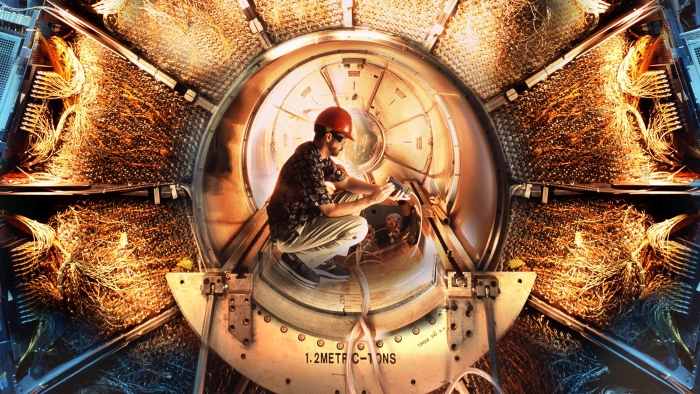
SLAC National Accelerator Laboratory physicist Michael Kelsey's knack for tinkering has led him to pursue do-it-yourself projects including modifying a crib, hacking a children’s toy and testing the fundamental properties of light using garbage bags, Silly Putty, a laser pointer and some thick foil.
Kelsey (pictured above) has worked on the detector for the Stanford Linear Collider experiment at SLAC, the Beijing Spectrometer and BaBar experiments, and is now involved in simulating particle interactions and searching for dark matter. While the practical and fun projects he takes on in his spare time may seem a far cry from his work in particle physics, Kelsey sees them as a natural crossover for the ingenuity and problem-solving skills that scientists routinely enlist.
Particle physics experiments are like massive DIY projects, Kelsey says, as they often require custom-built components and plenty of resourcefulness and inventiveness.
"What we build—what we do experiments with—is often a one-off,” he says. “It's a really huge do-it-yourself project." And the physics community is as open and collaborative as the community of do-it-yourselfers, he says.
For many years Kelsey has engaged in online science forums, freely sharing his expertise and working to demystify science for all comers. In 2008 a Web search led him to Instructables.com, an online DIY community launched in 2005 that features user-shared tutorials for projects ranging from electricity-generating shoes to wine-bottle electron accelerators to garage-built fusion reactors.
Kelsey's first foray to the Instructables.com community was in 2008, when he shared a furniture-modification project that accommodated his wife's disability by allowing her to get their daughter in and out of a crib without needing to reach over its top.
"I bought a wonderfully cheap Ikea crib, modified one side of it to be a French door so you could slide the door open sideways, and then cut the legs off," he says. The project was featured in Make magazine, a publication for the DIY community.
His most popular contribution to Instructables.com, which has so far drawn about 115,000 views, explains how to convert a children’s toy from battery-powered to plug-in.
Other instructions, which borrow from physics projects he carried out in college, explain how to demonstrate that light behaves like a wave. Kelsey gives advice and insight on other projects as well; he has logged thousands of comments on the site.
He’s not the only physicist using DIY projects to share his love of science.
Todd Johnson of Fermi National Accelerator Laboratory has posted numerous science how-to videos on YouTube, including instructions for building a ping-pong-ball accelerator. He says he hopes to make science more approachable for the masses.
“The real key is engaging those people who otherwise may be a little shy about it," he says. "If you can make them aware of what’s going on at a level they can appreciate, then maybe they will go and read some more about it."
Tim Koeth, a professor of electronics and applied physics at the University of Maryland, has shared numerous DIY science projects via Facebook and on his blog. He has built sophisticated gamma-ray spectrometers with an assortment of eBay purchases and spare and donated parts, built particle-accelerating cyclotrons (also featured in Make), and has offered up detailed online instructions on DIY cyclotrons.
He sometimes enlists the help of students in his DIY projects. “I’m able to turn some of these things into a teaching lab,” he says. His DIY gamma-ray tools, for example, demonstrate to students how to detect and measure radiation.
There’s a tremendous amount of information out there for DIY science enthusiasts, including online forums and textbooks, he says. Kelsey and others like him continue to contribute to the stockpile.
Waiting for supernova
Getting the jump on big data for LSST
Measuring the lifetime of the Higgs boson
Scientists are looking for new ways to determine the quick-as-a-thought lifetime of the Higgs boson, which could point the way to new physics.
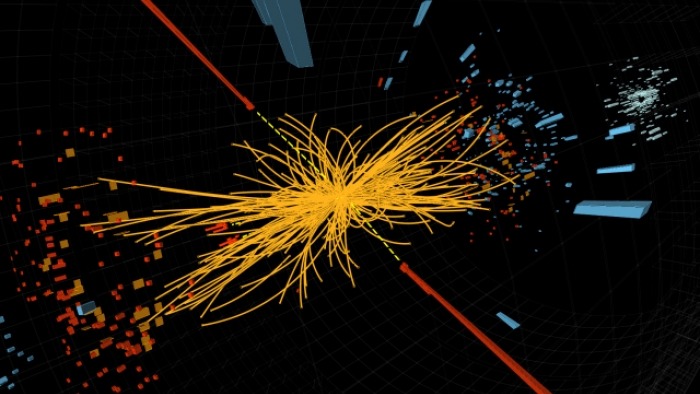
For all the media attention the Higgs boson has received over the last few years, it certainly doesn’t stick around very long to soak it all in. Once produced, it decays in less than a sextillionth of a second.
Despite its brevity, the lifespan of the Higgs boson could lead scientists to the next major discovery at the LHC.
Scientists are looking for better ways to measure this property of the Higgs boson to find out if it agrees with predictions from the Standard Model of physics. If it doesn’t, it could be a sign of undiscovered particles or forces at work.
Some particles—like electrons and protons—are extremely stable and remain unchanged for billions of years or more. But many more massive particles—like muons, top quarks and the Higgs boson—are unstable and quickly decay into more stable particles (such as electrons) shortly after they are produced.
By calculating the average lifespan of these unstable particles, scientists can develop a deeper understanding of their properties and the role they play in our larger understanding of physics.
“When a new particle is discovered, the first thing everyone thinks about measuring is its mass,” says Fermilab theorist John Campbell. “But lifetime is a very important fundamental property that we also need to test to better understand the particle.”
But measuring the lifetime of a fundamental particle directly is extremely difficult—if not impossible—because the lifetimes are often so short that they are imperceptible to even the best particle detectors. For instance, even though the Higgs boson moves at close to the speed of light, it travels less than the length of an atom before it decays into other particles.
For this reason, scientists scrutinize a related fundamental property called the width, a measurement of the range of variation in the particle’s mass.
“When the Higgs is produced, it is sometimes produced at exactly 125 GeV, but other times it is produced with a slightly higher or slightly lower mass,” Campbell says. “This is because of a quantum mechanical uncertainty in its mass, which we call the width. The smaller the width, the longer the lifetime.”
Originally, scientists measured the width of the Higgs directly by reconstructing many Higgs bosons from its well-known decay products and then mapping their masses. But because of limited detector resolution, this measurement only constrained the width of the Higgs boson within a factor of 1000 of the value predicted by the Standard Model.
For this latest measurement, scientists on the CMS experiment at the LHC used a clever trick developed by theorists to determine the width of the Higgs boson based not on what they saw in their measurement, but on what they did not see.
“If the Higgs boson had a large width, then we would regularly see its mass fluctuate above 200 gigaelectronvolts,” says CMS physicist Andrei Gritsan, a professor at Johns Hopkins University. “But because we did not see this this happen often, we know that this is a much rarer processes, and we can therefore restrict the maximum size of the width.”
This new measurement is within a factor of six of the width value predicted by the Standard Model—a huge improvement from the previous measurement.
However, Gritsan advises that more research is needed. “It may not be the cleanest way to measure the width of the Higgs boson because we still make the assumption that there are no new, unobserved particles which could affect the Higgs boson production through quantum effects,” Gritsan says. “We need to attack the problem from many directions."
The next run of the LHC will provide heaps of new data that will allow physicists to both search for new particles and probe the fundamental properties of the Higgs boson even further. It will also allow physicists to test this new technique on a number of different measurements.
“This is the beginning of a new field of research where people are realizing the power of this technique as a way to measure and constrain the properties of the Higgs particle,” Campbell says. “We benefit from more data, but we benefit even more from new ideas.”
Computing power for all
Massive neutrino detector moved into place
Higgs boson shows scientists new tricks
A new result from the Large Hadron Collider strengthens the case that the Higgs interacts with both types of particles in the Standard Model.
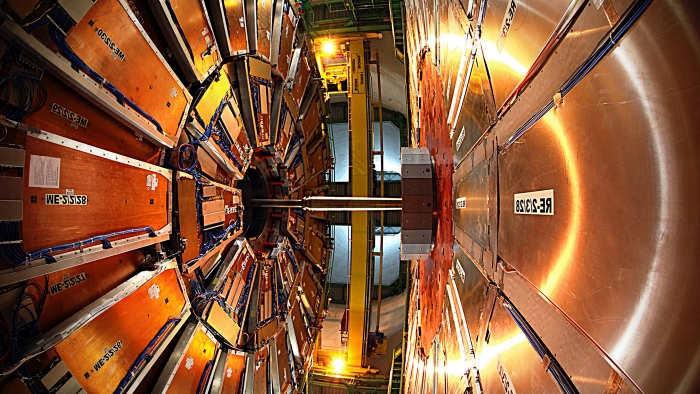
Scientists reported in Nature Physics this week that they have found substantial evidence of a previously unconfirmed property of the Higgs boson—that it gives mass to particles of both types found in the Standard Model of physics.
The fundamental building blocks of the universe can be sorted into two particle categories: fermions and bosons.
“All ‘matter’ particles—quarks and leptons—are fermions,” says physicist Jim Olsen, a member of the CMS experiment and a professor of physics at Princeton University, who helped lead the analysis.
Other particles are bosons, which are associated with the forces through which fermions interact. The photon, for example, is the particle associated with the electromagnetic force. The Higgs boson is associated with the Higgs field, which is thought to permeate all space and give mass to other particles.
When physicists first discovered the Higgs boson in 2012, they had solid evidence only that the Higgs field gave mass to bosons. Now scientists have strong signs that the Higgs interacts with “matter” particles as well. The CMS experiment's latest results, combined with results from the ATLAS experiment, show the Higgs decaying directly to tau particles, heavier cousins of the electron.
“Now that we have identified decays to fermions clearly, we are sure that there is a link between the Higgs boson and fermions,” says Markus Klute, an associate professor at MIT who also helped lead the CMS experiment’s study. “This is fundamental new information.”
It is also another sign that the Higgs boson discovered at the LHC is the one predicted by the Standard Model.
“There could have theoretically been multiple types of Higgs bosons that each interacted with a different type of particle—for instance, one Higgs that interacts with bosons and a different Higgs that interacts with fermions,” Olsen says. “But we now have strong evidence that this Higgs boson interacts with both.”
The next run of the LHC experiments, scheduled to start in spring 2015, should provide an even clearer picture.

 Frascati Scienza
 Buco Nero
 Io Non Faccio Niente
 Tommaso Dorigo
 Giovanni Mazzitelli
 Barbara Gallavotti
 Keplero Blog
 Research Gate