
Exploratorium exhibit reveals the invisible
A determined volunteer gives an old detector new life as the centerpiece of a cosmic ray exhibit.
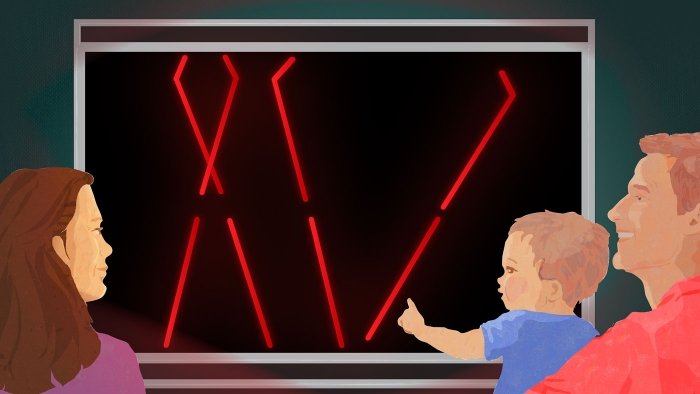
Watch one of the exhibits in San Francisco’s Exploratorium science museum and count to 10, and you’ll have a very good chance of seeing a three-foot-long, glowing red spark.
The exhibit is a spark chamber, a piece of experimental equipment 5 feet wide and more than 6 feet tall, and the spark marks the path of a muon, a particle released when a cosmic ray hits the Earth’s atmosphere. The spark chamber came to the museum by way of the garage of physicist and computer scientist Dave Grossman.
“I always thought this would make a great science exhibit,” says Grossman, who spent more than eight years gathering funding and equipment from places like SLAC National Accelerator Laboratory and Fermi National Accelerator Laboratory, building the chamber, and trying to find it a home.
Grossman wrote the book—the PhD dissertation, actually—on this type of spark chamber during the mid-1960s when he was a graduate student at Harvard University. His task was to help design and build a spark chamber that could reveal the precise paths of certain types of particles.
All spark chambers contain a mixture of inert gases—such as neon, helium and argon—that glow when an electric current passes through them (think neon signs). When an energetic charged particle passes through the gas, it leaves a trail of ionized molecules. When voltage is applied to the gas, the current flows along the trail, illuminating the particle’s path.
The longer the path, the higher the necessary voltage. Typical spark chambers from before Grossman’s time at Harvard could light up only a centimeter or two of trail. Grossman labored to design a compact, dependable generator that could produce 240,000 volts for 100 nanoseconds, enough voltage to illuminate charged particle paths measured in feet instead.
The spark chamber design worked well but was quickly rendered obsolete by more sensitive, more compact digital technology. After graduation, Grossman shifted from particle physics to computer science and went on to a long, successful career with IBM.
But during the years he spent as an occasional volunteer at his kids' and grandkids' schools, teaching students about robotics or sharing his telescope at star parties, Grossman never forgot his pet project or the thesis advisor and friend that guided him through it, Karl Strauch.
“Karl taught me the most by his own example,” Grossman says. “He was willing to do anything necessary for the sake of the science. He would even sweep the floor if he thought it was too dirty.”
Finally, retirement provided time; the garage of his Palo Alto home gave him the space; and donors provided the means for him to rebuild his spark chamber. Nobel Laureates Steven Weinberg and Norman Ramsey (Harvard colleagues of Strauch’s), Strauch’s son, venture capitalist Roger Strauch, and his business partner Dan Miller all pitched in.
The Exploratorium was happy to reap the benefits.
“I went to Dave Grossman’s house twice to look at it and I was impressed,” says Exploratorium Senior Scientist Thomas Humphrey. “I’ve made spark chambers, and they’re finicky beasts.”
Humphrey gave the go-ahead, and the detector was installed in the museum’s Central Gallery, where it attracts visitors young and old.
“Visitors are really excited to see it,” Humphrey says. “Cosmic rays are so mysterious. But here you can walk right up to a device and see a spark in real time. It makes the unseen seen.”
Editor's note: The exhibit will be available for viewing in mid-August.
Helping cancer treatment hit its mark
Scientists set aside rivalry to preserve knowledge
Science inspires at Sanford Lab’s Neutrino Day
The machine learning community takes on the Higgs
Detecting new physics isn’t quite like detecting cat videos—yet.
Scientists have created a contest that invites anyone to use machine learning—the kind of computing that allows Facebook to spot your friends in photos and Netflix to recommend your next film—to search for the Higgs boson.
More than 1000 individuals have already joined the race. They’re vying for prizes up to $7000, but according to contest organizers, the real winner might be the particle physics community, whose new connections with the world of data science could push them toward new methods of discovery.
The contest works like this: Participants receive data from 800,000 simulated particle collisions from the ATLAS experiment at the Large Hadron Collider. The collisions can be sorted into two groups: those with a Higgs boson and those without.
The data for each collision contains 30 details—including variables such as the energy and direction of the particles coming out of it. Contestants receive all of these details, but only 250,000 of the collisions are labeled “Higgs” or “non-Higgs.”
They must use this labeled fraction to train their algorithms to find patterns that point to the Higgs boson. When they’re ready, they unleash the algorithms on the unlabeled collision data and try to figure out where the Higgs is hiding.
Contestants submit their answers online to Kaggle, a company that holds the answer key. When Kaggle receives a submission, it grades, in real time, just a portion of it—to prevent people from gaming the system—and then places the contestant on its public leaderboard.
At the end of the Higgs contest, Kaggle will reveal whose algorithm did the best job analyzing the full dataset. The top three teams will win $7000, $4000 and $3000. In addition, whoever has the most useable algorithm will be invited to CERN to see the ATLAS detector and discuss machine learning with LHC scientists.
The contest was conceived of by a six-person group led by two senior researchers at France’s national scientific research center, CNRS: physicist David Rousseau, who served from 2010 to 2012 as software coordinator for the ATLAS experiment, and machine-learning expert Balázs Kégl, who since 2007 has been looking for ways to bring machine learning into particle physics.
The company running the contest, Kaggle, based in San Francisco, holds such challenges for research institutions and also businesses such as Liberty Mutual, Allstate, Merck, MasterCard and General Electric. They have asked data scientists to foresee the creditworthiness of loan applicants, to predict the toxicity of molecular compounds and to determine the sentiment of lines from movie reviews on the film-rating site Rotten Tomatoes.
Kaggle contests attract a mixed crowd of professional data scientists looking for fresh challenges, grad students and postdocs looking to test their skills, and newbies looking to get their feet wet, says Joyce Noah-Vanhoucke, Kaggle data scientist and head of competitions.
“We’re trying to be the home of data science on the internet,” she says.
Often contestants play for cash, but they have also competed for the chance to interview for data scientist positions at Facebook, Yelp and Walmart.
Kaggle is currently running about 20 contests on its site. Most of them will attract between 300 and 500 teams, Noah-Vanhoucke says. But the Higgs contest, which does not end until September, has already drawn almost 970. Names appear and drop off of the leaderboard every day.
“People love this type of problem,” Noah-Vanhoucke says. “It captures their imagination.”
A couple of the top contenders are physicists, but most come from outside the particle physics community. The team spent about 18 months working on organizing the contest in the hopes that it would create just this kind of crossover, Rousseau says.
“If due to this challenge physicists of the collaboration discover they have a friendly machine learning expert in the lab next door and they try to work together, that’s even better than just getting a new algorithm.”
Machine learning—known in physics circles as multivariate analysis—played a small role in the 2012 discovery of the Higgs. But physics is still about 15 years behind the cutting edge in this area, Kégl says. And it could be just what the science needs.
Until a couple of years ago, the Higgs was the last undiscovered particle of the Standard Model of particle physics.
“Physics is getting to a place where they’ve discovered everything they were looking for,” Kégl says.
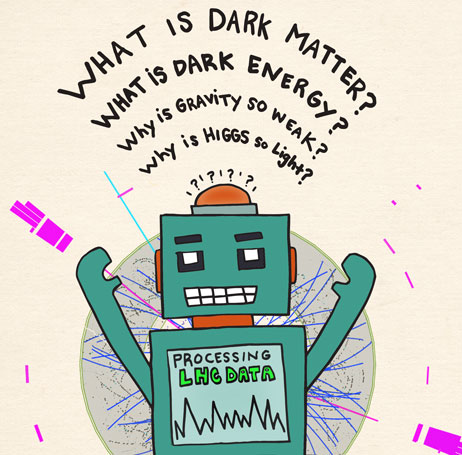
Questions still remain, of course. What is dark matter? What is dark energy? Why is gravity so weak? Why is the Higgs so light?
“But the Higgs is a very specific, predicted thing,” Kégl says. “Physicists knew if it had this mass, it would decay in this way.
“Now they’re looking for stuff they don’t know. I’m really interested in methods that can find things that are not modeled yet.”
In 2012, the Google X laboratory programmed 1000 computers to look through 10 million randomly selected thumbnail images from YouTube videos. This was an example of unsupervised machine learning: The computers had no answer code; they weren’t given any goal other than to search for patterns.
And they found them. They grouped photos by categories such as human faces, human bodies—and cats. People teased that Google had created the world’s most complicated cat video detector. But joking aside, it was an impressive example of the ability of a machine to quickly organize massive amounts of data.
Physicists already research in a similar way, sorting through huge amounts of information in search of patterns. The clue to their next revolutionary discovery could lie in an almost unnoticeable deviation from the expected. Machine learning could be an important tool in finding it.
Physicists shouldn’t consider this a threat to job security, though. In the case of the Higgs contest, scientists needed to greatly simplify their data to make it possible for algorithms to handle it.
“A new algorithm would be a small piece of a full physics analysis,” Rousseau says. “In the future, physics will not be done by robots.”
He hopes they might help, though. The team is already planning the next competition.
US reveals its next generation of dark matter experiments
A physicist in the neurobiology lab
What’s next for Higgs boson research?
Two years after the groundbreaking discovery of the Higgs boson, physicists are still hard at work.
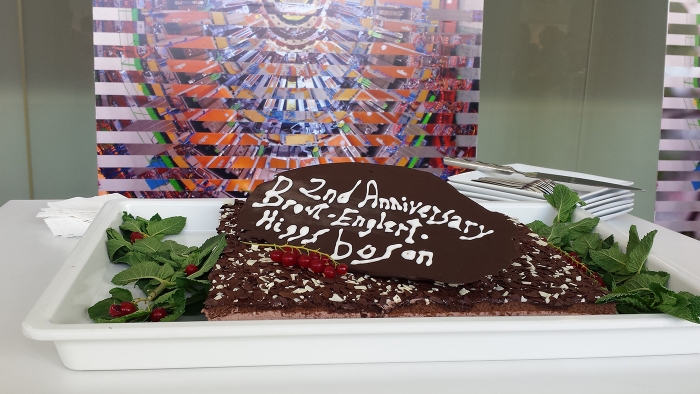
On July 4, 2012, physicists announced an amazing discovery—they had identified a new particle that looked very much like the predicted Higgs boson.
Two years later, physicists have pinned down the traits of this particle and confirmed its identity. But the story doesn’t end there.
This week, physicists presented their most recent measurements of the properties of the Higgs boson at the International Conference on High Energy Physics in Valencia, Spain (and celebrated with chocolate cake). Among the highlights are new precision measurements of the Higgs mass, characterizations of its quantum mechanical properties, an exploration of its decay patterns and new measurements of its lifetime.
“In just two years, our knowledge of this particle has improved dramatically,” says Gabriella Sciolla, an ATLAS physicist and professor at Brandeis University. “For instance, we now know the mass of this particle with a precision better than half a gigaelectronvolt—which is remarkable since just two years ago, we had no idea what this mass could be.”
But there is still more work to be done, she says.
"The measurements of the Higgs boson’s couplings [to other particles] are just in their infancy,” she says. “Much more accurate measurements will be possible in the future. They will allow us to really probe deeper into the Higgs properties and hopefully answer the main question that is on our mind: Is the Higgs really what the Standard Model predicts, or is there more to it?”
The Higgs is a totally new sector of physics, says Michael Peskin, a professor of theoretical physics at SLAC National Accelerator Laboratory. “It is a particle that is not related to any other particles we know about... There’s lots left to explore.”
Since the 1970s, the Higgs boson has been a cornerstone of the Standard Model of particle physics—our best understanding of matter at its most fundamental level. Its discovery in 2012 bolstered physicists’ confidence in the model, but it also surfaced deep, structural questions about what else might be hiding just out of reach.
“The mass of the Higgs boson tells us something, but theorists are having a big debate about what it tells us,” Peskin says. “We need more research to see how this Higgs fits into our theories and models exactly.”
Thus far, the measured properties of the Higgs boson have matched up with the Standard Model’s predictions quite nicely. But Peskin notes that there are still many small gaps that leave room for new physics.
“The presence of new, heavier particles would only affect the Higgs boson slightly,” Peskin says. “If there are heavier, new particles, the measurements of the Higgs will deviate only slightly from the Standard Model’s predictions—maybe about 5 percent.”
These heavier particles could even be new types of Higgs bosons.
“If this is just the lightest Higgs of many other Higgs bosons, we need precision measurements to look for these slight deviations from the Standard Model,” Peskin says. “And we’re just not there yet.”
The first run of the LHC gave scientists 14,000 Higgs bosons to study. The next run will give physicists five to 10 times more, which will let physicists make the precision measurements necessary to thoroughly examine this Higgs boson and see what else it might be hiding.
“The discovery itself was impressive,” Peskin says, “and two years later, I still think it is very impressive, but new discoveries are coming. Knowing the Higgs exists is an important milestone, but now we need to move to the next step.”

 Frascati Scienza
 Buco Nero
 Io Non Faccio Niente
 Tommaso Dorigo
 Giovanni Mazzitelli
 Barbara Gallavotti
 Keplero Blog
 Research Gate