
Particle physics to aid nuclear cleanup
First measurement of sun’s real-time energy
Holographic universe experiment begins
LHC physicist takes on new type of collisions
A whole-Earth approach
Dark Energy Survey kicks off second season
In September, DES will make data collected in its first season freely available to researchers.
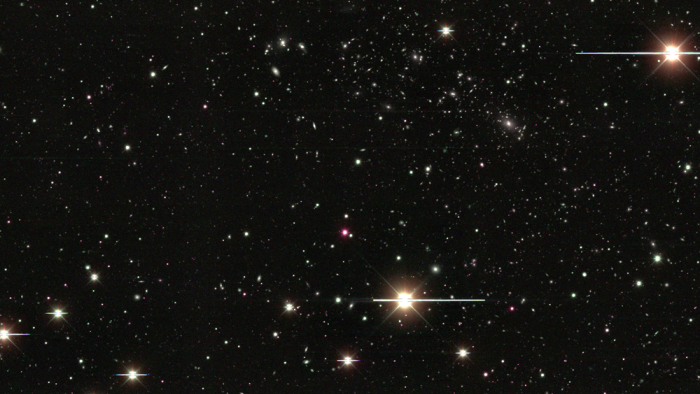
On August 15, with its successful first season behind it, the Dark Energy Survey collaboration began its second year of mapping the southern sky in unprecedented detail. Using the Dark Energy Camera, a 570-megapixel imaging device built by the collaboration and mounted on the Victor M. Blanco Telescope in Chile, the survey’s five-year mission is to unravel the fundamental mystery of dark energy and its impact on our universe.
Along the way, the survey will take some of the most breathtaking pictures of the cosmos ever captured. The survey team has announced two ways the public can see the images from the first year.
Today, the Dark Energy Survey relaunched its photo blog, Dark Energy Detectives. Once every two weeks during the survey’s second season, a new image or video will be posted to www.darkenergydetectives.org with an explanation provided by a scientist. During its first year, Dark Energy Detectives drew thousands of readers and followers, including more than 46,000 followers on its Tumblr site.
Starting on September 1, the one-year anniversary of the start of the survey, the data collected by DES in its first season will become freely available to researchers worldwide. The data will be hosted by the National Optical Astronomy Observatory. The Blanco Telescope is hosted at the National Science Foundation's Cerro Tololo Inter-American Observatory, the southern branch of NOAO.
In addition, the hundreds of thousands of individual images of the sky taken during the first season are being analyzed by thousands of computers at the National Center for Supercomputing Applications at the University of Illinois at Urbana-Champaign, Fermi National Accelerator Laboratory and Lawrence Berkeley National Laboratory. The processed data will also be released in coming months.
Scientists on the survey will use these images to unravel the secrets of dark energy, the mysterious substance that makes up 70 percent of the mass and energy of the universe. Scientists have theorized that dark energy works in opposition to gravity and is responsible for the accelerating expansion of the universe.
“The first season was a resounding success, and we’ve already captured reams of data that will improve our understanding of the cosmos,” says DES Director Josh Frieman of Fermilab and the University of Chicago. “We’re very excited to get the second season under way and continue to probe the mystery of dark energy.”
While results on the survey’s probe of dark energy are still more than a year away, a number of scientific results have already been published based on data collected with the Dark Energy Camera.
The first scientific paper based on Dark Energy Survey data was published in May by a team led by Ohio State University’s Peter Melchior. Using data that the survey team acquired while putting the Dark Energy Camera through its paces, they used a technique called gravitational lensing to determine the masses of clusters of galaxies.
In June, Dark Energy Survey researchers from the University of Portsmouth and their colleagues discovered a rare superluminous supernova in a galaxy 7.8 billion light years away. A group of students from the University of Michigan discovered five new objects in the Kuiper Belt, a region in the outer reaches of our solar system, including one that takes over a thousand years to orbit the Sun.
In February, Dark Energy Survey scientists used the camera to track a potentially hazardous asteroid that approached Earth. The data was used to show that the newly discovered Apollo-class asteroid 2014 BE63 would pose no risk.
Several more results are expected in the coming months, says Gary Bernstein of the University of Pennsylvania, project scientist for the Dark Energy Survey.
The Dark Energy Camera was built and tested at Fermilab. The camera can see light from more than 100,000 galaxies up to 8 billion light-years away in each crystal-clear digital snapshot.
“The Dark Energy Camera has proven to be a tremendous tool, not only for the Dark Energy Survey, but also for other important observations conducted year-round,” says Tom Diehl of Fermilab, operations scientist for the Dark Energy Survey. “The data collected during the survey’s first year—and its next four—will greatly improve our understanding of the way our universe works.”
Fermilab published a version of this article as a press release.
LHC research, presented in tangible tidbits
Rare isotopes facility underway at Michigan State
In July 140 truckloads of concrete arrived at Michigan State University to begin construction of the Facility for Rare Isotope Beams.

Michigan State University’s campus will soon feature a powerful accelerator capable of producing particles rarely observed in nature.
The under-construction Facility for Rare Isotope Beams at MSU will eventually generate atomic nuclei to be used in nuclear, biomedical, material and soil sciences, among other fields of research. FRIB (pronounced ef-rib) could even help scientists investigate a mystery of particle physics.
FRIB will produce beams of rare isotopes, highly unstable atomic nuclei that decay within fractions of a second after forming.
Nature produces bounteous amounts of rare isotopes in supernovae through a series of nuclear processes that physicists have yet to fully understand. But supernovae explode many light years away. Therefore to study rare isotopes, scientists must produce them in the laboratory.
On July 23, construction trucks poured enough concrete to fill four Olympic-sized swimming pools into a massive rectangular hole in the ground at MSU. It was the first of four installments for the floor of the 1500-by-70-foot tunnel that will house FRIB’s linear accelerator.
FRIB, which is funded by the Department of Energy's Office of Science, Michigan State University and the State of Michigan, will support the mission of DOE's Office of Nuclear Physics and will be available for use by researchers from around the world. It is scheduled for completion in 2022.
FRIB will produce the highest-intensity beam of uranium ions of any rare isotope facility in the world. When scientists accelerate uranium ions to about half the speed of light and then smash them into a target such as a disc of graphite, they create a slew of particles—including some rare isotopes.
The more intense the beam, the heavier and larger variety of rare isotopes that scientists can produce, says FRIB Project Manager Thomas Glasmacher: “The more incoming beam of particles you have, the better.”
FRIB should be able to produce a variety of different rare isotopes, says Walter Henning, former director for the GSI Laboratory in Germany that performs similar research.
“With FRIB, and other major facilities, one hopes to get further out on the periodic table and be more complete,” he says.
Nearly two dozen facilities across the globe produce rare isotopes. Facilities such as the ATLAS accelerator facility at Argonne National Laboratory and the Radioactive Ion Beam Factory at the RIKEN Institute in Japan focus their efforts on creating rare isotopes for scientists to study the nuclear properties and behavior. Other facilities, such as the Heavy Ion Research Facility in Lanzhou, China, and TRIUMF Laboratory in Canada, offer research in additional applications such as cancer treatment. FRIB will offer researchers the chance to do a little bit of both and more.
“There are four pillars of the FRIB science program,” says MSU professor Bradley Sherrill, chief scientist of FRIB: Understanding the stability of atomic nuclei; discovering their origin and history in the universe; testing the fundamental laws of symmetries of nature; and identifying industrial applications of rare isotopes.
The properties and behaviors of rare isotopes and how they decay could hold clues to why matter is far more abundant than antimatter in the universe—a mystery that concerns particle physicists.
The big bang should have created equal amounts of matter and antimatter particles. If particles and antiparticles behave differently, that could be the cause of the imbalance that allows us to exist. The decay behavior of rare isotopes could divulge never-before-seen particles or interactions that would offer further insight to this mystery.

 Frascati Scienza
 Buco Nero
 Io Non Faccio Niente
 Tommaso Dorigo
 Giovanni Mazzitelli
 Barbara Gallavotti
 Keplero Blog
 Research Gate