
Sci-fi writers, scientists imagine the future
Astrophysics at the edge of the Earth
What Hawking really meant
Fermilab physicist Don Lincoln explains the idea of a metastable universe, what it has to do with the Higgs boson, and why we're still in good shape.
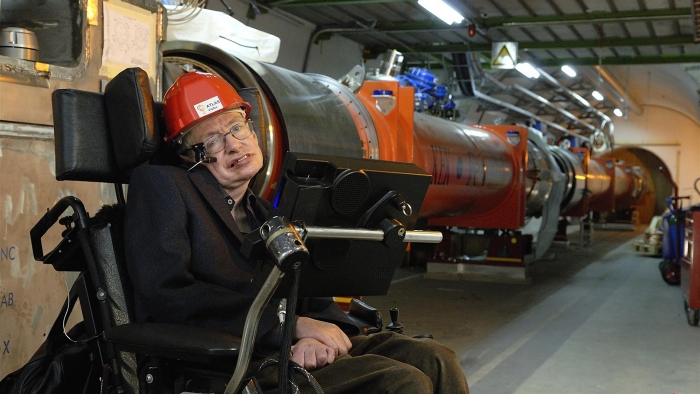
If you’re a science enthusiast, this week you have likely encountered headlines claiming that physicist Stephen Hawking thinks the Higgs boson will cause the end of the universe.
This is a jaw-dropping misrepresentation of science. The universe is safe and will be for a very long time—for trillions of years.
To understand how abominably Hawking’s words have been twisted, first we need to understand his statement. To paraphrase just a little, Hawking said that in a world in which the Higgs boson and another fundamental particle—the top quark—have the masses that scientists have measured them to have, the universe is in a metastable state.
Basically, metastable means “kind of stable.” So what does that mean? Let’s consider an example. Take a pool cue and lay it on the pool table. The cue is stable; it’s not going anywhere. Take the same cue and balance it on your finger. That’s unstable; under almost any circumstances, the cue will fall over.
The analogy for a metastable object is a barstool. Under almost all circumstances, the stool will sit there for all eternity. However, if you bump the stool hard enough, it will fall over. When the stool falls, it is more stable than it was, just like the pool cue lying on the table.
Now we need to bring in the universe and the laws that govern it. Here is an important guiding principle: The universe is lazy—a giant, cosmic couch potato. If at all possible, the universe will figure out a way to move to the lowest energy state it can. A simple analogy is a ball placed on the side of a mountain. It will roll down the mountainside and come to rest at the bottom of the valley. This ball will then be in a stable configuration.
The universe is the same way. After the cosmos was created, the fields that make up the universe should have arranged themselves into the lowest possible energy state.
There is a proviso. It is possible that there could be little “valleys” in the energy slope. As the universe cooled, it might have been caught in one of those little valleys. Ideally, the universe would like to fall into the deeper valley below, but it could be trapped.
This is an example of a metastable state. As long as the little valley is deep enough, it’s hard to get out of. Indeed, using classical physics, it is impossible to get out of it.
However, we don’t live in a classical world. In our universe, we must take into account the nature of quantum mechanics. There are many ways to describe the quantum realm, but one of the properties most relevant here is “rare things happen.” In essence, if the universe was trapped in a little valley of metastability, it could eventually tunnel out of the valley and fall down into the deeper valley below.
So what are the consequences of the universe slipping from one valley to another? Well, the rules of the universe are governed by the valley in which it finds itself. In the metastable valley that defines our familiar universe, we have the rules of physics and chemistry that allow matter to assemble into atoms and, eventually, us.
If the universe slipped into a different valley, the rules that govern matter and energy would be different. This means, among other things, particles such as quarks and leptons might be impossible. The known forces that govern the interaction of those particles might not apply. In short, there is no reason to think we’d exist at all.
Would we have any warning if this transition occurred? Actually, we’d have no warning at all. If, somewhere in the cosmos, the universe made a transition from a metastable valley to a deeper one, the laws of physics would change and sweep away at the speed of light. As the shockwave passed over the solar system, we’d simply disappear as the laws that govern the matter that makes us up ceased to apply. One second we’d be here; the next we’d be gone.
Coming back to the original question, what does the Higgs boson tell us about this? It turns out that we can use the Standard Model to tell us whether we are in a stable, unstable or metastable universe.
We know we don’t live in an unstable one, because we’re here, but the other two options are open. So, what is the answer? It depends on two parameters: the mass of the top quark and the mass of the Higgs boson.
If we follow our understanding of the Standard Model, combined with our best measurements, it appears that we live in a metastable universe that could one day disappear without warning. You can be forgiven if you take that pronouncement as a reason to indulge in some sort of rare treat tonight.
But before you splurge too much, take heed of a few words of caution. Using the same Standard Model we used to figure out whether the cosmos is metastable, we can predict how long it is likely to take for quantum mechanics to let the universe slip from the metastable valley to the stable one: It will take trillions of years.
Mankind has only existed for about 100,000 years, and the sun will grow to a red giant and incinerate the Earth in about 5 billion years. Since we’re talking about the universe existing as a metastable state for trillions of years, maybe overindulging tonight might be a bad idea.
It is important to note that finding the Higgs boson has no effect on whether the universe is in a metastable state. If we live in a metastable cosmos, it has been that way since the universe was created. The discovery of the Higgs boson has no effect at all on whether the universe is in a metastable state.
Returning to the original, overly hyped media stories, you can see that there was a kernel of truth and a barrel full of hysteria. There is no danger, and it’s completely OK to resume watching with great interest the news reports of the discovery and careful measurement of the Higgs boson. And, yes, you have to go to work tomorrow.
A version of this article was published in Fermilab Today.
True tales of science
Forecasting the future
Watching ‘the clock’ at the LHC
As time ticks down to the restart of the Large Hadron Collider, scientists are making sure their detectors run like clockwork.
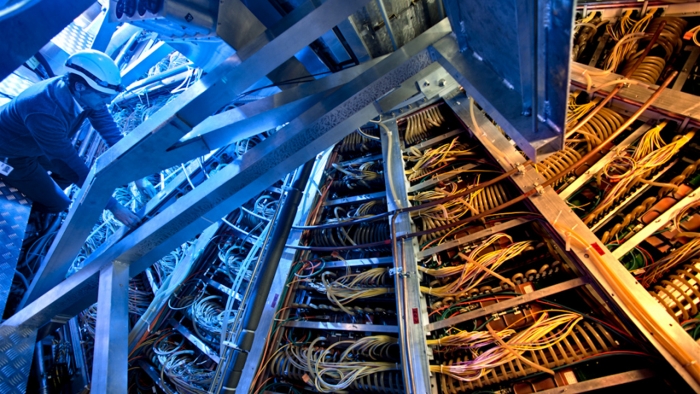
For the last two years, the Large Hadron Collider at CERN has been quietly slumbering while engineers and technicians prime it for the next run of data-taking in the summer of 2015.
But this has been anything but a break for researchers from the LHC experiments.
“Two years seems like a long time, but it goes by really fast,” says Michael Williams, a researcher on the LHCb experiment and assistant professor of physics at the Massachusetts Institute of Technology. “I think now it’s becoming a reality that running is coming soon, and it’s exciting.”
One of the biggest tasks the collaborations are confronting right now is calibrating all the individual components so that their timing is completely synchronized. This synchronization of the components—called “the clock”—allows physicists to reconstruct the flights of particles through the different parts of the detector to form a picture of the entire collision event.
“The clock is the foundation on which everything stands. It’s the heartbeat of the detector,” says UCLA physicist and CMS run coordinator Greg Rakness. “If the clock isn’t working, then the data makes no sense.”
The four largest LHC detectors—called ALICE, ATLAS, CMS and LHCb—each consist of dozens of smaller subdetectors, which in turn are supported by myriads of electronics and supporting subsystems. A huge challenge is ensuring that all of the subdetectors, electronics and supporting software are functioning as one single unit.
“We have 18 different detectors that make up ALICE, and we have several different detection techniques,” says Federico Ronchetti, a scientist associated with CERN and Italian laboratory INFN who serves as the ALICE experiment 2015 run coordinator. "You have to combine the different pieces of information to produce an event. This is an integration, one of the most critical parts of the overall detector commissioning."
As Rakness says: “In the end, it’s one detector.”
In addition to being in time with themselves, the LHC detectors must be in time with the LHC. During this next run, high-energy bunches of protons accelerated inside the LHC will collide every 25 nanoseconds. If a detector’s timing is out of sync with the accelerator, scientists will have no way of accurately reconstructing the particle collisions.
If the detector were out of sync with the LHC, it would mistakenly show large chunks of energy suddenly going missing—just what physicists expect would happen if a rarely interacting particle, such as a dark matter particle, passed through the detector.
“What a better way to create a fake ‘new physics’ signal than if half the detector is out of sync?” Rakness says. “You’d have new physics all the time!”
Even though the task is daunting, the LHC researchers charged with commissioning the detectors are confident that they and their detectors will be ready for the accelerator's second run in early 2015.
“We understand our detector much better now,” says Kendall Reeves, a researcher for the University of Texas, Dallas, who works on the ATLAS experiment. “We have the experience from Run 1 to help out—and having that experience is invaluable. We are in a much better position now then we were at the beginning of Run 1.”
“Nothing is too complicated,” Rakness says. “In the end, this whole complicated chain breaks down to a step-by-step process. And then it ticks.”

 Frascati Scienza
 Buco Nero
 Io Non Faccio Niente
 Tommaso Dorigo
 Giovanni Mazzitelli
 Barbara Gallavotti
 Keplero Blog
 Research Gate