
Auger reveals subtlety in cosmic rays
Big lessons from a Tiny Titan
Ancient pigments, modern mystery
The November Revolution
Forty years ago today, two different research groups announced the discovery of the same new particle and redefined how physicists view the universe.
On November 11, 1974, members of the Cornell high-energy physics group could have spent the lulls during their lunch meeting chatting about the aftermath of Nixon’s resignation or the upcoming Big Red hockey season.
But on that particular Monday, the most sensational topic was physics-related. One of the researchers in the audience stood up to report that two labs on opposite sides of the country were about to announce the same thing: the discovery of a new particle that helped bring about the acceptance of the Standard Model of particle physics.
“Nobody at the meeting knew what the hell it was,” says physicist Kenneth Lane of Boston University, a former postdoctoral researcher at Cornell. Lane, among others, would spend the next few years describing the theory and consequences of this new particle.
It isn’t often that a discovery comes along that forces everyone to reevaluate the way the world works. It’s even rarer for two groups to make such a discovery at the same time, using different methods.
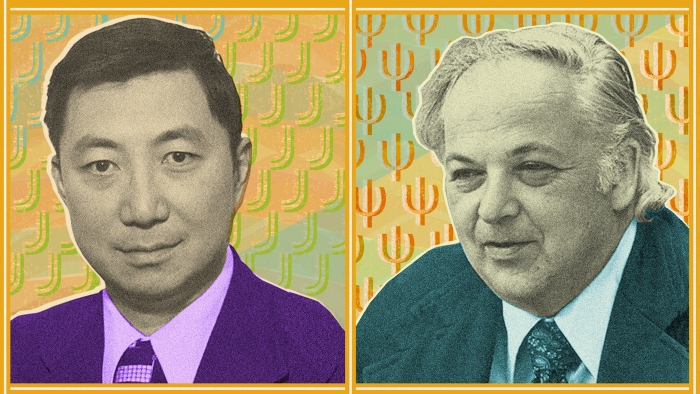
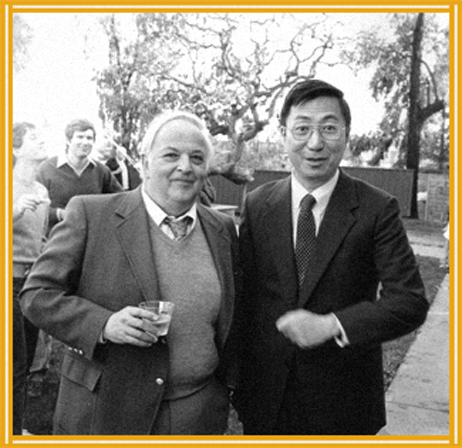
One announcement would come from a research group led by MIT physicist Sam Ting at Brookhaven National Laboratory in New York. The other was to come from a team headed by physicists Burton Richter and Martin Perl at SLAC National Accelerator Laboratory, then called the Stanford Linear Accelerator Center, and William Chinowsky, Gerson Goldhaber and George Trilling of Lawrence Berkeley National Laboratory. Word traveled fast.
“We started getting all sorts of inquiries and congratulations before we even finished writing the paper,” Richter says. “Somebody told a friend, and then a friend told another friend.”
Ting called the new particle the J particle. Richter called it psi. It became known as J/psi, the discovery that sparked the November Revolution.

Independently, the researchers at Brookhaven and SLAC had designed two complementary experiments.
Ting and his team had made the discovery using a proton machine, shooting an intense beam of particles at a fixed target. Ting was interested in how photons, particles of light, turn into heavy photons, particles with mass, and he wanted to know how many of these types of heavy photons existed in nature. So his team—consisting of 13 scientists from MIT with help from researchers at Brookhaven—designed and built a detector that would accept a wide range of heavy photon masses.
“The experiment was quite difficult,” Ting says. “I guess when you’re younger, you’re more courageous.”
In early summer 1974, they started the experiment at a high mass, around 4 to 5 billion electronvolts. They saw nothing. Later, they lowered the mass and soon saw a peak near 3 billion electronvolts that indicated a high production rate of a previously unknown particle.
At SLAC, Richter's group had designed and built a new type of collider, the Stanford Positron Electron Asymmetric Rings (SPEAR), along with a novel detector. His research group used a beam of electrons produced by a linear accelerator and stored the particles in a ring of magnets. Then, they would generate positrons in a linear accelerator and inject them in the other direction. The detector was able to look at everything produced in electron-positron collisions.
The goal was to study scattering and annihilations to known elementary particles, but the researchers saw strange effects in the summer of 1974. They looked at that particular region in more detail, and, in a single day, November 10, discovered a tall, thin energy peak at 3.09 billion electronvolts.
At the time, Ting visited SLAC as part of an advisory committee. The laboratory’s director, Pief Panofsky, asked Richter to meet with him.
“He called and said, ‘It sounds like you guys have found the same thing,’” Richter says.
Both researchers sent their findings to the journal Physical Review Letters. Their papers were published in the same issue. Other labs quickly replicated and confirmed the results.

At the time, the basic pieces of today’s Standard Model of particle physics were still falling into place. Just a decade before, it had resembled the periodic table of the elements, including a wide, unruly collection of different types of particles called hadrons.
Theorists Murray Gell-Mann and George Zweig were the first to propose that all of those different types of hadrons were actually made up of the same building blocks, called quarks. This model included three types of quark: up, down and strange. Other theorists—Sheldon Lee Glashow, James Bjorken, and then also John Iliopoulos and Luciano Maiani—proposed the existence of a fourth quark.
On the day of the J/psi announcement, the Cornell researchers talked about the findings well into the afternoon. One of the professors in the department, Ken Wilson, made a connection between the discovery and a seminar given earlier that fall by Tom Appelquist, a physicist at Harvard University. Appelquist had been working with his colleague David Politzer to describe new particles they called “charmonium,” bound states of a new type of quark and its antiquark.
“Only a few of us were thinking about the idea of a fourth quark,” says Appelquist, now a professor at Yale. “Ken called me right after the discovery and urged me to get our paper out ASAP.”
The J/psi news inspired many other theorists to pick up their chalk as well.
“It was clear from day one that J/psi was a major discovery,” Appelquist says. “It almost completely reoriented the theoretical community. Everyone wanted to think about it.”
Less than two weeks after the initial discovery, Richter’s group conducted a more detailed study of the J/psi and also found psi-prime, a relative of J/psi that showed even more cracks in the three-quark model.
“There was a whole collection of possibilities of what could exist outside the current model, and people were speculating about what that may be,” Richter says. “Our experiment pruned the weeds.”
The findings of the J/psi teams triggered additional searches for unknown elementary particles, exploration that would reveal the final shape of the Standard Model. In 1976, Ting and Richter were awarded the Nobel Prize for the achievement.
In 1977, scientists at Fermilab discovered the fifth quark, the bottom quark. In 1995, they discovered the sixth one, the top.
Today, theorists and experimentalists are still driven to answer questions not explained by the current prevailing model. Does supersymmetry exist? What are dark matter and dark energy? What particles have we yet to discover?
“If the answers are found, it will take us even deeper into what we are supposed to be doing as high-energy physicists,” Lane says. “But it probably isn’t going to be this lightning flash that happens on one Monday afternoon.”
The intersection of art and science
Scientists progress toward plasma acceleration
The rise of astrostatistics
Fabiola Gianotti chosen as next head of CERN
The former head of the ATLAS experiment at the LHC will be the first female leader of Europe's largest particle physics laboratory.
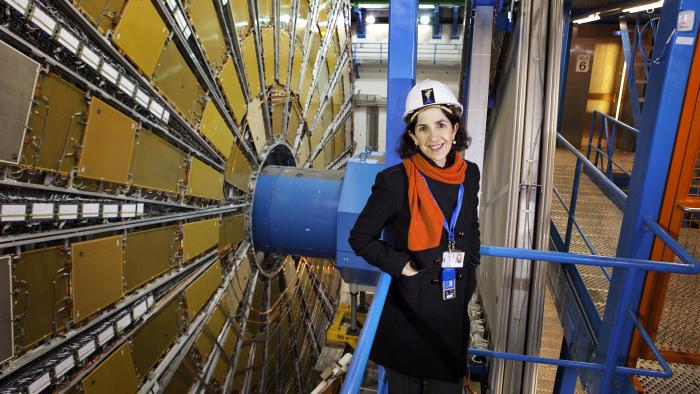
Today the CERN Council announced the selection of Italian physicist Fabiola Gianotti as the organization’s next director-general.
Gianotti was leader of the ATLAS experiment at the Large Hadron Collider from March 2009 to February 2013, covering the period in which the ATLAS and CMS experiments announced the long-awaited discovery of the Higgs boson, recognised by the award of the Nobel Prize to François Englert and Peter Higgs in 2013. She will be the first woman to hold the position of CERN director-general.
“We were extremely impressed with all three candidates put forward by the search committee,” says CERN Council President Agnieszka Zalewska. “It was Dr Gianotti’s vision for CERN’s future as a world-leading accelerator laboratory, coupled with her in-depth knowledge of both CERN and the field of experimental particle physics that led us to this outcome.”
The appointment will be formalised at the December session of Council. Gianotti’s mandate will begin on January 1, 2016, and will run for a period of five years.
“It is a great honor and responsibility for me to be selected as the next CERN director-general following 15 outstanding predecessors,” Gianotti says. “CERN is a center of scientific excellence and a source of pride and inspiration for physicists from all over the world. CERN is also a cradle for technology and innovation, a fount of knowledge and education and a shining, concrete example of worldwide scientific cooperation and peace.
“It is the combination of these four assets that renders CERN so unique, a place that makes better scientists and better people. I will fully engage myself to maintain CERN’s excellence in all its attributes, with the help of everybody, including CERN Council, staff and users from all over the world.”
Gianotti received her PhD in experimental particle physics from the University of Milan in 1989. Since 1994 she has been a research physicist in the Physics Department of CERN. She has worked on several CERN experiments, being involved in detector R&D and construction, software development and data analysis. She is the author or co-author on more than 500 publications in peer-reviewed scientific journals.
Since August 2013 she has been an honorary professor at the University of Edinburgh. She received honorary doctoral degrees from the University of Uppsala, the Ecole Polytechnique Federale de Lausanne, McGill University and Oslo University.
She was included among the “Top 100 most inspirational women” by The Guardian newspaper in the UK in 2011, chosen as a runner-up for Time magazine’s 2012 “Person of the Year,” included among the “Top 100 most powerful women” by Forbes magazine in 2013 and considered among the “Leading global thinkers of 2013” by Foreign Policy magazine.
She is a member of the Italian Academy of Sciences and has served on several other international committees. She was recently selected to be a member of the Scientific Advisory Board of the UN Secretary-General, Ban Ki-moon.
“Fabiola Gianotti is an excellent choice to be my successor,” says current CERN Director General Rolf Heuer. “It has been a pleasure to work with her for many years. I look forward to continuing to work with her through the transition year of 2015 and am confident that CERN will be in very good hands.”
CERN published a version of this article as a press release.

 Frascati Scienza
 Buco Nero
 Io Non Faccio Niente
 Tommaso Dorigo
 Giovanni Mazzitelli
 Barbara Gallavotti
 Keplero Blog
 Research Gate