
Einstein papers go digital
Searching for a dark light
A new experiment at Jefferson Lab is on the hunt for dark photons, hypothetical messengers of an invisible universe.
The matter we know accounts for less than 5 percent of the universe; the rest is filled with invisible dark matter and dark energy. Scientists working on a new experiment to be conducted at Thomas Jefferson National Accelerator Facility in Virginia hope to shed light on some of those cosmic unknowns.
According to certain theories known as hidden-sector models, dark matter is thought to consist of particles that interact with regular matter through gravitation (which is why we know about it) but not through the electromagnetic, strong and weak fundamental forces (which is why it is hard to detect). Such dark matter would interact with regular matter and with itself through yet-to-be-discovered hidden-sector forces. Scientists believe that heavy photons—also called dark photons—might be mediators of such a dark force, just as regular photons are carriers of the electromagnetic force between normal charged particles.
The Heavy Photon Search at Jefferson Lab will hunt for these dark, more massive cousins of light.
“The heavy photon could be the key to a whole rich world with many new dark particles and forces,” says Rouven Essig, a Stony Brook University theoretical physicist who in recent years helped develop the theory for heavy-photon searches.
Although the idea of heavy photons has been around for almost 30 years, it gained new interest just a few years ago when theorists suggested that it could explain why several experiments detected more high-energy positrons—the antimatter partners of electrons—than scientists had expected in the cosmic radiation of space. Data from the PAMELA satellite experiment; the AMS instrument aboard the International Space Station; the LAT experiment of the Fermi Gamma-ray Space Telescope and others have all reported finding an excess of positrons.
“The positron excess could potentially stem from dark matter particles that annihilate each other,” Essig says. “However, the data suggest a new force between dark matter particles, with the heavy photon as its carrier.”
Creating particles of dark light
If heavy photons exist, researchers want to create them in the lab.
Theoretically, a heavy photon can transform into what is known as a virtual photon—a short-lived fluctuation of electromagnetic energy with mass—and vice versa. This should happen only very rarely and for a very short time, but it still means that experiments that produce virtual photons could in principle also generate heavy photons. Producing enormous numbers of virtual photons may create detectable amounts of heavy ones.
At Jefferson Lab’s Continuous Electron Beam Accelerator Facility, CEBAF, scientists will catapult electrons into a tungsten target, which will generate large numbers of virtual photons—and perhaps some heavy photons, too.
“CEBAF provides a very stable, highly intense electron beam that is almost continuous,” says Jefferson Lab’s Stepan Stepanyan, one of three spokespersons for the international HPS collaboration, which includes more than 70 scientists. “It is a unique place for performing this experiment.”
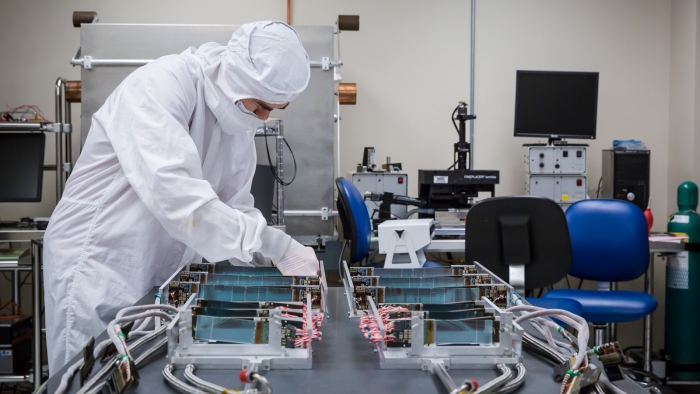
The virtual photons and potential heavy photons produced at CEBAF will go on to decay into pairs of electrons and positrons. A silicon detector placed right behind the target will then track the pairs’ flight paths, and an electromagnetic calorimeter will measure their energies. Researchers will use this information to reconstruct the exact location in which the electron-positron pair was produced and to determine the mass of the original photon that created the pair. Both are important data points for picking the heavy photons out of the bunch.
The photon mass measured in the experiment matters because a heavy photon has a unique mass, whereas virtual photons appear with a broad range of masses. “The heavy photon would reveal itself as a sharp bump on top of a smooth background from the virtual photon decays,” says SLAC National Accelerator Laboratory’s John Jaros, another HPS spokesperson.
The location in which the electron-positron pair was produced also matters because virtual photons decay almost instantaneously within the target, says Timothy Nelson, project lead for the silicon detector, which is being built at SLAC. Heavy photons could decay more slowly, after traveling beyond the target. So photons that decay outside the target can only be heavy ones. The HPS silicon detector’s unique ability to identify outside-of-target decays sets it apart from other experiments currently participating in a worldwide hunt for heavy photons.
The HPS calorimeter, whose construction was led by researchers from the French Institut de Physique Nucléaire, the Italian Istituto Nazionale di Fisica Nucleare and Jefferson Lab, is currently being tested at Jefferson Lab, while scientists at SLAC plan to ship their detector early next year. The experiment is scheduled to begin in the spring of 2015.
Muon versus the volcano
Particles produced by cosmic rays enter volcanoes and live to tell the tale.

Exploring the innards of Mount Vesuvius, the active volcano that once destroyed the ancient town of Pompeii, sounds like a risky endeavor. Unless you’re a muon.
Scientists from institutions in Italy, France, Japan and the United States are using muons, the big brothers of electrons, to study the structure of Mount Vesuvius and other volcanoes in Italy, France, Japan and the Caribbean.
Muons are particles produced in the constant shower of cosmic rays that interact with Earth’s atmosphere. If you hold out your hand, a muon will pass through it about once per second—and it will keep on going. The highest-energy muons can travel more than a mile through solid rock.
“[Studying volcanoes with muons] should help in giving information on how an eruption would develop,” says scientist Giulio Saracino of INFN, Italy’s National Institute for Nuclear Physics, who is a member of the MU-RAY experiment at Mount Vesuvius. Researchers say the measurements could be used in conjunction with other methods to identify areas of greatest risk based on concentrations of lower-density rock susceptible to fracture in an eruption.
In May 2013 MU-RAY scientists took a 1-square-meter prototype of a muon detector to a research station at the foot of Mount Vesuvius for a technical run. The detector is an advanced version of technology used in physics experiments at Fermi National Accelerator Laboratory and Gran Sasso National Laboratory. A handful of researchers, assisted by local high school students in the delivery and setup of equipment, completed the installation in about three workdays.
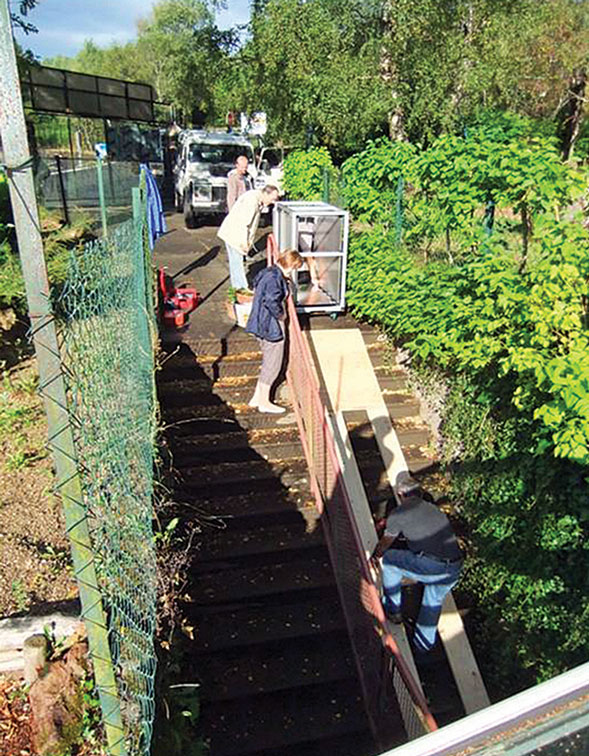
Vesuvius is considered the most dangerous volcano on the planet, owing to its well-documented history of incredibly explosive eruptions and the half a million people living in its high-risk “red zone.”
“If you live in Naples, you feel the presence of Mount Vesuvius as a sleeping giant that could suddenly awaken with tremendous effects,” says MU-RAY scientist Paolo Strolin, also of INFN. “A better understanding of its dangers is worth any challenge.”
Geologists and volcanologists have amassed an array of tools to study aspects of volcanoes: satellites, seismic readers, laser surveying kits and equipment to monitor gases, gravity fluctuations and electrical and electromagnetic signals.
Nobel Laureate Luis Alvarez of the University of California, Berkeley, pioneered the muon radiography technique used on volcanoes in the late 1960s when he used it to look for hidden chambers in the Great Pyramid of Chephren in Egypt. In 2007, scientists used it to image the interior of an active volcano, Japan’s Mount Asama, for the first time.
“This is quite unique compared to other survey methods,” says Valentin Niess of CNRS, the French National Center for Scientific Research, and a member of the TOMUVOL collaboration, a group of about 30 scientists studying the long-dormant Puy de Dôme in France.
Volcano researchers hope using muons will pay off by helping to identify areas prone to particular risk from eruptions, says TOMUVOL scientist Cristina Cârloganu of CNRS: “That could significantly reduce the volcanic hazards.”
Needed: citizen scientists for Higgs hunt
Students join the hunt for exotic new physics
Creating a spark
CERN frees LHC data
LHCb experiment finds new particles
A new LHCb result adds two new composite particles to the quark model.
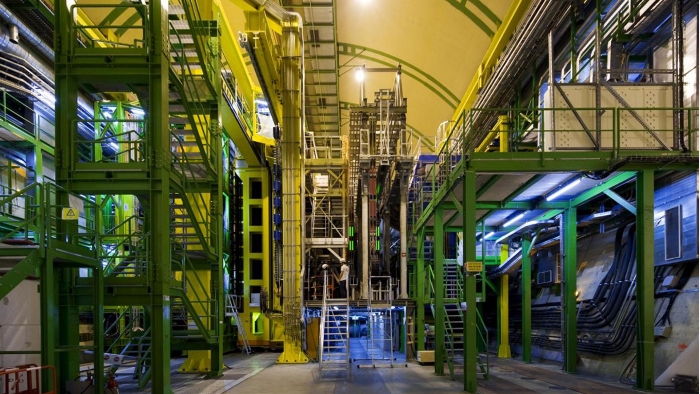
Today the LHCb experiment at CERN’s Large Hadron Collider announced the discovery of two new particles, each consisting of three quarks.
The particles, known as the Xi_b'- and Xi_b*-, were predicted to exist by the quark model but had never been observed. The LHCb collaboration submitted a paper reporting the finding to the journal Physical Review Letters.
Similar to the protons that the LHC accelerates and collides, these two new particles are baryons and made from three quarks bound together by the strong force.
But unlike protons—which are made of two up quarks and one down quark—the new Xi_b particles both contain one beauty quark, one strange quark and one down quark. Because the b quarks are so heavy, these particles are more than six times as massive as the proton.
“We had good reason to believe that we would be able to see at least one of these two predicted particles,” says Steven Blusk, an LHCb researcher and associate professor of physics at Syracuse University. “We were lucky enough to see two. It’s always very exciting to discover something new and unexpected.”
Even though these two new particles contain the same combination of quarks, they have a different configuration of spin—which is a quantum mechanical property that describes a particle’s angular momentum. This difference in spin makes Xi_b*- a little heavier than Xi_b'-.
“Nature was kind and gave us two particles for the price of one," says Matthew Charles of the CNRS's LPNHE laboratory at Paris VI University. "The Xi_b'- is very close in mass to the sum of its decay products’ masses. If it had been just a little lighter, we wouldn't have seen it at all.”
In addition to the masses of these particles, the research team studied their relative production rates, their widths—which is a measurement of how unstable they are—and other details of their decays. The results match up with predictions based on the theory of Quantum Chromodynamics (QCD).
“QCD is a powerful framework that describes the interactions of quarks, but it is difficult to compute properties of particles with high precision,” Blusk says. “If we do see something new, we need to be able to say that is not the result of uncertainties in QCD, but that it is in fact something new and unexpected. That is why we need precision data and precision measurements like these—to refine our models.”
The LHCb detector is one of the four main Large Hadron Collider experiments. It is specially designed to search for new forces of nature by studying the decays of particles containing beauty and charm quarks.
“As you go up in mass, it becomes harder to discover new particles,” Blusk says. “These new measurements really exploit the strengths of the LHCb detector, which has the unique ability to clearly identify hadrons.”
The measurements were made with the data taken at the LHC during 2011-2012. The LHC is currently being prepared—after its first long shutdown—to operate at higher energies and with more intense beams. It is scheduled to restart by spring 2015.
“Whenever you look for something, there is always the possibility that you will instead uncover something completely unexpected,” Blusk says. “Doing these generic searches opens the door for discovering new particles. We are just starting to explore b-baryon sector, and more data from the next run of the LHC will allow us to discover more particles not see before.”

 Frascati Scienza
 Buco Nero
 Io Non Faccio Niente
 Tommaso Dorigo
 Giovanni Mazzitelli
 Barbara Gallavotti
 Keplero Blog
 Research Gate