
How to build your own particle detector
20-ton magnet heads to New York
Scientists complete array on Mexican volcano
An international team of astrophysicists has completed an advanced detector to map the most energetic phenomena in the universe.
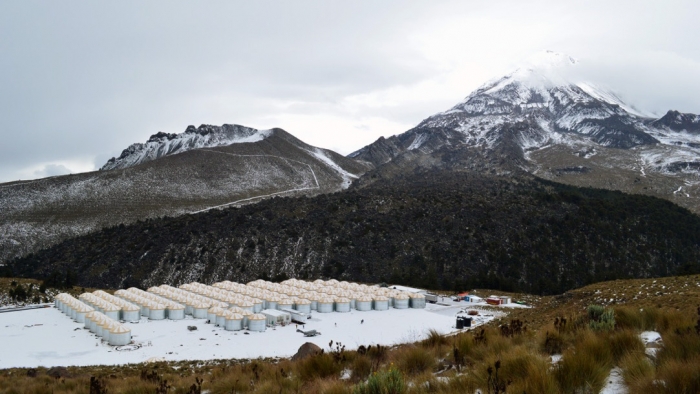
On Thursday, atop Volcán Sierra Negra, on a flat ledge near the highest point in Mexico, technicians filled the last of a collection of 300 cylindrical vats containing millions of gallons of ultrapure water.
Together, the vats serve as the High-Altitude Water Cherenkov (HAWC) Gamma-Ray Observatory, a vast particle detector covering an area larger than 5 acres. Scientists are using it to catch signs of some of the highest-energy astroparticles to reach the Earth.
The vats sit at an altitude of 4100 meters (13,500 feet) on a rocky site within view of the nearby Large Millimeter Telescope Alfonso Serrano. The area remained undeveloped until construction of the LMT, which began in 1997, brought with it the first access road, along with electricity and data lines.
Temperatures at the top of the mountain are usually just cool enough for snow year-round, even though the atmosphere at the bottom of the mountain is warm enough to host palm trees and agave.
“The local atmosphere is part of the detector,” says Alberto Carramiñana, general director of INAOE, the National Institute of Astrophysics, Optics and Electronics.
Scientists at HAWC are working to understand high-energy particles that come from space. High-energy gamma rays come from extreme environments such as supernova explosions, active galactic nuclei and gamma-ray bursts. They’re also associated with high-energy cosmic rays, the origins of which are still unknown.
When incoming gamma rays and cosmic rays from space interact with Earth’s atmosphere, they produce a cascade of particles that shower the Earth. When these high-energy secondary particles reach the vats, they shoot through the water inside faster than particles of light can, producing an optical shock wave called “Cherenkov radiation.” The boom looks like a glowing blue, violet or ultraviolet cone.
The Pierre Auger Cosmic Ray Observatory in western Argentina, in operation since 2004, uses similar surface detector tanks to catch cosmic rays, but its focus is particles at higher energies—up to millions of giga-electronvolts. HAWC observes widely and deeply between the energy range of 100 giga-electronvolts and 100,000 giga-electronvolts.
“HAWC is a unique water Cherenkov observatory, with no actual peer in the world,” Carramiñana says.
Results from HAWC will complement the Fermi Gamma-ray Space Telescope, which observes at lower energy levels, as well as dozens of other tools across the electromagnetic spectrum.
The vats at HAWC are made of corrugated steel, and each one holds a sealed, opaque bladder containing 50,000 gallons of liquid, according to Manuel Odilón de Rosas Sandoval, HAWC tank assembly coordinator. Each tank is 4 meters (13 feet) high and 7.3 meters (24 feet) in diameter and includes four light-reading photomultiplier tubes to detect the Cherenkov radiation.
From its perch, HAWC sees the high-energy spectrum, in which particles have more energy in their motion than in their mass. The device is open to particles from about 15 percent of the sky at a time and, as the Earth rotates, is exposed to about 2/3 of the sky per day.
Combining data from the 1200 sensors, astrophysicists can piece together the precise origins of the particle shower. With tens of thousands of events hitting the vats every second, around a terabyte of data will arrive per day. The device will record half a trillion events per year.
The observatory, which was proposed in 2006 and began construction in 2012, is scheduled to operate for 10 years. “I look forward to the operational lifetime of HAWC,” Carramiñana says. “We are not sure what we will find.”
More than 100 researchers from 30 partner organizations in Mexico and the United States collaborate on HAWC, with two additional associated scientists in Poland and Costa Rica. Prominent American partners include the University of Maryland, NASA’s Goddard Space Flight Center and Los Alamos National Laboratory. Funding comes from the Department of Energy, the National Science Foundation and Mexico’s National Council of Science and Technology.
Dark horse of the dark matter hunt
Dark matter might be made up of a type of particle not many scientists are looking for: the axion.

The ADMX experiment seems to be an exercise in contradictions.
Dark matter, the substance making up 85 percent of all the mass in the universe, is invisible. The goal of ADMX is to detect it by turning it into photons, particles of light. Dark matter was forged in the early universe, under conditions of extreme heat. ADMX, on the other hand, operates in extreme cold. Dark matter comprises most of the mass of a galaxy. To find it, ADMX will use sophisticated devices microscopic in size.
Scientists on ADMX—short for the Axion Dark Matter eXperiment—are searching for hypothetical particles called axions. The axion is a dark matter candidate that is also a bit of a dark horse, even as this esoteric branch of physics goes.
Unlike most dark matter candidate possibilities, axions are very low in mass and interact very weakly with particles of ordinary matter and so are difficult to detect. However, according to theory, axions can turn into photons, which are much more interactive and easier to detect.
In July 2014, the US Department of Energy picked three dark matter experiments as most promising for continued support, including ADMX. The other two—the Large Underground Xenon (LUX) detector and the Cryogenic Dark Matter Search (CDMS)—are both designed to hunt for another dark matter candidate, weakly interacting massive particles, or WIMPs.
With the upgrade funded by the Department of Energy, the ADMX team has added a liquid helium-cooled refrigerator to chill its sensitive detectors, known as superconducting quantum interference devices (SQUIDs). The ADMX experiment uses its powerful magnetic field to turn dark matter axions into microwave photons, which a SQUID can detect when operating at a specific frequency corresponding to the mass that of the axion.
Axions may be as puny as one trillionth of the mass of an electron. Compare that to WIMPs, which are predicted to be hundreds of thousands of times more massive than electrons, making them heavier than protons and neutrons.
The other two DOE-boosted experiments, CDMS and LUX, have plenty of competition around the world in their search for WIMPs. But ADMX stands nearly alone as a large-scale hunter for axions. Leslie Rosenberg, University of Washington physicist and a leader of the ADMX project, sees this as a call to work quickly before others catch up. “People are getting nervous about WIMP dark matter,” he says. So the pressure is on to “do a definitive experiment, and either detect this [axion] or reject the hypothesis.”
The answer to a problem
Axions are hypothetical particles proposed in the late 1970s, originally to fix a problem entirely unrelated to dark matter.
As physicists developed the theory of the strong nuclear force, which binds quarks together inside protons and neutrons, they noticed something wrong. Interactions inside neutrons should have made them electrically asymmetrical, so that they would flip when subjected to an electric field. However, experiments show no such thing, so something must have been missing in the theory.
“If you could just impose the symmetry, maybe that would be an answer, but you cannot,” says retired Stanford University physicist Helen Quinn. Instead, in 1977 she and Roberto Peccei, who was also at Stanford at that time, proposed a simple modification to the mathematics describing the strong force. The Peccei-Quinn model, as it is now known, both removed the neutron asymmetry and instead predicted a new particle: the axion.
Axions are appealing from a conceptual point of view, Rosenberg says. “I learned about axions when I was a graduate student, and it really hit a resonance with me then. Stuff that wasn't making sense suddenly made sense because of the axion.”
A dark matter candidate
Unlike the Higgs boson, axions lie outside the Standard Model of particle physics and are not governed by the same forces. If they exist, axions are transparent to light, don’t interact directly with ordinary matter except in very tenuous ways, and could have been produced in sufficient amounts in the early universe to make up the 85 percent of mass we call dark matter.
“Provided axions exist, they're almost certain to be some fraction of dark matter,” says Oxford University theoretical physicist Joseph Conlon.
“Axions are an explanation that fits in with everything we know about physics and all the ideas of how you might extend physics,” he says. “I think axions are one particle that almost all particle theorists would probably bet rather large amounts of money on that they do exist, even if they are very, very hard to detect.”
Even if, like Conlon, we’re willing to wager that axions exist, it’s another matter to say they exist in such quantities and at the proper mass range to show up in our detectors.
Rosenberg trusts that ADMX will work, and after that, it’s up to nature to reveal its hand: “What I can say is we'll likely have an experiment that at least over a broad mass range will either detect this axion or reject the hypothesis at high confidence.”
Finding any axion detection would be a vindication of the theory developed by Quinn, Peccei and others. Finding many axions could finally solve the dark matter problem and would make this dark horse particle a champion.

Mirror, mirror
After more than six years of grinding and polishing, the first-ever dual-surface mirror for a major telescope is complete.
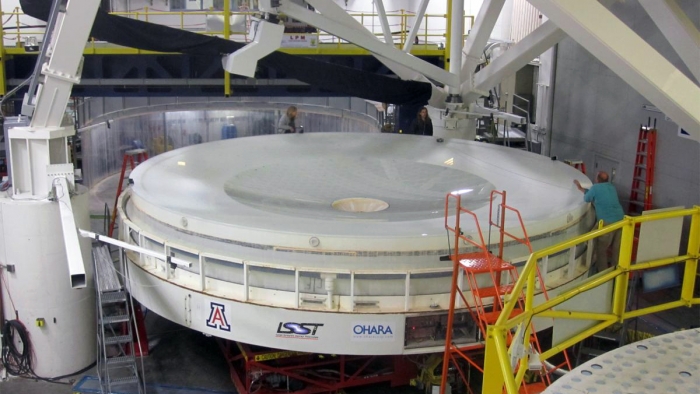
In March 2008, a group of people gathered around a giant, red oven in a six-story workshop space beneath the bleachers of the University of Arizona football stadium.
The oven was about 10 meters wide and 2 meters tall, big enough to live in, really. But that day it was rendered less than hospitable by its extreme internal temperature—2200 degrees Fahrenheit—and its persistent spinning at 35 miles per hour. Also, it was full of 22 tons of molten glass.
This was the “high-fire event,” the day the glass reached its melting point, freeing it to flow into a honeycomb-patterned mold on its way to becoming one of the largest telescope mirrors in the world.
Now, after months of cooling and more than six years of grinding and polishing, the mirror is complete.
On Saturday, a new group gathered in the Steward Observatory Mirror Lab—still located under the bleachers—to admire the finished product.
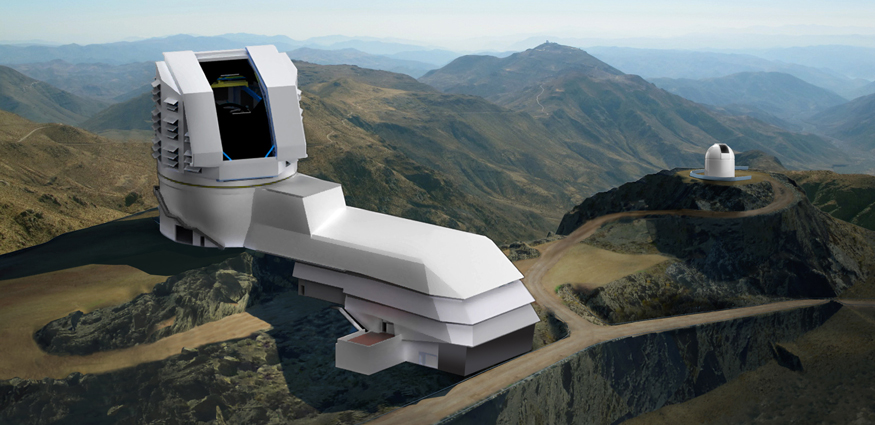
It is the first completed piece of the Large Synoptic Survey Telescope, which will eventually be located on Cerro Pachón, a mountain in Chile. In 2022, the massive mirror will enable LSST scientists to begin the most thorough survey ever of the Southern sky.
Making a movie of the universe
The mirror goes by the name M1M3, and it’s actually two mirrors in one. The outer ring serves as the first mirror, M1, and another, more steeply curved mirror, M3, has been carved out of the center.
LSST will capture and focus images of the night sky by bouncing them through a series of three mirrors. Light will shine onto M1, which will reflect it up to another mirror, the 3.4-meter M2, which will reflect it down to M3, which will reflect it up into the lens of a 3.2-gigapixel camera.
The three-mirror optical system, unique among large telescopes, will allow LSST to take in nearly 10 square degrees of sky with each image—a field of view large enough to fit 40 full moons.
The combined dual-surface mirror, also unique among large telescopes, will allow scientists to align LSST just as quickly as they could a two-mirror telescope. This will help make LSST nimble enough to scan across the entire Southern sky once every three nights.
LSST’s frequent sweeps across the same areas of sky will allow scientists to monitor changes to our galaxy and others in a way that has never before been possible.
They will create time-lapse videos of asteroids, supernovae, variable stars, the effects of dark matter and dark energy—as LSST Director Steve Kahn puts it, “anything that can go bump in the night.” In the end, they hope the survey will lead to a new understanding of our universe.
The multi-year mirror
The LSST project has already met a major milestone with the completion of M1M3, although it only recently received federal funding for its construction start.
In August 2014 the National Science Foundation authorized $473 million for the project. And just this month the US Department of Energy approved $165 million for construction of the LSST camera.
The early development of LSST was supported by the LSST Corporation, a non-profit consortium of 40 universities and other research institutions. Building M1M3 and getting started on M2 have been supported by private funding: $20 million from the Charles and Lisa Simonyi Fund for Arts and Sciences; $10 million from Microsoft founder Bill Gates; and more contributions from Interface Inc. founder and chair Richard Caris; the WM Keck Foundation; Wayne Rosing and Dorothy Largay; Eric and Wendy Schmidt; and Edgar Smith.
For its part, the Tucson-based Research Corporation for Science Advancement contributed $400,000 toward the purchase of the glass.
This was no ordinary glass; it was high-quality glass made by a specialty company in Japan. It came in chunks weighing a couple of pounds each—light enough for technicians kneeling on a ramp suspended over the mold to pick them up and gently nestle them into place.
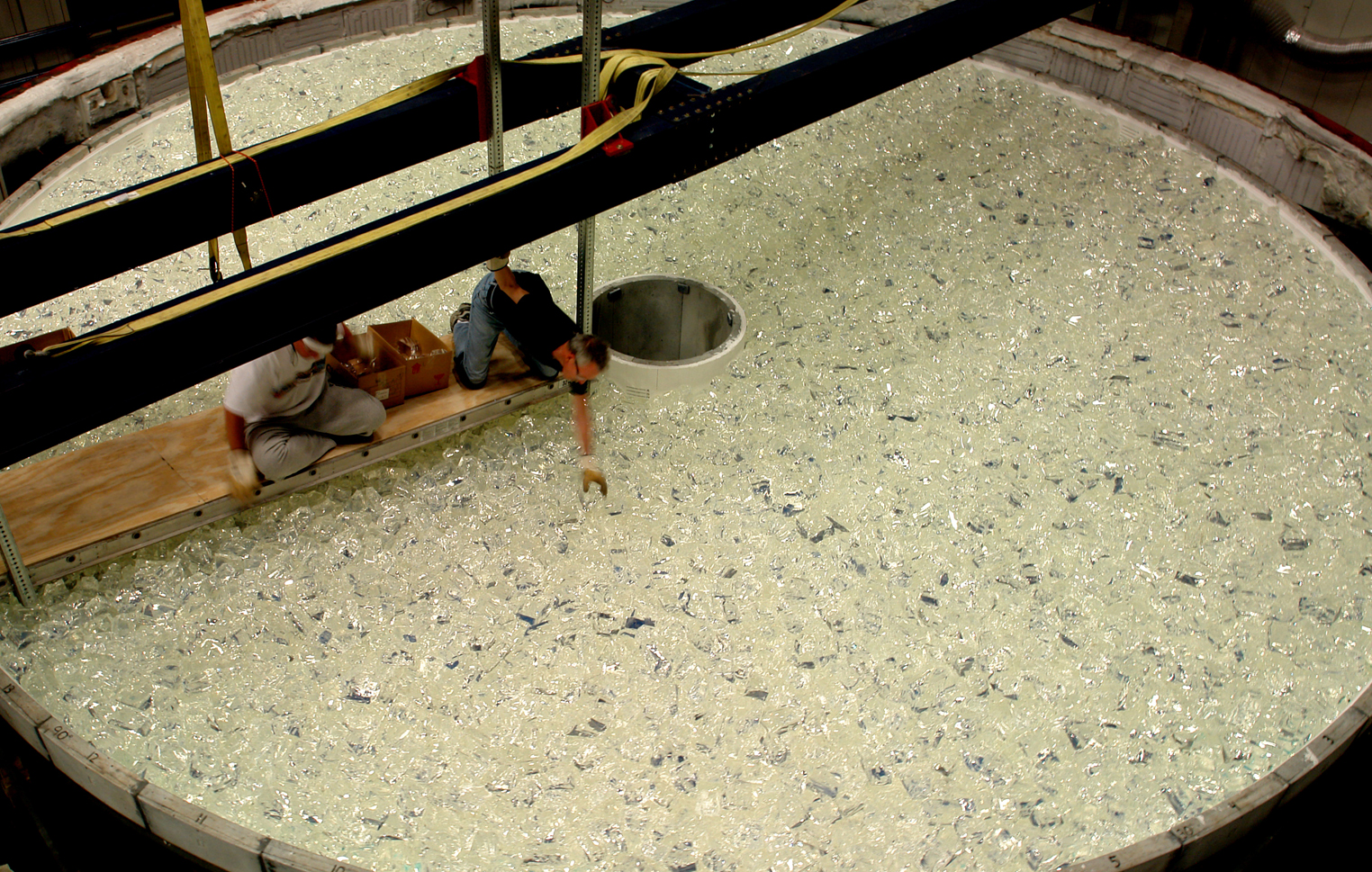
Once the mold was filled, technicians heated it in the oven, which rotated to encourage the glass to travel up the sides and form a shallow bowl shape. The honeycomb design in the mold formed 1600 air pockets in the back of the mirror to reduce its mass and increase temperature-regulating airflow.
To avoid cracking the mirror, technicians cooled it down slowly over 90 days.
Scientist Chuck Claver, who has been a part of LSST since it was no more than an interesting idea, was one of the few people in the room when the oven was finally opened.
“It’s like a cake cover,” he says. “They lift it off with a crane and then there it is… You walk up to this thing and your jaw just drops.”
Claver keeps a picture of himself and a few other scientists standing in the center of the freshly baked M1M3. “Glass is actually pretty strong stuff. You can take your shoes off and walk on it in socks,” he says.
“I hate it when they do that,” says LSST Project Manager Victor Krabbendam.
Once the baking was done, the grinding and polishing began. A special machine shaved and sanded away layers of glass—including several tons from the center to form M2—in a process that removed millimeters and then nanometers at a time.
“The shape of this mirror has to be good to small fractions of the diameter of a human hair across the whole surface,” Krabbendam says.
Soon the mirror began to take on a dull shine, like an ice-skating rink after a Zamboni polish. Today, it’s crystal clear.
After enduring a series of tests, M1M3 will go into storage in a hangar at Tucson International Airport. In a couple of years, scientists will apply a reflective surface and load it on a truck to start its journey to its mountaintop home in Chile.

 Frascati Scienza
 Buco Nero
 Io Non Faccio Niente
 Tommaso Dorigo
 Giovanni Mazzitelli
 Barbara Gallavotti
 Keplero Blog
 Research Gate