
Q&A: Steven Molaro, ‘The Big Bang Theory’
The show’s executive producer explains how a niche particle physics blog wound up in a recent plot.
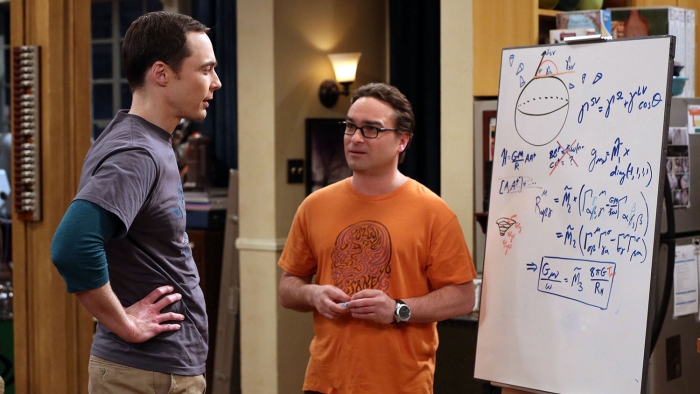
In Thursday’s episode of The Big Bang Theory, two of the show’s main characters, Leonard and Sheldon, publish a paper together. The paper becomes the topic of a post on Quantum Diaries, a blog written by a collection of particle physicists from around the world. To Sheldon’s dismay, it also becomes the target of criticism in the blog’s comments section.
The inclusion in the plot of the niche particle physics blog prompted some questions among the symmetry staff, which The Big Bang Theory’s Executive Producer and Showrunner Steven Molaro was kind enough to answer:
S: How did the writers discover Quantum Diaries?
SM: We wanted to do a story that included an element of Internet haters tearing down Leonard and Sheldon's paper. We asked our science consultant, David Saltzberg, to recommend a few science blogs that might discuss a paper like the one they wrote which also have an active comment section. Quantum Diaries fit the bill.
S: Where do the writers get their ideas about unique situations a physicist might encounter?
SM: Our science consultant is often a big help in that area. Frequently we will have an idea of the type of story or situation we want to write about and we will ask him to provide the science specifics that could work with what we are trying to achieve. Also, we will often come across interesting science stories online and try to figure out how they might affect our characters.
S: Does learning about something from particle physics culture ever inspire a plot idea? Or is the physics usually added to the plot after the basic idea is formed?
SM: The physics can either come first or be added later. Each story is unique. Sometimes we will have a decent idea of the science and take a swing at it in the script and our science consultant will adjust it accordingly to be accurate.
S: What happened in this case?
SM: In the case of this particular episode, we knew we wanted Leonard (who is an experimental physicist) to come up with his own theory and to ask for Sheldon’s blessing and help with it. What Leonard ultimately came up with (the universe acts like the surface of a super-fluid) was then added later by our consultant.
We were also asking questions like, “As an experimental physicist, realistically, how far could Leonard get with the math of this idea before needing the assistance of a brain like Sheldon’s?”
If you feel like participating in some life-imitating-art, you can read a blog post inspired by the episode from Quantum Diaries blogger Ken Bloom of University of Nebraska, Lincoln. Just beware of the comments section!
Tracking glaciers with accelerators
Cosmic inflation remains undiscovered
A new study puts earlier discovery claims into perspective.
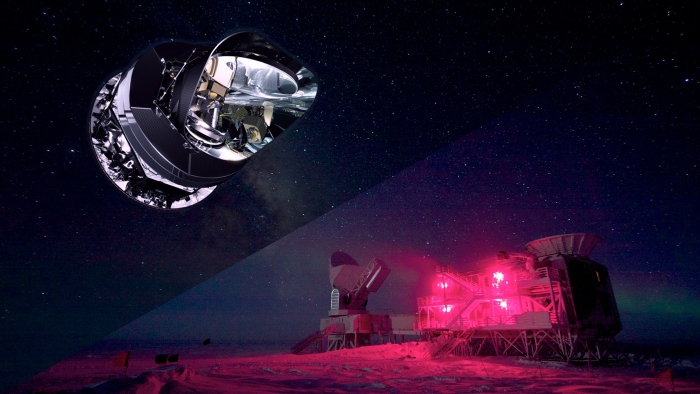
A previous study claiming the discovery of gravitational waves as cosmic inflation’s fingerprint has most likely been over-interpreted, scientists found in a joint analysis between the Planck and BICEP2 experiments.
The new study, whose key results were released today in statements from the European Space Agency and the National Science Foundation, did not find conclusive evidence of cosmic inflation. Cosmic inflation is the exponential growth of the universe within the first few fractions of a second after the big bang almost 14 billion years ago.
“This joint work has shown that [the earlier claims are] no longer robust once the emission from galactic dust is removed,” says Jean-Loup Puget, principal investigator of Planck’s High Frequency Instrument at the Institut d’Astrophysique Spatiale in Orsay, France, in the statements. “So, unfortunately, we have not been able to confirm that the signal is an imprint of cosmic inflation.”
“These results have important consequences for the entire research field,” says Planck project scientist Jan Tauber from ESA. “They will impact how future experiments searching for cosmic inflation will be designed.”
Controversial cosmic pattern
In the 1980s, physicists Alan Guth and Andrei Linde developed the theory of cosmic inflation. This rapid expansion would have left its mark in the form of a pattern in the cosmic microwave background—faint light left behind from just after the big bang. The BICEP2 experiment was designed to search for this pattern.
Last March, BICEP2 scientists announced that they had found the characteristic pattern, and that it was even more pronounced than expected. If this interpretation turned out to be confirmed, it would be direct evidence of cosmic inflation.
However, scientists began to raise the concern that the pattern found by the BICEP2 study could have been caused by something else, such as dust in our own galaxy.
The BICEP2 researchers were aware that dust might give them a false signal. To minimize this possibility, they located their experiment at the South Pole and pointed their telescope at a part of the sky that was considered particularly “clean.” Then, in their analysis, the researchers carefully subtracted possible dust signals based on various theoretical models and earlier dust measurements.
“However, we did not have a precise dust map of the sky at the time,” says Chao-Lin Kuo, a BICEP2 lead scientist at the Kavli Institute for Particle Astrophysics and Cosmology, a joint institute of Stanford University and SLAC National Accelerator Laboratory.
Six months later, the Planck collaboration published the missing map, which showed that at least a significant portion of the BICEP2 signal came from dust.
“The Planck results demonstrated that no place in the sky is free of dust and that you have to deal with it accordingly," Tauber says.
Joining forces
To find out whether the BICEP2 signal was more than just background, the two experiments combined forces.
“We gave our data to the Planck team and vice versa,” says KIPAC’s Jaime Tolan, a member of the BICEP2 analysis crew. “Each team then analyzed the other group’s data using its own analysis tools.”
The Planck satellite, which surveyed the entire sky from 2009 to 2013, had analyzed cosmic light of different colors, or wavelengths. Because the signal components—dust and primordial gravity waves—have a different color spectrum, scientists could compare the measurements at different wavelengths to determine how much of the signal came from dust.
The key result of the new study is a measurement of how likely it is that the BICEP2 pattern is caused by cosmic inflation.
“The amount of gravitational waves can probably be no more than about half the level claimed in our earlier study,” says Clem Pryke, a principal investigator of BICEP2 at the University of Minnesota, in the statements.
The results do not completely rule out that the gravitational wave signal could still be there; however, it is not very likely that most of the BICEP2 signal was caused by it.
Future experiments will be able to use the information from Planck to subtract dust backgrounds from their signal and to adjust their observation strategies.
“BICEP3, for instance, will be using a wavelength that is much less sensitive to dust than the one used by BICEP2,” says KIPAC researcher Walter Ogburn, a member of the BICEP2 team.
Deployed last November, the successor experiment of BICEP2 will start looking for signs of cosmic inflation during the next Antarctic winter.
The BICEP2/Planck collaboration has submitted a paper to the journal Physical Review Letters, and a preprint will be available on the arXiv next week.
Real scientists borrow ‘Big Bang’ costumes
Of symmetries, the strong force and Helen Quinn
Scientist Helen Quinn has had a significant impact on the field of theoretical physics.
Modern theoretical physicists spend much of their time examining the symmetries governing particles and their interactions. Researchers describe these principles mathematically and test them with sophisticated experiments, leading to profound insights about how the universe works. For example, understanding symmetries in nature allowed physicists to predict the flow of electricity through materials and the shape of protons. Spotting imperfect symmetries led to the discovery of the Higgs boson.
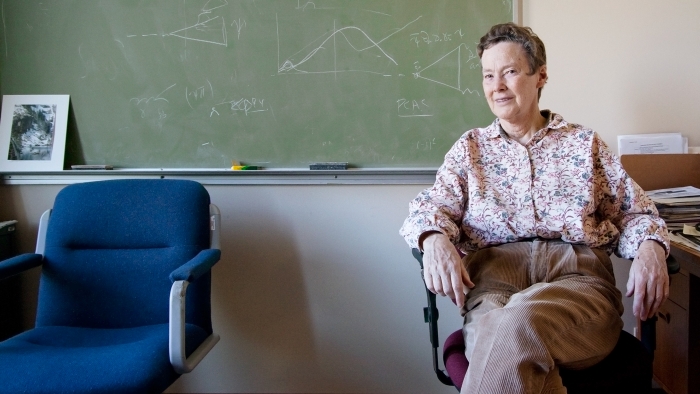
One researcher who has used an understanding of symmetry in nature to make great strides in theoretical physics is Helen Quinn. Over the course of her career, she has helped shape the modern Standard Model of particles and interactions— and outlined some of its limitations. With various collaborators, she has worked to establish the deep mathematical connection between the fundamental forces of nature, pondered solutions to the mysterious asymmetry between matter and antimatter in the cosmos and helped describe properties of the particle known as the charm quark before it was discovered experimentally.
“Helen's contributions to physics are legendary,” says Stanford University professor of physics Eva Silverstein. Silverstein first met Quinn as an undergraduate in 1989, then became her colleague at SLAC in 1997.
Quinn’s best-known paper is one she wrote with fellow theorist Roberto Peccei in 1977. In it, they showed how to solve a major problem with the strong force, which governs the structure of protons and other particles. The theory continues to find application across particle physics. “That's an amazing thing: that an idea you had almost 40 years ago is still alive and well,” says Peccei, now a professor emeritus of physics at the University of California, Los Angeles.
GUTs, glory, and broken symmetries
Quinn was born in Australia in 1943 and emigrated with her family to the United States while she was still a university student. For that reason, she says, “I had a funny path through undergraduate school.”
When she moved to Stanford University, she had already spent two years studying at the University of Melbourne to become a meteorologist with support from the Australian Weather Bureau, and needed to select an academic major that wouldn’t force her to start over again. That program happened to be physics.
With the longest linear accelerator in the world nearing completion next door at what is now called SLAC National Accelerator Laboratory, Stanford was an auspicious place to study particle physics, so Quinn stayed on to finish her PhD. “Really, the beginning was the fact that particle physics was bubbling at that time at Stanford, and that's where I got hooked on it,” she says. She entered the graduate program when women comprised only about 2 percent of all physics students in American PhD programs.
After finishing her PhD, Quinn traveled to Germany for postdoctoral research at the DESY laboratory before returning to the United States. She taught high school in Boston briefly before landing a position at Harvard University. While there, she collaborated with theorist Steven Weinberg and Howard Georgi to work on something known as “grand unified theories,” whimsically nicknamed GUTs. GUT models were attempts to bring together the three forces described by quantum physics: electromagnetism, which holds together atoms, and the weak and strong forces, which govern nuclear structure. (There still is no quantum theory of gravity, the fourth fundamental force.)
“Her paper with Howard Georgi and Steve Weinberg on grand unified theories was the first paper that made sense of grand unified theories,” Peccei says.
Quinn returned to SLAC during a leave of absence from Harvard, where she connected with Peccei. The two of them had frequent conversations with Weinberg and Gerard ’t Hooft, both of whom were visiting SLAC at that time. (Both Weinberg and ’t Hooft later won Nobel Prizes for their work on symmetries in particle physics.)
At that time, many theorists were engaged in understanding the strong force, which governs the structure of particles such as protons, using a theory called quantum chromodynamics, or QCD. (The name “chromodynamics” refers to the “color charge” of quarks, which is analogous to electric charge.)
The problem: QCD predicted some results at odds with experiment, including an electrical property of neutrons.
Quinn and Peccei realized that they could make that problem go away if one type of quark had no mass. While that was at odds with reality, it hadn’t always been so, Quinn says: “That led me to think, well, in the very early universe when it's hot …quarks are massless.”
By adding a new symmetry once quarks acquired their masses from the Higgs field, they could resolve the problem with QCD. As soon as their paper came out, Weinberg realized the theory also made a prediction that Quinn and Peccei had not noticed: the axion, which might comprise some or all of the mysterious dark matter binding galaxies together. (Independently, Frank Wilczek also found the axion implicit in the Peccei-Quinn theory.) Quinn laughs now over how obvious she says it seems in retrospect.
Experiments and education
After her collaboration with Peccei, Quinn worked extensively with experimentalists and other theorists at SLAC to understand the interactions involving the bottom quark. Studying particles containing bottom quarks is one of the best ways to investigate the symmetries built into QCD, which in turn may offer clues as to why there’s a lot more matter than antimatter in the cosmos.
Along the way, Quinn was elected as member of the National Academy of Sciences, and has received a number of prestigious prizes, including the J.J. Sakurai Prize for theoretical physics and the Dirac Medal from the International Center for Theoretical Physics. She also served as president of the American Physical Society, the premiere professional organization for physicists in the United States.
Since retiring in 2010, Quinn has turned her attention full-time to one of her long-time passions: science education at the kindergarten through high-school level. As part of the board on science education at the National Academy of Sciences, she headed the committee that produced the document “A Framework for K-12 Science Education” in 2011.
“The overarching goal is that most students should have the experience of learning and understanding, not just a bunch of disconnected facts,” she says.
Instead of enduring perpetual tests as required under current policy, she wants students to focus on learning “the way science works: how to think about problems as scientists do and analyze data and evidence and draw conclusions based on evidence.” Peccei calls her “unique among very well-known physicists” for this later work.
“She's devoted a tremendous amount of time to physics education, and has been really a champion of that at a national level,” he says.
On top of that, the Peccei-Quinn model remains a powerful tool for theorists and “a good candidate to solve some of the outstanding problems in particle physics and cosmology,” Silverstein says. Along with dark matter, these include Silverstein’s own research in string theory and early universe inflation.
As with her efforts on behalf of education, the impact of Quinn’s physics research is in how it lays the foundation for others to build on. There’s a certain symmetry in that.
Superconducting electromagnets of the LHC
You won't find these magnets in your kitchen.
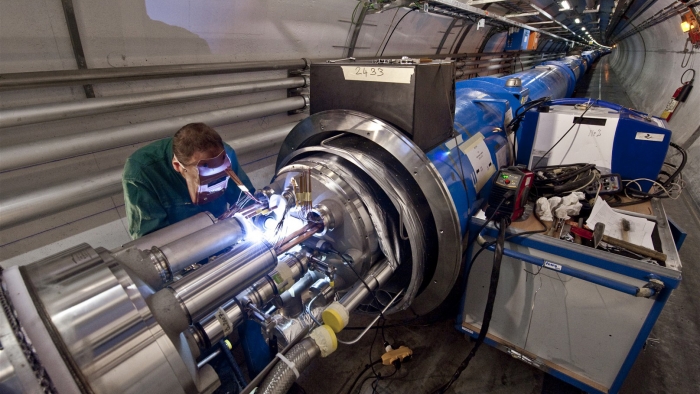
Magnets are something most of us are familiar with, but you may not know that magnets are an integral part of almost all modern particle accelerators. These magnets aren’t the same as the one that held your art to your parent’s refrigerator when you were a kid. Although they have a north and south pole just as your fridge magnets do, accelerator magnets require quite a bit of engineering.
When an electrically charged particle such as a proton moves through a constant magnetic field, it moves in a circular path. The size of the circle depends on both the strength of the magnets and the energy of the beam. Increase the energy, and the ring gets bigger; increase the strength of the magnets, the ring gets smaller.
The Large Hadron Collider is an accelerator, a crucial word that reminds us that we use it to increase the energy of the beam particles. If the strength of the magnets remained the same, then as we increased the beam energy, the size of the ring would similarly have to increase. Since the size of the ring necessarily remains the same, we must increase the strength of the magnets as the beam energy is increased. For that reason, particle accelerators employ a special kind of magnet.
When you run an electric current through a wire, it creates a magnetic field; the strength of the magnetic field is proportional to the amount of electric current. Magnets created this way are called electromagnets. By controlling the amount of current, we can make electromagnets of any strength we want. We can even reverse the magnet’s polarity by reversing the direction of the current.
Given the connection between electrical current and magnetic field strength, it is clear that we need huge currents in our accelerator magnets. To accomplish this, we use superconductors, materials that lose their resistance to electric current when they are cooled enough. And “cooled” is an understatement. At 1.9 Kelvin (about 450 degrees Fahrenheit below zero), the centers of the magnets at the LHC are one of the coldest places in the universe—colder than the temperature of space between galaxies.
Given the central role of magnets in modern accelerators, scientists and engineers at Fermilab and CERN are constantly working to make even stronger ones. Although the main LHC magnets can generate a magnetic field about 800,000 times that generated by the Earth, future accelerators will require even more. The technology of electromagnets, first observed in the early 1800s, is a vibrant and crucial part of the laboratories’ futures.
A version of this article was published in Fermilab Today.

 Frascati Scienza
 Buco Nero
 Io Non Faccio Niente
 Tommaso Dorigo
 Giovanni Mazzitelli
 Barbara Gallavotti
 Keplero Blog
 Research Gate