
From the Standard Model to space
Physics in fast-forward
During their first run, experiments at the Large Hadron Collider rediscovered 50 years' worth of physics research in a single month.
In 2010, the brand-spanking-new CMS and ATLAS detectors started taking data for the first time. But the question physicists asked was not, “Where is the Higgs boson?” but rather “Do these things actually work?”
“Each detector is its own prototype,” says UCLA physicist Greg Rakness, run coordinator for the CMS experiment. “We don’t get trial runs with the LHC. As soon as the accelerator fires up, we’re collecting data.”
So LHC physicists searched for a few old friends: previously discovered particles.
“We can’t say we found a new particle unless we find all the old ones first,” says Fermilab senior scientist Dan Green. “Well, you can, but you would be wrong.”
Rediscovering 50 years' worth of particle physics research allowed LHC scientists to calibrate their rookie detectors and appraise their experiments’ reliability.
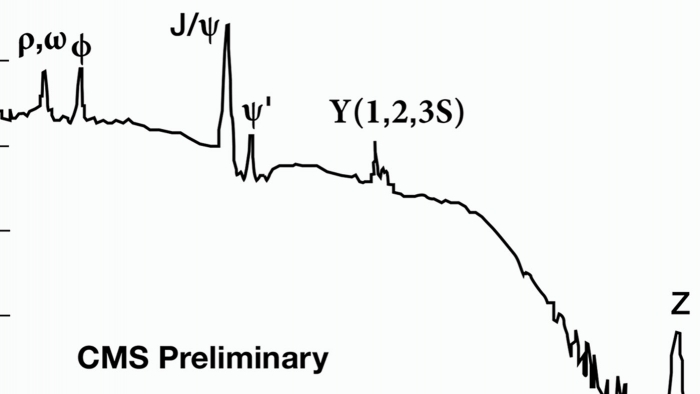
The CMS collaboration produced this graph using data from the first million LHC particle collisions identified as interesting by the experiment's trigger. It represents the instances in which the detector saw a pair of muons.
Muons are heavier versions of electrons. The LHC can produce muons in its particle collisions. It can also produce heavier particles that decay into muon pairs.
On the x-axis of the graph is the combined mass of two muons that appeared simultaneously in the aftermath of a high-energy LHC collision. On the y-axis is the number of times scientists saw each muon+muon mass combination.
On top of a large and raggedy-looking half-parabola, six sharp peaks emerge.
“Each peak represents a parent particle, which was produced during the collision and then spat out two muons during its decay,” Green says.
When muon pairs appear at a particular mass more often than random chance can explain, scientists can deduce that there must some other process tipping the scale. This is how scientists find new particles and processes—by looking for an imbalance in the data and then teasing out the reason why.
Each of the six peaks on this graph can be traced back to a well-known particle that decays to two muons.
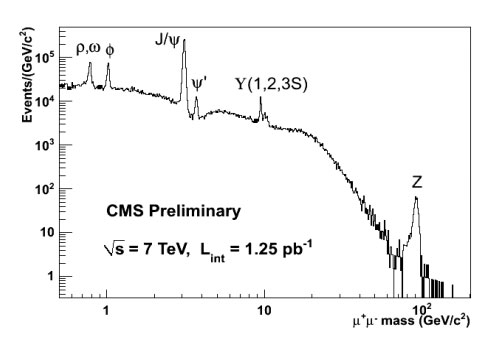
- The rho [ρ] was discovered in 1961.
- The J-psi [J/ Ψ] was discovered in 1974 (and earned a Nobel Prize for experimenters at the Massachusetts Institute of Technology and SLAC National Accelerator Laboratory).
- The upsilon [Y] was discovered in 1982 (and earned a Nobel Prize for experimenters at Fermi National Accelerator Laboratory).
- The Z was discovered in 1983 (and earned a Nobel Prize for experimenters at CERN).
What originally took years of work and multiple experiments to untangle, the CMS and ATLAS collaborations rediscovered after only about a month.
“The LHC is higher energy and produces a lot more data than earlier accelerators,” Green says. “It’s like going from a garden hose to a fire hose. The data comes in amazingly fast.”
But even the LHC has its limitations. On the far-right side, the graph stops looking like a half-parabola and start looking like a series of short, jutting lines.
“It looks chaotic because we just didn’t have enough data for events at higher masses,” Green says. “Eventually, we would expect to see a peak representing the Higgs decaying to two muons popping up at around 125 GeV. But we just hadn’t produced enough high-mass muons to see it yet.”
Over the summer, the CMS and ATLAS detectors will resume taking data—this time with collisions containing 60 percent more energy. Green says he and his colleagues are excited to push the boundaries of this graph to see what lies just out of reach.
Video: LHC experiments prep for restart
Physics for the people
10 unusual detector materials
What’s new for LHC Run II
The Large Hadron Collider gears up for restart.
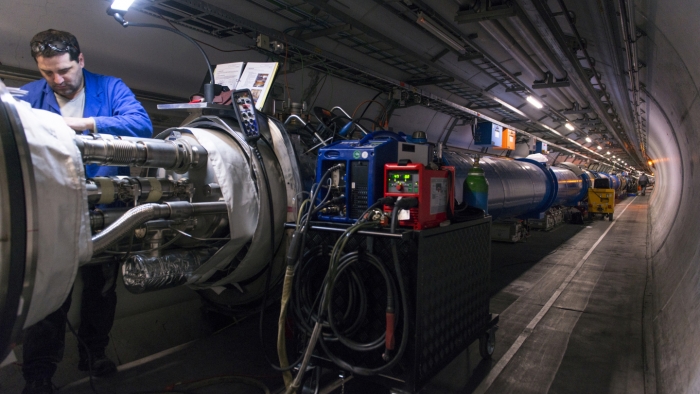
The most powerful particle accelerator on Earth has been asleep for the past two years. Soon it will reawaken for its second run.
Since shutting down in early 2013, the LHC and its detectors have undergone a multitude of upgrades and repairs. When the particle accelerator restarts, it will collide protons at an unprecedented energy: 13 trillion electron volts. Scaled up into our macroscopic world, the force of these proton-proton collisions is roughly equivalent to an apple hitting the moon hard enough to create a crater 6 miles across.
The upgraded capabilities of the ATLAS, CMS, ALICE and LHCb detectors—plus the LHC’s extra boost of power—will give scientists access to a previously inaccessible realm of physics.
To the Higgs boson …and beyond!
In the first run of the LHC, the ATLAS and CMS experiments ended the 50-year hunt for the Higgs boson, which was predicted the Standard Model of particles and forces. Now scientists want to know if the Higgs they found is hiding any surprises.
“All the properties of the Higgs boson are already predicted by the Standard Model, so it’s our job to go out and measure those properties and see if they agree,” says Jay Hauser, a University of California, Los Angeles physicist working on the CMS experiment. “If anything disagrees, it could be a window to new physics.”
Because the Higgs boson loves mass, scientists suspect that it might interact with a range of hidden, massive particles that we cannot see, such as dark matter. If the Higgs boson is dancing with any undiscovered physics, scientists should see evidence of this in the way the Higgs behaves.
But even if the Higgs agrees with all predictions, something about it still seems a bit strange.
“The Higgs mass doesn’t make any sense,” says Beate Heinemann, a physicist from University of California, Berkeley and Lawrence Berkeley National Laboratory and the deputy head of the ATLAS experiment. “It would make much more sense if it was much heavier, which is why we think there must be something that protects the Higgs boson and gives it a lower mass.”
This Higgs bodyguard could be anything from supersymmetric particles to dark matter to extra dimensions.
“We have quite a few puzzles,” Heinemann says. “We think that there should be new physics at this energy scale, but we don’t know what it is yet.”
Bringing it back to the big bang
Scientists on the ALICE experiment have their sights on something else.
In the beginning, the entire universe—all the stars, planets and galaxies—were part of a hot soup of matter called quark gluon plasma. The LHC can recreate those conditions in miniature by colliding beams of heavy atomic nuclei, which it does for four weeks per year. The ALICE detector specializes in investigating the properties of this primordial material.
“The quark gluon plasma is so hot that ordinary protons and neutrons cannot exist in it,” says Peter Jacobs, a Berkeley physicist working on the ALICE experiment. “Quarks and gluons move around in it and interact in new ways that we haven’t seen before. It’s a new form of matter and we want to know how it behaves and what its properties are—like its structure and how it acts at different temperatures.”
In the first run of the LHC, the ALICE experiment was able to characterize many aspects of this weird semi-liquid plasma, such as its viscosity.
“The quarks and gluons interact more than we originally thought, indicating that the quark-qluon plasma is more like a liquid than a gas; indeed, almost as “perfect” a liquid as nature allows,” Jacobs says.
But there is still more to investigate.
“Run I was a discovery run, and we were able to explore many new things and developed a lot of curiosities,” Jacobs says. “During Run II, we will be able to explore these curiosities more deeply and give them quantitative values instead of just being able to describe them qualitatively.”
The case of the missing antimatter
Scientists suspect that the big bang acted like a universe-sized supercollider that brought equal parts of matter and antimatter into existence. But where did all of the antimatter go?
The LHCb experiment is one of the world’s best early-universe detectives and looks for clues in the case of the disappearing antimatter.
“We should have started with equivalent amount of matter and antimatter in the universe,” says Michael Williams, an MIT physicist working on the LHCb experiment. “But now, all we see is matter, and there is no way the Standard Model can explain this huge discrepancy. There must be some other way matter and antimatter behave differently.”
To uncover the root of this huge discrepancy, the LHCb experiment does precision measurements of subatomic processes. LHCb scientists then compare the Standard Model predictions with these experimental observations to see how well they match up.
Thus far, the Standard Model has been hard to break. But Williams thinks that increasing the precision of these measurements could start to show where the cracks are.
“You never know if you're on the cusp of making a discovery,” Williams says. “In Run II, we will measure lots of processes with a much higher precision, and this might reveal something that the Standard Model is not explaining.”
Craft astrophysics
Physics Valentines
In love? Or just the opposite? Express how you feel with physics-inspired Valentines—and anti-Valentines—courtesy of symmetry.

In the spirit of the approaching holiday, the staff of symmetry has created a set of physics-themed Valentines for you to share with the people who give you warmth and happiness. And—because we live in a universe that contains both matter and antimatter—we have also created a set of physics-themed anti-Valentines for you to share with the people who don't. (Mouse over the cards to flip them.)
Is your present (or soon-to-be former) love interested in producing Higgs bosons by crashing together pairs of protons in the Large Hadron Collider? One of these cards will be a smashing success:





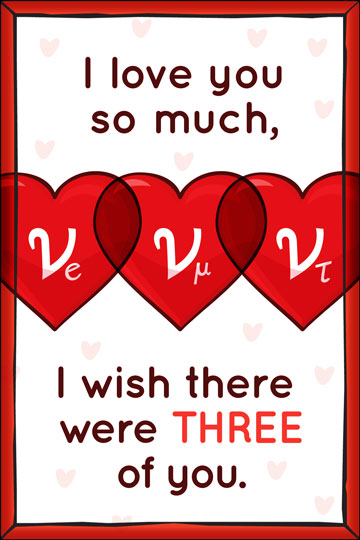
Perhaps your favorite (or least favorite) person is more interested in neutrinos: hard-to-catch particles that come in a trio of different flavors. In that case, this Valentine’s Day greeting might be your best bet:
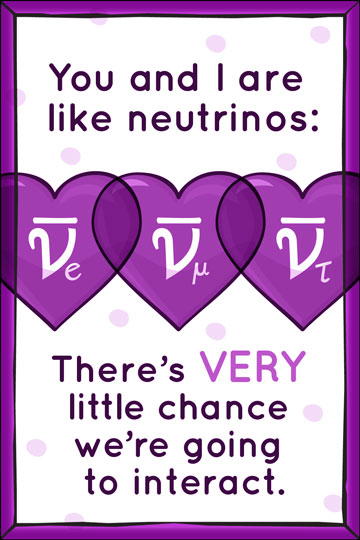
If you seek to rekindle (or extinguish) a romance with someone intrigued by the invisible elements of the cosmos, such as the yet-to-be-discovered dark matter, one of these cards might do the trick:


Or perhaps the object of your desire (or ire) is more of a physics history buff. Just let Nobel laureate Max Planck—the founder of quantum theory and the physicist who calculated Planck’s constant—do the talking:
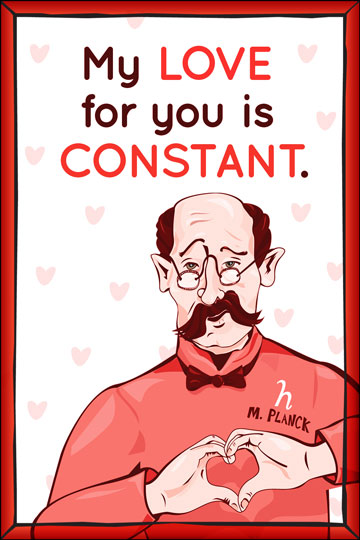
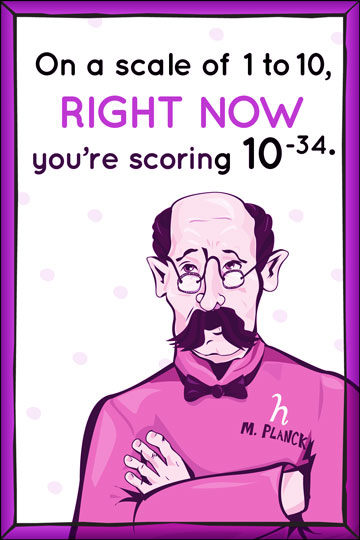
Download the Valentines PDF to print your own cards! (Print double-sided.)

 Frascati Scienza
 Buco Nero
 Io Non Faccio Niente
 Tommaso Dorigo
 Giovanni Mazzitelli
 Barbara Gallavotti
 Keplero Blog
 Research Gate