
Inside the CERN Control Centre
Experiments combine to find mass of Higgs
The CMS and ATLAS experiments at the Large Hadron Collider joined forces to make the most precise measurement of the mass of the Higgs boson yet.
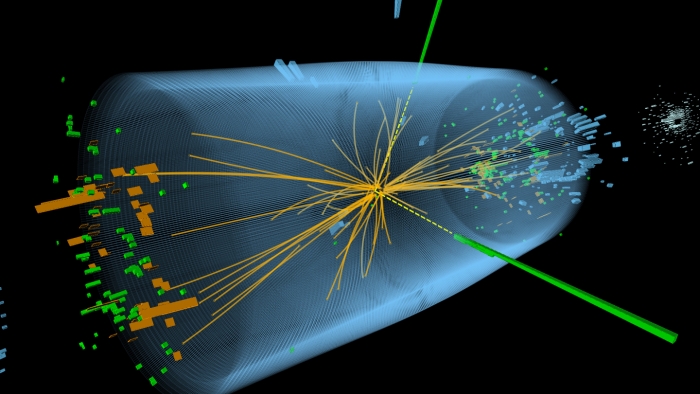
On the dawn of the Large Hadron Collider restart, the CMS and ATLAS collaborations are still gleaning valuable information from the accelerator’s first run. Today, they presented the most precise measurement to date of the Higgs boson’s mass.
“This combined measurement will likely be the most precise measurement of the Higgs boson’s mass for at least one year,” says CMS scientist Marco Pieri of the University of California, San Diego, co-coordinator of the LHC Higgs combination group. “We will need to wait several months to get enough data from Run II to even start performing any similar analyses.”
The mass is the only property of the Higgs boson not predicted by the Standard Model of particle physics—the theoretical framework that describes the interactions of all known particles and forces in the universe.
The mass of subatomic particles is measured in GeV, or giga-electronvolts. (A proton weighs about 1 GeV.) The CMS and ATLAS experiments measured the mass of the Higgs to be 125.09 GeV ± 0.24. This new result narrows in on the Higgs mass with more than 20 percent better precision than any previous measurements.
Experiments at the LHC measure the Higgs by studying the particles into which it decays. This measurement used decays into two photons or four electrons or muons. The scientists used data collected from about 4000 trillion proton-proton collisions.
By precisely pinning down the Higgs mass, scientists can accurately calculate its other properties—such as how often it decays into different types of particles. By comparing these calculations with experimental measurements, physicists can learn more about the Higgs boson and look for deviations from the theory—which could provide a window to new physics.
“This is the first combined publication that will be submitted by the ATLAS and CMS collaborations, and there will be more in the future," says deputy head of the ATLAS experiment Beate Heinemann, a physicist from the University of California, Berkeley, and Lawrence Berkeley National Laboratory.
ATLAS and CMS are the two biggest Large Hadron Collider experiments and designed to measure the properties of particles like the Higgs boson and perform general searches for new physics. Their similar function allows them to cross check and verify experimental results, but it also inspires a friendly competition between the two collaborations.
“It’s good to have competition,” Pieri says. “Competition pushes people to do better. We work faster and more efficiently because we always like to be first and have better results.”
Normally, the two experiments maintain independence from one another to guarantee their results are not biased or influenced by the other. But with these types of precision measurements, working together and performing combined analyses has the benefit of strengthening both experiments’ results.
“CMS and ATLAS use different detector technologies and different detailed analyses to determine the Higgs mass,” says ATLAS spokesperson Dave Charlton of the University of Birmingham. “The measurements made by the experiments are quite consistent, and we have learnt a lot by working together, which stands us in good stead for further combinations.”
It also provided the unique opportunity for the physicists to branch out from their normal working group and learn what life is like on the other experiment.
“I really enjoyed working with the ATLAS collaboration,” Pieri says. “We normally always interact with the same people, so it was a real pleasure to get to know better the scientists working across the building from us.”
With this groundwork for cross-experimental collaboration laid and with the LHC restart on the horizon, physicists from both collaborations look forward to working together to increase their experimental sensitivity. This will enable them not only to make more precise measurements in the future, but also to look beyond the Standard Model into the unknown.
Einstein's most famous equation
Buying into physics
Scientists find rare dwarf satellite galaxy candidates
Revamped LHC to get first taste of protons
Engineers plan to send 40 trillion protons through sections of the Large Hadron Collider during tests this weekend.
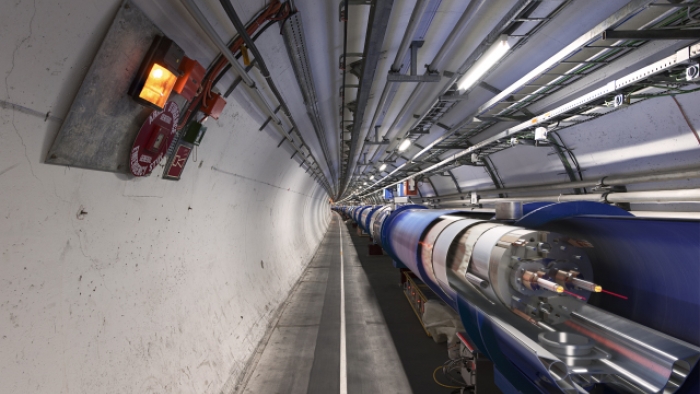
The world’s largest particle accelerator is gearing up for its second run. This weekend engineers will test it by firing protons through parts of the Large Hadron Collider for the first time in two years.
“This is a very important milestone,” says Reyes Alemany Fernandez, one of the two engineers responsible for this weekend’s test. “If this test works, we will be well prepared for the end of March, when we plan to send the proton beam all they way around the LHC.”
During this test, engineers will fire densely packed clumps of 5 billion protons into the LHC in opposite directions. The mass of each proton packet is roughly equivalent to that of a single bacterium cell. Half of the proton packets will go around the pre-accelerator chain, dive into the LHC and race through the ALICE experiment before crashing into a particle roadblock made of tungsten at point 3 (see below). The other half will fly through the LHCb experiment and then smash into a thick graphite block at point 6.
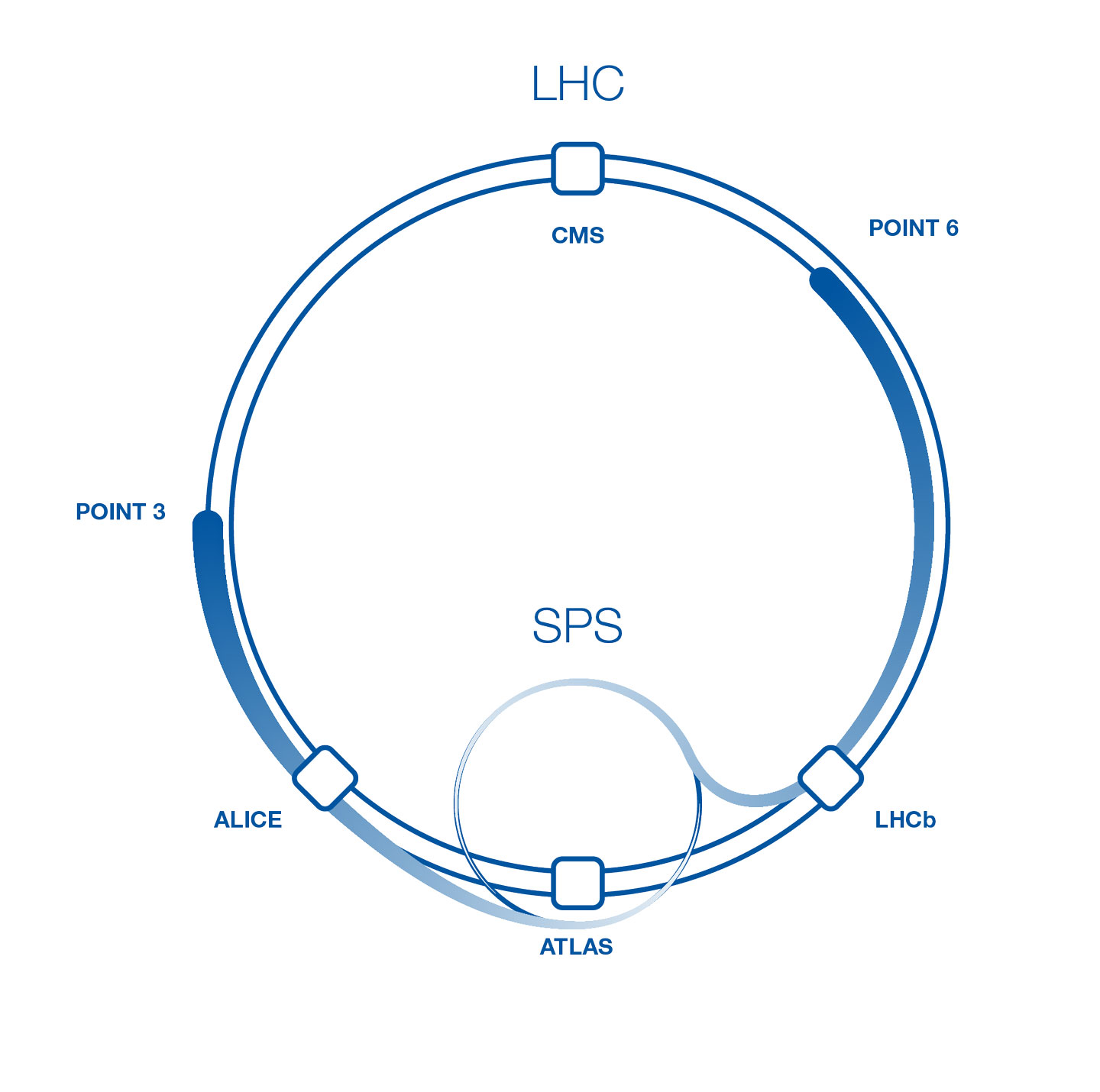
“If all goes well, we’ll be able to inject two bunches of 5 billion protons into the machine every minute for 66 hours,” Alemany Fernandez says.
Even though each proton packet’s journey will last no more than a few microseconds, engineers will be able to gather invaluable information about how this new and improved accelerator will work.
“This is a unique opportunity to test the accelerator control system, the accelerator equipment and beam instrumentation before the restart,” says Verena Kain, the other engineer responsible for the tests. “It is always possible to find issues, like unexpected bottlenecks inside the machine or misaligned elements that make us lose part of the beam. We want to identify and fix any potential problems before the restart.”
The LHCb and ALICE experiments will have the exclusive opportunity to use the proton beam to calibrate their detectors. In addition to sending the proton packets into the LHC, engineers will bombard targets inside the transfer lines that take particles into the LHC to create sprays of particles for LHCb and ALICE to detect.
“It's exciting to see the beam back at LHCb,” says Michael Williams, an MIT physicist working on the experiment. “This will provide us with a nice opportunity to calibrate our global timing alignment and test that some of our subsystems are functioning properly.”
After these sector tests, engineers at CERN will continue to prep the LHC for restart. They plan to power-test the whole accelerator through the entire operational cycle and check the LHC safety systems to ensure that they are ready to handle the highest energy particle beam ever produced on Earth.

 Frascati Scienza
 Buco Nero
 Io Non Faccio Niente
 Tommaso Dorigo
 Giovanni Mazzitelli
 Barbara Gallavotti
 Keplero Blog
 Research Gate