
LHC restart back on track
The Large Hadron Collider has overcome a technical hurdle and could restart as early as next week.
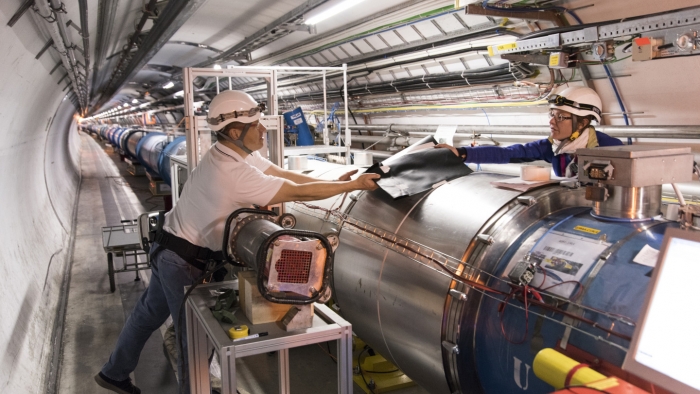
On Monday, teams working on the Large Hadron Collider resolved a problem that had been delaying the restart of the accelerator, according to a statement from CERN.
On March 24, the European physics laboratory announced that a short circuit to ground had occured in one of the connections with an LHC magnet. LHC magnets are superconducting, which means that they can maintain a high electrical current with zero electrical resistance. To be superconducting, the LHC magnets must be chilled to almost minus 460 degrees Fahrenheit.
The short circuit ocurred between a superconducting magnet and its diode. Diodes help protect the LHC's magnets by diverting electrical current into a parallel circuit if the magnets lose their superconductivity.
When teams discovered the problem, all eight sections of the LHC were already cooled to operating temperature. To fix the problem, they knew that they might have to go through a weeks-long process of carefully rewarming and then recooling one section.
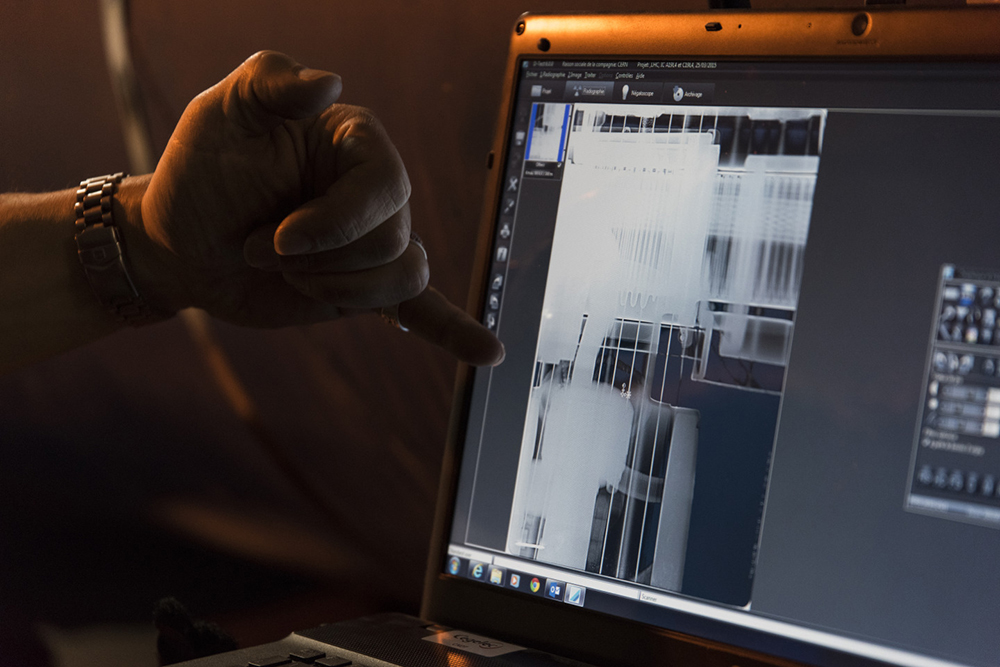
The short circuit was caused by a fragment of metal caught between the magnet and the diode. After locating the fragment and examining it via X-ray, engineers and technicians decided to try to melt it. They could do this in a way similar to blowing a fuse. Importantly, the technique would not require them to warm up the magnets.
They injected almost 400 amps of current into the diode circuit for a few milliseconds. Measurements made today showed the short circuit had disappeared.
Now the teams must conduct further tweaks and tests and restart the final commissioning of the accelerator. The LHC could see beams as early as next week.
Physics Madness: The Fundamental Four
Physics Madness: The Elemental Eight
Better ‘cosmic candles’ to illuminate dark energy
The dawn of DUNE
A powerful planned neutrino experiment gains new members, new leaders and a new name.
The neutrino experiment formerly known as LBNE has transformed. Since January, its collaboration has gained about 50 new member institutions, elected two new spokespersons and chosen a new name: Deep Underground Neutrino Experiment, or DUNE.
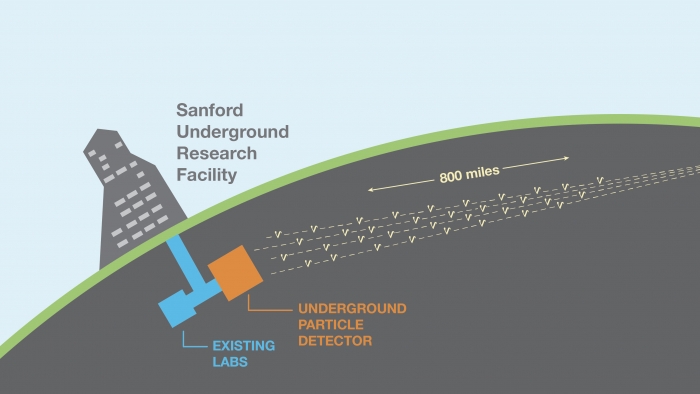
The proposed experiment will be the most powerful tool in the world for studying hard-to-catch particles called neutrinos. It will span 800 miles. It will start with a near detector and an intense beam of neutrinos produced at Fermi National Accelerator Laboratory in Illinois. It will end with a 10-kiloton far detector located underground in a laboratory at the Sanford Underground Research Facility in South Dakota. The distance between the two detectors will allow scientists to study how neutrinos change as they zip at close to the speed of light straight through the Earth.
“This will be the flagship experiment for particle physics hosted in the US,” says Jim Siegrist, associate director of high-energy physics for the US Department of Energy’s Office of Science. “It’s an exciting time for neutrino science and particle physics generally.”
In 2014, the Particle Physics Project Prioritization Panel identified the experiment as a top priority for US particle physics. At the same time, it recommended the collaboration take a few steps back and invite more international participation in the planning process.
Physicist Sergio Bertolucci, director of research and scientific computing at CERN, took the helm of an executive board put together to expand the collaboration and organize the election of new spokespersons.
DUNE now includes scientists from 148 institutions in 23 countries. It will be the first large international project hosted by the US to be jointly overseen by outside agencies.
This month, the collaboration elected two new spokespersons: André Rubbia, a professor of physics at ETH Zurich, and Mark Thomson, a professor of physics at the University of Cambridge. One will serve as spokesperson for two years and the other for three to provide continuity in leadership.
Rubbia got started with neutrino research as a member of the NOMAD experiment at CERN in the ’90s. More recently he was a part of LAGUNA-LBNO, a collaboration that was working toward a long-baseline experiment in Europe. Thomson has a long-term involvement in US-based underground and neutrino physics. He is the DUNE principle investigator for the UK.
Scientists are coming together to study neutrinos, rarely interacting particles that constantly stream through the Earth but are not well understood. They come in three types and oscillate, or change from type to type, as they travel long distances. They have tiny, unexplained masses. Neutrinos could hold clues about how the universe began and why matter greatly outnumbers antimatter, allowing us to exist.
“The science is what drives us,” Rubbia says. “We’re at the point where the next generation of experiments is going to address the mystery of neutrino oscillations. It’s a unique moment.”
Scientists hope to begin installation of the DUNE far detector by 2021. “Everybody involved is pushing hard to see this project happen as soon as possible,” Thomson says.

LHC will not restart this week
Engineers and technicians may need to warm up and recool a section of the accelerator before they can introduce particles.
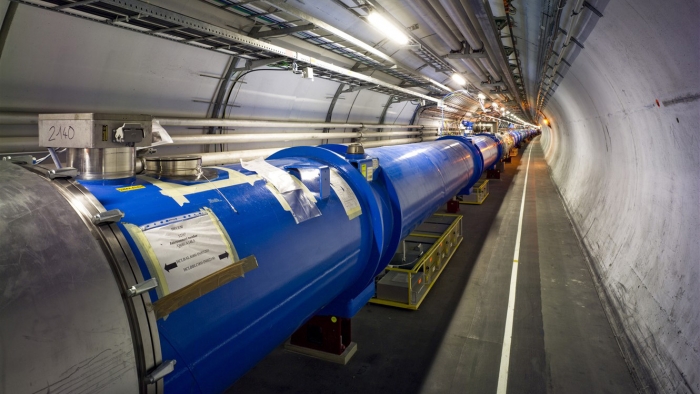
The Large Hadron Collider will not restart this week, according to a statement from CERN.
Engineers and technicians are investigating an intermittent short circuit to ground in one of the machine’s magnet circuits. They identified the problem during a test run on March 21. It is a well understood issue, but one that could take time to resolve since it is in a cold section of the machine. The repair process may require warming up and re-cooling that part of the accelerator.
“Any cryogenic machine is a time amplifier,” says CERN’s Director for Accelerators, Frédérick Bordry, “so what would have taken hours in a warm machine could end up taking us weeks.”
Current indications suggest a delay of between a few days and several weeks. CERN's press office says a revised schedule will be announced as soon as possible.
The other seven of the machine’s eight sectors have successfully been commissioned to the 2015 operating energy of 6.5 trillion electron-volts per beam.
According to the statement, the impact on LHC operation will be minimal: 2015 is a year for fully understanding the performance of the upgraded machine with a view to full-scale physics running in 2016 through 2018.
“All the signs are good for a great Run II,” says CERN Director General Rolf Heuer. “In the grand scheme of things, a few weeks delay in humankind’s quest to understand our universe is little more than the blink of an eye.”

 Frascati Scienza
 Buco Nero
 Io Non Faccio Niente
 Tommaso Dorigo
 Giovanni Mazzitelli
 Barbara Gallavotti
 Keplero Blog
 Research Gate