
DES releases dark matter map
The Dark Energy Survey's detailed maps may help scientists better understand galaxy formation.
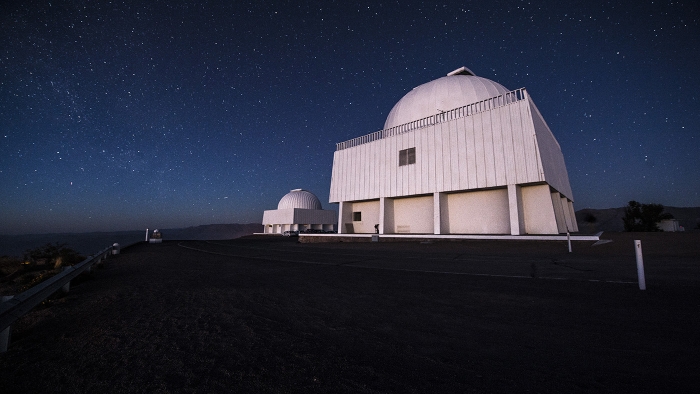
Scientists on the Dark Energy Survey have released the first in a series of dark matter maps of the cosmos. These maps, created with one of the world's most powerful digital cameras, are the largest contiguous maps created at this level of detail and will improve our understanding of dark matter's role in the formation of galaxies. Analysis of the clumpiness of the dark matter in the maps will also allow scientists to probe the nature of the mysterious dark energy, believed to be causing the expansion of the universe to speed up.
The new maps were released today at the April meeting of the American Physical Society in Baltimore, Maryland. They were created using data captured by the Dark Energy Camera, a 570-megapixel imaging device that is the primary instrument for the Dark Energy Survey.
Dark matter, the mysterious substance that makes up roughly a quarter of the universe, is invisible to even the most sensitive astronomical instruments because it does not emit or block light. But its effects can be seen by studying a phenomenon called gravitational lensing – the distortion that occurs when the gravitational pull of dark matter bends light around distant galaxies. Understanding the role of dark matter is part of the research program to quantify the role of dark energy, which is the ultimate goal of the survey.
This analysis was led by Vinu Vikram of Argonne National Laboratory (then at the University of Pennsylvania) and Chihway Chang of ETH Zurich. Vikram, Chang and their collaborators at Penn, ETH Zurich, the University of Portsmouth, the University of Manchester and other DES institutions worked for more than a year to carefully validate the lensing maps.
"We measured the barely perceptible distortions in the shapes of about 2 million galaxies to construct these new maps," Vikram says. "They are a testament not only to the sensitivity of the Dark Energy Camera, but also to the rigorous work by our lensing team to understand its sensitivity so well that we can get exacting results from it."
The camera was constructed and tested at the US Department of Energy's Fermi National Accelerator Laboratory and is now mounted on the 4-meter Victor M. Blanco telescope at the National Optical Astronomy Observatory's Cerro Tololo Inter-American Observatory in Chile. The data were processed at the National Center for Supercomputing Applications at the University of Illinois in Urbana-Champaign.
The dark matter map released today makes use of early DES observations and covers only about three percent of the area of sky DES will document over its five-year mission. The survey has just completed its second year. As scientists expand their search, they will be able to better test current cosmological theories by comparing the amounts of dark and visible matter.
Those theories suggest that, since there is much more dark matter in the universe than visible matter, galaxies will form where large concentrations of dark matter (and hence stronger gravity) are present. So far, the DES analysis backs this up: The maps show large filaments of matter along which visible galaxies and galaxy clusters lie and cosmic voids where very few galaxies reside. Follow-up studies of some of the enormous filaments and voids, and the enormous volume of data, collected throughout the survey will reveal more about this interplay of mass and light.
"Our analysis so far is in line with what the current picture of the universe predicts," Chang says. "Zooming into the maps, we have measured how dark matter envelops galaxies of different types and how together they evolve over cosmic time. We are eager to use the new data coming in to make much stricter tests of theoretical models."
View the Dark Energy Survey analysis.
Fermilab published a version of this article as a press release.
LHC breaks energy record
The Large Hadron Collider has beaten its own world record for accelerating particles.
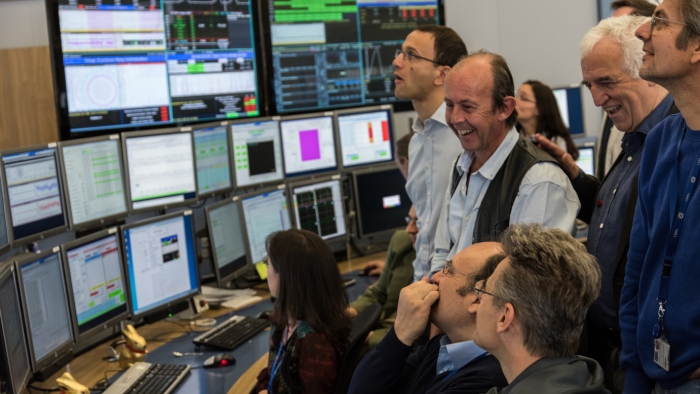
Around midnight last night, engineers at CERN broke a world record when they accelerated a beam of particles to 6.5 trillion electronvolts—60 percent higher than the previous world record of 4 TeV.
On April 5 engineers sent beams of protons all the way around the improved Large Hadron Collider for the first time in more than two years (pictured above). On April 9, they ramped up the power of the LHC and maintained the 6.5 TeV beam for more than 30 minutes before dumping the high-energy protons into a thick graphite block.
“This is an important milestone, but it is really just a stepping stone to generating 13 TeV collisions, which is our real goal,” says Giulia Papotti, a lead engineer at the LHC. “If you want to find something new in particle physics, you have to search where no one’s searched before. That’s the point of going to higher energy.”
Now engineers are focused on preparing the machine to maintain two safe and stable beams—one in each direction—for several consecutive hours.
“During collisions we will run the beam continuously for six to 10 hours, until it is no longer efficient to collide the particles,” Papotti says. “Then we will dump the beam and start the process over again.”
Over the next few weeks, engineers will ensure that all the hardware and software systems work together and will finish defining the machine and beam parameters. Papotti says there might be a few surprises along the way to bringing the world’s largest machine back to life.
“There may be, for example, problems keeping the beam stable, and we also don’t know how many times the magnets will quench—or suddenly lose their superconducting state—while the beam is running,” Papotti says. “It’s experimental work. It’s partly about knowing what we have to do and partly about solving unexpected problems. But everything we do is to make the experiments happy and let them take data safely.”
With the energy record achieved and the first proton-proton collisions on the horizon, physicists are one step closer to exploring a new energy frontier.
“At this new higher energy, the collisions have the potential to create particles that have never been seen before in a laboratory,” says Greg Rakness, a Fermilab applications physicist and the run coordinator for the CMS experiment at the LHC. “The physicists at CMS are incredibly excited about this because discovering new physical phenomena is every physicist's dream. Discovering new physics is what we are here to do.”
LHC restart timeline
February 2015

The Large Hadron Collider is now cooled to nearly its operational temperature.
LHC filled with liquid helium
Read more…

First LHC magnets prepped for restart

LHC experiments prep for restart
Read more…
April 2015

The Large Hadron Collider has circulated the first protons, ending a two-year shutdown.
LHC sees first beams

The Large Hadron Collider accelerated protons to the fastest speed ever attained on Earth.
LHC breaks energy record
Read more…
Seeing dark matter without seeing
Our flat universe
Physics Madness Grand Champion
The Grand Unified Championship
The final contenders collide. Your vote crowns the best piece of physics equipment in Physics Madness!

It’s the ultimate showdown: the Large Hadron Collider vs. the Dark Energy Camera. Everyone's favorite particle collider will take on underdog DECam, which rallied support to take down the famed Hubble Space Telescope in the last round. Will the collider or camera win the top honor in the Grand Unified Championship?
You have until midnight PDT on Sunday, April 5, to vote in this final round. Come back on April 6 to find out who voters named the 2015 Physics Madness Grand Champ!

US scientists celebrate the restart of the LHC
The Large Hadron Collider circulates the first beam of Run II.
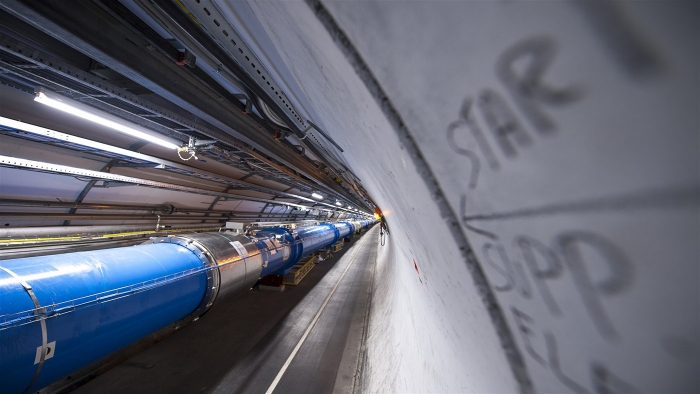
Earlier today, the world’s most powerful particle accelerator began its second act. After two years of upgrades and repairs, proton beams once again circulated around the Large Hadron Collider, located at the CERN laboratory near Geneva, Switzerland.
With the collider back in action, the more than 1700 US scientists who work on LHC experiments are prepared to join thousands of their international colleagues to study the highest-energy particle collisions ever achieved in the laboratory.
These collisions – hundreds of millions of them every second – will lead scientists to new and unexplored realms of physics, and could yield extraordinary insights into the nature of the physical universe.
A highlight of the LHC’s first run, which began in 2009, was the discovery of the Higgs boson, the last in the suite of elementary particles that make up scientists’ best picture of the universe and how it works. The discovery of the Higgs was announced in July 2012 by two experimental collaborations, ATLAS and CMS. Continuing to measure the properties of the Higgs will be a major focus of LHC Run 2.
“The Higgs discovery was one of the most important scientific achievements of our time,” says James Siegrist, the US Department of Energy’s Associate Director of Science for High Energy Physics. “With the LHC operational again, at even higher energies, the possibilities for new discoveries are endless, and the United States will be at the forefront of those discoveries.”
During the LHC’s second run, particles will collide at a staggering 13 teraelectronvolts (TeV), which is 60 percent higher than any accelerator has achieved before. The LHC’s four major particle detectors – ATLAS, CMS, ALICE and LHCb – will collect and analyze data from these collisions, allowing them to probe new areas of research that were previously unattainable.
At 17 miles around, the Large Hadron Collider is one of the largest machines ever built. The United States played a vital role in the construction of the LHC and the huge and intricate detectors for its experiments. Seven US Department of Energy national laboratories joined roughly 90 US universities to build key components of the accelerator, detectors and computing infrastructure, with funding from the DOE Office of Science and the National Science Foundation.
The US contingent was part of an estimated 10,000 people from 113 different countries who helped to design, build, and upgrade the LHC accelerator and its four particle detectors.
“We are on the threshold of an exciting time in particle physics: the LHC will turn on with the highest energy beam ever achieved," says Fleming Crim, National Science Foundation Assistant Director for Mathematical and Physical Sciences. "This energy regime will open the door to new discoveries about our universe that were impossible as recently as two years ago.”
In addition to the scientists pushing toward new discoveries on the four main experiments, the US provides a significant portion of the computing and data analysis – roughly 23 percent for ATLAS and 33 percent for CMS. US scientists on the ALICE experiment developed control and tracking systems for the detector and made significant contributions in software, hardware and computing support. US scientists also helped improve trigger software for data analysis for the LHCb experiment.
US institutions will continue to make important contributions to the LHC and its experiments, even beyond the second run, which is scheduled to continue through the middle of 2018. Universities and national laboratories are developing new accelerator and detector technology for future upgrades of the LHC and its experiments. This ongoing work encourages a strong partnership between science and industry, and drives technological innovation in the United States.
"Operating accelerators for the benefit of the physics community is what CERN’s here for,” says CERN Director General Rolf Heuer. "Today, CERN’s heart beats once more to the rhythm of the LHC.”
Fermilab published a version of this article as a press release.

 Frascati Scienza
 Buco Nero
 Io Non Faccio Niente
 Tommaso Dorigo
 Giovanni Mazzitelli
 Barbara Gallavotti
 Keplero Blog
 Research Gate