
The accelerator in the Louvre
The Accélérateur Grand Louvre d’analyse élémentaire solves ancient mysteries with powerful particle beams.

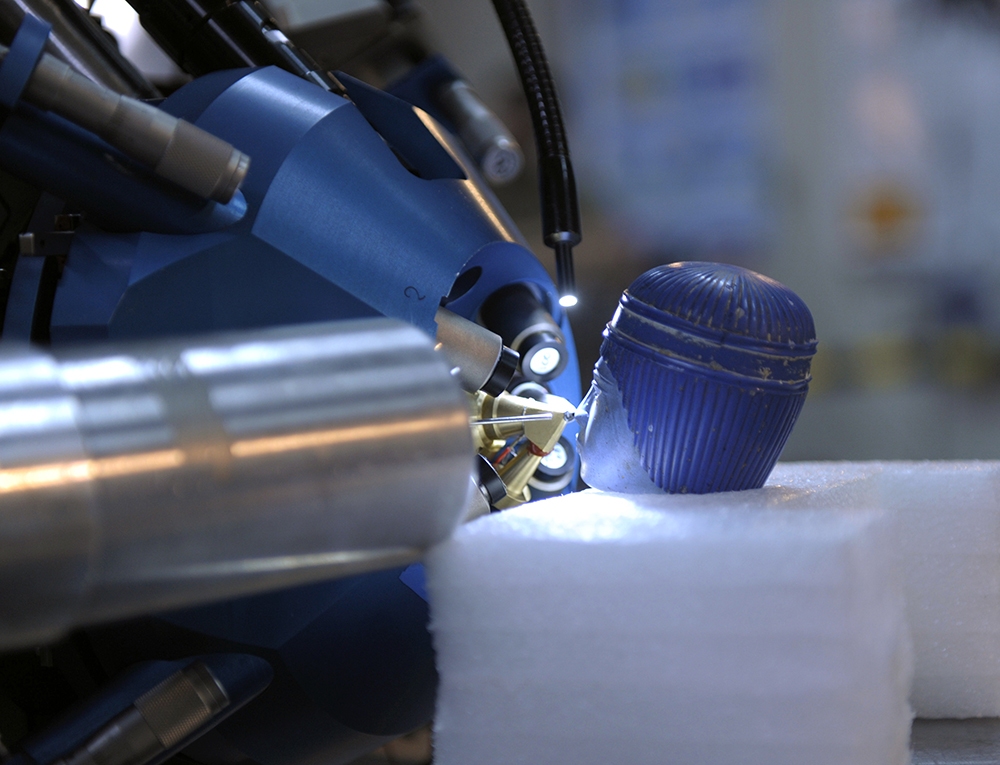
In a basement 15 meters below the towering glass pyramid of the Louvre Museum in Paris sits a piece of work the curators have no plans to display: the museum’s particle accelerator.
This isn’t a Dan Brown novel. The Accélérateur Grand Louvre d’analyse élémentaire is real and has been a part of the museum since 1988.
Researchers use AGLAE’s beams of protons and alpha particles to find out what artifacts are made of and to verify their authenticity. The amounts and combinations of elements an object contains can serve as a fingerprint hinting at where minerals were mined and when an item was made.
Scientists have used AGLAE to check whether a saber scabbard gifted to Napoleon Bonaparte by the French government was actually cast in solid gold (it was) and to identify the minerals in the hauntingly lifelike eyes of a 4500-year-old Egyptian sculpture known as The Seated Scribe (black rock crystal and white magnesium carbonate veined with thin red lines of iron oxide).
“What makes the AGLAE facility unique is that our activities are 100 percent dedicated to cultural heritage,” says Claire Pacheco, who leads the team that operates the machine. It is the only particle accelerator that has been used solely for this field of research.
Pacheco began working with ion-beam analysis at AGLAE while pursuing a doctorate degree in ancient materials at France’s University of Bordeaux. She took over as its lead scientist in 2011 and now operates the particle accelerator with a team of three engineers.
Jean-Claude Dran, a scientist who worked with AGLAE during its early days and served for several years as a scientific advisor, says the study methods pioneered for AGLAE are uniquely suited to art and archaeological artifacts. “These techniques are very powerful, very accurate and very sensitive to trace elements.”
The Seated Scribe
Crucially, they are also non-destructive in most cases, Pacheco says.
“Of course, AGLAE is non-invasive, which is priority No. 1 for cultural heritage” she says. The techniques used at AGLAE include particle-induced X-ray and gamma-ray emission spectrometries, which can identify the slightest traces of elements ranging from lithium to uranium.
Before AGLAE, research facilities typically required samples to be placed in a potentially damaging vacuum for similar materials analysis. Researchers hoping to study pieces too large for a vacuum chamber were out of luck. AGLAE, because its beams work outside the vacuum, allows researchers to study objects of any size and shape.
The physicists and engineers who conduct AGLAE experiments typically work hand-in-hand with curators and art historians.
While AGLAE frequently studies items from the local collection, it has a larger mission to study art and relics from museums all around France. It is also available to outside researchers, who have used it on pieces from museums such as the J. Paul Getty Museum in Los Angeles and the Metropolitan Museum of Art in New York.
AGLAE has been used to study glasses, metals and ceramics. In one case, Pacheco’s team wanted to know the origins of pieces of lusterware, a type of ceramic that takes on a metallic shine when kiln-fired. The technique emerged in ninth-century Mesopotamia and was spread all around the Mediterranean during the Muslim conquests. It had mostly faded by the 17th century, but some potters in Spain still carry on the tradition.
Pacheco’s team used AGLAE to pinpoint the elements in the lusterware, and then they mixed up batches of raw materials from different locations. “What we have tried to do is make a kind of ‘identity card’ for every production center at every period in time,” Pacheco says.
Another, recently published study details how AGLAE was also used to analyze the chemical signature of traces of decorative paint on ivory tusks. Pacheco’s team determined that the tusks were likely painted during the seventh century B.C.
A limitation of the AGLAE particle analysis techniques is that they are not very effective for studying paintings because of a slight risk of damage. But Pacheco says that an upgrade now in progress aims to produce a lower-power beam that, coupled with more sensitive detectors, could solve this problem.
Dubbed NEW AGLAE, the upgraded setup could boost automation to allow the accelerator to operate around the clock—it now operates only during the day.
While public tours are not permitted of AGLAE, Pacheco says there are frequent visits by researchers working in cultural heritage.
“It’s so marvelous,” she says. “We are very, very lucky to work in this environment, to study these objects.”
LHC experiments first to observe rare process
High adventure physics
Three groups of hardy scientists recently met up in Antarctica to launch experiments into the big blue via balloon.
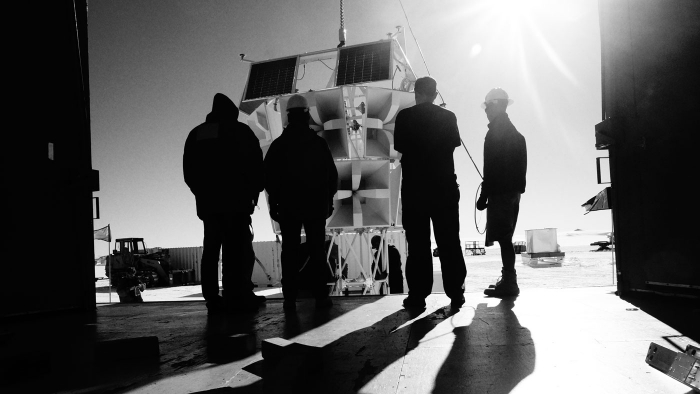
UC Berkeley grad student Carolyn Kierans recently watched her 5000-pound astrophysics experiment ascend 110,000 feet over Antarctica on the end of a helium-filled balloon the size of a football field.
She had been up since 3 a.m. with the team that prepped and transported the telescope known as COSI—Compton Spectrometer and Imager—across the ice shelf on an oversized vehicle called “The Boss.” They waited hours at the launch site in a thick fog for the winds to die down before getting the go-ahead to fill the balloon.
Then the sky opened up, and they were cleared for launch.
“I was with the crew at the launch pad, in the middle of nowhere, when the clouds disappeared and I could finally see the balloon hundreds of feet up,” she recalls. “I had to stop and say, ‘Wait, I’m doing my PhD in physics right now?’”
Kierans was among three groups of hardy physicists who met up at Antarctica’s McMurdo Station last fall to fly their curious-looking instruments during NASA’s most recent Antarctic Scientific Balloon Campaign.

Fully assembled and flight ready, COSI gets some final adjustments from Carolyn Kierans during testing.
For Antarctica’s three summer months, December through February, conditions are right to conduct studies in the upper atmosphere via scientific balloon. The sun never sets during those months, so the balloons are spared nighttime temperatures that would cause significant changes in altitude. And seasonal wind patterns take the balloons on a circular route almost entirely over land.
To allow the balloons enough time to collect data and safely land before conditions change, all launches must take place within a few weeks in December. Near the end of 2014, three teams of physicists arrived at the end of the Earth to try to launch, one after the other, within that small window.
Each team was driven by a different scientific pursuit: COSI set out to capture images of gamma rays for clues to the life and death of stars; ANITA (Antarctic Impulsive Transient Antenna) sought rare signs of ultra-high-energy neutrinos; and SPIDER was probing the cosmic microwave background for evidence of cosmic inflation.
Months of intense preparation, naps on the floor of a barn, competition for launch times during narrow windows of opportunity, and numerous aborted attempts did not dampen spirits. The teams shared meals, supplies, hikes and live music jams with locals at one of two town bars—united by the common pursuit of physics on high.
“The community was like a gigantic family with the same goal of getting those balloons up,” Kierans says.
None could be sure of a successful launch. Nor could they know exactly when or where their balloon would land once it took flight or how they would navigate the icy landscape to retrieve their precious data.
‘The crinkling of Mylar’
Balloon-based physics experiments take many months of preparation. The teams first met up during the summer at the Columbia Scientific Balloon Facility in Palestine, Texas, where they assembled payloads and tested science and flight systems. Then they disassembled their experiments, shipped them in boxes and put them back together at McMurdo starting in October to be launch-ready by early December. Each group had 10 to 20 team members on the continent during peak work efforts.
“We had about eight weeks to get everything back together and perform all the calibrations—it’s an exhausting and stressful period—and a very long time to be away from family,” recalls William Jones, assistant professor of physics at Princeton University and SPIDER lead.
A successful launch depends on the optimal functioning of gear and instruments—and the cooperation of the weather.
First in line was the ANITA experiment. ANITA hunts for the highest energy particles ever observed. Scientists have known about ultra-high-energy neutrinos since the 1960s, but they still don’t know exactly where they come from or how they get their energy.
“Nothing on Earth can produce such particles right now,” says Harm Schoorlemmer, a postdoctoral fellow at the University of Hawaii from the ANITA team. “They are five to seven orders of magnitude higher in energy than particles we can accelerate in machines like the LHC at CERN.”
Neutrinos travel through the universe barely interacting with anything—until they hit the dense Earth. ANITA’s 48 antennas on a 25-foot-tall gondola fly pointed down to capture radio waves in the Antarctic ice—signs of ultra-high-energy neutrino reactions.
“The ice sheet has the advantage that it is transparent for radio waves,” says Christian Miki, University of Hawaii staff scientist and ANITA on-ice lead. “By flying high—about 120,000 feet up—ANITA can capture a diameter of 600 kilometers all at once.”
Numerous ANITA launch attempts were scrubbed due to weather. It took several hours from hangar to launch at the Long Duration Balloon Facility, and Antarctic weather is known for radical shifts within the hour, Miki says.
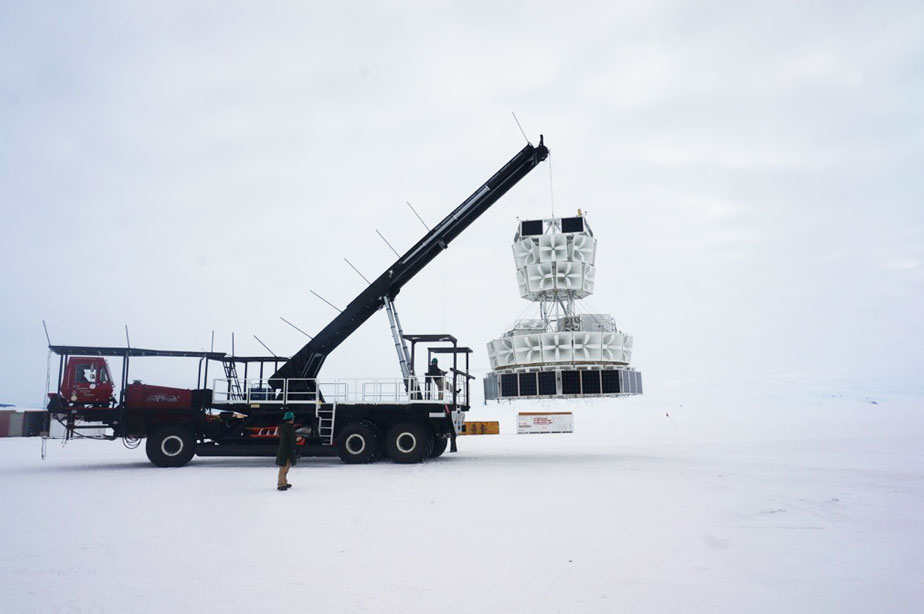
ANITA hangs from the The Boss on its way to the launch pad.
The day before the actual launch, the payload had been brought out of the hanger and checks were being performed when the team noticed an Emperor penguin hanging out on the edge of the launch pad. “We thought this was either good luck—getting a blessing from the Antarctic gods—or bad luck as penguins are flightless birds,” Miki recalls.
Apparently graced, the ANITA team rolled out on December 18 for the real deal. The 4944-pound experiment was loaded onto the The Boss and taken to the launch site. Hours passed as they waited for optimal conditions; all the instruments were checked and double-checked. Finally, they got the go-ahead from NASA.
“It’s hard to grasp the scales involved,” Schoorlemmer says. “The balloon is 800 to 900 feet above The Boss before the line is cut—buildings are about 35 to 40 feet tall. It takes one and a half hours to fill the balloon with helium, and then everything goes quiet. All we could hear is the crinkling of the Mylar and people going ‘Ooh, ooh.’”
Hunting gamma rays
Next up was COSI, a wide-field gamma-ray telescope that studies radiation blasted toward Earth by the most energetic or extreme environments in the universe, such as gamma-ray bursts, pulsars and nuclear decay from supernova remnants. Because gamma rays don’t make it through the Earth’s atmosphere, the telescope must rise above it. Pointed out to space, it can survey 25 percent of the sky at one time for sources of gamma-ray emissions and help detect where these high-energy photons come from. Researchers hope to use its images to learn more about the life and death of stars or the mysterious source of positrons in our galaxy.
Testing gamma ray telescopes like COSI on balloons can help scientists develop technologies that can eventually be used on satellites. The recent COSI launch was the first to use a new ultra-long-duration balloon design in hopes of getting 100 days worth of data.
COSI was launch-ready at the same time as ANITA but waited for it to go up before preparing to do the same. They also experienced several attempts called off due to weather.
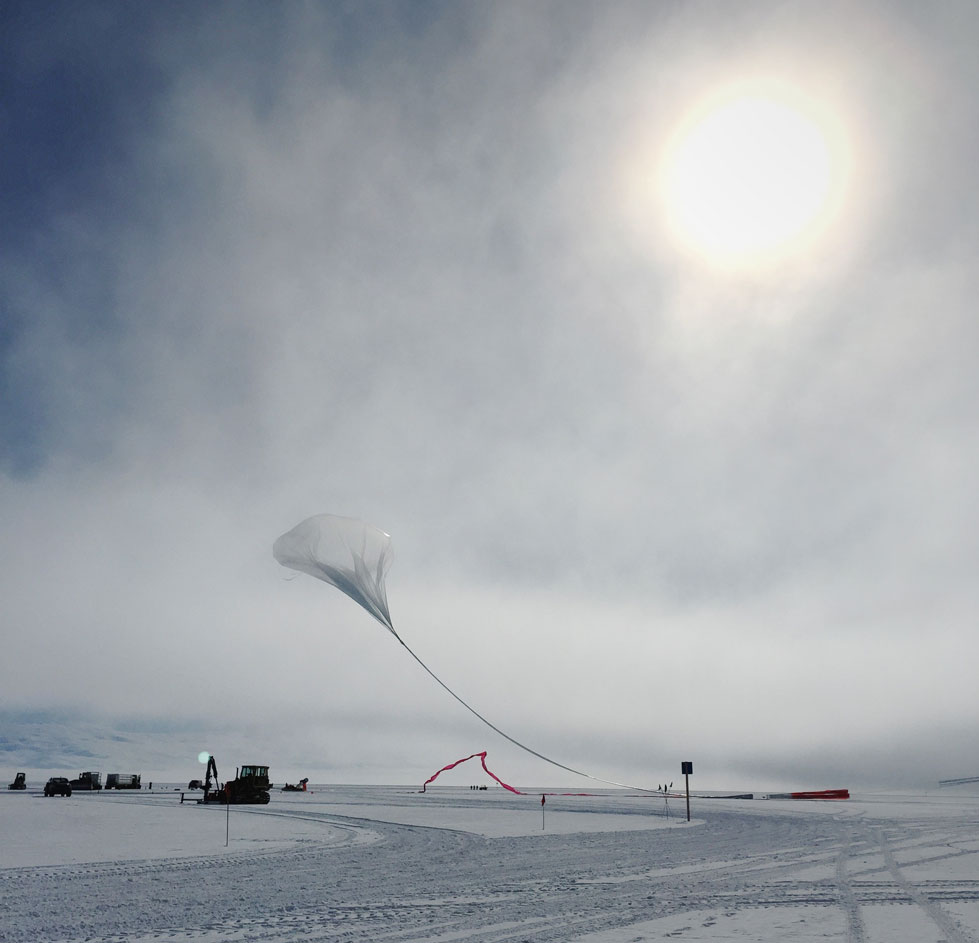
COSI's super pressure balloon is finally released from the spool and takes flight.
“For nine days in a row, we showed up and did all the prep work,” only to abandon the efforts, Kierans says. On one attempt they got as far as laying out the balloon, which was theoretically the point of no return, before the weather turned against them. They somehow managed to put the 1.5-millimeter-thick, 5000-pound balloon back into the box. “It took 10 riggers over an hour of strenuous, delicate work” to put it back, Kierans wrote on her blog.
Finally, on December 27 the silvery white balloon was filled with helium and cut loose, taking COSI up to the dark space above the Earth’s atmosphere.
Jubilation at the successful launch did not last long. Just 40 hours later, a leak in the balloon forced the team to bring it back down. “It will be tough to get science data out of that short flight,” Kierans says. “But we will learn a lot. We made the decision to bring it down where we could get everything back and rebuild.”
COSI was fully recovered by Kierans, who made three trips by twin otter plane to the Polar Plateau just over the Transantarctic Mountains—known as the “great flat white”—to disassemble and load up the instruments.
Every inch of their flesh was covered to prevent frostbite. “This was not what I signed up for when I started out in physics,” she says. “But don’t get me wrong—I love it!”
Big sky, big bang
Last in line was SPIDER, which uses six telescopes designed to create extremely high-fidelity images of the polarization of the sky at certain wavelengths—or “colors”—of light. Scientists will use the images to search for patterns in the cosmic microwave background, the oldest light ever observed. Such patterns could provide evidence for the period of rapid expansion in the early universe known as cosmic inflation.
Rising 118,000 feet above the Earth, the 6500-pound SPIDER is able to observe over six times more sky than Earth-based CMB experiments like BICEP.
“Large sky coverage is the best way to be able to say whether or not the signal appears the same no matter where you look,” explains Jones, SPIDER lead.
With just days remaining in the launch window after the COSI launch, SPIDER took advantage of a good patch of weather on the last possible day—New Year’s Eve in the US.
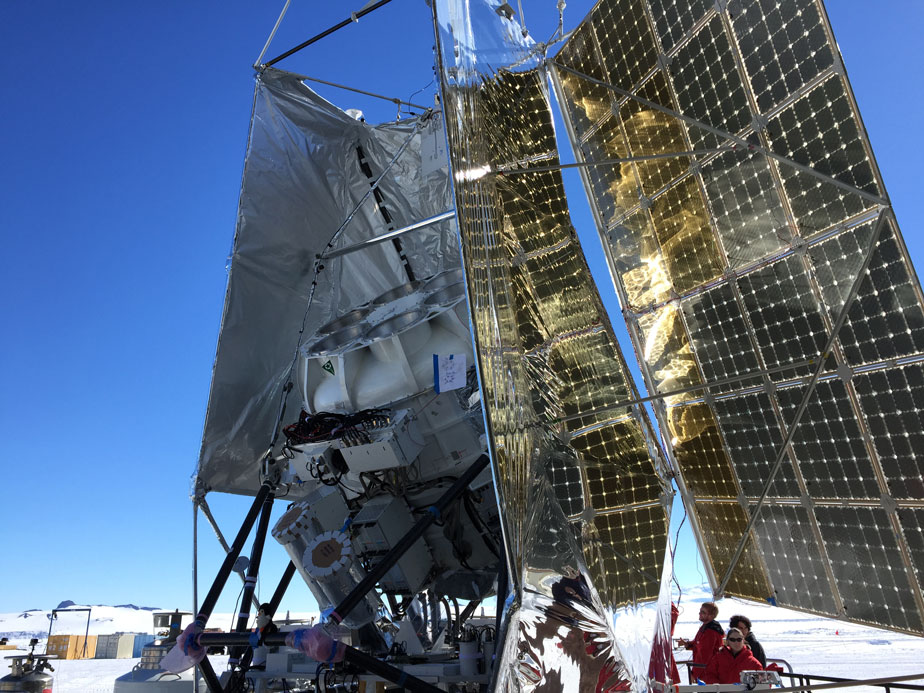
SPIDER reflects its first rays of Antarctic sun with its Mylar sun shields after being rolled out of the bay.
The team started out at 4 a.m. with what seemed like perfect weather, but the winds higher up were too fast and the launch was put on hold for about five hours. Eventually the winds died down and SPIDER was back on track to fly.
“The launch, in particular the final few minutes once the balloon filled and released, represents the culmination of over eight years of work. It is a thrill. At the same time it is truly frightening,” Jones says.
Princeton University graduate student Anne Gambrel left this note on the experiment's “SPIDER on the Ice” blog: “Over the next couple of hours, we all huddled around our computers, and as each subsystem came online, working as designed, we all cheered. By 9 p.m., we were at float altitude and nothing had gone seriously wrong. I went home and slept like a rock as others got all of the details sorted and started taking data on the CMB.”
Around and around she goes
During the first 24 hours after their launch, the ANITA team constantly observed and tuned the instruments from the base. “There were six of us rotating in and out of the controls, while others were sleeping in cardboard boxes next to commanders,” Schoorlemmer says.
The balloons are tracked in their circular flight around the continent, watched carefully for the optimal time to call them back to Earth.
“Once the balloon is launched, you only have historical record to guide your intuition about where it will go,” Jones says. “No one really knows.”
ANITA was up in the air for 22 days and 9 hours and was able to collect about twice the data of the experiment’s last polar flight.
The instruments came down near the Australian Antarctic Station on January 9. “The Australians volunteered their services in recovering the instruments. They will go on a vessel up to Hobart and be picked up by the team in spring,” Miki says.
SPIDER flew for about 17 days, generating approximately 85 GB of data each day, mainly from snapshots taken at about 120 images per second.
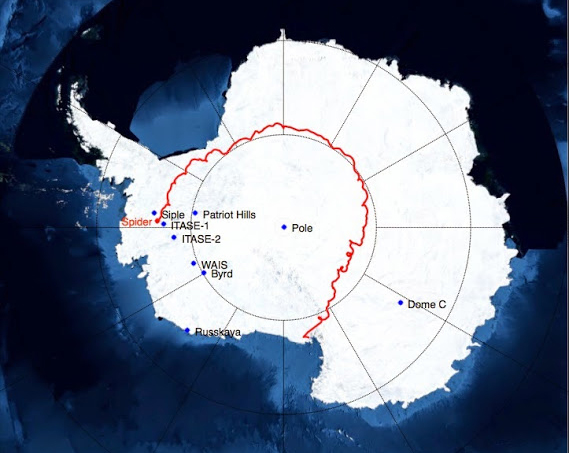
This map shows SPIDER’s flight path and final resting place.
“It’s a daunting analysis task,” Jones says. But his team will eventually combine the data to make an image of the southern hemisphere representing about 10 percent of the full sky.
SPIDER was brought down on January 17, 1500 miles from launch location “before it could go over the water and possibly not come back,” Jones says.
The SPIDER team received assistance from the British Antarctic Survey in recovering the data. “Our experiment weighed roughly 6200 pounds, and we got back about 180,” Jones says. The rest, including the science cameras and most electronics, will remain on the West Antarctic plateau over the southern hemisphere winter.
Other discoveries
Finally arriving in New Zealand post-recovery, a few of the scientists went to the botanical gardens to lie on the grass.
“To be able to walk barefoot in it!” Miki says. “I remember landing at 6 o’clock in the morning, walking out of the airport and actually smelling plants and the rain.”
While the landscape, the science, the instruments, engineering and logistics of such balloon experiments are impressive, the Antarctic researchers were just as taken with the stalwart souls that make them happen.
“The biggest surprise for me was the people,” Kierans says. “The contractors who work at McMurdo devote half the year to be in the harshest of continents, and they are some of the most interesting people I’ve ever met.”
Miki concurs. “You’d be surprised who you might find working as support staff there. There was a lawyer taking a break from law; PhDs driving dozers. Some are just out of college and others are seasoned Antarctic veterans.”
The staff is as friendly as they are professional, Miki says. “They’ll invite ‘beakers’ (what they call scientists) to parties, knitting circles, hikes, etc. With a peak population of over 900 people living in close quarters, getting along is essential.”
Miki also reflected on the strong friendships made: “Maybe it’s the 24 hours of sunlight, living in close proximity, minimal privacy, long work hours, the desolation in which we are all immersed. Maybe it’s just that the ice attracts amazing, brilliant, talented people from around the world.”
For Jones, the commitment such adventure-ready researchers show to their work goes above and beyond.
“We were always supportive, always competitive, sometimes strained, sometimes ecstatic,” he says. “It’s an honor to be able to work with such talented people who are selflessly devoted to learning more about how Nature works at a fundamental level.”
Lonely chairs at CERN
The US and CERN upgrade their relationship
A new agreement paves the way for joint projects between the United States and CERN.

Today in a White House ceremony in Washington, DC, representatives from the US Department of Energy, the US National Science Foundation and the European research center CERN signed a cooperation agreement that lays the groundwork for continued joint research in particle physics and advanced computing both at CERN and in the United States.
The agreement succeeds an existing US-CERN agreement, signed in 1997 and set to expire in 2017, that was the basis for significant US participation in research at the Large Hadron Collider. The new agreement aligns the United States’ and CERN’s long-term strategies for particle physics and provides for “reciprocity,” opening the way for potential CERN participation in US-hosted experiments, including prospective projects focused on neutrinos.
“Today’s agreement not only enables US scientists to continue their vital contribution to the important work at CERN, but it also opens the way to CERN’s participation in experiments hosted in the United States,” says Energy Secretary Ernest Moniz in a press release. “As we’ve seen, international collaboration between the United States and CERN helps provide a foundation for groundbreaking discoveries that push crucial scientific frontiers and expand our understanding of the universe.”
The signing of the new agreement sets the stage for a new level of cooperation. CERN already has established a test facility that is being used to refurbish the 760-ton ICARUS neutrino detector before it is shipped to DOE’s Fermi National Accelerator Laboratory for use in a suite of experiments to search for a new type of neutrino. At the same time, more than 1700 scientists from US institutions are working on the next phase of the LHC experiments.
“I am delighted to sign this agreement,” says CERN Director General Rolf Heuer in the press release. “It allows us to look forward to a fruitful long-term collaboration with the United States, in particular in guiding the Large Hadron Collider to its full potential over many years through a series of planned upgrades. This agreement is also historic since it formalizes CERN’s participation in US-based programs such as prospective future neutrino facilities for the first time.”
Europe and the United States have a rich history of collaboration in particle physics research. In 1954, American physicist Isidor Rabi served as one of the founding members of CERN. Seven years later, Austrian-American physicist Victor Weisskopf became CERN’s director general. On the other side of the Atlantic, physicist Maurice Goldhaber, who received his PhD in England, became director of DOE’s Brookhaven National Laboratory in 1961, and European-born scientists, such as Carlo Rubbia, played significant roles in shaping the experimental program at Fermilab.
Scientists from European institutions have made major contributions toward planning and advancing experiments at Fermilab, SLAC and other DOE national laboratories. In the last two decades, they accounted for up to 50 percent of the researchers working on the Tevatron and BaBar experiments in the US, which led to the discovery of the top quark and the observation of quark mixing in greater detail than ever before. Simultaneously, US scientists played significant roles in the four experiments at CERN’s Large Electron-Positron collider. MIT physicist and Nobel Laureate Sam Ting, for example, led LEP’s L3 experiment.
In the 1990s, CERN invented the technology that would become the World Wide Web, revolutionizing the way in which people share information and do business. European research institutions and three US laboratories—SLAC, Fermilab and MIT—were the first ones to operate Web servers and publish webpages.
Today, the American and European physics communities remain closely intertwined. Scientists and engineers from US institutions are heavily involved in LHC research, representing 20 percent of the ATLAS collaboration and 33 percent of the CMS collaboration. US scientists hold key leadership positions within the several-thousand-physicist collaborations, and they lead many of the physics analyses that study the properties of the Higgs boson and look for hints of new physics. UCSB physicist Joe Incandela, who was the spokesperson of the CMS experiment from 2012 to 2014, presented the collaboration’s results at the press conference that announced the discovery of the Higgs boson.
US institutions also built vital parts of the LHC accelerator, including the focusing magnets that concentrate the high-energy particles into hair-thin beams as they enter the experimental halls and some of the cryogenic systems that keep the superconducting magnets at a frigid 1.7 Kelvin. And US institutions provide approximately a third of the computing power necessary to analyze the LHC data.
“CERN is a place for explorers, in the truest sense of the word,” says NSF Director France A. Córdova in the press release. “The discoveries enabled by this world-class laboratory—insights into the Standard Model, into the fundamental nature of our universe—have yielded answers to some questions and produced new questions.”
Fabiola Gianotti, who will become the director general of CERN in 2016, served on the US Particle Physics Project Prioritization Panel, which in May 2014 outlined the plan for US particle physics research for the next decade. The panel’s top recommendations included the United States’ continued participation in LHC research and upgrades, as well as the establishment of an international, world-class neutrino research facility at Fermilab, culminating in the construction of the Deep Underground Neutrino Experiment. CERN is taking steps to coordinate and support European scientists’ participation in the US-based neutrino research program.
The new agreement between CERN and the US has an initial five-year duration and, unless a change or termination is set in motion, will renew automatically every five years. It will enable American and European scientists to continue to develop technologies, build experiments and seek answers to questions such as: What is dark matter? Why do particles have mass? Are there more Higgs particles? Are neutrinos the key to the dominance of matter over antimatter in our universe?
“Society and the global research community benefit greatly from productive scientific cooperation across borders,” says John P. Holdren, director of the White House Office of Science and Technology Policy, in the press release. “Today’s agreement is a model for the kinds of international scientific collaboration that can enable breakthrough insights and innovations in areas of mutual interest.”

 Frascati Scienza
 Buco Nero
 Io Non Faccio Niente
 Tommaso Dorigo
 Giovanni Mazzitelli
 Barbara Gallavotti
 Keplero Blog
 Research Gate