
The universe at your fingertips
LHC arrives at the next energy frontier
Inside particle detectors: calorimeters
Physicist Jim Pivarski explains how particle detectors tell us about the smallest constituents of matter.
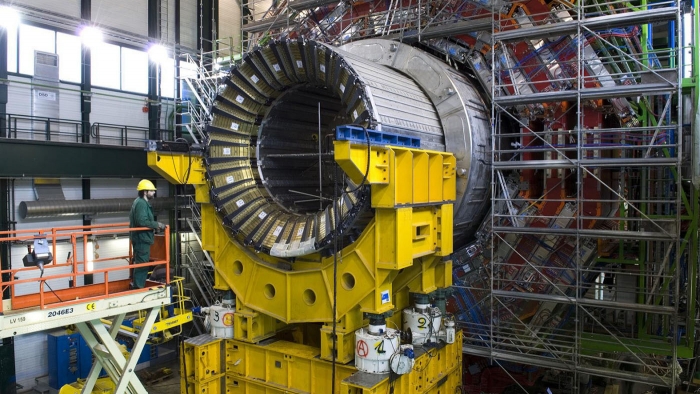
The previous article in this series introduced tracking, a technique that allows physicists to see the trajectories of individual particles. The biggest limitation of tracking is that only charged particles ionize the medium that forms clouds, bubbles, discharges or digital signals. Neutral particles are invisible to any form of tracking.
Calorimetry, which now complements tracking in most particle physics experiments, takes advantage of a curious effect that was first observed in cloud chambers in the 1930s. Occasionally, a single high-energy particle seemed to split into dozens of low-energy particles. These inexplicable events were called “bursts,” “explosions” or “die Stöße.” Physicists initially thought they could only be explained by a radical revision of the prevailing quantum theory.
As it turns out, these events are due to two well-understood processes, iterated ad nauseam. Electrons and positrons recoil from atoms of matter to produce photons, and photons in matter split to form electron-positron pairs. Each of these steps doubles the total number of particles, turning a single high-energy particle into many low-energy particles.
This cascading process is now known as a shower. The cycle of charged particles creating neutral particles and neutral particles creating charged particles can be started by either type, making it sensitive to any particle that interacts with matter, including neutral ones. Although the shower process is messy, the final particle energies should add up to the original particle's energy, providing a way to measure the energy of the initial particle—by destroying it.
Modern calorimeters initiate the shower using a heavy material and then measure the energy using ordinary light sensors. To accurately measure the energy of the final photons, this heavy material should also be transparent. Crystals are a common choice, as are lead-infused glass, liquid argon and liquid xenon.
Not all calorimeters are made in the laboratory. Neutrinos produce electrons in water or ice, which cascade into showers of electrons, positrons and photons. The IceCube experiment uses a cubic kilometer of Antarctic ice to observe neutrinos a hundred times more energetic than the beams in the Large Hadron Collider. Cosmic rays form showers in the Earth's atmosphere, producing about 4 watts of ultraviolet light and billions of particles. The Pierre Auger Observatory uses sky-facing cameras and 3000 square kilometers of ground-based detectors to capture both and has measured particles that are a million times more energetic than the LHC's beams.
A version of this article was published in Fermilab Today.
Inside particle detectors: trackers
Fermilab physicist Jim Pivarski explains how particle detectors tell us about the smallest constituents of matter.
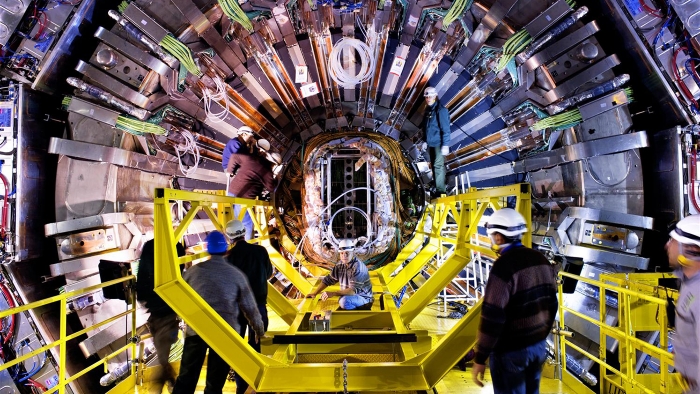
Much of the complexity of particle physics experiments can be boiled down to two basic types of detectors: trackers and calorimeters. They each have strengths and weaknesses, and most modern experiments use both.
The first tracker started out as an experiment to study clouds, not particles. In the early 1900s, Charles Wilson built an enclosed sphere of moist air to study cloud formation. Dust particles were known to seed cloud formation—water vapor condenses on the dust to make clouds of tiny droplets. But no matter how clean Wilson made his chamber, clouds still formed.
Moreover, they formed in streaks, especially near radioactive sources. It turned out that subatomic particles were ionizing the air, and droplets condensed along these trails like dew on a spider web.
This cloud chamber was phenomenally useful to particle physicists—finally, they could see what they were doing! It's much easier to find strange, new particles when you have photos of them acting strangely. In some cases, they were caught in the act of decaying—the kaon was discovered as a V-shaped intersection of two pion tracks, since kaons decay into pairs of pions in flight.
In addition to turning vapor into droplets, ionization trails can cause bubbles to form in a near-boiling liquid. Bubble chambers could be made much larger than cloud chambers, and they produced clear, crisp tracks in photographs. Spark chambers used electric discharges along the ionization trails to collect data digitally. More recently, time projection chambers measure the drift time of ions between the track and a high-voltage plate for more spatial precision, and silicon detectors achieve even higher resolution by collecting ions on microscopic wires printed on silicon microchips. Today, trackers can reconstruct millions of three-dimensional images per second.
The disadvantage of tracking is that neutral particles do not produce ionization trails and hence are invisible. The kaon that decays into two pions is neutral, so you only see the pions. Neutral particles that never or rarely decay are even more of a nuisance. Fortunately, calorimeters fill in this gap, since they are sensitive to any particle that interacts with matter.
Interestingly, the Higgs boson was discovered in two decay modes at once. One of these, Higgs to four muons, uses tracking exclusively, since the muons are all charged and deposit minimal energy in a calorimeter. The other, Higgs to two (neutral) photons, uses calorimetry exclusively.
A version of this article was published in Fermilab Today.
LHC restart timeline
LHC achieves record-energy collisions
The Large Hadron Collider broke its own record again in 13-trillion-electronvolt test collisions.
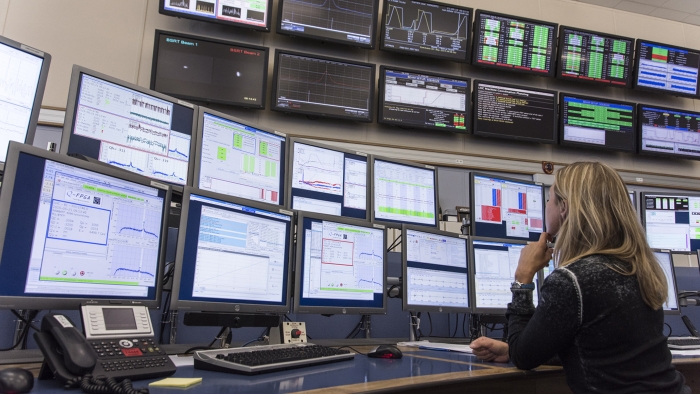
Today engineers at the Large Hadron Collider successfully collided several tightly packed bunches of particles at 13 trillion electronvolts. This is one of the last important steps on the way toward data collection, which is scheduled for early June.
As engineers ramp up the energy of the collider, the positions of the protons inside the beam pipes change. The protons are also focused into much tighter packets, so getting two bunches to actually intersect requires very precise tuning.
“Colliding protons inside the LHC is equivalent to firing two needles 6 miles apart with such precision that they collide halfway,” says Syracuse University physicist Sheldon Stone, a senior researcher on the LHCb experiment. “It take a lot of testing to make sure the two bunches meet at the right spot and do not miss each other.”
Engineers spent the last two years outfitting the LHC to collide protons at a higher energy and faster rate than ever before. Last month they successfully circulated low-energy protons around the LHC for the first time since the shutdown. Five days later, they broke their own energy record by ramping up the energy of a single proton beam to 6.5 trillion electronvolts.
High-energy test collisions allow engineers to practice steering beams in the LHC.
“We have to find the positions where the two beams cross, so what we do is steer the beams up and down and left and right until we get the optimal collision rate,” says CERN engineer Ronaldus SuykerBuyk of the operations team.
In addition to finding the collision sweet spots, engineers will also use these tests to finish calibrating the machine components and positioning the collimators, which protect the accelerator and detectors from stray particles.
The design of the LHC allows more than 2800 bunches of protons to circulate in the machine at a time. But the LHC operations team is testing the machine with just one or two bunches per beam to ensure all is running smoothly.
The next important milestone will be preparing the LHC to consistently and safely ramp, steer and collide proton beams for up to eight consecutive hours.
Declaring stable beams will be only the beginning for the LHC operations team.
"The machine evolves around you," says CERN engineer Jorg Wenninger of the LHC Operations team. "There are little changes over the months. There’s the reproducibility of the magnets. And the alignment of the machine moves a little with the slow-changing geology of the area. So we keep adjusting every day."
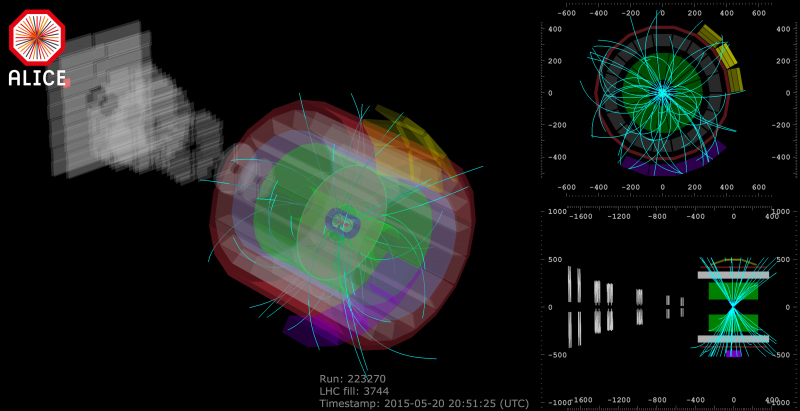
First 13 TeV collisions in the ALICE detector
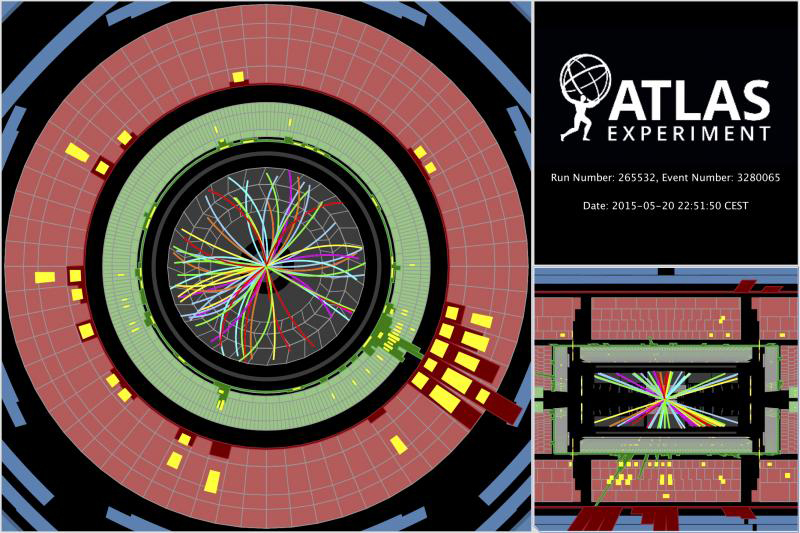
First 13 TeV collisions in the ATLAS detector
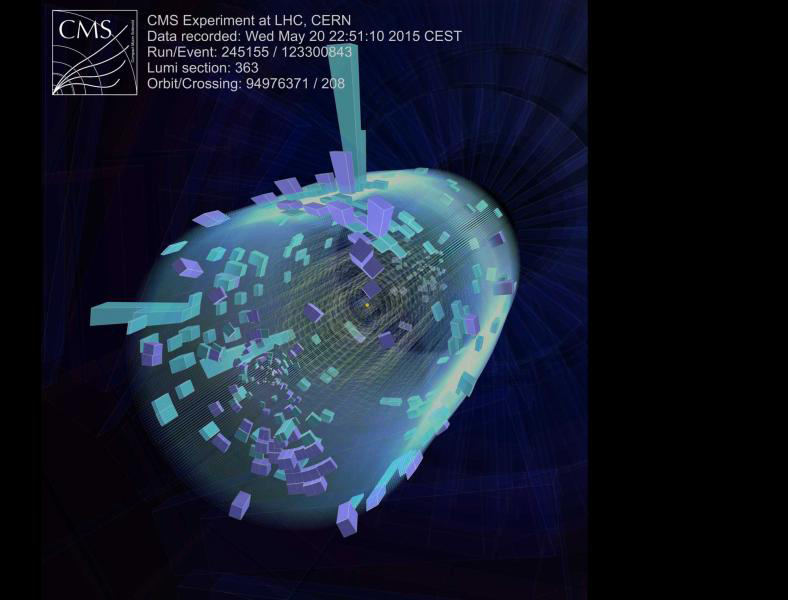
First 13 TeV collisions in the CMS detector
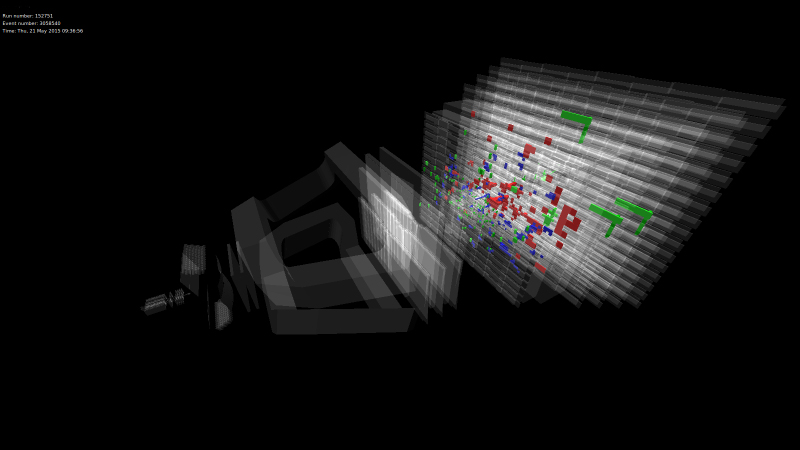
First 13 TeV collisions in the LHCb detector

 Frascati Scienza
 Buco Nero
 Io Non Faccio Niente
 Tommaso Dorigo
 Giovanni Mazzitelli
 Barbara Gallavotti
 Keplero Blog
 Research Gate