
Bringing neutrino research back to India
The India-based Neutrino Observatory will provide a home base for Indian particle physicists.

Pottipuram, a village in southern India, is mostly known for its farming. Goats graze on the mountains and fields yield modest harvests of millets and pulses.
Earlier this year, Pottipuram became known for something else: The government announced that, nearby, scientists will construct a new research facility that will advance particle physics in India.
A legacy of discovery
From 1951 to 1992, Indian scientists studied neutrinos and muons in a facility located deep within what was then one of the largest active gold mines in the world, the Kolar Gold Fields.
The lab hosted international collaborations, including one that discovered atmospheric neutrinos—elusive particles that shoot out of collisions between cosmic rays and our atmosphere. The underground facility also served as a training ground for young and aspiring particle physicists.
But when the gold reserves dwindled, the mining operations pulled out. And the lab, unable to maintain a vast network of tunnels on its own, shut down, too. Indian particle physicists who wanted to do science in their country had to switch to a related field, such as nuclear physics or materials science.
Almost immediately after the closure of the Kolar lab, plans began to take shape to build a new place to study fundamental particles and forces. Physicist Naba Mondal of the Tata Institute of Fundamental Research in Mumbai, who had researched at Kolar, worked with other scientists to build a collaboration—informally at first, and then officially in 2002. They now count as partners scientists from 21 universities and research institutions across India.
The facility they plan to build is called the India-based Neutrino Observatory.
Mondal, who leads the INO collaboration, has high hopes the facility will give Indian particle physics students the chance to do first-class research at home.
“They can't all go to CERN or Fermilab,” he says. “If we want to attract them to science, we have to have experimental facilities right here in the country.”
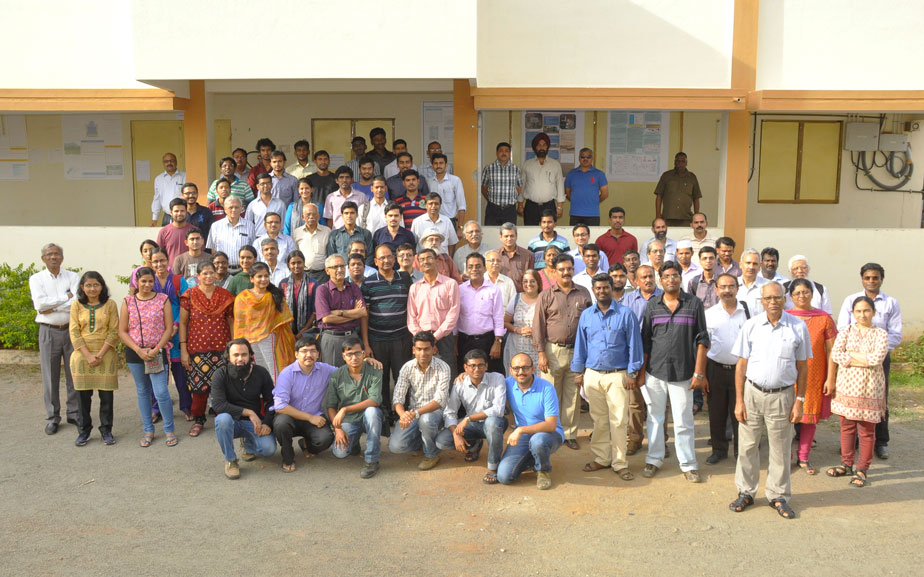
INO collaboration meeting 2014, at Iichep Madurai.
Finding a place
INO will house large detectors that will catch particles called neutrinos.
Neutrinos are produced by a variety of processes in nature and hardly ever interact with other matter; they are constantly streaming through us. But they’re not the only particles raining down on us from space. There are also protons and atomic nuclei coming from cosmic rays.
To study neutrinos, scientists need a way to pick them out from the crowd. INO scientists want to do this by building their detectors inside a mountain, shielded by layers of rock that can stop cosmic ray particles but not the slippery neutrinos.
Rock is especially dense in the remote, monolithic hills near Pottipuram. So, the scientists set about asking the village for their blessing to build there.
This posed a challenge to Mondal. India is a large country with 22 officially sanctioned languages. Mondal grew up in West Bengal, near Kolkata, more than 1200 miles away from Pottipuram and speaks Bengali, Hindi and English. The residents of Pottipuram speak Tamil.
Luckily, some of Mondal’s colleagues speak Tamil, too.
One such colleague is D. Indumathi of the Institute of Mathematical Sciences in Chennai. Indumathi spent more than 5 years coordinating a physics subgroup working on designing INO’s proposed main detector, a 50,000-ton, magnetized stack of iron plates and scintillator. But her abilities and interests extend beyond the pure physics of the project.
“I like talking about science to people,” she says. “I get very involved, and I am very passionate about it. So in that sense [outreach] was also a role that I could naturally take up.”
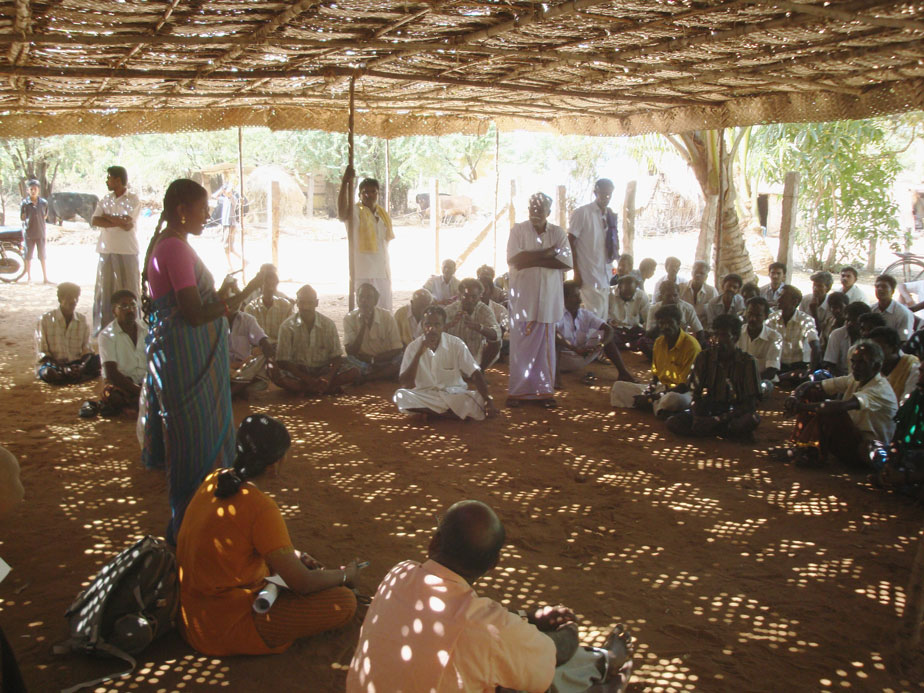
She spent about one year talking with residents of Pottipuram, fielding questions about whether the experiment would produce a radiation hazard (it won’t) and whether the goats would continue to have access to the mountain (they will). In the end, the village consented to the construction.
Neutrino physics for a new generation
Young people have shown the most interest in INO, Indumathi says. Students in both college and high school are tantalized by these particles that might throw light on yet unanswered questions about the evolution of the universe. They enjoy discussing research ideas that haven’t even found their way into their textbooks.
“[There] is a tremendous feeling of wanting to participate—to be a part of this lab that is going to come up in their midst,” Indumathi says.
Student S. Pethuraj, from another village in Tamil Nadu, first heard about INO when he attended a series of lectures by Mondal and other scientists in his second year of what was supposed to be a terminal master’s degree at Madurai Kamaraj University.
Pethuraj connected with the professors and arranged to take a winter course from them on particle physics.
“After their lectures my mind was fully trapped in particle physics,” he says.
Pethuraj applied and was accepted to a PhD program expressly designed as preparation for INO studies at the Tata Institute for Fundamental Research. He is now completing coursework.
“INO is giving me cutting-edge research experience in experimental physics and instrumentation,” he says. “This experience creates in me a lot of confidence in handling and understanding the experiments.”
Other young people are getting involved with engineering at INO. The collaboration has already hired recent graduates to help design the many intricate detector systems involved in such a massive undertaking.
The impact of the INO will only increase after its construction, especially for those who will have the lab in their backyard, Mondal says.
“The students from the area—they will visit and talk to the scientists there and get an idea about how science is being done,” he says. “That will change even the culture of doing science.”
Mathematician to know: Emmy Noether
Noether's theorem is a thread woven into the fabric of the science.
We are able to understand the world because it is predictable. If we drop a rubber ball, it falls down rather than flying up. But more specifically: if we drop the same ball from the same height over and over again, we know it will hit the ground with the same speed every time (within vagaries of air currents). That repeatability is a huge part of what makes physics effective.
The repeatability of the ball experiment is an example of what physicists call “the law of conservation of energy.” An equivalent way to put it is to say the force of gravity doesn’t change in strength from moment to moment.
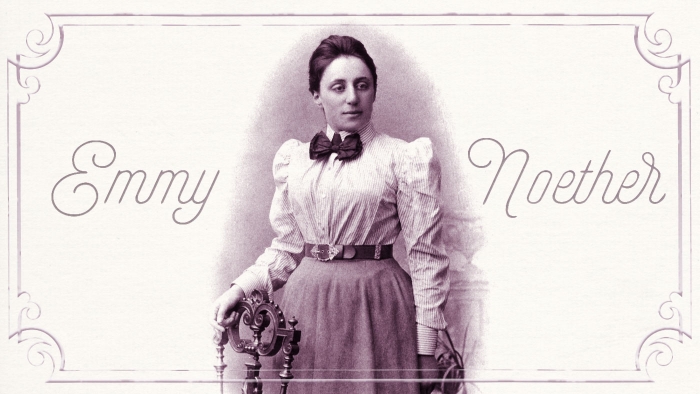
The connection between those ways of thinking is a simple example of a deep principle called Noether’s theorem: Wherever a symmetry of nature exists, there is a conservation law attached to it, and vice versa. The theorem is named for arguably the greatest 20th century mathematician: Emmy Noether.
“Noether's theorem to me is as important a theorem in our understanding of the world as the Pythagorean theorem,” says Fermilab physicist Christopher Hill, who wrote a book on the topic with Nobel laureate Leon Lederman.
So who was the mathematician behind Noether’s theorem?
The life of Noether
Amalie Emmy Noether was born in Bavaria (now part of Germany) in 1882. She earned her doctorate in mathematics in 1907 from the University of Erlangen, which was a socially progressive institution for its day. She stayed at Erlangen to teach for several years, though without pay, as women were not technically allowed to teach at universities in Germany at the time.
One of the leading mathematicians of the age, David Hilbert, invited her to join him at the University of Göttingen, where she remained from 1916 until 1933. Liberalized laws in Germany following World War I allowed Noether to be granted a teaching position, but she was still paid only a small amount for her teaching work.
In 1933, the Nazi regime fired all Jewish professors and followed the next year by firing all female professors. A Jewish woman, Noether left Germany for the United States. She worked as a visiting professor at Bryn Mawr College, but her time in America was short. She died in 1935 at age 53, from complications following surgery.
Many of the leading male mathematicians and physicists of the day eulogized her, including Albert Einstein, who wrote in the New York Times, “However inconspicuously the life of these individuals runs its course, none the less the fruits of their endeavors are the most valuable contributions which one generation can make to its successors.”
Physicists tend to know her work primarily through her 1918 theorem. But mathematicians are familiar with a variety of Noether theorems, Noetherian rings, Noether groups, Noether equations, Noether modules and many more.
Over the course of her career, Noether developed much of modern abstract algebra: the grammar and the syntax of math, letting us say what we need to in math and science. She also contributed to the theory of groups, which is another way to treat symmetries; this work has influenced mathematical side of quantum mechanics and superstring theory.
Noether and particle physics
Because their work relies on symmetry and conservation laws, nearly every modern physicist uses Noether’s theorem. It’s a thread woven into the fabric of the science, part of the whole cloth. Every time scientists use a symmetry or a conservation law, from the quantum physics of atoms to the flow of matter on the scale of the cosmos, Noether’s theorem is present. Noetherian symmetries answer questions like these: If you perform an experiment at different times or in different places, what changes and what stays the same? Can you rotate your experimental setup? Which properties of particles can change, and which are inviolable?
Conservation of energy comes from time-shift symmetry: You can repeat an experiment at different times, and the result is the same. Conservation of momentum comes from space-shift symmetry: You can perform the same experiment in different places, and it comes out with the same results. Conservation of angular momentum, which when combined with the conservation of energy under the force of gravity explains the Earth’s motion around the sun, comes from symmetry under rotations. And the list goes on.
The greatest success of Noether’s theorem came with quantum physics, and especially the particle physics revolution that rose after Noether’s death. Many physicists, inspired by Noether’s theorem and the success of Einstein’s general theory of relativity, looked at geometrical descriptions and mathematical symmetries to describe the new types of particles they were discovering.
“It's definitely true that Noether's theorem is part of the foundation on which modern physics is built,” says physicist Natalia Toro of the Perimeter Institute and the University of Waterloo. “We apply it every day to deep and well-tested principles like conservation of energy and momentum.”
According to the law of conservation of electric charge, the total amount of electric charge going into an experiment must be the same as what comes out, even if particle types change or if matter hits antimatter and is annihilated. That law has the same symmetry that a circle has. A perfect circle can be rotated around its center by any angle and it looks the same; the same math describes the quantum mechanical property of an electron. If the amount of that rotation can change from place to place, the symmetry of a circle yields the entire theory of electromagnetism, which governs everything from the generation of electricity to the structure of atoms to matter on cosmic scales. In that way, Noether takes us from a simple symmetry to the world we know.
“Noether's theorem has even greater power than that,” Toro says, “in helping us to organize our thinking when exploring aspects of the universe where we don't yet know the basic laws. That's a tall order, and as we seek experimental answers to these questions, symmetries and conservation laws—tightly linked by Noether's theorem—are one of the few theoretical tools that we have to guide us.”
Making the portable gamma camera
The end of the Cold War and the cancellation of the Superconducting Super Collider led to the creation of a life-saving medical device.
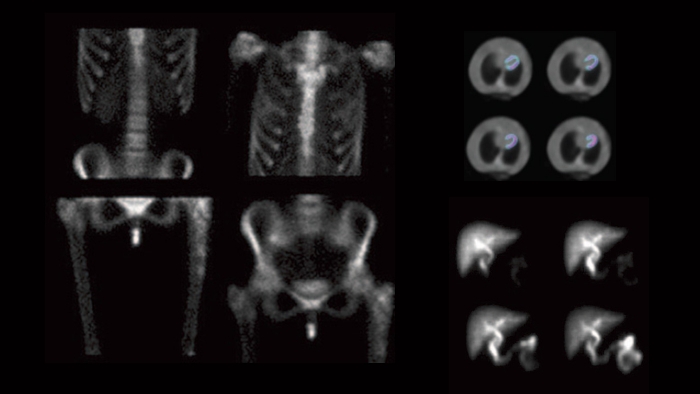
Each year, more than 5 million Americans take a nuclear heart stress test, which images blood flow in the heart before and after a brisk walk on a treadmill. The test allows doctors to visualize a lack of blood flow that may result from blocked or narrowed coronary arteries, which are linked to heart disease, the leading cause of death in the United States.
The test is conducted with a device called a gamma camera, which also helps diagnose dozens of other conditions, from arthritis to renal failure. Invented in the 1950s, gamma cameras used two 500-pound detectors the size of truck tires and cost hundreds of thousands of dollars. As a result, they were usually located only in regional medical centers.
But new options are available, thanks to a small company, a national laboratory and, in part, the rise and fall of both the Cold War and the Superconducting Super Collider.
A Cold War camera
The small company is Digirad, which a materials scientist started in 1985 as San Diego Semiconductors to create and develop applications for complex crystalline materials. Its name changed to Aurora Technologies in 1991 and to Digirad in 1994.
Sustained by a variety of government R&D contracts, the company’s most successful early product was a gamma-ray detector. In 1991, the Defense Advanced Research Projects Agency (DARPA) gave the company a contract to do more. The agency asked for a prototype portable gamma camera—a detector array with readout and display systems that could remotely determine the number of nuclear warheads contained within the nosecone of a missile. At the camera’s heart were cadmium zinc telluride crystals, which converted gamma rays into electrical signals.
Digirad’s portable gamma camera was to have been a key tool for verifying nuclear weapons reductions. But after the end of the Cold War, the government lost interest. DARPA halted its funding to Digirad in 1993. To survive, the company needed to diversify.
A University of California, San Diego physician who had seen a news story about Digirad suggested that the company repurpose the prototype into a revolutionary medical imaging device. That’s what Digirad set out to create.
Heart-saving gamma rays
To use a gamma camera, physicians first inject into the bloodstream a small amount of a short-lived radioactive isotope, which sends out gamma rays as it decays. The patient must then lay very still inside a hospital’s tunnel-like gamma camera for five to 30 minutes as its detectors record the isotope’s emissions and create images that show doctors where the patient’s blood is flowing or blocked.
With the help of a cooperative research agreement with SLAC National Accelerator Laboratory in 1994 and 1995, Digirad modified its warhead-detecting camera into a much smaller, lightweight version of the medical gamma camera. It unveiled its new product in 1997.
The camera worked, but its price was higher than hospitals could afford.
“Unfortunately, cadmium zinc telluride was just too expensive to use in a commercial product,” says Richard Conwell, then Digirad’s vice president for research and development.
Unbeknownst to Digirad, the solution to this problem had just been created at Lawrence Berkeley National Laboratory.
A Super Collider’s sensor
In the early 1990s, Berkeley Lab electrical engineer Steve Holland was working on silicon detector technology for use in the Superconducting Super Collider, a particle collider slated to be built in central Texas that would have been twice as large and powerful as today’s Large Hadron Collider.
Holland’s challenge was to develop a mass-producible low-noise diode component for the SSC's many charged-particle detectors that would sense matter streaming from the high-energy collisions inside the collider. He did it by creating a diode with a micron-thick electrical-contact layer on the back that could trap noise-creating impurities introduced during fabrication.
In 1993, Congress canceled funding for the Superconducting Super Collider. The silicon detector effort seemed doomed to fade into obscurity.
But fellow Berkeley Lab researcher Carolyn Rossington told physicist William Moses, a member of Berkeley Lab’s Life Sciences Division, about Holland’s diode.
Moses was interested in making a compact gamma camera for diagnosing breast cancer. It turned out that Holland’s diode was just the thing needed to complete the design. The Berkeley Lab team, which included Moses, Rossington and Nadine Wang, described their device at a nuclear medicine and imaging conference in Albuquerque, New Mexico, in November 1997. Digirad scientist Bo Pi was in the audience.
Digirad negotiated with Berkeley Lab for an exclusive license to use Holland’s innovation in nuclear medicine. After developing new methods to manufacture the diode in commercial quantities, Digirad produced its first portable gamma cameras in 2000. Its business rejuvenated, Digirad went public in 2004.
Today, Digirad provides onsite gamma imaging services in remote locations and produces two additional compact portable gamma cameras that have two or three of the thin, lightweight and adjustable detectors to produce clearer heart images in doctors’ offices or clinics.
Digirad’s portable camera is even valuable to hospitals that already have a large conventional gamma camera.
“I can roll it into any room in my hospital,” says Dr. Janusz Kikut, Associate Professor and Nuclear Medicine Division Chief at the Vermont Medical Center. “In many urgent or unstable cases, it is faster, safer and less expensive to use this portable camera instead of transporting the critically ill patients down to the nuclear medicine department.”
“Holland’s diode has been huge for us,” says Virgil Lott, Digirad’s head of diagnostic imaging. “It has enabled us to take faster, higher-quality gamma imaging much closer to millions of patients.”
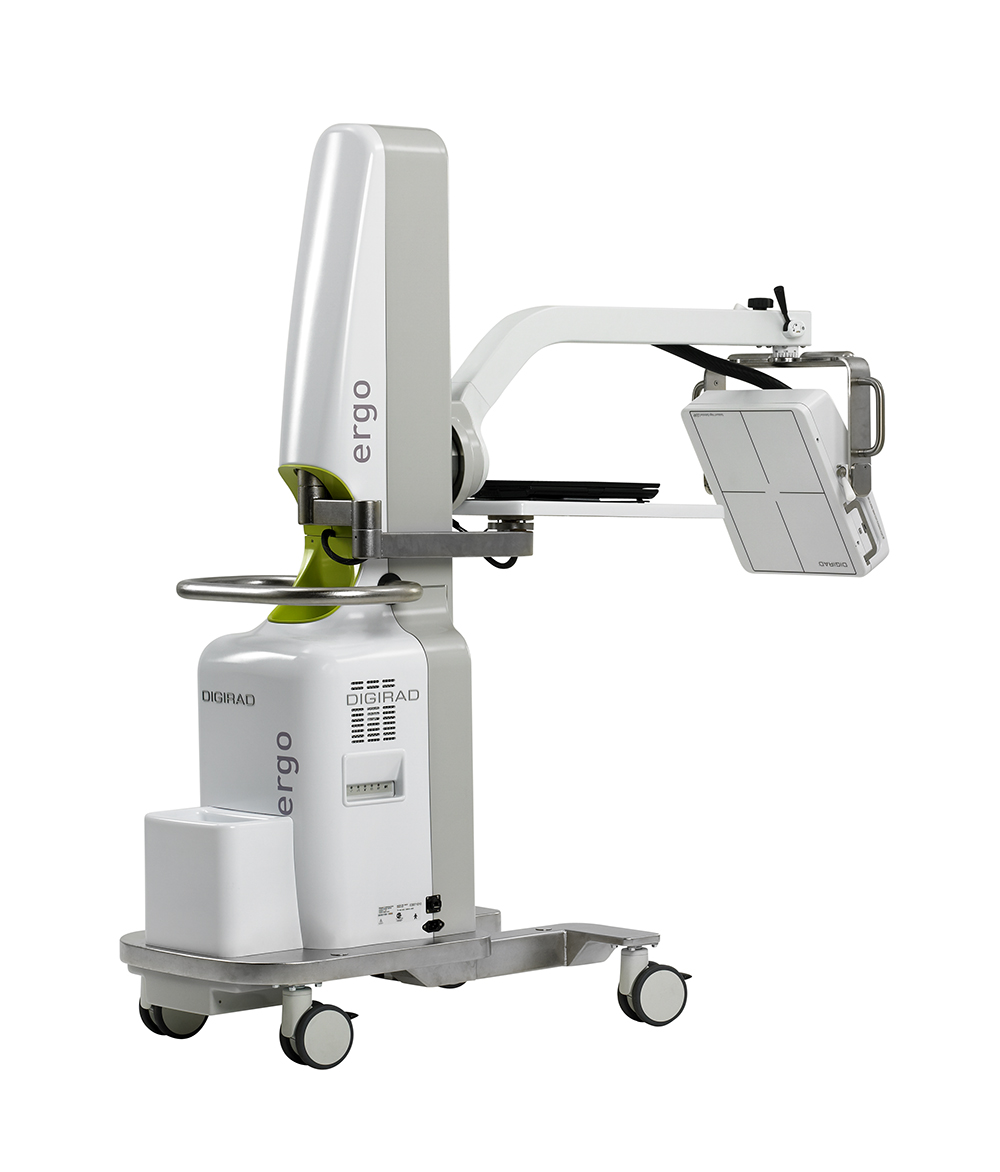
Portable gamma camera from Digirad
OPERA catches fifth tau neutrino
Q&A: New director-general of KEK
Masanori Yamauchi started his three-year term as head of Japan’s major center of particle physics research this spring.
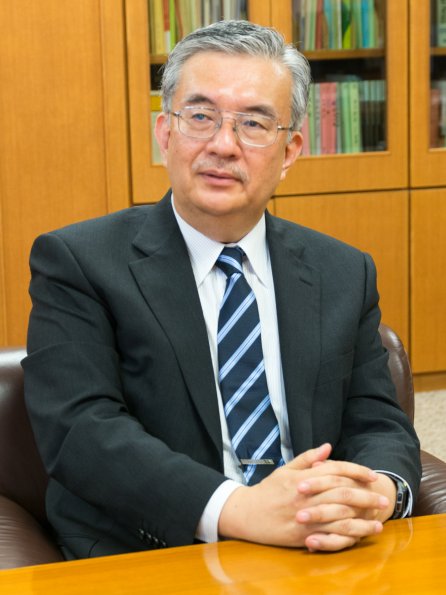
At a recent symposium about the proposed International Linear Collider, Symmetry chatted with Masanori Yamauchi, the new director-general of KEK, Japan’s high-energy accelerator research organization. Yamauchi, who received his PhD in physics at the University of Tokyo, has been at the laboratory for more than 30 years.
S: When did you first become interested in physics?
MY: A long time ago, as a high school student. I read a book on symmetry and asymmetry which impressed me a lot. At university, I chose to enter the physics department.
S:What was particle physics like when you were a student?
MY: When I was a grad student, I was staying at Lawrence Berkeley laboratory and doing experiments at SLAC laboratory. At the time, things were centralized in the US and Europe. Experiments in Japan were small. The nature of collaboration at the time was different.
S: How has it changed?
MY: It’s more international. KEK’s Belle experiment, which started in 1999, is truly an international collaboration. Almost half of its members are from abroad.
These days more than 20,000 scientists visit KEK every year from abroad to carry out an extensive research program at the accelerator facilities. This provides an extraordinary opportunity, especially to young scientists.
Now we’re hoping to construct the ILC in Japan. Everyone is getting together to design the ILC from scratch. Japan is not taking a strong lead; it’s an international collaboration.
S: What have been some of the highlights of your career?
MY: I was a spokesperson for the Belle experiment. We confirmed theory of CP violation proposed by [theorists] Makoto Kobayashi and Toshihide Maskawa [who won the Nobel Prize in Physics in 2008].
In the course of measurements, we observed many interesting things, including CP violation [a violation in the symmetry between matter and antimatter] in B meson decays. This is still puzzling. We still don’t know how it happens. We need at least 10 times more data to find out. That’s why we started the upgrade of KEKB [KEK’s particle accelerator]. It’s called Super KEKB factory, including the upgrade of detector to Belle II.
S: What do you do in your free time?
MY: I used to swim a lot, two times a week. Since I became the director-general of KEK, I have no time to swim. That’s my pity.
S: What did you do to prepare to become director-general?
MY: I had many chances to talk to the former director-general.
I know what I should do. For a big lab like KEK, it’s extremely important to keep a good relationship with the Japanese people, including people in government and at funding agencies. We deeply recognize that their understanding and support are essential to our scientific research. I often talk to them.
Conversation as the representative of KEK is a lot different from dialog with physicists. I’m not used to it. I have to find appropriate words. Physicists are more likely to talk very frankly and fight.
S: What makes KEK unique?
MY: One thing is our diversity. We cover many fields of research.
In physics, besides confirming the Kobayashi-Maskawa theory, we discovered many exotic compound particles and confirmed the discovery of neutrino oscillation. In material and life science, we determined the structure of novel superconductors and protein-drug complexes. We also studied novel properties induced by hydrogen atoms, spins and electrons in condensed matter.
We have two physics facilities, KEK and J-PARC. Between them we cover flavor physics, B and D meson decays, tau lepton decays, kaons, muons and neutrinos. We have a commitment to the ATLAS experiment [at the Large Hadron Collider].
S: What are your priorities for KEK?
MY: KEK's mission in the near future is to derive the best scientific outcomes from ongoing research programs, and to open a firm route to future programs.
The most important thing is the construction of the Super KEKB factory [an upgrade of the KEKB accelerator]. We expect to have the first beam early next year. It is extremely important for us to finish the beam. We are going to carry out a neutrino, muon and kaon program.
As I said, KEK does more than particle physics research. It also has nuclear physics and materials science and life science programs. We will promote them as well.
LHC physicists preserve Native American voices
Japan’s next big neutrino project
The proposed Hyper-K experiment would dwarf its predecessor.

In 1998, the Super-K detector in Japan revealed that ubiquitous, almost massless particles called neutrinos have the ability to morph from one type to another. That landmark finding has become one of the most heavily cited scientific results in particle physics.
Now scientists have proposed to build a successor to the still-operating Super-K: Hyper-K, a detector with an active volume 25 times its size.
Part microscope and part telescope, the proposed Hyper-K experiment could fill in some of the blanks in our understanding of our universe. It could help explain why the universe favors matter over antimatter. It could provide new details about the fluctuating “flavors” or types of neutrinos. It could help elucidate whether there is any difference between neutrinos and their anti-particles.
It could also provide a better understanding of dark matter and exploding stars and could reveal whether protons—a main ingredient in all atoms—have an expiration date.
The proposed experiment would be complementary to DUNE, a planned long-baseline neutrino experiment in the United States that will use different technology.
The “K” in Super-K and Hyper-K stands for a play on the word Kamioka, the name of a mountainous area about 200 miles west of Tokyo that houses multiple particle physics experiments.
“The uniqueness of Hyper-K is its size and resolution,” says Tsuyoshi Nakaya of Kyoto University, who leads the Hyper-K steering committee and has been a part of Super-K since 1999.
The central component in the Hyper-K project would be a massive cylindrical tank measuring about 248 meters long and 54 meters high, filled with 1.1 million tons of highly purified water. An alternate Hyper-K design calls for an egg-shaped tank.
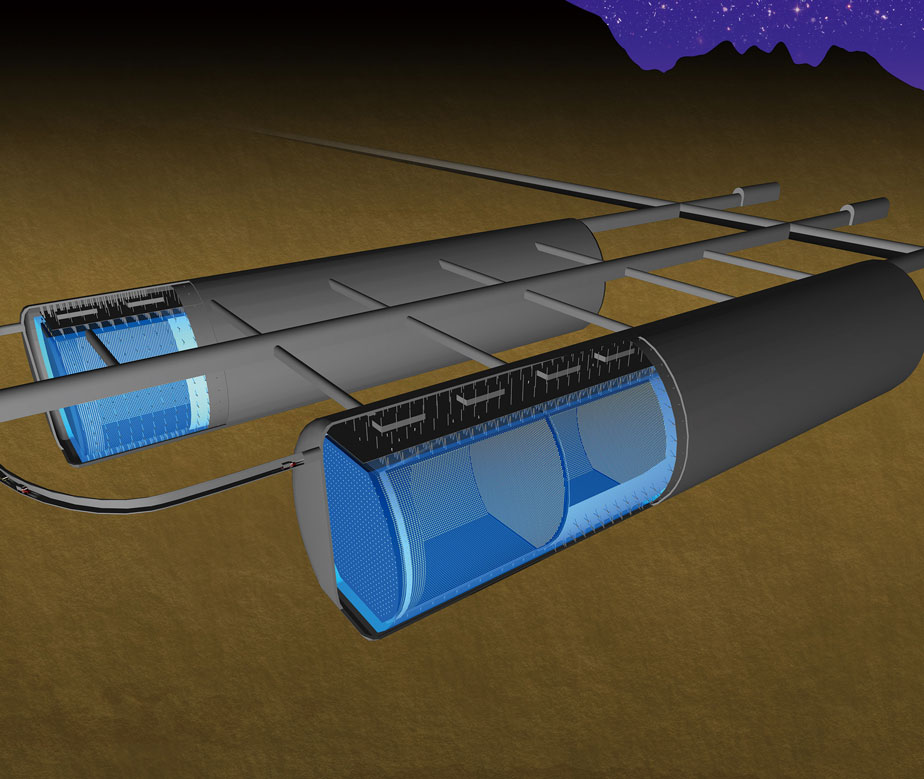
Hyper-K would consist of an array of photo-detectors that would measure flashes of light produced in particle events and processes occurring in the tank. The mountain above Hyper-K would help to shield the detectors from the “noise” of other particles such as cosmic rays.
Hyper-K would study a beam of neutrinos produced at the Japan Proton Accelerator Research Complex about 180 miles away in Tokai, and it would be able to detect neutrinos produced even farther away in Earth’s atmosphere and beyond. Hyper-K could also detect particles produced in the decay of a proton, something scientists have yet to see.
“The discovery of proton decays would be revolutionary,” says Masato Shiozawa, Hyper-K project leader who works at the Institute for Cosmic Ray Research in Japan.
Hyper-K has already won international support from institutions in 13 countries, with the largest groups coming from Japan, the United Kingdom, the United States, Switzerland and Canada. In January the ICCR announced a cooperative agreement to pursue Hyper-K with the Institute of Particle and Nuclear Studies in Japan’s High Energy Accelerator Research Organization.
About 200 researchers are already working on the design of Hyper-K, and the collaboration is still welcoming new members. They hope to begin construction in 2018.

 Frascati Scienza
 Buco Nero
 Io Non Faccio Niente
 Tommaso Dorigo
 Giovanni Mazzitelli
 Barbara Gallavotti
 Keplero Blog
 Research Gate