
One Higgs is the loneliest number
Is this the only universe?
Our universe could be just one small piece of a bubbling multiverse.

Human history has been a journey toward insignificance.
As we’ve gained more knowledge, we’ve had our planet downgraded from the center of the universe to a chunk of rock orbiting an average star in a galaxy that is one among billions.
So it only makes sense that many physicists now believe that even our universe might be just a small piece of a greater whole. In fact, there may be infinitely many universes, bubbling into existence and growing exponentially. It’s a theory known as the multiverse.
One of the best pieces of evidence for the multiverse was first discovered in 1998, when physicists realized that the universe was expanding at ever increasing speed. They dubbed the force behind this acceleration dark energy. The value of its energy density, also known as the cosmological constant, is bizarrely tiny: 120 orders of magnitude smaller than theory says it should be.
For decades, physicists have sought an explanation for this disparity. The best one they’ve come up with so far, says Yasunori Nomura, a theoretical physicist at the University of California, Berkeley, is that it’s only small in our universe. There may be other universes where the number takes a different value, and it is only here that the rate of expansion is just right to form galaxies and stars and planets where people like us can observe it. “Only if this vacuum energy stayed to a very special value will we exist,” Nomura says. “There are no good other theories to understand why we observe this specific value.”
For further evidence of a multiverse, just look to string theory, which posits that the fundamental laws of physics have their own phases, just like matter can exist as a solid, liquid or gas. If that’s correct, there should be other universes where the laws are in different phases from our own—which would affect seemingly fundamental values that we observe here in our universe, like the cosmological constant. “In that situation you’ll have a patchwork of regions, some in this phase, some in others,” says Matthew Kleban, a theoretical physicist at New York University.
These regions could take the form of bubbles, with new universes popping into existence all the time. One of these bubbles could collide with our own, leaving traces that, if discovered, would prove other universes are out there. We haven't seen one of these collisions yet, but physicists are hopeful that we might in the not so distant future.
If we can’t find evidence of a collision, Kleban says, it may be possible to experimentally induce a phase change—an ultra-high-energy version of coaxing water into vapor by boiling it on the stove. You could effectively prove our universe is not the only one if you could produce phase-transitioned energy, though you would run the risk of it expanding out of control and destroying the Earth. “If those phases do exist—if they can be brought into being by some kind of experiment—then they certainly exist somewhere in the universe,” Kleban says.
No one is yet trying to do this.
There might be a (relatively) simpler way. Einstein’s general theory of relativity implies that our universe may have a “shape.” It could be either positively curved, like a sphere, or negatively curved, like a saddle. A negatively curved universe would be strong evidence of a multiverse, Nomura says. And a positively curved universe would show that there’s something wrong with our current theory of the multiverse, while not necessarily proving there’s only one. (Proving that is a next-to-impossible task. If there are other universes out there that don’t interact with ours in any sense, we can’t prove whether they exist.)
In recent years, physicists have discovered that the universe appears almost entirely flat. But there’s still a possibility that it’s slightly curved in one direction or the other, and Nomura predicts that within the next few decades, measurements of the universe’s shape could be precise enough to detect a slight curvature. That would give physicists new evidence about the nature of the multiverse. “In fact, this evidence will be reasonably strong since we do not know any other theory which may naturally lead to a nonzero curvature at a level observable in the universe,” Nomura says.
If the curvature turned out to be positive, theorists would face some very difficult questions. They would still be left without an explanation for why the expansion rate of the universe is what it is. The phases within string theory would also need re-examining. “We will face difficult problems,” Nomura says. “Our theory of dark energy is gone if it’s the wrong curvature.”
But with the right curvature, a curved universe could reframe how physicists look at values that, at present, appear to be fundamental. If there were different universes with different phases of laws, we might not need to seek fundamental explanations for some of the properties our universe exhibits.
And it would, of course, mean we are tinier still than we ever imagined. “It’s like another step in this kind of existential crisis,” Kleban says. “It would have a huge impact on people’s imaginations.”
W bosons remain left-handed
A new result from the LHCb collaboration weakens previous hints at the existence of a new type of W boson.
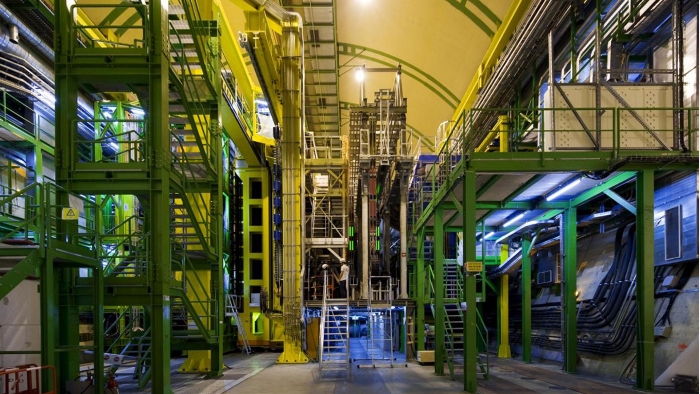
A measurement released today by the LHCb collaboration dumped some cold water on previous results that suggested an expanded cast of characters mediating the weak force.
The weak force is one of the four fundamental forces, along with the electromagnetic, gravitational and strong forces. The weak force acts on quarks, fundamental building blocks of nature, through particles called W and Z bosons.
Just like a pair of gloves, particles can in principle be left-handed or right-handed. The new result from LHCb presents evidence that the W bosons that mediate the weak force are all left-handed; they interact only with left-handed quarks.
This weakens earlier hints from the Belle and BaBar experiments of the existence of right-handed W bosons.
The LHCb experiment at the Large Hadron Collider examined the decays of a heavy and unstable particle called Lambda-b—a baryon consisting of an up quark, down quark and bottom quark. Weak decays can change a bottom quark into either a charm quark, about 1 percent of the time, or into a lighter up quark. The LHCb experiment measured how often the bottom quark in this particle transformed into an up quark, resulting in a proton, muon and neutrino in the final state.
“We found no evidence for a new right-handed W boson,” says Marina Artuso, a Professor of Physics at Syracuse University and a scientist working on the LHCb experiment.
If the scientists on LHCb had seen bottom quarks turning into up quarks more often than predicted, it could have meant that a new interaction with right-handed W bosons had been uncovered, Artuso says. “But our measured value agreed with our model’s value, indicating that the right-handed universe may not be there.”
Earlier experiments by the Belle and BaBar collaborations studied transformations of bottom quarks into up quarks in two different ways: in studies of a single, specific type of transformation, and in studies that ideally included all the different ways the transformation occurs.
If nothing were interfering with the process (like, say, a right-handed W boson), then these two types of studies would give the same value of the bottom-to-up transformation parameter. However, that wasn’t the case.
The difference, however, was small enough that it could have come from calculations used in interpreting the result. Today’s LHCb result makes it seem like right-handed W bosons might not exist after all, at least not in a way that is revealed in these measurements.
Michael Roney, spokesperson for the BaBar experiment, says, "This result not only provides a new, precise measurement of this important Standard Model parameter, but it also rules out one of the interesting theoretical explanations for the discrepancy... which still leaves us with this puzzle to solve."
A new first for T2K
Underground plans
The Super-Kamiokande collaboration has approved a project to improve the sensitivity of the Super-K neutrino detector.
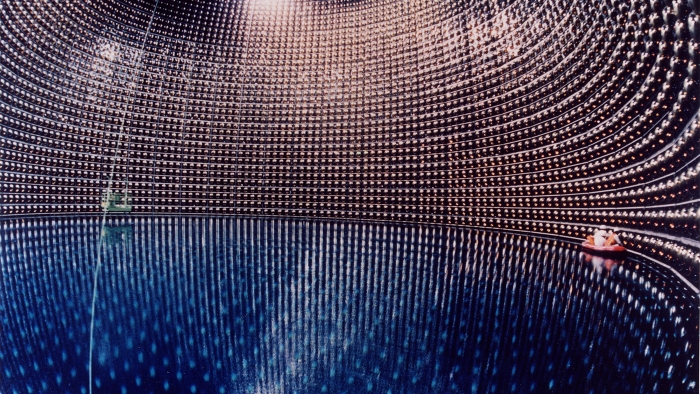
Super-Kamiokande, buried under about 1 kilometer of mountain rock in Kamioka, Japan, is one of the largest neutrino detectors on Earth. Its tank is full of 50,000 tons (about 13 million gallons) of ultrapure water, which it uses to search for signs of notoriously difficult-to-catch particles.
Recently members of the Super-K collaboration gave the go-ahead to a plan to make the detector a thousand times more sensitive with the help of a chemical compound called gadolinium sulfate.
Neutrinos are made in a variety of natural processes. They are also produced in nuclear reactors, and scientists can create beams of neutrinos in particle accelerators. These particles are electrically neutral, have little mass and interact only weakly with matter—characteristics that make them extremely difficult to detect even though trillions fly through any given detector each second.
Super-K catches about 30 neutrinos that interact with the hydrogen and oxygen in the water molecules in its tank each day. It keeps its water ultrapure with a filtration system that removes bacteria, ions and gases.
Scientists take extra precautions both to keep the ultrapure water clean and to avoid contact with the highly corrosive substance.
“Somebody once dropped a hammer into the tank,” says experimentalist Mark Vagins of the University of Tokyo's Kavli Institute for the Physics and Mathematics of the Universe. “It was chrome-plated to look nice and shiny. Eventually we found the chrome and not the hammer.”
When a neutrino interacts in the Super-K detector, it creates other particles that travel through the water faster than the speed of light, creating a blue flash. The tank is lined with about 13,000 phototube detectors that can see the light.
Looking for relic neutrinos
On average, several massive stars explode as supernovae every second somewhere in the universe. If theory is correct, all supernovae to have exploded throughout the universe’s 13.8 billion years have thrown out trillions upon trillions of neutrinos. That means the cosmos would glow in a faint background of relic neutrinos—if scientists could just find a way to see even a fraction of those ghostlike particles.
For about half of the year, the Super-K detector is used in the T2K experiment, which produces a beam of neutrinos in Tokai, Japan, some 183 miles (295 kilometers) away, and aims it at Super-K. During the trip to the detector, some of the neutrinos change from one type of neutrino to another. T2K studies that change, which could give scientists hints as to why our universe holds so much more matter than antimatter.
But a T2K beam doesn’t run continuously during that half year. Instead, researchers send a beam pulse every few seconds, and each pulse lasts just a few microseconds long. Super-K still detects neutrinos from natural processes while scientists are running T2K.
In 2002, at a neutrino meeting in Munich, Germany, experimentalist Vagins and theorist John Beacom of The Ohio State University began thinking of how they could better use Super-K to spy the universe’s relic supernova neutrinos.
“For at least a few hours we were standing there in the Munich subway station somewhere deep underground, hatching our underground plans,” Beacom says.
To pick out the few signals that come from neutrino events, you have to battle a constant clatter of background noise of other particles. Other incoming cosmic particles such as muons (the electron’s heavier cousin) or even electrons emitted from naturally occurring radioactive substances in rock can produce signals that look like the ones scientists hope to find from neutrinos. No one wants to claim a discovery that later turns out to be a signal from a nearby rock.
Super-K already guards against some of this background noise by being buried underground. But some unwanted particles can get through, and so scientists need ways to separate the signals they want from deceiving background signals.
Vagins and Beacom settled on an idea—and a name for the next stage of the experiment: Gadolinium Antineutrino Detector Zealously Outperforming Old Kamiokande, Super! (GADZOOKS!). They proposed to add 100 tons of the compound gadolinium sulfate—Gd2(SO4)3—to Super-K’s ultrapure water.
When a neutrino interacts with a molecule, it releases a charged lepton (a muon, electron, tau or one of their antiparticles) along with a neutron. Neutrons are thousands of times more likely to interact with the gadolinium sulfate than with another water molecule. So when a neutrino traverses Super-K and interacts with a molecule, its muon, electron, or antiparticle (Super-K can’t see tau particles) will generate a first pulse of light, and the neutron will create a second pulse of light: “two pulses, like a knock-knock,” Beacom says.
By contrast, a background muon or electron will make only one light pulse.
To extract only the neutrino interactions, scientists will use GADZOOKS! to focus on the two-signal events and throw out the single-signal events, reducing the background noise considerably.
The prototype
But you can’t just add 100 tons of a chemical compound to a huge detector without doing some tests first. So Vagins and colleagues built a scaled-down version, which they called Evaluating Gadolinium’s Action on Detector Systems (EGADS). At 0.4 percent the size of Super-K, it uses 240 of the same phototubes and 200 tons (52,000 gallons) of ultrapure water.
Over the past several years, Vagins’ team has worked extensively to show the benefits of their idea. One aspect of their efforts has been to build a filtration system that removes everything from the ultrapure water except for the gadolinium sulfate. They presented their results at a collaboration meeting in late June.
On June 27, the Super-K team officially approved the proposal to add gadolinium sulfate but renamed the project SuperK-Gd. The next steps are to drain Super-K to check for leaks and fix them, replace any burned out phototubes, and then refill the tank.
But this process must be coordinated with T2K, says Masayuki Nakahata, the Super-K collaboration spokesperson.
Once the tank is refilled with ultrapure water, scientists will add in the 100 tons of gadolinium sulfate. Once the compound is added, the current filtration system could remove it any time researchers would like, Vagins says.
“But I believe that once we get this into Super-K and we see the power of it, it’s going to become indispensable,” he says. “It’s going to be the kind of thing that people wouldn’t want to give up the extra physics once they’re used to it.”
The Standard Model of particle physics
Explore the elementary particles that make up our universe.
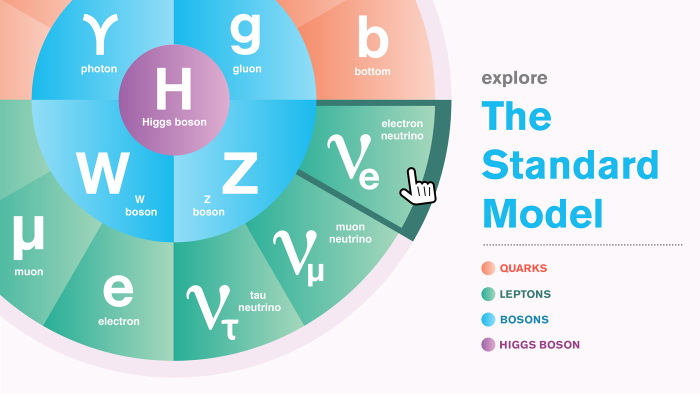
The Standard Model is a kind of periodic table of the elements for particle physics. But instead of listing the chemical elements, it lists the fundamental particles that make up the atoms that make up the chemical elements, along with any other particles that cannot be broken down into any smaller pieces.
The complete Standard Model took a long time to build. Physicist J.J. Thomson discovered the electron in 1897, and scientists at the Large Hadron Collider found the final piece of the puzzle, the Higgs boson, in 2012.
Use this interactive model (based on a design by Walter Murch for the documentary Particle Fever) to explore the different particles that make up the building blocks of our universe.
Quarks
Up Quark
Discovered in:
1968
Mass:
2.3 MeV
Discovered at:
SLAC
Charge:
2/3
Generation:
First
Spin:
1/2
About:
Up and down quarks make up protons and neutrons, which make up the nucleus of every atom.
Charm Quark
Discovered in:
1974
Mass:
1.275 GeV
Discovered at:
Brookhaven & SLAC
Charge:
2/3
Generation:
Second
Spin:
1/2
About:
In 1974, two independent research groups conducting experiments at two independent labs discovered the charm quark, the fourth quark to be found. The surprising discovery forced physicists to reconsider how the universe works at the smallest scale.
Top Quark
Discovered in:
1995
Mass:
173.21 GeV
Discovered at:
Fermilab
Charge:
2/3
Generation:
Third
Spin:
1/2
About:
The top quark is the heaviest quark discovered so far. It has about the same weight as a gold atom. But unlike an atom, it is a fundamental, or elementary, particle; as far as we know, it is not made of smaller building blocks.
Down Quark
Discovered in:
1968
Mass:
4.8 MeV
Discovered at:
SLAC
Charge:
-1/3
Generation:
First
Spin:
1/2
About:
Nobody knows why, but a down quark is a just a little bit heavier than an up quark. If that weren’t the case, the protons inside every atom would decay and the universe would look very different.
Strange Quark
Discovered in:
1947
Mass:
95 MeV
Discovered at:
Manchester University
Charge:
-1/3
Generation:
Second
Spin:
1/2
About:
Scientists discovered particles with “strange" properties many years before it became clear that those strange properties were due to the fact that they all contained a new, “strange” kind of quark. Theorist Murray Gell-Mann was awarded the Nobel Prize for introducing the concepts of strangeness and quarks.
Bottom Quark
Discovered in:
1977
Mass:
4.18 GeV
Discovered at:
Fermilab
Charge:
-1/3
Generation:
Third
Spin:
1/2
About:
This particle is a heavier cousin of the down and strange quarks. Its discovery confirmed that all elementary building blocks of ordinary matter come in three different versions.
Leptons
Electron
Discovered in:
1897
Mass:
0.511 MeV
Discovered at:
Cavendish Laboratory
Charge:
-1
Generation:
First
Spin:
1/2
About:
The electron powers the world. It is the lightest particle with an electric charge and a building block of all atoms. The electron belongs to the family of charged leptons.
Muon
Discovered in:
1937
Mass:
105.66 MeV
Discovered at:
Caltech & Harvard
Charge:
-1
Generation:
Second
Spin:
1/2
About:
The muon is a heavier version of the electron. It rains down on us as it is created in collisions of cosmic rays with the Earth’s atmosphere. When it was discovered in 1937, a physicist asked, “Who ordered that?”
Tau
Discovered in:
1976
Mass:
1776.82 MeV
Discovered at:
SLAC
Charge:
-1
Generation:
Third
Spin:
1/2
About:
The discovery of this particle in 1976 completely surprised scientists. It was the first discovery of a particle of the so-called third generation. It is the third and heaviest of the charged leptons, heavier than both the electron and the muon.
Electron Neutrino
Discovered in:
1956
Mass:
<2 eV
Discovered at:
Savannah River Plant
Charge:
0
Generation:
First
Spin:
1/2
About:
Measurements and calculations in the 1920s led to the prediction of the existence of an elusive particle without electric charge, the neutrino. But it wasn’t until 1956 that scientists observed the signal of an electron neutrino interacting with other particles. Nuclear reactions in the sun and in nuclear power plants produce electron antineutrinos.
Muon Neutrino
Discovered in:
1962
Mass:
<0.19 MeV
Discovered at:
Brookhaven
Charge:
0
Generation:
Second
Spin:
1/2
About:
Neutrinos come in three flavors. The muon neutrino was first discovered in 1962. Neutrino beams from accelerators are typically made up of muon neutrinos and muon antineutrinos.
Tau Neutrino
Discovered in:
2000
Mass:
<18.2 MeV
Discovered at:
Fermilab
Charge:
0
Generation:
Third
Spin:
1/2
About:
Based on theoretical models and indirect observations, scientists expected to find a third generation of neutrino. But it took until 2000 for scientists to develop the technologies to identify the particle tracks created by tau neutrino interactions.
Bosons
Higgs
Photon
Discovered in:
1923
Mass:
<1x10^-18 eV
Discovered at:
Washington University
Charge:
0
Spin:
1
About:
The photon is the only elementary particle visible to the human eye—but only if it has the right energy and frequency (color). It transmits the electromagnetic force between charged particles.
Gluon
Discovered in:
1979
Mass:
0
Discovered at:
DESY
Charge:
0
Spin:
1
About:
The gluon is the glue that holds together quarks to form protons, neutrons and other particles. It mediates the strong nuclear force.
Z Boson
Discovered in:
1983
Mass:
91.1876 GeV
Discovered at:
CERN
Charge:
0
Spin:
1
About:
The Z boson is the electrically neutral cousin of the W boson and a heavy relative of the photon. Together, these particles explain the electroweak force.
W Boson
Discovered in:
1983
Mass:
80.385 GeV
Discovered at:
CERN
Charge:
±1
Spin:
1
About:
The W boson is the only force carrier that has an electric charge. It’s essential for weak nuclear reactions: Without it, the sun would not shine.
Higgs Boson
Discovered in:
2012
Mass:
125.7 GeV
Discovered at:
CERN
Charge:
0
Spin:
0
About:
Discovered in 2012, the Higgs boson was the last missing piece of the Standard Model puzzle. It is a different kind of force carrier from the other elementary forces, and it gives mass to quarks as well as the W and Z bosons. Whether it also gives mass to neutrinos remains to be discovered.
Launch the interactive model »

 Frascati Scienza
 Buco Nero
 Io Non Faccio Niente
 Tommaso Dorigo
 Giovanni Mazzitelli
 Barbara Gallavotti
 Keplero Blog
 Research Gate