
MicroBooNE sees first cosmic muons
The experiment will begin collecting data from a neutrino beam in October.
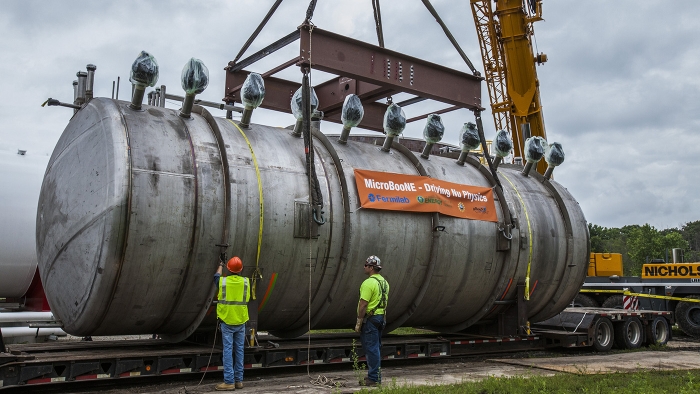
A school bus-sized detector packed with 170 tons of liquid argon has seen its first particle footprints.
On August 6, MicroBooNE, a liquid-argon time projection chamber, or LArTPC, recorded images of the tracks of cosmic muons, particles that shower down on Earth when cosmic rays collide with nuclei in our atmosphere.
"This is the first detector of this size and scale we've ever launched in the US for use in a neutrino beam, so it's a very important milestone for the future of neutrino physics," says Sam Zeller, co-spokesperson for the MicroBooNE collaboration.
Picking up cosmic muons is just one brief stop during MicroBooNE's expedition into particle physics. The centerpiece of the three detectors planned for Fermilab's Short-Baseline Neutrino program, or SBN, MicroBooNE will pursue the much more elusive neutrino, taking data about this weakly interacting particle for about three years.
When beam starts up in October, it will travel 470 meters and then traverse the liquid argon in MicroBooNE, where neutrino interactions will result in tracks that the detector can convert into precise three-dimensional images. Scientists will use these images to investigate anomalies seen in an earlier experiment called MiniBooNE, with the aim to determine whether the excess of low-energy events that MiniBooNE saw was due to a new source of background photons or if there could be additional types of neutrinos beyond the three established flavors.
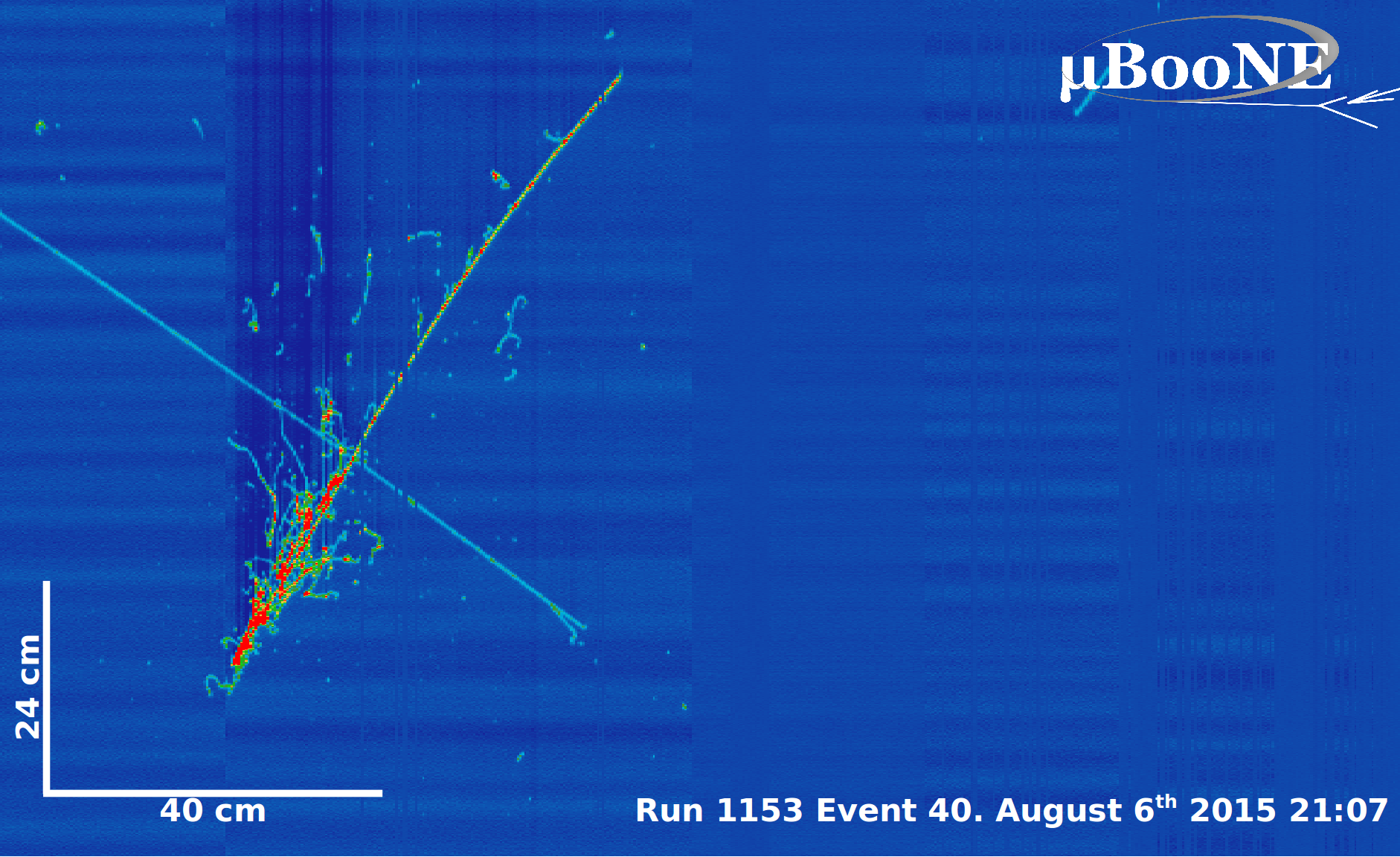
One of the first images of cosmic rays recorded by MicroBooNE.
One of MicroBooNE's goals is to measure how often a neutrino that interacts with an argon atom will produce certain types of particles. A second goal is to conduct R&D for future large-scale LArTPCs.
MicroBooNE will carry signals up to 2.5 meters across the detector, the longest drift ever for a LArTPC in a neutrino beam. This requires a very high voltage and very pure liquid argon. It is also the first time a detector will operate with its electronics submerged in liquid argon on such a large scale. All of these characteristics will be important for future experiments such as the Deep Underground Neutrino Experiment, or DUNE, which plans to use similar technology to probe neutrinos.
"The entire particle physics community worldwide has identified neutrino physics as one of the key lines of research that could help us understand better how to go beyond what we know now," says Matt Toups, run coordinator and co-commissioner for MicroBooNE with Fermilab scientist Bruce Baller. "Those questions that are driving the field, we hope to answer with a very large LArTPC detector."
Another benefit of the experiment, Zeller said, is training the next generation of LArTPC experts for future programs and experiments. MicroBooNE is a collaborative effort of 25 institutions, with 55 students and postdocs working tirelessly to perfect the technology. Collaborators are keeping their eyes on the road toward the future of neutrino physics and liquid-argon technology.
"It's been a long haul," says Bonnie Fleming, MicroBooNE co-spokesperson. "Eight and a half years ago liquid argon was a total underdog. I used to joke that no one would sit next to me at the lunch table. And it's a world of difference now. The field has chosen liquid argon as its future technology, and all eyes are on us to see if our detector will work."
A version of this article was published in Fermilab Today.
MicroBooNE sees first cosmic muons
The experiment will begin collecting data from a neutrino beam in October.
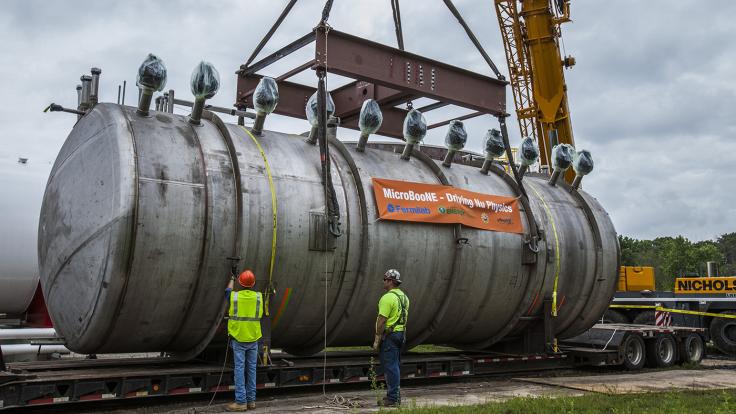
A school bus-sized detector packed with 170 tons of liquid argon has seen its first particle footprints.
On August 6, MicroBooNE, a liquid-argon time projection chamber, or LArTPC, recorded images of the tracks of cosmic muons, particles that shower down on Earth when cosmic rays collide with nuclei in our atmosphere.
"This is the first detector of this size and scale we've ever launched in the US for use in a neutrino beam, so it's a very important milestone for the future of neutrino physics," says Sam Zeller, co-spokesperson for the MicroBooNE collaboration.
Picking up cosmic muons is just one brief stop during MicroBooNE's expedition into particle physics. The centerpiece of the three detectors planned for Fermilab's Short-Baseline Neutrino program, or SBN, MicroBooNE will pursue the much more elusive neutrino, taking data about this weakly interacting particle for about three years.
When beam starts up in October, it will travel 470 meters and then traverse the liquid argon in MicroBooNE, where neutrino interactions will result in tracks that the detector can convert into precise three-dimensional images. Scientists will use these images to investigate anomalies seen in an earlier experiment called MiniBooNE, with the aim to determine whether the excess of low-energy events that MiniBooNE saw was due to a new source of background photons or if there could be additional types of neutrinos beyond the three established flavors.
One of MicroBooNE's goals is to measure how often a neutrino that interacts with an argon atom will produce certain types of particles. A second goal is to conduct R&D for future large-scale LArTPCs.
MicroBooNE will carry signals up to 2.5 meters across the detector, the longest drift ever for a LArTPC in a neutrino beam. This requires a very high voltage and very pure liquid argon. It is also the first time a detector will operate with its electronics submerged in liquid argon on such a large scale. All of these characteristics will be important for future experiments such as the Deep Underground Neutrino Experiment, or DUNE, which plans to use similar technology to probe neutrinos.
"The entire particle physics community worldwide has identified neutrino physics as one of the key lines of research that could help us understand better how to go beyond what we know now," says Matt Toups, run coordinator and co-commissioner for MicroBooNE with Fermilab scientist Bruce Baller. "Those questions that are driving the field, we hope to answer with a very large LArTPC detector."
Another benefit of the experiment, Zeller said, is training the next generation of LArTPC experts for future programs and experiments. MicroBooNE is a collaborative effort of 25 institutions, with 55 students and postdocs working tirelessly to perfect the technology. Collaborators are keeping their eyes on the road toward the future of neutrino physics and liquid-argon technology.
"It's been a long haul," says Bonnie Fleming, MicroBooNE co-spokesperson. "Eight and a half years ago liquid argon was a total underdog. I used to joke that no one would sit next to me at the lunch table. And it's a world of difference now. The field has chosen liquid argon as its future technology, and all eyes are on us to see if our detector will work."
A version of this article was published in Fermilab Today.
Q&A: Underground machinist
Q&A: Underground machinist
What’s it like being the machinist at the deepest machine shop in the world?
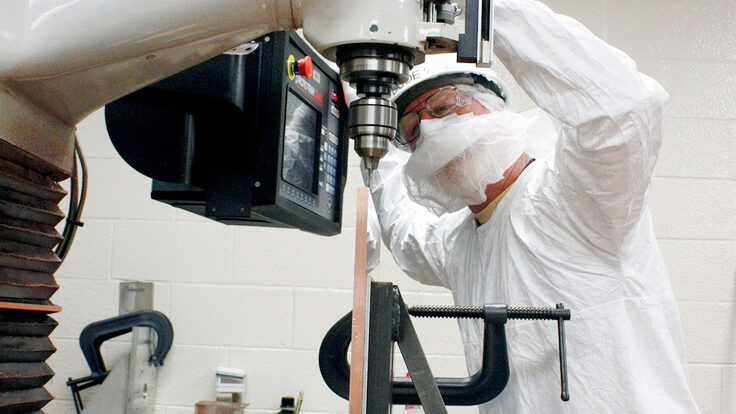
The Majorana Demonstrator searches for a rare decay process a mile below the surface at Sanford Lab in Lead, South Dakota. To craft the experiment’s precise copper parts away from cosmic rays, the lab evolved a unique feature: the deepest machine shop in the world, complete with lathe, CNC mill, wire EDM (electrical discharge machine), 70-ton press and a laser engraver to track the parts.
It is here that Randy Hughes comes to work every day and has for the last three years. He dons two pairs of booties, full white coveralls, glasses, two pairs of gloves and a facemask before he starts machining the majority of the pieces in the experiment, from thick shield plates to microscopic pins.
Hughes, a motorcycle enthusiast and baseball fan from Detroit, brings 40 years of experience as a machinist and toolmaker to the job. He just happened to be working at Adams ISC in Rapid City when the experiment came around looking for a temporary cleanroom. The rest is history.
S: Had you worked on anything of this scale before?
RH: I don’t think anybody has done anything on this scale. I’ve had experiences that were more detailed and demanding as far as the product, but nothing in such an environment as this one.
S: How do you feel about working a mile underground?
RH: At first I was wondering if I was capable. They were preparing me to come down, and I’m wondering if I can handle it, which turned out to be a silly question. It’s like working anywhere else, but without a view. I can’t step outside and look out the window. And I can’t go out for lunch.
S: What’s a typical day?
RH: Presently, I’m finished with the string parts and working mostly on the larger parts, such as the shield. Two years ago, I was working mainly on string parts, which were all the smaller parts. As far as the inventory of what they need, I am winding down to the end of it. The shield parts could wait until the end. They didn’t want the surface to be machined and then sit around.
S: Is there anything that has surprised you about working down here?
RH: The lack of vitamin D. I feel like a mole. On days where I travel to get here, I never see the sun until the weekend. Hopefully it’s sunny out. I travel almost an hour to get here one way. I come through the Black Hills here every day. I like to tell people I have the most beautiful one-hour commute in the country. It’s along a creek and through canyons, and I see elk and eagles and deer.
S: What have been your favorite and least favorite things to work on?
RH: The least favorite thing was the hollow hex rods. Trying to thread them because they are so long, and then cutting the threads with no support and no coolant, has made for a real balancing act as far as not breaking the parts off in the machine. The hex rod is the main building block of the string. There are three of them where each detector is, and it stacks the build together.
Favorite parts, believe it or not, were little things, like the Vespel pins. It’s my favorite because of the sense of pride and the look I get from people when they see how small it is. The parts are no bigger than the ball of a ball-point pen. Vespel pins plug into voltage connectors to hold the wire in place, so it doesn’t get pulled and tugged on other than at that particular point.
S: What is unique about working on this job?
RH: Copper is not something that, as a machinist, you have to spend a lot of time making parts out of. The entire project, from my point of view, has been copper. And copper would be your last choice to make anything out of, for more than one reason. One, you wouldn’t think it would be durable enough, and two, it’s really soft, pliable and gummy, and it creates manufacturing problems.
S: What adaptations have you made?
RH: I’ve had to come up with procedures to accommodate the lack of equipment, tooling, coolant and processability. The way I set the tooling against the part, what kind of feeds and speeds I use to cut and the angle of the tools—it’s a lot of trial and error. I’ve developed a few little tricks that have paid off for me.
S: Do you ever practice on normal copper?
RH: There is some commercial copper down here for a few things, such as the prototype. What I was working on at the beginning was that copper. It machines almost exactly the same, but for the most part, I might be overconfident in my ability and I go at it. As a machinist, I have a machinist attitude: I can do anything. I can make anything.
S: What is the back-and-forth communication between the machine shop and the cleanroom?
RH: I try to build in my head as I’m doing something. If I see something in numbers that doesn’t make sense to me mechanically, all I have to do is pick up a phone or knock on the door, and I can ask them about it.
S: How do you feel about working in a cleanroom every day?
RH: At first, it was unique. And it was kinda novel. But after three years, it’s monotonous and trying. The first thing I do when I get out of this room is take this facemask off. The hood was given up for visibility’s sake. You steam up a lot, and I have my fingers and hands around the machines. I need any kind of help with being able to see where my hands are. Forty years, I still have all my digits.
S: Did you know anything about neutrinos or physics or Sanford Lab before this?
RH: Nooo. This was like a trip into outer space for me. It’s taken me all of these three years of small talk and side talk and listening to the scientists and physicists and students, and a few questions, and having them translate it into layman’s terms. I’ve learned quite a bit about it. And that’s another reward from this job. When I start talking about this project, everybody stops and listens, because it’s unique, and it’s different, and it’s interesting.
S: What are your plans after this?
RH: I’m still employed with Adams, and they’re anticipating my return. They offered me my old position back as shop foreman and are starting to pick up business and would really like to have me back.
S: And you won’t have to wear this getup everyday.
RH: That would be a pleasurable change. But I’ll also be getting dirty every day. The problem with wearing the gloves every day is I’ve lost all the calluses on my hands. And the few times I’ve gone back there and worked, I always seem to get a metal shaving sliver or little cut because my hands are soft. I have to get toughened up again.
Testing the nature of neutrinos
NOvA experiment announces first results
The mystery of particle generations
Why are there three almost identical copies of each particle of matter?

The Standard Model of particles and interactions is remarkably successful for a theory everyone knows is missing big pieces. It accounts for the everyday stuff we know like protons, neutrons, electrons and photons, and even exotic stuff like Higgs bosons and top quarks. But it isn’t complete; it doesn’t explain phenomena such as dark matter and dark energy.
The Standard Model is successful because it is a useful guide to the particles of matter we see. One convenient pattern that has proven valuable is generations. Each particle of matter seems to come in three different versions, differentiated only by mass.
Scientists wonder whether that pattern has a deeper explanation or if it’s just convenient for now, to be superseded by a deeper truth.
The next generations
The Standard Model is a menu listing all of the known fundamental particles: particles that cannot be broken down into constituent parts. It distinguishes between the fermions, which are particles of matter, and the bosons, which carry forces.
The matter particles include six quarks and six leptons. The six quarks are called the up, down, charm, strange, top and bottom quark. Quarks typically don’t exist as single particles but lump together to form heavier particles such as protons and neutrons. Leptons include electrons and their cousins the muons and tau particles, along with the three types of neutrinos.
All of these matter particles fall into three “generations.”
“The three generations are literally copy-paste of the first generation,” says Carleton University physicist Heather Logan. The up, charm and top quarks have the same electric charge, along with the same weak and strong interactions—they primarily differ in the mass, which comes from the Higgs field. The same thing holds for the down, strange and bottom quarks, along with the electron, muon and tau leptons.
“The fact that the three generations couple differently to the Higgs sector is maybe telling us something, but we don't really know what yet,” Logan says. Most of the generations differ in mass by a lot. For example, the tau lepton is roughly 3600 times more massive than the electron, and the top quark is nearly 100,000 times heavier than the up quark. That difference manifests itself in stability: The heavier generations decay into the lighter generations, until they reach the lightest, which are (as far as we can tell) stable forever.
The generations play a big role in experiments. The Higgs boson, for instance, is an unstable particle that decays into a variety of other particles, including tau leptons. “Since the tau is the heaviest, the Higgs [boson] prefers to change into taus more than electrons or muons,” says Clara Nellist, an experimental particle physicist at the Laboratoire de l'Accélérateur Linéaire (LAL) in Orsay, France. “The best way to study how the Higgs interacts with leptons is by looking at a Higgs changing into two taus.”
That sort of observation is the heart of Standard Model physics: Crash two or more particles together, watch what new particles are born, look for patterns in the detritus, and—if we’re really lucky—see what doesn’t fit into the map we have.
Roads outward
While some stuff like dark matter obviously lies outside the charts, the Standard Model itself has a few problems. For example, neutrinos should be massless according to the Standard Model, but real-world experiments show they have very tiny masses. And unlike quarks and electrically charged leptons, the mass differences between the generations of neutrinos are very small, which is why we see them oscillating from one type to another.
Without mass, neutrinos are exactly identical; with the mass, they’re different. And that generational difference is puzzling to theorist Richard Ruiz of the University of Pittsburgh. “There is a pattern here staring at us but we cannot quite figure out how to make sense of it.”
Even if there is only the one Standard Model Higgs, we can learn a lot by how it interacts and decays. For instance, Nellist says, “by studying how often the Higgs boson changes into taus compared to other particles, we can test the validity of the Standard Model and see if there are hints of other generations.”
It’s unlikely, since any fourth generation quark would need to be far more massive even than the top quark. But any anomaly in Higgs decay could tell us a lot.
“Nobody knows why there are three generations,” Logan says. However, the structure of the Standard Model is a clue to what might be beyond, including the theory known as Supersymmetry: “If there are supersymmetric partners of the fermions, they should also fall into the three generations. How their masses are set might give us clues to understanding how the masses of the Standard Model fermions are set and why we have those patterns.”
No matter how many there are, nobody knows why there are generations to begin with. “‘Generations’ is just a conventional organization of the Standard Model’s matter content,” Ruiz says. That organization might survive in a deeper theory (for instance, theories in which quarks are made up of smaller particles called “preons”, which are unlikely based on present data), but new ideas would have to explain why the quarks and leptons seem to fall into the patterns they do.
Ultimately, even though the Standard Model is not the final description of the cosmos, it’s been a good guide so far. As we look for the edges of the map it provides, we get closer to a true and accurate chart of all the particles and their interactions.

 Frascati Scienza
 Buco Nero
 Io Non Faccio Niente
 Tommaso Dorigo
 Giovanni Mazzitelli
 Barbara Gallavotti
 Keplero Blog
 Research Gate