
All about supernovae
Exploding stars have an immense capacity to destroy—and create.

Somewhere in the cosmos, a star is reaching the end of its life.
Maybe it’s a massive star, collapsing under its own gravity. Or maybe it’s a dense cinder of a star, greedily stealing matter from a companion star until it can’t handle its own mass.
Whatever the reason, this star doesn’t fade quietly into the dark fabric of space and time. It goes kicking and screaming, exploding its stellar guts across the universe, leaving us with unparalleled brightness and a tsunami of particles and elements. It becomes a supernova. Here are ten facts about supernovae that will blow your mind.

1. The oldest recorded supernova dates back almost 2000 years
In 185 AD, Chinese astronomers noticed a bright light in the sky. Documenting their observations in the Book of Later Han, these ancient astronomers noted that it sparkled like a star, appeared to be half the size of a bamboo mat and did not travel through the sky like a comet. Over the next eight months this celestial visitor slowly faded from sight. They called it a “guest star.”
Two millennia later, in the 1960s, scientists found hints of this mysterious visitor in the remnants of a supernova approximately 8000 light-years away. The supernova, SN 185, is the oldest known supernova recorded by humankind.
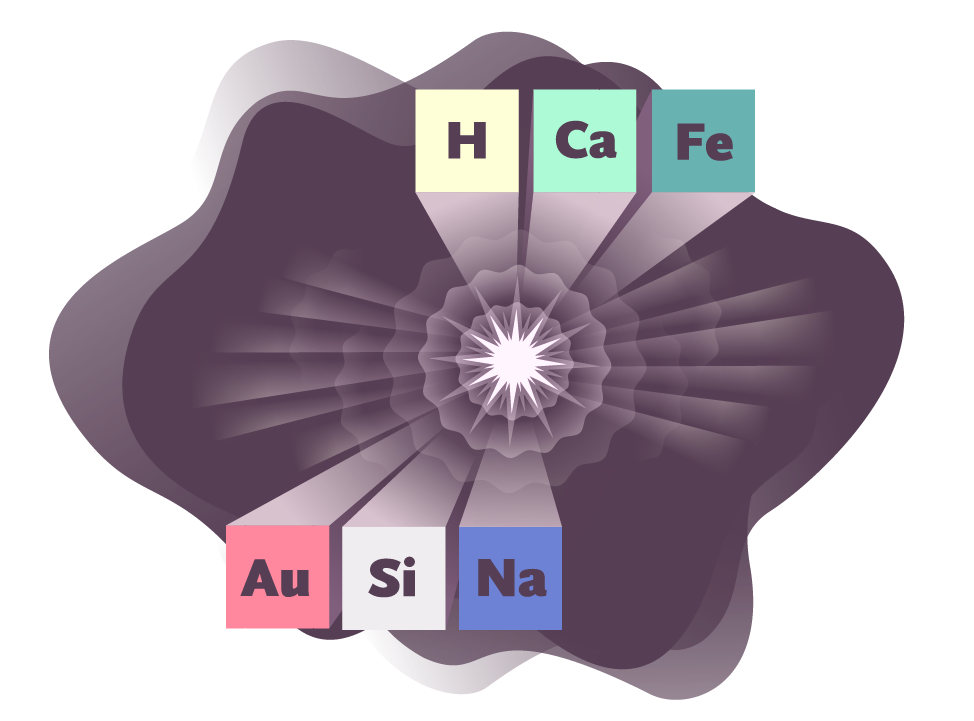
2. Many of the elements we’re made of come from supernovae
Everything from the oxygen you’re breathing to the calcium in your bones, the iron in your blood and the silicon in your computer was brewed up in the heart of a star.
As a supernova explodes, it unleashes a hurricane of nuclear reactions. These nuclear reactions produce many of the building blocks of the world around us. The lion’s share of elements between oxygen and iron comes from core-collapse supernovae, those massive stars that collapse under their own gravity. They share the responsibility of producing the universe’s iron with thermonuclear supernovae, white dwarves that steal mass from their binary companions. Scientists also believe supernovae are a key site for the production of most of the elements heavier than iron.
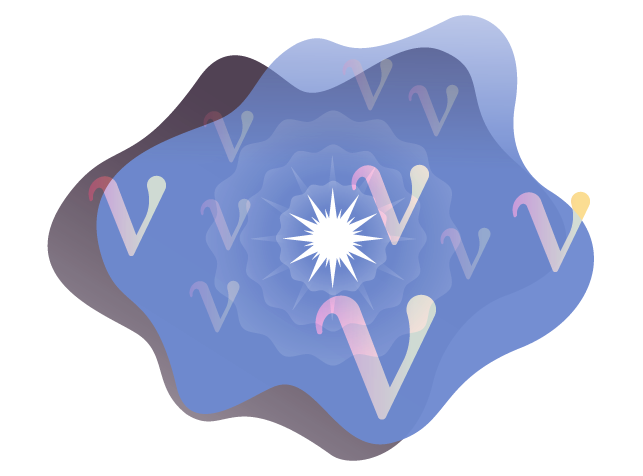
3. Supernovae are neutrino factories
In a 10-second period, a core-collapse supernova will release a burst of more than 1058 neutrinos, ghostly particles that can travel undisturbed through almost everything in the universe.
Outside of the core of a supernova, it would take a light-year of lead to stop a neutrino. But when a star explodes, the center can become so dense that even neutrinos take a little while to escape. When they do escape, neutrinos carry away 99 percent of the energy of the supernova.
Scientists watch for that burst of neutrinos using an early warning system called SNEWS. SNEWS is a network of neutrino detectors across the world. Each detector is programmed to send a datagram to a central computer whenever it sees a burst of neutrinos. If more than two experiments observe a burst within 10 seconds, the computer issues an automatic alert to the astronomical community to look out for an exploding star.
But you don’t have to be an expert astronomer to receive an alert. Anyone can sign up to be among the first to know that a star's core has collapsed.

4. Supernovae are powerful particle accelerators
Supernovae are natural space laboratories; they can accelerate particles to at least 1000 times the energy of particles in the Large Hadron Collider, the most powerful collider on Earth.
The interaction between the blast of a supernova and the surrounding interstellar gas creates a magnetized region, called a shock. As particles move into the shock, they bounce around the magnetic field and get accelerated, much like a basketball being dribbled closer and closer to the ground. When they are released into space, some of these high-energy particles, called cosmic rays, eventually slam into our atmosphere, colliding with atoms and creating showers of secondary particles that rain down on our heads.

5. Supernovae produce radioactivity
In addition to forging elements and neutrinos, the nuclear reactions inside of supernovae also cook up radioactive isotopes. Some of this radioactivity emits light signals, such as gamma rays, that we can see in space.
This radioactivity is part of what makes supernovae so bright. It also provides us with a way to determine if any supernovae have blown up near Earth. If a supernova occurred close enough to our planet, we’d be sprayed with some of these unstable nuclei. So when scientists come across layers of sediment with spikes of radioactive isotopes, they know to investigate whether what they’ve found was spit out by an exploding star.
In 1998, physicists analyzed crusts from the bottom of the ocean and found layers with a surge of 60Fe, a rare radioactive isotope of iron that can be created in copious amounts inside supernovae. Using the rate at which 60Fe decays over time, they were able to calculate how long ago it landed on Earth. They determined that it was most likely dumped on our planet by a nearby supernova about 2.8 million years ago.

6. A nearby supernova could cause a mass extinction
If a supernova occurred close enough, it could be pretty bad news for our planet. Although we’re still not sure about all the ways being in the midst of an exploding star would affect us, we do know that supernovae emit truckloads of high-energy photons such as X-rays and gamma rays. The incoming radiation would strip our atmosphere of its ozone. All of the critters in our food chain from the bottom up would fry in the sun’s ultraviolet rays until there was nothing left on our planet but dirt and bones.
Statistically speaking, a supernova in our own galaxy has been a long time coming.
Supernovae occur in our galaxy at a rate of about one or two per century. Yet we haven’t seen a supernova in the Milky Way in around 400 years. The most recent nearby supernova was observed in 1987, and it wasn’t even in our galaxy. It was in a nearby satellite galaxy called the Large Magellanic Cloud.
But death by supernova probably isn’t something you have to worry about in your lifetime, or your children’s or grandchildren’s or great-great-great-grandchildren’s lifetime. IK Pegasi, the closest candidate we have for a supernova, is 150 light-years away—too far to do any real damage to Earth.
Even that 2.8-million-year-old supernova that ejected its radioactive insides into our oceans was at least 100 light-years from Earth, which was not close enough to cause a mass-extinction. The physicists deemed it a “near miss.”
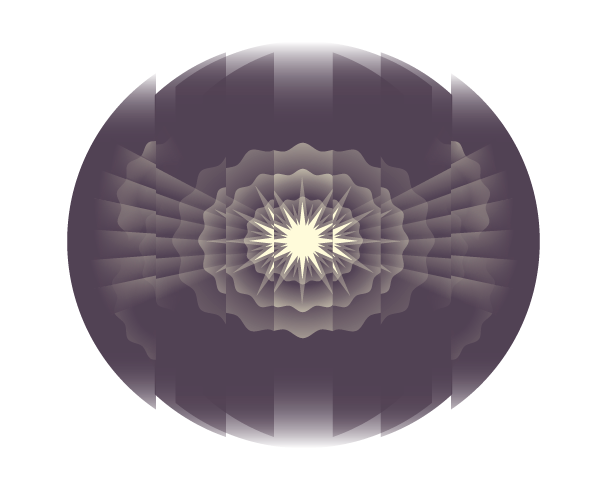
7. Supernovae light can echo through time
Just as your voice echoes when its sound waves bounce off a surface and come back again, a supernova echoes in space when its light waves bounce off cosmic dust clouds and redirect themselves toward Earth.
Because the echoed light takes a scenic route to our planet, this phenomenon opens a portal to the past, allowing scientists to look at and decode supernovae that occurred hundreds of years ago. A recent example of this is SN1572, or Tycho’s supernova, a supernova that occurred in 1572. This supernova shined brighter than Venus, was visible in daylight and took two years to dim from the sky.
In 2008, astronomers found light waves originating from the cosmic demolition site of the original star. They determined that they were seeing light echoes from Tycho’s supernova. Although the light was 20 billion times fainter than what astronomer Tycho Brahe observed in 1572, scientists were able to analyze its spectrum and classify the supernova as a thermonuclear supernova.
More than four centuries after its explosion, light from this historical supernova is still arriving at Earth.

8. Supernovae were used to discover dark energy
Because thermonuclear supernovae are so bright, and because their light brightens and dims in a predictable way, they can be used as lighthouses for cosmology.
In 1998, scientists thought that cosmic expansion, initiated by the big bang, was likely slowing down over time. But supernova studies suggested that the expansion of the universe was actually speeding up.
Scientists can measure the true brightness of supernovae by looking at the timescale over which they brighten and fade. By comparing how bright these supernovae appear with how bright they actually are, scientists are able to determine how far away they are.
Scientists can also measure the increase in the wavelength of a supernova’s light as it moves farther and farther away from us. This is called the redshift.
Comparing the redshift with the distances of supernovae allowed scientists to infer how the rate of expansion has changed over the history of the universe. Scientists believe that the culprit for this cosmic acceleration is something called dark energy.

9. Supernovae occur at a rate of approximately 10 per second
By the time you reach the end of this sentence, it is likely a star will have exploded somewhere in the universe.
As scientists evolve better techniques to explore space, the number of supernovae they discover increases. Currently they find over a thousand supernovae per year.
But when you look deep into the night sky at bright lights shining from billions of light-years away, you’re actually looking into the past. The supernovae that scientists are detecting stretch back to the very beginning of the universe. By adding up all of the supernovae they’ve observed, scientists can figure out the rate at which supernovae occur across the entire universe.
Scientists estimate about 10 supernovae occur per second, exploding in space like popcorn in the microwave.

10. We’re about to get much better at detecting far-away supernovae
Even though we’ve been aware of these exploding stars for millennia, there’s still so much we don’t know about them. There are two known types of supernovae, but there are many different varieties that scientists are still learning about.
Supernovae could result from the merger of two white dwarfs. Alternatively, the rotation of a star could create a black hole that accretes material and launches a jet through the star. Or the density of a star’s core could be so high that it starts creating electron-positron pairs, causing a chain reaction in the star.
Right now, scientists are mapping the night sky with the Dark Energy Survey, or DES. Scientists can discover new supernova explosions by looking for changes in the images they take over time.
Another survey currently going on is the All-Sky Automated Survey for Supernovae, or the ASAS-SN, which recently observed the most luminous supernova ever discovered.
In 2019, the Large Synoptic Survey Telescope, or LSST, will revolutionize our understanding of supernovae. LSST is designed to collect more light and peer deeper into space than ever before. It will move rapidly across the sky and take more images in larger chunks than previous surveys. This will increase the number of supernovae we see by hundreds of thousands per year.
Studying these astral bombs will expand our knowledge of space and bring us even closer to understanding not just our origin, but the cosmic reach of the universe.
All about supernovae
Exploding stars have an immense capacity to destroy—and create.

Somewhere in the cosmos, a star is reaching the end of its life.
Maybe it’s a massive star, collapsing under its own gravity. Or maybe it’s a dense cinder of a star, greedily stealing matter from a companion star until it can’t handle its own mass.
Whatever the reason, this star doesn’t fade quietly into the dark fabric of space and time. It goes kicking and screaming, exploding its stellar guts across the universe, leaving us with unparalleled brightness and a tsunami of particles and elements. It becomes a supernova. Here are ten facts about supernovae that will blow your mind.
1. The oldest recorded supernova dates back almost 2000 years
In 185 AD, Chinese astronomers noticed a bright light in the sky. Documenting their observations in the Book of Later Han, these ancient astronomers noted that it sparkled like a star, appeared to be half the size of a bamboo mat and did not travel through the sky like a comet. Over the next eight months this celestial visitor slowly faded from sight. They called it a “guest star.”
Two millennia later, in the 1960s, scientists found hints of this mysterious visitor in the remnants of a supernova approximately 8000 light-years away. The supernova, SN 185, is the oldest known supernova recorded by humankind.
2. Many of the elements we’re made of come from supernovae
Everything from the oxygen you’re breathing to the calcium in your bones, the iron in your blood and the silicon in your computer was brewed up in the heart of a star.
As a supernova explodes, it unleashes a hurricane of nuclear reactions. These nuclear reactions produce many of the building blocks of the world around us. The lion’s share of elements between oxygen and iron comes from core-collapse supernovae, those massive stars that collapse under their own gravity. They share the responsibility of producing the universe’s iron with thermonuclear supernovae, white dwarves that steal mass from their binary companions. Scientists also believe supernovae are a key site for the production of most of the elements heavier than iron.
3. Supernovae are neutrino factories
In a 10-second period, a core-collapse supernova will release a burst of more than 1058 neutrinos, ghostly particles that can travel undisturbed through almost everything in the universe.
Outside of the core of a supernova, it would take a light-year of lead to stop a neutrino. But when a star explodes, the center can become so dense that even neutrinos take a little while to escape. When they do escape, neutrinos carry away 99 percent of the energy of the supernova.
Scientists watch for that burst of neutrinos using an early warning system called SNEWS. SNEWS is a network of neutrino detectors across the world. Each detector is programmed to send a datagram to a central computer whenever it sees a burst of neutrinos. If more than two experiments observe a burst within 10 seconds, the computer issues an automatic alert to the astronomical community to look out for an exploding star.
But you don’t have to be an expert astronomer to receive an alert. Anyone can sign up to be among the first to know that a star's core has collapsed.
4. Supernovae are powerful particle accelerators
Supernovae are natural space laboratories; they can accelerate particles to at least 1000 times the energy of particles in the Large Hadron Collider, the most powerful collider on Earth.
The interaction between the blast of a supernova and the surrounding interstellar gas creates a magnetized region, called a shock. As particles move into the shock, they bounce around the magnetic field and get accelerated, much like a basketball being dribbled closer and closer to the ground. When they are released into space, some of these high-energy particles, called cosmic rays, eventually slam into our atmosphere, colliding with atoms and creating showers of secondary particles that rain down on our heads.
5. Supernovae produce radioactivity
In addition to forging elements and neutrinos, the nuclear reactions inside of supernovae also cook up radioactive isotopes. Some of this radioactivity emits light signals, such as gamma rays, that we can see in space.
This radioactivity is part of what makes supernovae so bright. It also provides us with a way to determine if any supernovae have blown up near Earth. If a supernova occurred close enough to our planet, we’d be sprayed with some of these unstable nuclei. So when scientists come across layers of sediment with spikes of radioactive isotopes, they know to investigate whether what they’ve found was spit out by an exploding star.
In 1998, physicists analyzed crusts from the bottom of the ocean and found layers with a surge of 60Fe, a rare radioactive isotope of iron that can be created in copious amounts inside supernovae. Using the rate at which 60Fe decays over time, they were able to calculate how long ago it landed on Earth. They determined that it was most likely dumped on our planet by a nearby supernova about 2.8 million years ago.
6. A nearby supernova could cause a mass extinction
If a supernova occurred close enough, it could be pretty bad news for our planet. Although we’re still not sure about all the ways being in the midst of an exploding star would affect us, we do know that supernovae emit truckloads of high-energy photons such as X-rays and gamma rays. The incoming radiation would strip our atmosphere of its ozone. All of the critters in our food chain from the bottom up would fry in the sun’s ultraviolet rays until there was nothing left on our planet but dirt and bones.
Statistically speaking, a supernova in our own galaxy has been a long time coming.
Supernovae occur in our galaxy at a rate of about one or two per century. Yet we haven’t seen a supernova in the Milky Way in around 400 years. The most recent nearby supernova was observed in 1987, and it wasn’t even in our galaxy. It was in a nearby satellite galaxy called the Large Magellanic Cloud.
But death by supernova probably isn’t something you have to worry about in your lifetime, or your children’s or grandchildren’s or great-great-great-grandchildren’s lifetime. IK Pegasi, the closest candidate we have for a supernova, is 150 light-years away—too far to do any real damage to Earth.
Even that 2.8-million-year-old supernova that ejected its radioactive insides into our oceans was at least 100 light-years from Earth, which was not close enough to cause a mass-extinction. The physicists deemed it a “near miss.”
7. Supernovae light can echo through time
Just as your voice echoes when its sound waves bounce off a surface and come back again, a supernova echoes in space when its light waves bounce off cosmic dust clouds and redirect themselves toward Earth.
Because the echoed light takes a scenic route to our planet, this phenomenon opens a portal to the past, allowing scientists to look at and decode supernovae that occurred hundreds of years ago. A recent example of this is SN1572, or Tycho’s supernova, a supernova that occurred in 1572. This supernova shined brighter than Venus, was visible in daylight and took two years to dim from the sky.
In 2008, astronomers found light waves originating from the cosmic demolition site of the original star. They determined that they were seeing light echoes from Tycho’s supernova. Although the light was 20 billion times fainter than what astronomer Tycho Brahe observed in 1572, scientists were able to analyze its spectrum and classify the supernova as a thermonuclear supernova.
More than four centuries after its explosion, light from this historical supernova is still arriving at Earth.
8. Supernovae were used to discover dark energy
Because thermonuclear supernovae are so bright, and because their light brightens and dims in a predictable way, they can be used as lighthouses for cosmology.
In 1998, scientists thought that cosmic expansion, initiated by the big bang, was likely slowing down over time. But supernova studies suggested that the expansion of the universe was actually speeding up.
Scientists can measure the true brightness of supernovae by looking at the timescale over which they brighten and fade. By comparing how bright these supernovae appear with how bright they actually are, scientists are able to determine how far away they are.
Scientists can also measure the increase in the wavelength of a supernova’s light as it moves farther and farther away from us. This is called the redshift.
Comparing the redshift with the distances of supernovae allowed scientists to infer how the rate of expansion has changed over the history of the universe. Scientists believe that the culprit for this cosmic acceleration is something called dark energy.
9. Supernovae occur at a rate of approximately 10 per second
By the time you reach the end of this sentence, it is likely a star will have exploded somewhere in the universe.
As scientists evolve better techniques to explore space, the number of supernovae they discover increases. Currently they find over a thousand supernovae per year.
But when you look deep into the night sky at bright lights shining from billions of light-years away, you’re actually looking into the past. The supernovae that scientists are detecting stretch back to the very beginning of the universe. By adding up all of the supernovae they’ve observed, scientists can figure out the rate at which supernovae occur across the entire universe.
Scientists estimate about 10 supernovae occur per second, exploding in space like popcorn in the microwave.
10. We’re about to get much better at detecting far-away supernovae
Even though we’ve been aware of these exploding stars for millennia, there’s still so much we don’t know about them. There are two known types of supernovae, but there are many different varieties that scientists are still learning about.
Supernovae could result from the merger of two white dwarfs. Alternatively, the rotation of a star could create a black hole that accretes material and launches a jet through the star. Or the density of a star’s core could be so high that it starts creating electron-positron pairs, causing a chain reaction in the star.
Right now, scientists are mapping the night sky with the Dark Energy Survey, or DES. Scientists can discover new supernova explosions by looking for changes in the images they take over time.
Another survey currently going on is the All-Sky Automated Survey for Supernovae, or the ASAS-SN, which recently observed the most luminous supernova ever discovered.
In 2019, the Large Synoptic Survey Telescope, or LSST, will revolutionize our understanding of supernovae. LSST is designed to collect more light and peer deeper into space than ever before. It will move rapidly across the sky and take more images in larger chunks than previous surveys. This will increase the number of supernovae we see by hundreds of thousands per year.
Studying these astral bombs will expand our knowledge of space and bring us even closer to understanding not just our origin, but the cosmic reach of the universe.
Q&A: Marcelle Soares-Santos
Scientist Marcelle Soares-Santos talks about Brazil, neutron stars and a love of discovery.

Marcelle Soares-Santos has been exploring the cosmos since she was an undergraduate at the Federal University of Espirito Santo in southeast Brazil. She received her PhD from the University of São Paulo and is currently an astrophysicist on the Dark Energy Survey based at Fermi National Accelerator Laboratory outside Chicago.
Soares-Santos has worked at Fermilab for only five years, but she has already made a significant impact: In 2014, she was bestowed the Alvin Tollestrup Award for postdoctoral research. Now she is embarking on a new study to measure gravitational waves from neutron star collisions.
S: You recently attended the LISHEP conference, a high-energy physics conference held annually in Brazil. This year it was held in the region of Manaus, near your childhood home. What was it like to grow up there?
MS: Manaus is very different from the region that I think most foreigners know, Rio or São Paulo, but it’s very beautiful, very interesting. When I was four, my father worked for a mining company, and they found a huge reserve of iron ore in the middle of the Amazon forest. All over Brazil, people got offers from that company to get some extra benefits, which was very good for us because one of the benefits was a chance to go a good school there.
S: When did you get interested in physics?
MS: That was very early on, when I was a little kid. I didn’t know that it was physics I wanted to do, but I knew I wanted to do science. I tend to say that I lacked any other talents. I could not play any sport, I wasn’t good in the arts. But math and science, that was something I was good at.
These days I look back and feel that, had I known what I know today, I might not have had this confidence, because I understand now how lots of people are not encouraged to view physics as a topic they can handle. But back then I had a little bit of blind faith in the school system.
S: You work on the Dark Energy Survey. When did the interest in astrophysics kick in?
MS: I did an undergraduate research project. In Brazil, there is a program of research initiation where undergraduates can work for an entire year on a particular topic. My supervisor’s research was related to dark energy and gravitational waves. It’s interesting, because today I work on those two topics from a completely different perspective.
S: You’re also starting on a new project to study gravitational waves. What’s that about?
MS: For the first time we are building detectors that will be able to detect gravitational waves, not from cosmological sources, but from colliding neutron stars. These events are very rare, but we know they occur, and we can calculate how much gravitational wave emission there will be. The detectors are now reaching the sensitivity that they can see that. There’s LIGO in the United States and VIRGO in Europe.
Relying solely on gravitational waves, it’s possible only to roughly localize in the sky where the star collision happens. But we also have the Dark Energy Camera, so we can use it to find the optical counterpart—lots and lots of photons—and pinpoint the event picked up by the gravitational wave detector.
If we see the collision, we will be the first ones to see it based on a gravitational wave signal. That will be really cool.
S: How did the project get started? What is it called?
MS: I saw an announcement that LIGO was going to start operating this year, and I thought, “DECam would be great for this.” I talked to Jim Annis [at Fermilab] and said, “Look, look at this. It would be cool.” And he said, “Yeah, it would.”
It’s called the DES-GW project. It will start up in September. Groups from Fermilab, the University of Chicago, University of Pennsylvania and Harvard are participating.
S: What’s your favorite thing about what you do?
MS: Building these crazy ideas to become a reality. That’s the fun part of it. Of course, it’s not always possible, and we have more ideas than we can actually realize, but if you get to do one, it’s really cool. Part of the reason I moved from theory [as a graduate student] to experiment is that I wanted to do something where you actually get to close the loop of answering a question.
S: Has anything about being a scientist surprised you?
MS: In the beginning I thought I’d never be the person doing hands-on work on detector. I thought of myself more as someone who would be sitting in front of a computer. And it’s true that I spend most of my time sitting in front of the computer, but I also get a chance to go to Chile [where the Dark Energy Camera is located] and take data, be at the lab and get my hands dirty. Back then I thought that was more the role of an engineer than a scientist. I learned it doesn’t matter the label. It is a part of the job, and it’s a fun part.
S:In June 2014 Fermilab posted a Facebook post about you winning the Alvin Tollestrup Award. It received by far more likes than any Fermilab post up to that point, and most were pouring in from Brazil. What was behind its popularity?
MS:That was surprising for me. Typically whenever there is something on Facebook related to what I do, my parents will be excited about it and repost, so I get a few likes and reposts from relatives and friends. This one, I don’t know what happened. I think in part there was a little bit of pride, people seeing a Brazilian being successful abroad.
I got lots of friend requests from people I’ve never met before. I got questions from high schoolers about physics and how to pursue a physics education. It’s a big responsibility to say something. What do you say to people? I tried to answer reasonably and tell them my experience. It was my 15 minutes of fame in social media.
Q&A: Marcelle Soares-Santos
Scientist Marcelle Soares-Santos talks about Brazil, neutron stars and a love of discovery.

Marcelle Soares-Santos has been exploring the cosmos since she was an undergraduate at the Federal University of Espirito Santo in southeast Brazil. She received her PhD from the University of São Paulo and is currently an astrophysicist on the Dark Energy Survey based at Fermi National Accelerator Laboratory outside Chicago.
Soares-Santos has worked at Fermilab for only five years, but she has already made a significant impact: In 2014, she was bestowed the Alvin Tollestrup Award for postdoctoral research. Now she is embarking on a new study to measure gravitational waves from neutron star collisions.
S: You recently attended the LISHEP conference, a high-energy physics conference held annually in Brazil. This year it was held in the region of Manaus, near your childhood home. What was it like to grow up there?
MS: Manaus is very different from the region that I think most foreigners know, Rio or São Paulo, but it’s very beautiful, very interesting. When I was four, my father worked for a mining company, and they found a huge reserve of iron ore in the middle of the Amazon forest. All over Brazil, people got offers from that company to get some extra benefits, which was very good for us because one of the benefits was a chance to go a good school there.
S: When did you get interested in physics?
MS: That was very early on, when I was a little kid. I didn’t know that it was physics I wanted to do, but I knew I wanted to do science. I tend to say that I lacked any other talents. I could not play any sport, I wasn’t good in the arts. But math and science, that was something I was good at.
These days I look back and feel that, had I known what I know today, I might not have had this confidence, because I understand now how lots of people are not encouraged to view physics as a topic they can handle. But back then I had a little bit of blind faith in the school system.
S: You work on the Dark Energy Survey. When did the interest in astrophysics kick in?
MS: I did an undergraduate research project. In Brazil, there is a program of research initiation where undergraduates can work for an entire year on a particular topic. My supervisor’s research was related to dark energy and gravitational waves. It’s interesting, because today I work on those two topics from a completely different perspective.
S: You’re also starting on a new project to study gravitational waves. What’s that about?
MS: For the first time we are building detectors that will be able to detect gravitational waves, not from cosmological sources, but from colliding neutron stars. These events are very rare, but we know they occur, and we can calculate how much gravitational wave emission there will be. The detectors are now reaching the sensitivity that they can see that. There’s LIGO in the United States and VIRGO in Europe.
Relying solely on gravitational waves, it’s possible only to roughly localize in the sky where the star collision happens. But we also have the Dark Energy Camera, so we can use it to find the optical counterpart—lots and lots of photons—and pinpoint the event picked up by the gravitational wave detector.
If we see the collision, we will be the first ones to see it based on a gravitational wave signal. That will be really cool.
S: How did the project get started? What is it called?
MS: I saw an announcement that LIGO was going to start operating this year, and I thought, “DECam would be great for this.” I talked to Jim Annis [at Fermilab] and said, “Look, look at this. It would be cool.” And he said, “Yeah, it would.”
It’s called the DES-GW project. It will start up in September. Groups from Fermilab, the University of Chicago, University of Pennsylvania and Harvard are participating.
S: What’s your favorite thing about what you do?
MS: Building these crazy ideas to become a reality. That’s the fun part of it. Of course, it’s not always possible, and we have more ideas than we can actually realize, but if you get to do one, it’s really cool. Part of the reason I moved from theory [as a graduate student] to experiment is that I wanted to do something where you actually get to close the loop of answering a question.
S: Has anything about being a scientist surprised you?
MS: In the beginning I thought I’d never be the person doing hands-on work on detector. I thought of myself more as someone who would be sitting in front of a computer. And it’s true that I spend most of my time sitting in front of the computer, but I also get a chance to go to Chile [where the Dark Energy Camera is located] and take data, be at the lab and get my hands dirty. Back then I thought that was more the role of an engineer than a scientist. I learned it doesn’t matter the label. It is a part of the job, and it’s a fun part.
S:In June 2014 Fermilab posted a Facebook post about you winning the Alvin Tollestrup Award. It received by far more likes than any Fermilab post up to that point, and most were pouring in from Brazil. What was behind its popularity?
MS:That was surprising for me. Typically whenever there is something on Facebook related to what I do, my parents will be excited about it and repost, so I get a few likes and reposts from relatives and friends. This one, I don’t know what happened. I think in part there was a little bit of pride, people seeing a Brazilian being successful abroad.
I got lots of friend requests from people I’ve never met before. I got questions from high schoolers about physics and how to pursue a physics education. It’s a big responsibility to say something. What do you say to people? I tried to answer reasonably and tell them my experience. It was my 15 minutes of fame in social media.
The age of the universe
The age of the universe
How can we figure out when the universe began?

Looking out from our planet at the vast array of stars, humans have always asked questions central to our origin: How did all of this come to be? Has it always existed? If not, how and when did it begin?
How can we determine the history of something so complex when we were not around to witness its birth?
Scientists have used several methods: checking the age of the oldest objects in the universe, determining the expansion rate of the universe to trace backward in time, and using measurements of the cosmic microwave background to figure out the initial conditions of the universe and its evolution.
Hubble and an expanding universe
In the early 1900s, there was no such concept of the age of the universe, says Stanford University associate professor Chao-Lin Kuo of SLAC National Accelerator Laboratory. “Philosophers and physicists thought the universe had no beginning and no end.”
Then in the 1920s, mathematician Alexander Friedmann predicted an expanding universe. Edwin Hubble confirmed this when he discovered that many galaxies were moving away from our own at high speeds. Hubble measured several of these galaxies and in 1929 published a paper stating the universe is getting bigger.
Scientists then realized that they could wind this expansion back in time to a point when it all began. “So it was not until Friedmann and Hubble that the concept of a birth of the universe started,” Kuo says.
Tracing the expansion of the universe back in time is called finding its “dynamical age,” says Nobel Laureate Adam Riess, professor of astronomy and physics at Johns Hopkins University.
“We know the universe is expanding, and we think we understand the expansion history,” he says. “So like a movie, you can run it backwards until everything is on top of everything in the big bang.”
The expansion rate of the universe is known as the Hubble constant.

The Hubble puzzle
The Hubble constant has not been easy to measure, and the number has changed several times since the 1930s, Kuo says.
One way to check the Hubble constant is to compare its prediction for the age of the universe with the age of the oldest objects we can see. At the very least, the universe should be older than the objects it contains.
Scientists can estimate the age of very old stars that have burned out—called white dwarfs—by determining how long they have been cooling. Scientists can also estimate the age of globular clusters, large clusters of old stars that formed at roughly the same time.
They have estimated the oldest objects to be between 12 billion and 13 billion years old.
In the 1990s, scientists were puzzled when they found that their estimate of the age of the universe—based on their measurement of the Hubble constant—was several billion years younger than the age of these oldest stars.
However, in 1998, Riess and colleagues Saul Perlmutter of Lawrence Berkeley National Laboratory and Brian Schmidt of the Australian National Lab found the root of the problem: The universe wasn’t expanding at a steady rate. It was accelerating.
They figured this out by observing a type of supernova, the explosion of a star at the end of its life. Type 1a supernovae explode with uniform brightness, and light travels at a constant speed. By observing several different Type 1a supernovae, the scientists were able to calculate their distance from the Earth and how long the light took to get here.
“Supernovae are used to determine how fast the universe is expanding around us,” Riess says. “And by looking at very distant supernovae that exploded in the past and whose light has taken a long time to reach us, we can also see how the expansion rate has recently been changing.”
Using this method, scientists have estimated the age of the universe to be around 13.3 billion years.

Recipe for the universe
Another way to estimate the age of the universe is by using the cosmic microwave background, radiation left over from just after the big bang that extends in every direction.
“The CMB tells you the initial conditions and the recipe of the early universe—what kinds of stuff it had in it,” Riess says. “And if we understand that well enough, in principle, we can predict how fast the universe made that stuff with those initial conditions and how the universe would expand at different points in the future.”
Using NASA’s Wilkinson Microwave Anisotropy Probe, scientists created a detailed map of the minute temperature fluctuations in the CMB. They then compared the fluctuation pattern with different theoretical models of the universe that predict patterns of CMB. In 2003 they found a match.
“Using these comparisons, we have been able to figure out the shape of the universe, the density of the universe and its components,” Kuo says. WMAP found that ordinary matter makes up about 4 percent of the universe; dark matter is about 23 percent; and the remaining 73 percent is dark energy. Using the WMAP data, scientists estimated the age of the universe to be 13.772 billion years, plus or minus 59 million years.
In 2013, the European Space Agency’s Planck space telescope created an even more detailed map of the CMB temperature fluctuations and estimated the universe to be 13.82 billion years old, plus or minus 50 million years—slightly older than WMAP’s estimate. Planck also made more detailed measurements of the components of the universe and found slightly less dark energy (around 68 percent) and slightly more dark matter (around 27 percent).
New puzzles
Even with these extremely precise measurements, scientists still have puzzles to solve. The measured current expansion rate of the universe tends to be about 5 percent higher than what is predicted from the CMB, and scientists are not sure why, Riess says.
“It could be a sign that we do not totally understand the physics of the universe, or it could be an error in either of the two measurements,” Riess says.
“It is a sign of tremendous progress in cosmology that we get upset and worried about a 5 percent difference, whereas 15 or 20 years ago, measurements of the expansion rate could differ by a factor of two.”
There is also much left to understand about dark matter and dark energy, which appear to make up about 95 percent of the universe. “Our best chance to understand the nature of these unknown dark components is by making these kinds of precise measurements and looking for small disagreements or a loose thread that we can pull on to see if the sweater unravels.”
Dark Energy Survey finds more celestial neighbors
Dark Energy Survey finds more celestial neighbors
The observation of new dwarf galaxy candidates could mean our sky is more crowded than we thought.
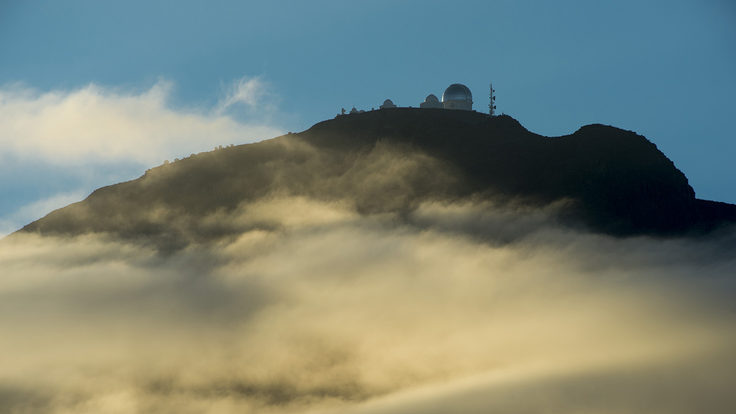
Scientists on the Dark Energy Survey, using one of the world’s most powerful digital cameras, have discovered eight more faint celestial objects hovering near our Milky Way galaxy. Signs indicate that they—like the objects found by the same team earlier this year—are likely dwarf satellite galaxies, the smallest and closest known form of galaxies.
Satellite galaxies are small celestial objects that orbit larger galaxies, such as our own Milky Way. Dwarf galaxies can be found with fewer than 1000 stars, in contrast to the Milky Way, an average-sized galaxy containing billions of stars. Scientists have predicted that larger galaxies are built from smaller galaxies, which are thought to be especially rich in dark matter, which makes up about 25 percent of the total matter and energy in the universe. Dwarf satellite galaxies, therefore, are considered key to understanding dark matter and the process by which larger galaxies form.
The main goal of the Dark Energy Survey, as its name suggests, is to better understand the nature of dark energy, the mysterious stuff that makes up about 70 percent of the matter and energy in the universe. Scientists believe that dark energy is the key to understanding why the expansion of the universe is speeding up. To carry out its dark energy mission, DES is taking snapshots of hundreds of millions of distant galaxies. However, some of the DES images also contain stars in dwarf galaxies much closer to the Milky Way. The same data can therefore be used to probe both dark energy, which scientists think is driving galaxies apart, and dark matter, which is thought to hold galaxies together.
Scientists can only see the nearest dwarf galaxies, since they are so faint, and had previously found only a handful. If these new discoveries are representative of the entire sky, there could be many more galaxies hiding in our cosmic neighborhood.
“Just this year, more than 20 of these dwarf satellite galaxy candidates have been spotted, with 17 of those found in Dark Energy Survey data,” says Alex Drlica-Wagner of Fermi National Accelerator Laboratory, one of the leaders of the DES analysis. “We’ve nearly doubled the number of these objects we know about in just one year, which is remarkable.”
In March, researchers with the Dark Energy Survey and an independent team from the University of Cambridge jointly announced the discovery of nine of these objects in snapshots taken by the Dark Energy Camera, the extraordinary instrument at the heart of the DES, an experiment funded by the DOE, the National Science Foundation and other funding agencies. Two of those have been confirmed as dwarf satellite galaxies so far.
Prior to 2015, scientists had located only about two dozen such galaxies around the Milky Way.
“DES is finding galaxies so faint that they would have been very difficult to recognize in previous surveys,” says Keith Bechtol of the University of Wisconsin-Madison. “The discovery of so many new galaxy candidates in one-eighth of the sky could mean there are more to find around the Milky Way.”
The closest of these newly discovered objects is about 80,000 light years away, and the furthest roughly 700,000 light years away. These objects are, on average, around a billion times dimmer than the Milky Way and a million times less massive. The faintest of the new dwarf galaxy candidates has about 500 stars.
Most of the newly discovered objects are in the southern half of the DES survey area, in close proximity to the Large Magellanic Cloud and the Small Magellanic Cloud. These are the two largest satellite galaxies associated with the Milky Way, about 158,000 light years and 208,000 light years away, respectively. It is possible that many of these new objects could be satellite galaxies of these larger satellite galaxies, which would be a discovery by itself.
“That result would be fascinating,” says Risa Wechsler of SLAC National Accelerator Laboratory. “Satellites of satellites are predicted by our models of dark matter. Either we are seeing these types of systems for the first time, or there is something we don’t understand about how these satellite galaxies are distributed in the sky.”
Since dwarf galaxies are thought to be made mostly of dark matter, with very few stars, they are excellent targets to explore the properties of dark matter. Further analysis will confirm whether these new objects are indeed dwarf satellite galaxies, and whether signs of dark matter can be detected from them.
The 17 dwarf satellite galaxy candidates were discovered in the first two years of data collected by the Dark Energy Survey, a five-year effort to photograph a portion of the southern sky in unprecedented detail. Scientists have now had a first look at most of the survey area, but data from the next three years of the survey will likely allow them to find objects that are even fainter, more diffuse or farther away. The third survey season has just begun.
“This exciting discovery is the product of a strong collaborative effort from the entire DES team,” says Basilio Santiago, a DES Milky Way Science Working Group coordinator and a member of the DES-Brazil Consortium. “We’ve only just begun our probe of the cosmos, and we’re looking forward to more exciting discoveries in the coming years.”
This article is based on a Fermilab press release.

 Frascati Scienza
 Buco Nero
 Io Non Faccio Niente
 Tommaso Dorigo
 Giovanni Mazzitelli
 Barbara Gallavotti
 Keplero Blog
 Research Gate