
Combined results find Higgs still standard
Combined results find Higgs still standard
The CMS and ATLAS experiments combined forces to more precisely measure properties of the Higgs boson.
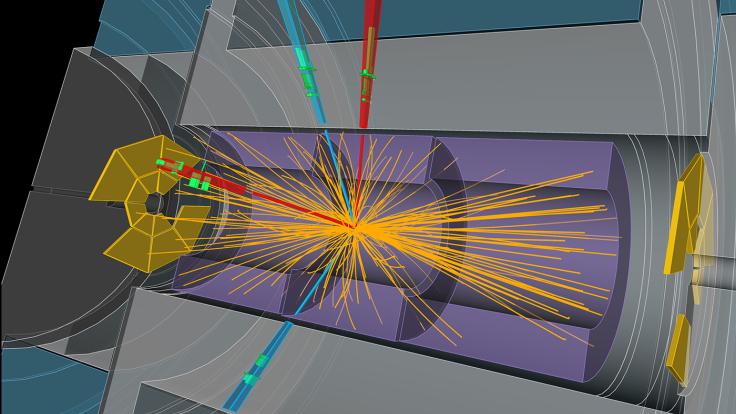
The ATLAS and CMS experiments on the Large Hadron Collider were designed to be partners in discovery.
In 2012, both experiments reported evidence of a Higgs-like boson, the fundamental particle that gives mass to the other fundamental particles.
ATLAS reported the mass of this new boson to be in the mass region of 126 billion electronvolts, and CMS found it to be in the region of 125. In May 2015, the two experiments combined their measurements, refining the Higgs mass closer to 125.09 GeV.
Sticking with the philosophy that two experiments are better than one, scientists from the ATLAS and CMS collaborations presented combined measurements of other Higgs properties earlier today at the third annual Large Hadron Collider Physics Conference in St. Petersburg, Russia.
This particular analysis focused on the interaction of the Higgs boson with other particles, known as coupling strength. The combined measurements are more precise than each experiment could accomplish alone, and results establish that the Higgs mechanism grants mass to both the matter and force-carrying particles as predicted by the Standard Model of particle physics.
“The analysis, presented for the first time at the LHCP Conference, fully exploits the data collected in Run 1 at the LHC by the two experiments,” says Nick Wardle, a CERN Fellow on CMS. “The uncertainties on the couplings of the Higgs boson are reduced by almost 30 percent, making these measurements of Higgs boson production and decay the most precise obtained to date.”
In the Standard Model, how strongly the Higgs boson couples to another particle determines that particle’s mass and the rate at which a Higgs boson decays into other particles.
For instance, the Higgs boson couples strongly with the bottom quark and very weakly with the electron; therefore, the bottom quark has a much greater mass than the electron and the Higgs will commonly decay into a bottom quark and its antiquark.
One of the objectives of combining the ATLAS and CMS data is to examine some Higgs decay signals that were picked up by each experiment but did not have the statistical significance to validate.
“For example, the Higgs boson decaying to a pair of tau leptons is established with a greater statistical significance when ATLAS and CMS data are combined,” says Ketevi Assamagan, an ATLAS physicist at Brookhaven National Laboratory.
While the discovery and measurement of the mass of the Higgs itself was perhaps the most notable driver of research during the first run of the LHC, measurements of Higgs couplings and their impact on Higgs boson production and decay will be important to searches for new physics in the current run.
Construction approved for world's most powerful digital camera
It would take 1500 high-definition television screens to display just one image from the Large Synoptic Survey Telescope's high-resolution camera.
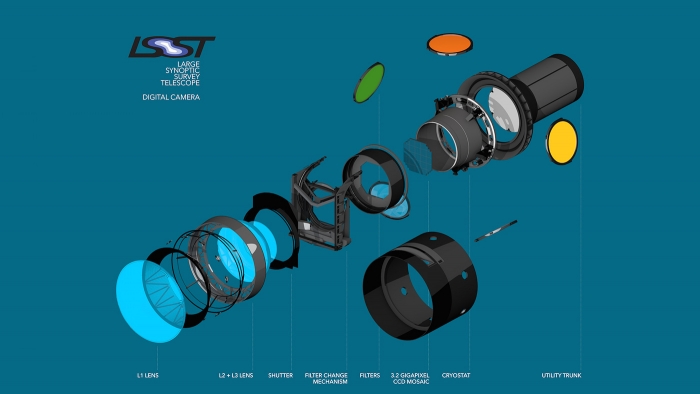
The US Department of Energy has approved the start of construction for a 3.2-gigapixel digital camera—the world’s largest—at the heart of the Large Synoptic Survey Telescope. Assembled at SLAC National Accelerator Laboratory, the camera will be the eye of LSST, revealing unprecedented details of the universe and helping unravel some of its greatest mysteries.
The construction milestone, known as Critical Decision 3, is the last major approval decision before the acceptance of the finished camera, says LSST Director Steven Kahn: “Now we can go ahead and procure components and start building it.”
Starting in 2022, LSST will take digital images of the entire visible southern sky every few nights from atop a mountain called Cerro Pachón in Chile. It will produce a wide, deep and fast survey of the night sky, cataloguing by far the largest number of stars and galaxies ever observed. During a 10-year time frame, LSST will detect tens of billions of objects—the first time a telescope will observe more galaxies than there are people on Earth—and will create movies of the sky with unprecedented detail. Funding for the camera comes from the DOE, while financial support for the telescope and site facilities, the data management system, and the education and public outreach infrastructure of LSST comes primarily from the National Science Foundation.
The telescope’s camera—the size of a small car and weighing more than three tons—will capture full-sky images at such high resolution that it would take 1500 high-definition television screens to display just one of them.
This has already been a busy year for the LSST Project. Its dual-surface primary/tertiary mirror—the first of its kind for a major telescope—was completed; a traditional stone-laying ceremony in northern Chile marked the beginning of on-site construction of the facility; and a nearly 2000-square-foot, 2-story-tall clean room was completed at SLAC to accommodate fabrication of the camera.
“We are very gratified to see everyone’s hard work appreciated and acknowledged by this DOE approval,” says SLAC Director Chi-Chang Kao. “SLAC is honored to be partnering with the National Science Foundation and other DOE labs on this groundbreaking endeavor. We’re also excited about the wide range of scientific opportunities offered by LSST, in particular increasing our understanding of dark energy.”
Components of the camera are being built by an international collaboration of universities and labs, including DOE’s Brookhaven National Laboratory, Lawrence Livermore National Laboratory and SLAC. SLAC is responsible for overall project management and systems engineering, camera body design and fabrication, data acquisition and camera control software, cryostat design and fabrication, and integration and testing of the entire camera. Building and testing the camera will take approximately five years.
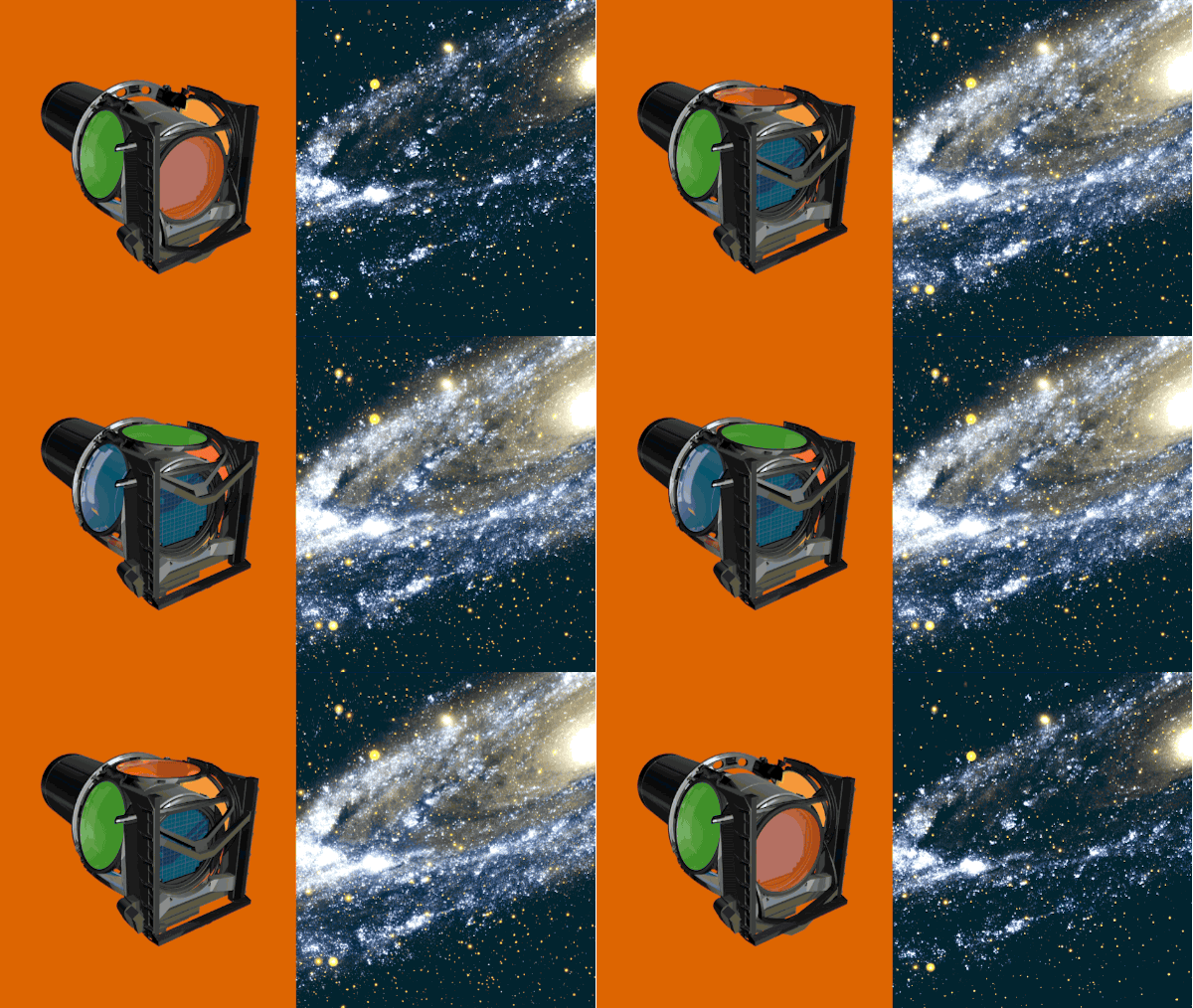
The LSST’s camera will include a filter-changing mechanism and shutter. This animation shows that mechanism, which allows the camera to view different wavelengths; the camera is capable of viewing light from near-ultraviolet to near-infrared (0.3-1 μm) wavelengths.
SLAC is also designing and constructing the NSF-funded database for the telescope’s data management system. LSST will generate a vast public archive of data—approximately 6 million gigabytes per year, or the equivalent of shooting roughly 800,000 images with a regular 8-megapixel digital camera every night, albeit of much higher quality and scientific value. This data will help researchers study the formation of galaxies, track potentially hazardous asteroids, observe exploding stars and better understand dark matter and dark energy, which together make up 95 percent of the universe but whose natures remain unknown.
“We have a busy agenda for the rest of 2015 and 2016,” Kahn says. “Construction of the telescope on the mountain is well underway. The contracts for fabrication of the telescope mount and the dome enclosure have been awarded and the vendors are at full steam.”
Nadine Kurita, camera project manager at SLAC, says fabrication of the state-of-the-art sensors for the camera has already begun, and contracts are being awarded for optical elements and other major components. “After several years of focusing on designs and prototypes, we are excited to start construction of key parts of the camera. The coming year will be crucial as we assemble and test the sensors for the focal plane.”
The National Research Council’s Astronomy and Astrophysics decadal survey, Astro2010, ranked the LSST as the top ground-based priority for the field for the current decade. The recent report of the Particle Physics Project Prioritization Panel of the federal High Energy Physics Advisory Panel, setting forth the strategic plan for US particle physics, also recommended completion of the LSST.
“We’ve been working hard for years to get to this point,” Kurita says. “Everyone is very excited to start building the camera and take a big step toward conducting a deep survey of the Southern night sky.”
This article is based on a SLAC press release.
Construction approved for world’s most powerful digital camera
It would take 1500 high-definition television screens to display just one image from the Large Synoptic Survey Telescope's high-resolution camera.
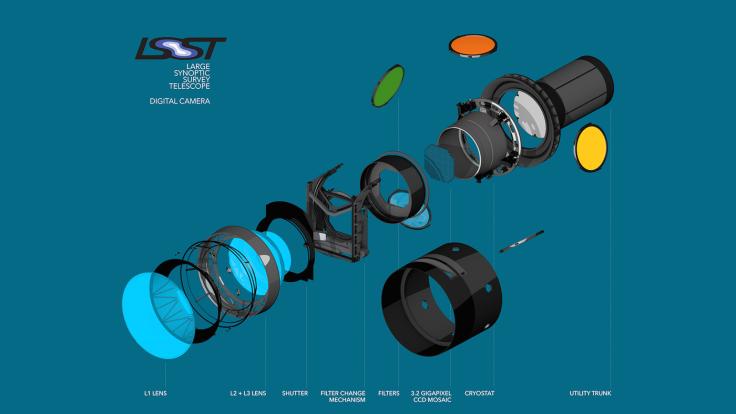
The US Department of Energy has approved the start of construction for a 3.2-gigapixel digital camera—the world’s largest—at the heart of the Large Synoptic Survey Telescope. Assembled at SLAC National Accelerator Laboratory, the camera will be the eye of LSST, revealing unprecedented details of the universe and helping unravel some of its greatest mysteries.
The construction milestone, known as Critical Decision 3, is the last major approval decision before the acceptance of the finished camera, says LSST Director Steven Kahn: “Now we can go ahead and procure components and start building it.”
Starting in 2022, LSST will take digital images of the entire visible southern sky every few nights from atop a mountain called Cerro Pachón in Chile. It will produce a wide, deep and fast survey of the night sky, cataloguing by far the largest number of stars and galaxies ever observed. During a 10-year time frame, LSST will detect tens of billions of objects—the first time a telescope will observe more galaxies than there are people on Earth—and will create movies of the sky with unprecedented detail. Funding for the camera comes from the DOE, while financial support for the telescope and site facilities, the data management system, and the education and public outreach infrastructure of LSST comes primarily from the National Science Foundation.
The telescope’s camera—the size of a small car and weighing more than three tons—will capture full-sky images at such high resolution that it would take 1500 high-definition television screens to display just one of them.
This has already been a busy year for the LSST Project. Its dual-surface primary/tertiary mirror—the first of its kind for a major telescope—was completed; a traditional stone-laying ceremony in northern Chile marked the beginning of on-site construction of the facility; and a nearly 2000-square-foot, 2-story-tall clean room was completed at SLAC to accommodate fabrication of the camera.
“We are very gratified to see everyone’s hard work appreciated and acknowledged by this DOE approval,” says SLAC Director Chi-Chang Kao. “SLAC is honored to be partnering with the National Science Foundation and other DOE labs on this groundbreaking endeavor. We’re also excited about the wide range of scientific opportunities offered by LSST, in particular increasing our understanding of dark energy.”
Components of the camera are being built by an international collaboration of universities and labs, including DOE’s Brookhaven National Laboratory, Lawrence Livermore National Laboratory and SLAC. SLAC is responsible for overall project management and systems engineering, camera body design and fabrication, data acquisition and camera control software, cryostat design and fabrication, and integration and testing of the entire camera. Building and testing the camera will take approximately five years.
The LSST’s camera will include a filter-changing mechanism and shutter. This animation shows that mechanism, which allows the camera to view different wavelengths; the camera is capable of viewing light from near-ultraviolet to near-infrared (0.3-1 μm) wavelengths.
SLAC is also designing and constructing the NSF-funded database for the telescope’s data management system. LSST will generate a vast public archive of data—approximately 6 million gigabytes per year, or the equivalent of shooting roughly 800,000 images with a regular 8-megapixel digital camera every night, albeit of much higher quality and scientific value. This data will help researchers study the formation of galaxies, track potentially hazardous asteroids, observe exploding stars and better understand dark matter and dark energy, which together make up 95 percent of the universe but whose natures remain unknown.
“We have a busy agenda for the rest of 2015 and 2016,” Kahn says. “Construction of the telescope on the mountain is well underway. The contracts for fabrication of the telescope mount and the dome enclosure have been awarded and the vendors are at full steam.”
Nadine Kurita, camera project manager at SLAC, says fabrication of the state-of-the-art sensors for the camera has already begun, and contracts are being awarded for optical elements and other major components. “After several years of focusing on designs and prototypes, we are excited to start construction of key parts of the camera. The coming year will be crucial as we assemble and test the sensors for the focal plane.”
The National Research Council’s Astronomy and Astrophysics decadal survey, Astro2010, ranked the LSST as the top ground-based priority for the field for the current decade. The recent report of the Particle Physics Project Prioritization Panel of the federal High Energy Physics Advisory Panel, setting forth the strategic plan for US particle physics, also recommended completion of the LSST.
“We’ve been working hard for years to get to this point,” Kurita says. “Everyone is very excited to start building the camera and take a big step toward conducting a deep survey of the Southern night sky.”
This article is based on a SLAC press release.
Looking for strings inside inflation
Theorists from the Institute for Advanced Study have proposed a way forward in the quest to test string theory.
Two theorists recently proposed a way to find evidence for an idea famous for being untestable: string theory. It involves looking for particles that were around 14 billion years ago, when a very tiny universe hit a growth spurt that used 15 billion times more energy than a collision in the Large Hadron Collider.
Scientists can’t crank the LHC up that high, not even close. But they could possibly observe evidence of these particles through cosmological studies, with the right technological advances.
Unknown particles
During inflation—the flash of hyperexpansion that happened 10-33 seconds after the big bang— particles were colliding with astronomical power. We see remnants of that time in tiny fluctuations in the haze of leftover energy called the cosmic microwave background.
Scientists might be able to find remnants of any prehistoric particles that were around during that time as well.
“If new particles existed during inflation, they can imprint a signature on the primordial fluctuations, which can be seen through specific patterns,” says theorist Juan Maldacena of the Institute for Advanced Study at Princeton University.
Maldacena and his IAS collaborator, theorist Nima Arkani-Hamed, have used quantum field theory calculations to figure out what these patterns might look like. The pair presented their findings at an annual string theory conference held this year in Bengaluru, India, in June.
The probable, impossible string
String theory is frequently summed up by its basic tenet: that the fundamental units of matter are not particles. They are one-dimensional, vibrating strings of energy.
The theory’s purpose is to bridge a mathematic conflict between quantum mechanics and Einstein’s theory of general relativity. Inside a black hole, for example, quantum mechanics dictates that gravity is impossible. Any attempt to adjust one theory to fit the other causes the whole delicate system to collapse. Instead of trying to do this, string theory creates a new mathematical framework in which both theories are natural results. Out of this framework emerges an astonishingly elegant way to unify the forces of nature, along with a correct qualitative description of all known elementary particles.
As a system of mathematics, string theory makes a tremendous number of predictions. Testable predictions? None so far.
Strings are thought to be the smallest objects in the universe, and computing their effects on the relatively enormous scales of particle physics experiments is no easy task. String theorists predict that new particles exist, but they cannot compute their masses.
To exacerbate the problem, string theory can describe a variety of universes that differ by numbers of forces, particles or dimensions. Predictions at accessible energies depend on these unknown or very difficult details. No experiment can definitively prove a theory that offers so many alternative versions of reality.
Putting string theory to the test
But scientists are working out ways that experiments could at least begin to test parts of string theory. One prediction that string theory makes is the existence of particles with a unique property: a spin of greater than two.
Spin is a property of fundamental particles. Particles that don’t spin decay in symmetric patterns. Particles that do spin decay in asymmetric patterns, and the greater the spin, the more complex those patterns get. Highly complex decay patterns from collisions between these particles would have left signature impressions on the universe as it expanded and cooled.
Scientists could find the patterns of particles with greater than spin 2 in subtle variations in the distribution of galaxies or in the cosmic microwave background, according to Maldacena and Arkani-Hamed. Observational cosmologists would have to measure the primordial fluctuations over a wide range of length scales to be able to see these small deviations.
The IAS theorists calculated what those measurements would theoretically be if these massive, high-spin particles existed. Such a particle would be much more massive than anything scientists could find at the LHC.
A challenging proposition
Cosmologists are already studying patterns in the cosmic microwave background. Experiments such as Planck, BICEP and POLAR BEAR are searching for polarization, which would be evidence that a nonrandom force acted on it. If they rewind the effects of time and mathematically undo all other forces that have interacted with this energy, they hope that what pattern remains will match the predicted twists imbued by inflation.
The patterns proposed by Maldacena and Arkani-Hamed are much subtler and much more susceptible to interference. So any expectation of experimentally finding such signals is still a long way off.
But this research could point us toward someday finding such signatures and illuminating our understanding of particles that have perhaps left their mark on the entire universe.
The value of strings
Whether or not anyone can prove that the world is made of strings, people have proven that the mathematics of string theory can be applied to other fields.
In 2009, researchers discovered that string theory math could be applied to conventional problems in condensed matter physics. Since then researchers have been applying string theory to study superconductors.
Fellow IAS theorist Edward Witten, who received the Fields Medal in 1990 for his mathematical contributions to quantum field theory and Supersymmetry, says Maldacena and Arkani-Hamed’s presentation was among the most innovative work he saw at the Strings ‘15 conference.
Witten and others believe that such successes in other fields indicate that string theory actually underlies all other theories at some deeper level.
"Physics—like history—does not precisely repeat itself,” Witten says. However, with similar structures appearing at different scales of lengths and energies, “it does rhyme.”
Looking for strings inside inflation
Theorists from the Institute for Advanced Study have proposed a way forward in the quest to test string theory.
Two theorists recently proposed a way to find evidence for an idea famous for being untestable: string theory. It involves looking for particles that were around 14 billion years ago, when a very tiny universe hit a growth spurt that used 15 billion times more energy than a collision in the Large Hadron Collider.
Scientists can’t crank the LHC up that high, not even close. But they could possibly observe evidence of these particles through cosmological studies, with the right technological advances.
Unknown particles
During inflation—the flash of hyperexpansion that happened 10-33 seconds after the big bang— particles were colliding with astronomical power. We see remnants of that time in tiny fluctuations in the haze of leftover energy called the cosmic microwave background.
Scientists might be able to find remnants of any prehistoric particles that were around during that time as well.
“If new particles existed during inflation, they can imprint a signature on the primordial fluctuations, which can be seen through specific patterns,” says theorist Juan Maldacena of the Institute for Advanced Study in Princeton, New Jersey.
Maldacena and his IAS collaborator, theorist Nima Arkani-Hamed, have used quantum field theory calculations to figure out what these patterns might look like. The pair presented their findings at an annual string theory conference held this year in Bengaluru, India, in June.
The probable, impossible string
String theory is frequently summed up by its basic tenet: that the fundamental units of matter are not particles. They are one-dimensional, vibrating strings of energy.
The theory’s purpose is to bridge a mathematic conflict between quantum mechanics and Einstein’s theory of general relativity. Inside a black hole, for example, quantum mechanics dictates that gravity is impossible. Any attempt to adjust one theory to fit the other causes the whole delicate system to collapse. Instead of trying to do this, string theory creates a new mathematical framework in which both theories are natural results. Out of this framework emerges an astonishingly elegant way to unify the forces of nature, along with a correct qualitative description of all known elementary particles.
As a system of mathematics, string theory makes a tremendous number of predictions. Testable predictions? None so far.
Strings are thought to be the smallest objects in the universe, and computing their effects on the relatively enormous scales of particle physics experiments is no easy task. String theorists predict that new particles exist, but they cannot compute their masses.
To exacerbate the problem, string theory can describe a variety of universes that differ by numbers of forces, particles or dimensions. Predictions at accessible energies depend on these unknown or very difficult details. No experiment can definitively prove a theory that offers so many alternative versions of reality.
Putting string theory to the test
But scientists are working out ways that experiments could at least begin to test parts of string theory. One prediction that string theory makes is the existence of particles with a unique property: a spin of greater than two.
Spin is a property of fundamental particles. Particles that don’t spin decay in symmetric patterns. Particles that do spin decay in asymmetric patterns, and the greater the spin, the more complex those patterns get. Highly complex decay patterns from collisions between these particles would have left signature impressions on the universe as it expanded and cooled.
Scientists could find the patterns of particles with greater than spin 2 in subtle variations in the distribution of galaxies or in the cosmic microwave background, according to Maldacena and Arkani-Hamed. Observational cosmologists would have to measure the primordial fluctuations over a wide range of length scales to be able to see these small deviations.
The IAS theorists calculated what those measurements would theoretically be if these massive, high-spin particles existed. Such a particle would be much more massive than anything scientists could find at the LHC.
A challenging proposition
Cosmologists are already studying patterns in the cosmic microwave background. Experiments such as Planck, BICEP and POLAR BEAR are searching for polarization, which would be evidence that a nonrandom force acted on it. If they rewind the effects of time and mathematically undo all other forces that have interacted with this energy, they hope that what pattern remains will match the predicted twists imbued by inflation.
The patterns proposed by Maldacena and Arkani-Hamed are much subtler and much more susceptible to interference. So any expectation of experimentally finding such signals is still a long way off.
But this research could point us toward someday finding such signatures and illuminating our understanding of particles that have perhaps left their mark on the entire universe.
The value of strings
Whether or not anyone can prove that the world is made of strings, people have proven that the mathematics of string theory can be applied to other fields.
In 2009, researchers discovered that string theory math could be applied to conventional problems in condensed matter physics. Since then researchers have been applying string theory to study superconductors.
Fellow IAS theorist Edward Witten, who received the Fields Medal in 1990 for his mathematical contributions to quantum field theory and Supersymmetry, says Maldacena and Arkani-Hamed’s presentation was among the most innovative work he saw at the Strings ‘15 conference.
Witten and others believe that such successes in other fields indicate that string theory actually underlies all other theories at some deeper level.
"Physics—like history—does not precisely repeat itself,” Witten says. However, with similar structures appearing at different scales of lengths and energies, “it does rhyme.”
Scientists accelerate antimatter
Accelerating positrons with plasma is a step toward smaller, cheaper particle colliders.
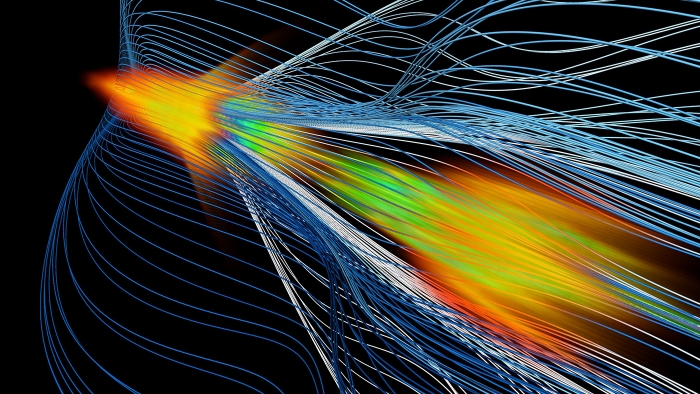
A study led by researchers from SLAC National Accelerator Laboratory and the University of California, Los Angeles, has demonstrated a new, efficient way to accelerate positrons, the antimatter opposites of electrons. The method may help boost the energy and shrink the size of future linear particle colliders—powerful accelerators that could be used to unravel the properties of nature’s fundamental building blocks.
The scientists had previously shown that boosting the energy of charged particles by having them “surf” a wave of ionized gas, or plasma, works well for electrons. While this method by itself could lead to smaller accelerators, electrons are only half the equation for future colliders. Now the researchers have hit another milestone by applying the technique to positrons at SLAC’s Facility for Advanced Accelerator Experimental Tests, a US Department of Energy Office of Science user facility.
“Together with our previous achievement, the new study is a very important step toward making smaller, less expensive next-generation electron-positron colliders,” says SLAC’s Mark Hogan, co-author of the study published today in Nature. “FACET is the only place in the world where we can accelerate positrons and electrons with this method.”
SLAC Director Chi-Chang Kao says, “Our researchers have played an instrumental role in advancing the field of plasma-based accelerators since the 1990s. The recent results are a major accomplishment for the lab, which continues to take accelerator science and technology to the next level.”
Shrinking particle colliders
Researchers study matter’s fundamental components and the forces between them by smashing highly energetic particle beams into one another. Collisions between electrons and positrons are especially appealing, because unlike the protons being collided at CERN’s Large Hadron Collider – where the Higgs boson was discovered in 2012—these particles aren’t made of smaller constituent parts.
“These collisions are simpler and easier to study,” says SLAC’s Michael Peskin, a theoretical physicist not involved in the study. “Also, new, exotic particles would be produced at roughly the same rate as known particles; at the LHC they are a billion times more rare.”
However, current technology to build electron-positron colliders for next-generation experiments would require accelerators that are tens of kilometers long. Plasma wakefield acceleration is one way researchers hope to build shorter, more economical accelerators.
Previous work showed that the method works efficiently for electrons: When one of FACET’s tightly focused bundles of electrons enters an ionized gas, it creates a plasma “wake” that researchers use to accelerate a trailing second electron bunch.
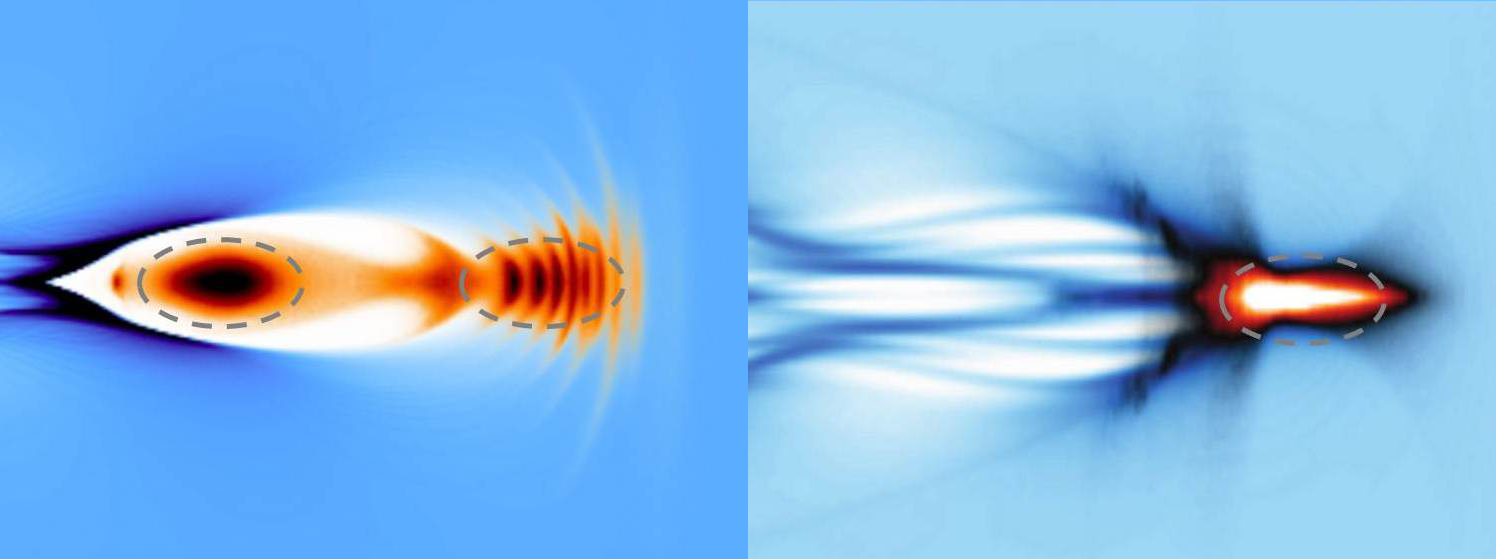
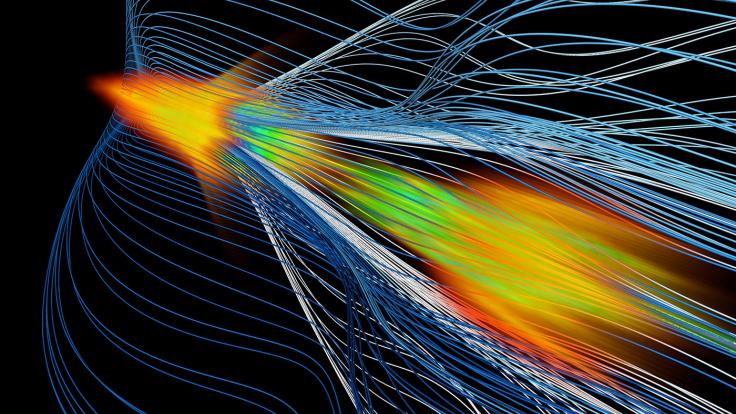
Computer simulations of the interaction of electrons (left) and positrons (right) with a plasma.
Creating a plasma wake for antimatter
For positrons—the other required particle ingredient for electron-positron colliders—plasma wakefield acceleration is much more challenging. In fact, many scientists believed that no matter where a trailing positron bunch was placed in a wake, it would lose its compact, focused shape or even slow down.
“Our key breakthrough was to find a new regime that lets us accelerate positrons in plasmas efficiently,” says study co-author Chandrashekhar Joshi from UCLA.
Instead of using two separate particle bunches—one to create a wake and the other to surf it—the team discovered that a single positron bunch can interact with the plasma in such a way that the front of it generates a wake that both accelerates and focuses its trailing end. This occurs after the positrons have traveled about four inches through the plasma.
“In this stable state, about 1 billion positrons gained 5 billion electronvolts of energy over a short distance of only 1.3 meters,” says former SLAC researcher Sebastien Corde, the study’s first author, who is now at the Ecole Polytechnique in France. “They also did so very efficiently and uniformly, resulting in an accelerated bunch with a well-defined energy.”
Looking into the future
All of these properties are important qualities for particle beams in accelerators. In the next step, the team will look to further improve their experiment.
“We performed simulations to understand how the stable state was created,” says co-author Warren Mori of UCLA. “Based on this understanding, we can now use simulations to look for ways of exciting suitable wakes in an improved, more controlled way. This will lead to ideas for future experiments.”
This study underscores the critical importance of test facilities such as FACET, says Lia Merminga, associate laboratory director for accelerators at TRIUMF in Canada.
“Plasma wakefield acceleration of positrons has been a longstanding problem in this field,” she says. “Today's announcement is a breakthrough that offers a possible solution.”
Although plasma-based particle colliders will not be built in the near future, the method could be used to upgrade existing accelerators much sooner.
“It’s conceivable to boost the performance of linear accelerators by adding a very short plasma accelerator at the end,” Corde says. “This would multiply the accelerator’s energy without making the entire structure significantly longer.”
Additional contributors included researchers from the University of Oslo in Norway and Tsinghua University in China. The research was supported by the US Department of Energy, the National Science Foundation, the Research Council of Norway and the Thousand Young Talents Program of China.
This article is based on a SLAC press release.
Scientists accelerate antimatter
Accelerating positrons with plasma is a step toward smaller, cheaper particle colliders.
A study led by researchers from SLAC National Accelerator Laboratory and the University of California, Los Angeles, has demonstrated a new, efficient way to accelerate positrons, the antimatter opposites of electrons. The method may help boost the energy and shrink the size of future linear particle colliders—powerful accelerators that could be used to unravel the properties of nature’s fundamental building blocks.
The scientists had previously shown that boosting the energy of charged particles by having them “surf” a wave of ionized gas, or plasma, works well for electrons. While this method by itself could lead to smaller accelerators, electrons are only half the equation for future colliders. Now the researchers have hit another milestone by applying the technique to positrons at SLAC’s Facility for Advanced Accelerator Experimental Tests, a US Department of Energy Office of Science user facility.
“Together with our previous achievement, the new study is a very important step toward making smaller, less expensive next-generation electron-positron colliders,” says SLAC’s Mark Hogan, co-author of the study published today in Nature. “FACET is the only place in the world where we can accelerate positrons and electrons with this method.”
SLAC Director Chi-Chang Kao says, “Our researchers have played an instrumental role in advancing the field of plasma-based accelerators since the 1990s. The recent results are a major accomplishment for the lab, which continues to take accelerator science and technology to the next level.”
Shrinking particle colliders
Researchers study matter’s fundamental components and the forces between them by smashing highly energetic particle beams into one another. Collisions between electrons and positrons are especially appealing, because unlike the protons being collided at CERN’s Large Hadron Collider – where the Higgs boson was discovered in 2012—these particles aren’t made of smaller constituent parts.
“These collisions are simpler and easier to study,” says SLAC’s Michael Peskin, a theoretical physicist not involved in the study. “Also, new, exotic particles would be produced at roughly the same rate as known particles; at the LHC they are a billion times more rare.”
However, current technology to build electron-positron colliders for next-generation experiments would require accelerators that are tens of kilometers long. Plasma wakefield acceleration is one way researchers hope to build shorter, more economical accelerators.
Previous work showed that the method works efficiently for electrons: When one of FACET’s tightly focused bundles of electrons enters an ionized gas, it creates a plasma “wake” that researchers use to accelerate a trailing second electron bunch.
Creating a plasma wake for antimatter
For positrons—the other required particle ingredient for electron-positron colliders—plasma wakefield acceleration is much more challenging. In fact, many scientists believed that no matter where a trailing positron bunch was placed in a wake, it would lose its compact, focused shape or even slow down.
“Our key breakthrough was to find a new regime that lets us accelerate positrons in plasmas efficiently,” says study co-author Chandrashekhar Joshi from UCLA.
Instead of using two separate particle bunches—one to create a wake and the other to surf it—the team discovered that a single positron bunch can interact with the plasma in such a way that the front of it generates a wake that both accelerates and focuses its trailing end. This occurs after the positrons have traveled about four inches through the plasma.
“In this stable state, about 1 billion positrons gained 5 billion electronvolts of energy over a short distance of only 1.3 meters,” says former SLAC researcher Sebastien Corde, the study’s first author, who is now at the Ecole Polytechnique in France. “They also did so very efficiently and uniformly, resulting in an accelerated bunch with a well-defined energy.”
Looking into the future
All of these properties are important qualities for particle beams in accelerators. In the next step, the team will look to further improve their experiment.
“We performed simulations to understand how the stable state was created,” says co-author Warren Mori of UCLA. “Based on this understanding, we can now use simulations to look for ways of exciting suitable wakes in an improved, more controlled way. This will lead to ideas for future experiments.”
This study underscores the critical importance of test facilities such as FACET, says Lia Merminga, associate laboratory director for accelerators at TRIUMF in Canada.
“Plasma wakefield acceleration of positrons has been a longstanding problem in this field,” she says. “Today's announcement is a breakthrough that offers a possible solution.”
Although plasma-based particle colliders will not be built in the near future, the method could be used to upgrade existing accelerators much sooner.
“It’s conceivable to boost the performance of linear accelerators by adding a very short plasma accelerator at the end,” Corde says. “This would multiply the accelerator’s energy without making the entire structure significantly longer.”
Additional contributors included researchers from the University of Oslo in Norway and Tsinghua University in China. The research was supported by the US Department of Energy, the National Science Foundation, the Research Council of Norway and the Thousand Young Talents Program of China.
This article is based on a SLAC press release.

 Frascati Scienza
 Buco Nero
 Io Non Faccio Niente
 Tommaso Dorigo
 Giovanni Mazzitelli
 Barbara Gallavotti
 Keplero Blog
 Research Gate