
XMASS continues dark matter debate
XMASS is the latest of multiple experiments to contradict a previous dark matter discovery claim, but the conversation isn't over yet.
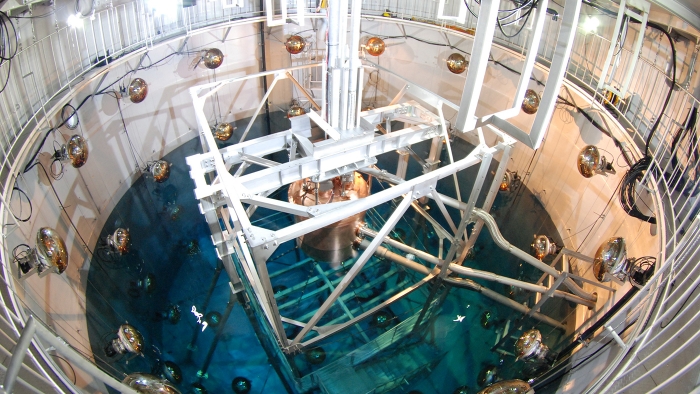
Since 1998, scientists on the DAMA-LIBRA experiment at Gran Sasso National Laboratory in Italy have claimed the discovery of an increasingly statistically significant sign of dark matter.
This week, the XMASS experiment in Japan joined the LUX, Xenon100 and CDMS experiments in reporting results that seem to contradict that claim.
Scientists look for dark matter in many ways. Both this result from the XMASS experiment and the results from DAMA-LIBRA look for something called annual modulation, a sign that the Earth is constantly moving through a halo of dark matter particles.
As the sun rotates around the center of the Milky Way, the Earth moves around the sun, completing one revolution per year. During the first half of the year, the Earth moves in the same direction as the sun; during the second half, the Earth completes its circle, moving in the opposite direction.
When the sun and Earth are moving in the same direction, the Earth should move through slightly more dark matter than when the sun and Earth are moving in opposite directions. So scientists should see a few more dark matter particles hit their detectors during that part of the year.
Experiments other than DAMA-LIBRA have seen hints of an annual modulation, but only the CoGeNT experiment has ever provided support for DAMA-LIBRA’s claim that this modulation comes from dark matter.
The effect could be caused by other annual changes. Pressure and temperature could affect an experiment. Atmospheric changes with the seasons could affect the number of cosmic rays that reach the experiment. Background radiation from radon gas has been known to change seasonally for underground experiments because of its interaction with the water table in the rock, says Fermilab scientist Dan Bauer of the CDMS experiment.
“Nobody’s been able to put their finger on what’s causing the DAMA modulation,” he says. “We can’t find the smoking gun.”
The XMASS experiment in Kamioka, Japan, looks for signs that dark matter particles have bounced off the nuclei in their 832-kilogram container of liquid Xenon. The experiment has sensitivity to two types of possible dark matter interactions, says scientist Yoichiro Suzuki, principal investigator for XMASS at the Tokyo-based Kavli Institute for the Physics and Mathematics of the Universe, in an email.
After taking data for about 16 months, the XMASS experiment disagreed with the DAMA-LIBRA claim, if one assumes dark matter particles scatter like billiard balls when they collide with nuclei. XMASS did find a low level of annual modulation, though, and that could be a hint of dark matter interacting with normal matter in a different way.
However, XMASS scientists deduced from their signal some characteristics that the dark matter particles causing the modulation would need to have: their masses and their rates of interaction with normal matter. And experiments that search for dark matter directly have already ruled out those masses and interaction rates.
But scientists still don’t know for sure what dark matter particles are like. Until they do, or until they identify the source of the annual modulation signals, they might have a hard time dissuading scientists on DAMA-LIBRA.
The XMASS experiment continues to take data, Suzuki says. XMASS scientists hope eventually to build a 5-ton version of the experiment.
XMASS continues dark matter debate
XMASS is the latest of multiple experiments to contradict a previous dark matter discovery claim, but the conversation isn't over yet.
Since 1998, scientists on the DAMA-LIBRA experiment at Gran Sasso National Laboratory in Italy have claimed the discovery of an increasingly statistically significant sign of dark matter.
This week, the XMASS experiment in Japan joined the LUX, Xenon100 and CDMS experiments in reporting results that seem to contradict that claim.
Scientists look for dark matter in many ways. Both this result from the XMASS experiment and the results from DAMA-LIBRA look for something called annual modulation, a sign that the Earth is constantly moving through a halo of dark matter particles.
As the sun rotates around the center of the Milky Way, the Earth moves around the sun, completing one revolution per year. During the first half of the year, the Earth moves in the same direction as the sun; during the second half, the Earth completes its circle, moving in the opposite direction.
When the sun and Earth are moving in the same direction, the Earth should move through slightly more dark matter than when the sun and Earth are moving in opposite directions. So scientists should see a few more dark matter particles hit their detectors during that part of the year.
Experiments other than DAMA-LIBRA have seen hints of an annual modulation, but only the CoGeNT experiment has ever provided support for DAMA-LIBRA’s claim that this modulation comes from dark matter.
The effect could be caused by other annual changes. Pressure and temperature could affect an experiment. Atmospheric changes with the seasons could affect the number of cosmic rays that reach the experiment. Background radiation from radon gas has been known to change seasonally for underground experiments because of its interaction with the water table in the rock, says Fermilab scientist Dan Bauer of the CDMS experiment.
“Nobody’s been able to put their finger on what’s causing the DAMA modulation,” he says. “We can’t find the smoking gun.”
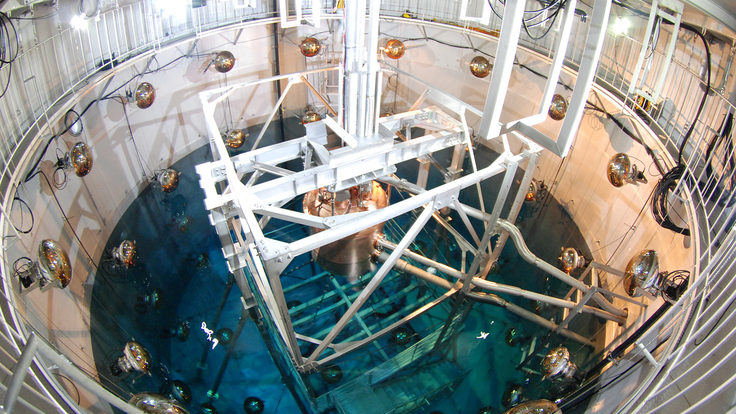
The XMASS experiment in Kamioka, Japan, looks for signs that dark matter particles have bounced off the nuclei in their 832-kilogram container of liquid Xenon. The experiment has sensitivity to two types of possible dark matter interactions, says scientist Yoichiro Suzuki, principal investigator for XMASS at the Tokyo-based Kavli Institute for the Physics and Mathematics of the Universe, in an email.
After taking data for about 16 months, the XMASS experiment disagreed with the DAMA-LIBRA claim, if one assumes dark matter particles scatter like billiard balls when they collide with nuclei. XMASS did find a low level of annual modulation, though, and that could be a hint of dark matter interacting with normal matter in a different way.
However, XMASS scientists deduced from their signal some characteristics that the dark matter particles causing the modulation would need to have: their masses and their rates of interaction with normal matter. And experiments that search for dark matter directly have already ruled out those masses and interaction rates.
But scientists still don’t know for sure what dark matter particles are like. Until they do, or until they identify the source of the annual modulation signals, they might have a hard time dissuading scientists on DAMA-LIBRA.
The XMASS experiment continues to take data, Suzuki says. XMASS scientists hope eventually to build a 5-ton version of the experiment.
The birth of a black hole, live
The birth of a black hole, live
Scientists hope to use neutrino experiments to watch a black hole form.
Black holes fascinate us. We easily conjure up images of them swallowing spaceships, but we know very little about these strange objects. In fact, we’ve never even seen a black hole form. Scientists on neutrino experiments such as the upcoming Deep Underground Neutrino Experiment hope to change that.
“You’ve got to be a bit lucky,” says Mark Thomson, DUNE co-spokesperson. “But it would be one of the major discoveries in science. It would be absolutely incredible.”
Black holes are sometimes born when a massive star, typically more than eight times the mass of our own sun, collapses. But there are a lot of questions about what exactly happens during the process: How often do these collapsing stars give rise to black holes? When in the collapse does the black hole actually develop?
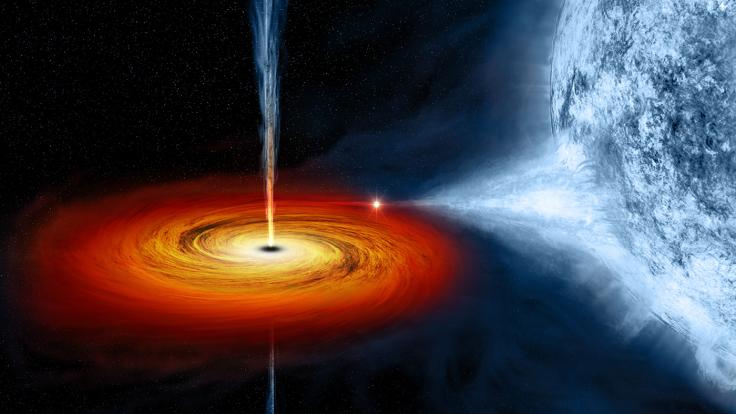
What scientists do know is that deep in the dense core of the star, protons and electrons are squeezed together to form neutrons, sending ghostly particles called neutrinos streaming out. Matter falls inward. In the textbook case, matter rebounds and erupts, leaving a neutron star. But sometimes, the supernova fails, and there’s no explosion; instead, a black hole is born.
DUNE’s gigantic detectors, filled with liquid argon, will sit a mile below the surface in a repurposed goldmine. While much of their time will be spent looking for neutrinos sent from Fermi National Accelerator Laboratory 800 miles away, the detectors will also have the rare ability to pick up a core collapse in our Milky Way galaxy – whether or not that leads to a new black hole.
The only supernova ever recorded by neutrino detectors occurred in in 1987, when scientists saw a total of 19 neutrinos. Scientists still don’t know if that supernova formed a black hole or a neutron star—there simply wasn’t enough data. Thomson says that if a supernova goes off nearby, DUNE could see up to 10,000 neutrinos.
DUNE will look for a particular signature in the neutrinos picked up by the detector. It’s predicted that a black hole will form relatively early in a supernova. Neutrinos will be able to leave the collapse in great numbers until the black hole emerges, trapping everything—including light and neutrinos—in its grasp. In data terms, that means you’d get a big burst of neutrinos with a sudden cutoff.
Neutrinos come in three types, called flavors: electron, muon and tau. When a star explodes, it emits all the various types of neutrinos, as well as their antiparticles.
They’re hard to catch. These neutrinos arrive with 100 times less energy than those arriving from an accelerator for experiments, which makes them less likely to interact in a detector.
Most of the currently running, large particle detectors capable of seeing supernova neutrinos are best at detecting electron antineutrinos—and not great at detecting their matter equivalents, electron neutrinos.
“It would be a tragedy to not be ready to detect the neutrinos in full enough detail to answer key questions,” says John Beacom, director of the Center for Cosmology and Astroparticle Physics at The Ohio State University.
Luckily, DUNE is unique. “The only one that is sensitive to a huge slug of electron neutrinos is DUNE, and that’s a function of using argon [as the detector fluid],” says Kate Scholberg, professor of physics at Duke University.
It will take more than just DUNE to get the whole picture, though. Getting an entire suite of large, powerful detectors of different types up and running is the best way to figure out the lives of black holes, Beacom says.
There is a big scintillator detector, JUNO, in the works in China, and plans for a huge water-based detector, Hyper-K, in Japan. Gravitational wave detectors such as LIGO could pick up additional information about the density of matter and what’s happening in the collapse.
“My dream is to have a supernova with JUNO, Hyper-K and DUNE all online,” Scholberg says. “It would certainly make my decade.”
The rate at which neutrinos arrive after a supernova will tell scientists about what’s happening at the center of a core collapse—but it will also provide information about the mysterious neutrino, including how they interact with each other and potential insights as to how much the tiny particles actually weigh.
Within the next three years, the rapidly growing DUNE collaboration will build and begin testing a prototype of the 40,000-ton liquid argon detector. This 400-ton version will be the second-largest liquid-argon experiment ever built to date. It is scheduled for testing at CERN starting in 2018.
DUNE is scheduled to start installing the first of its four detectors in the Sanford Underground Research Facility in 2021.
Labs to hold particle physics photo competition
Participants will go behind the scenes at eight particle physics laboratories in Asia, Australia, Europe and North America.
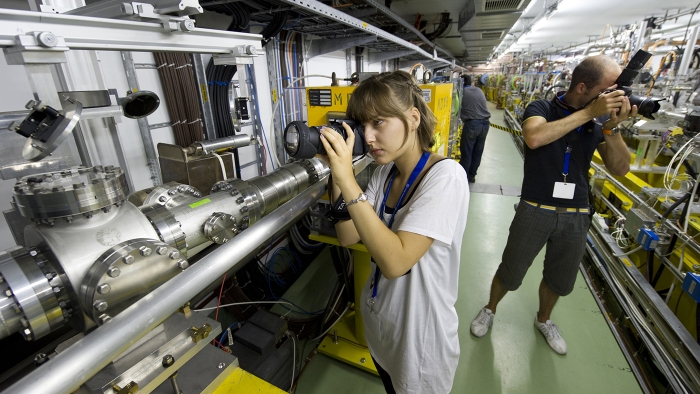
Eight of the world’s leading particle physics laboratories are joining together to host the Global Physics Photowalk on September 25-26.
Over 200 participants will have the rare opportunity to photograph state-of-the-art accelerators and detectors in all their beauty and complexity and to share them with the world through a global competition. This event grants photographers special behind-the-scenes access to laboratories in Asia, Australia, Europe and North America, with tours tailored to the creative eye. Professional and amateur photographers alike are invited to register at one of these participating laboratories:
- Deutsches Elektronen-Synchrotron (DESY) in Hamburg, Germany
- European Organization for Nuclear Research (CERN) in Geneva, Switzerland
- Fermi National Accelerator Laboratory (Fermilab) in Illinois, USA
- High Energy Accelerator Research Organization (KEK) in Tsukuba, Japan
- National Laboratory of Frascati (INFN-LNF) in Frascati, Italy
- SLAC National Accelerator Laboratory in Menlo Park, California, USA
- Stawell Underground Physics Laboratory (SUPL) in Victoria, Australia
- TRIUMF in Vancouver, Canada
For the first time, the Stawell Underground Physics Laboratory, the only lab of its kind in Australia, is opening its doors to the underground facility in its early stages of development for photographers. The lab will house the first ever direct-detection dark matter experiment in the Southern Hemisphere.
At Japan's KEK laboratory, highlights include the upgraded SuperKEKB accelerator and Belle II detector that will start running experiments early next year.
In Europe, participants will have a behind-the-scenes tour at CERN, including the brand new Linac 4, the future source of proton beams for the Large Hadron Collider. In Germany, participants will experience DESY’s campus and research facilities, including the 300-meter PETRA III experimental hall with its impressive architecture and numerous experimental huts. In Italy, participants will visit the National Laboratory of Frascati, birthplace of the first accelerator prototype, designed and built by Bruno Touschek, and currently home to the powerful accelerator DAΦNE.
In North America, sites include two of the US Department of Energy's national labs, with an underground cavern that houses three neutrino detectors at Fermilab and an X-ray free-electron laser that makes movies of atoms and molecules at SLAC. In Canada, participants will visit the world’s largest cyclotron and the isotope research facilities for physics and medicine at TRIUMF.
After the photowalk event, the Interactions Collaboration is inviting participants to submit their best photos to the respective laboratories for local competitions. The winning photos from each laboratory's local competition will be announced in November and then be released into a global competition.
Three photos per laboratory will compete globally in two categories: a “People’s Choice” conducted via an online popular-vote competition, and a “Jury Competition” facilitated through a panel of international judges.
Global winners will have the opportunity to be featured in symmetry magazine, in the CERN Courier, and as part of a travelling exhibit across laboratories in Australia, Asia, Europe and North America. Winners of the global competition will be announced in December.
Visit www.flickr.com/photos/interactions_photos for photos from previous events.
For photowalk registration details and information, visit www.interactions.org/photowalk. On Twitter, follow #PhysPics15 for the latest updates.
The Global Physics Photowalk is organized by the InterAction collaboration, whose members represent particle physics laboratories in Australia, Asia, Europe and North America.
Labs to hold particle physics photo competition
Participants will go behind the scenes at eight particle physics laboratories in Asia, Australia, Europe and North America.
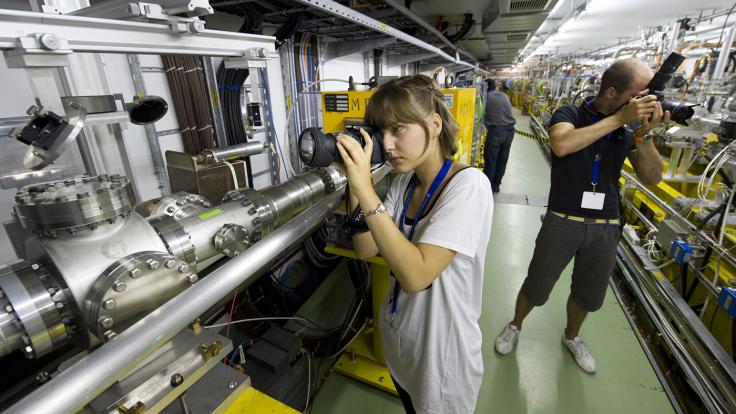
Eight of the world’s leading particle physics laboratories are joining together to host the Global Physics Photowalk on September 25-26.
Over 200 participants will have the rare opportunity to photograph state-of-the-art accelerators and detectors in all their beauty and complexity and to share them with the world through a global competition. This event grants photographers special behind-the-scenes access to laboratories in Asia, Australia, Europe and North America, with tours tailored to the creative eye. Professional and amateur photographers alike are invited to register at one of these participating laboratories:
- Deutsches Elektronen-Synchrotron (DESY) in Hamburg, Germany
- European Organization for Nuclear Research (CERN) in Geneva, Switzerland
- Fermi National Accelerator Laboratory (Fermilab) in Illinois, USA
- High Energy Accelerator Research Organization (KEK) in Tsukuba, Japan
- National Laboratory of Frascati (INFN-LNF) in Frascati, Italy
- SLAC National Accelerator Laboratory in Menlo Park, California, USA
- Stawell Underground Physics Laboratory (SUPL) in Victoria, Australia
- TRIUMF in Vancouver, Canada
For the first time, the Stawell Underground Physics Laboratory, the only lab of its kind in Australia, is opening its doors to the underground facility in its early stages of development for photographers. The lab will house the first ever direct-detection dark matter experiment in the Southern Hemisphere.
At Japan's KEK laboratory, highlights include the upgraded SuperKEKB accelerator and Belle II detector that will start running experiments early next year.
In Europe, participants will have a behind-the-scenes tour at CERN, including the brand new Linac 4, the future source of proton beams for the Large Hadron Collider. In Germany, participants will experience DESY’s campus and research facilities, including the 300-meter PETRA III experimental hall with its impressive architecture and numerous experimental huts. In Italy, participants will visit the National Laboratory of Frascati, birthplace of the first accelerator prototype, designed and built by Bruno Touschek, and currently home to the powerful accelerator DAΦNE.
In North America, sites include two of the US Department of Energy's national labs, with an underground cavern that houses three neutrino detectors at Fermilab and an X-ray free-electron laser that makes movies of atoms and molecules at SLAC. In Canada, participants will visit the world’s largest cyclotron and the isotope research facilities for physics and medicine at TRIUMF.
After the photowalk event, the Interactions Collaboration is inviting participants to submit their best photos to the respective laboratories for local competitions. The winning photos from each laboratory's local competition will be announced in November and then be released into a global competition.
Three photos per laboratory will compete globally in two categories: a “People’s Choice” conducted via an online popular-vote competition, and a “Jury Competition” facilitated through a panel of international judges.
Global winners will have the opportunity to be featured in symmetry magazine, in the CERN Courier, and as part of a travelling exhibit across laboratories in Australia, Asia, Europe and North America. Winners of the global competition will be announced in December.
Visit www.flickr.com/photos/interactions_photos for photos from previous events.
For photowalk registration details and information, visit www.interactions.org/photowalk. On Twitter, follow #PhysPics15 for the latest updates.
The Global Physics Photowalk is organized by the InterAction collaboration, whose members represent particle physics laboratories in Australia, Asia, Europe and North America.
Scientists below the surface
How do you get to work when your office is a clean room a mile below ground?
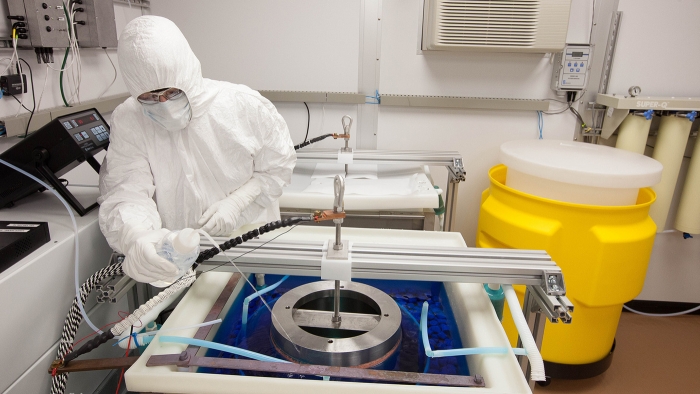
Getting into the Majorana Demonstrator clean room is an adventure. Unless you have to do it every day for work, in which case, it’s probably a chore.
It all starts in Lead, South Dakota, a town once built around and seemingly forever linked to the underground. It’s 10 miles from Sturgis, which celebrated its 75th annual motorcycle rally in August by welcoming almost 1 million bikers. It’s three miles from Deadwood, the 1870s, Wild West version of which is the setting for the eponymous HBO show (though it’s filmed in California).
Lead, pronounced so that it rhymes with reed and not red, is home to a former goldmine turned science lab. A mile below the surface, it hosts an immaculate clean room where scientists are assembling a detector to find what could be one of the rarest processes in nature, if it occurs at all. Their laboratory is 3230 square feet of scrubbed floor and filtered air, filled with glove boxes, a chemistry lab, hand-machined parts and a big shield made of lead bricks that looked like a pizza oven before it was wrapped in a few additional layers of insulation.
It’s a unique environment with a bizarre commute. The road to Sanford Lab winds past old brick and timber buildings and the modern Sanford Lab Visitors Center before climbing a steep hill to Summit Avenue. An abrupt left takes scientists through the gate to the set of brick administration buildings and the gateway to the Yates shaft, a tall, white beacon in the Black Hills.
After descending a few creaky flights of stairs with bright yellow handrails, scientists gear up. Those who didn’t arrive in dark coveralls with reflective yellow bands slide them on, along with a hard hat, lamp, wraparound safety glasses, a belt or backpack with a rescue breather, and (often) steel-toe boots. Backpacks, lunches, laptops and other gear are placed in thick plastic bags to protect them on the trip down the shaft. Scientists take one of their metal tags from the “Out” board and place it in their pocket, while the twin tag goes on the “In” board, a record of those living the mole lifestyle for the day.
Then it’s through a series of heavy sliding doors to the staging area where everyone boards the cage—tall people toward the back, shorties in the front. The cage operator talks to the hoist operator, who frees the box and sends it smoothly down through the rock and timber supports.
It’s a damp yet delightful ride, strangely reminiscent of the Haunted Mansion at Disneyland. For 10 minutes, slabs of wet wood stream past, many with colorful numbers or letters marking repair work or the level of descent. The dizzying streaks are punctuated by black holes, drifts once mined for gold that now disappear into the earth. And for the entire ride, water splatters in, kissing faces and climbing up any coverall leg long and foolish enough to touch the floor.
One can only imagine how it was for miners descending at three times the speed.
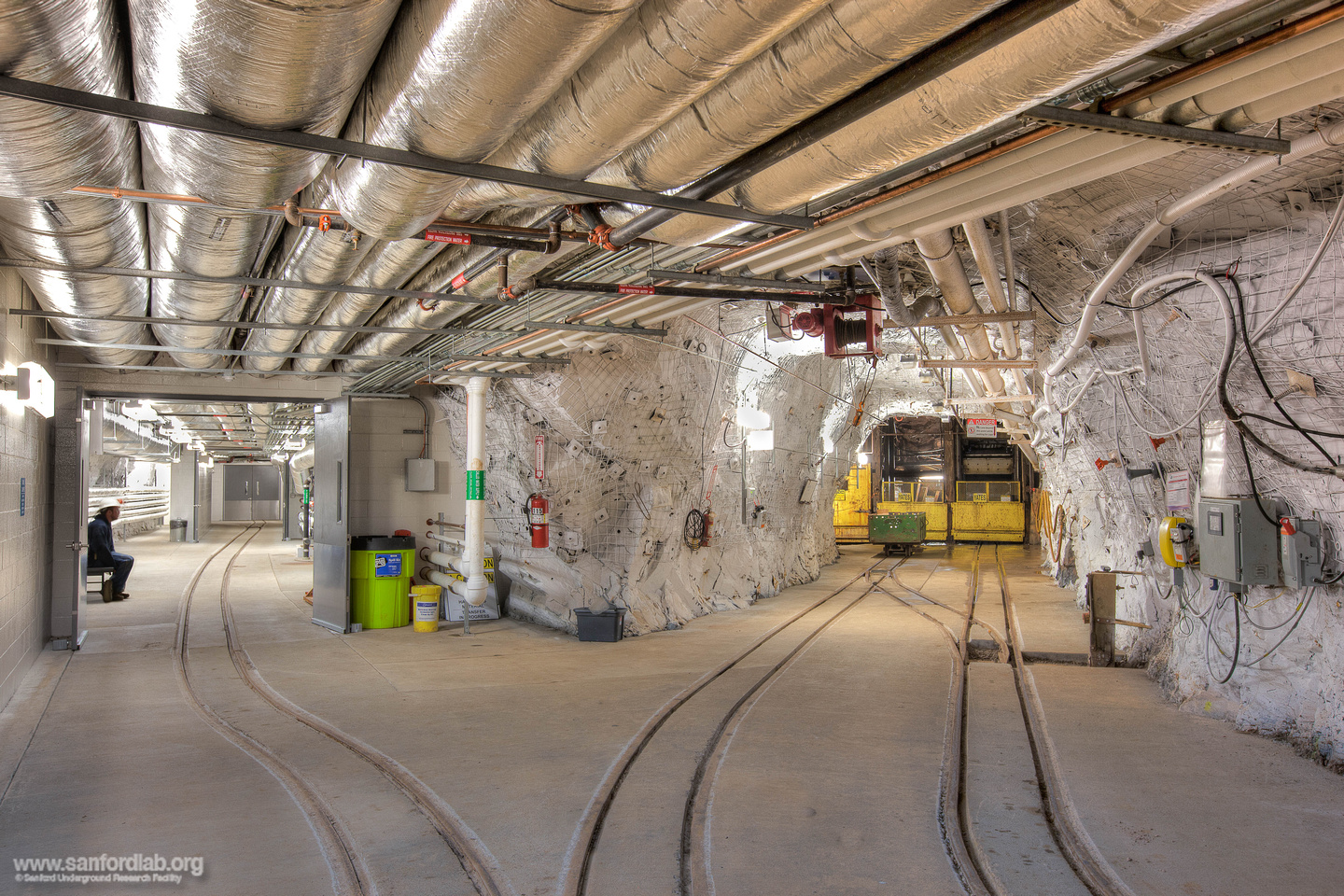
A mile below, the cage slows and gently settles near a spot called The Big X, where pathways split and run deep into the darkness or toward the well-lit lab areas. Researchers—and engineers, construction workers, guides and other myriad folk who pass through—run their feet through a boot wash before heading toward the scientific portion of the underground. Then it’s a quick stripping of the coveralls, a helmet exchange, a slip of two pairs of booties around the shoes, and the debagging process—complete with a brief alcohol swipe for object exteriors.
Another set of doors reveals the shiny brown hallway leading to the experiments. Thin tables run along their exterior in the hallway, the home for researchers working on laptops when not completing the day’s other tasks. A morning meeting to discuss the day’s plan, and then it’s on to the next costume change.
The machinist and his assistant often head in first. Randy Hughes is the sole machinist underground at Majorana (and perhaps the only machinist working a mile underground anywhere in the world, let alone at a scientific experiment), and he has a tight schedule for creating parts out of special copper electroformed underground, away from radiation.
Then the scientists get changed. The clean room is not so different from those on the surface—it has special air filtration and is kept free of particulate matter through special procedures and handy yet unexpected items like clean room paper and clean room pens.
The Majorana lab is a class 100-400 clean room, meaning there can be only 100 to 400 particles larger than half a micron per cubic foot (by comparison, a human hair is 100 microns). Typically, the room has only 100 to 200 particles. Humans are by far the dirtiest things that enter, causing the particle count to spike even with all the precautions.
First, scientists step through plastic sheeting into a space barely large enough to fit a full-size bed. Sticky blue sheets on the ground pull any dirt off the booties, but scientists still pull off the outer pair and replace them with a fresh set. Helmets come off and are swabbed with alcohol, and hairnets go on.
Facemasks slide over the nose and mouth. Because the wraparound safety glasses are still required in the lab, many people opt to tape the upper portion of the facemask down around their nose and cheeks, preventing hot air from rising up the channel and fogging their glasses. Over that goes a full head hood, leaving an oval of space for the glasses to pop out. The hood tucks into a clean pair of white coveralls that zip up. White booties slide up over the legs, the elastic holding them around mid calf, a wrap-around string at the ankles making them vaguely shoe-like.
Then it’s two pairs of white gloves on each hand. The coverall sleeves have button snaps and are taped to the inner pair of gloves. Scientists replace the outer ones fairly often throughout the day.
Finally, the helmet goes back on, and everything that will enter the clean room is attacked with alcohol-soaked pads. Fabrics aren’t friends of the clean room, so most of what goes in is plastic or metal—cameras and what must be the cleanest laptops in South Dakota seem the most common.
And then that’s it. Through the doors onto more blue sticky tape, and the scientists are finally ready for work. That might mean cleaning copper components, assembling detectors in a glove box, calibrating modules, testing cryostats, working on wiring or vacuum systems, or a hundred other things. It’s not the easiest outfit to work in. It’s a little warm, a little hard to breathe, a little like working through a fog. Most agree that the best part of the day is the sweet freedom when they remove their layers, ripping off the face mask and tape like a scientific Bioré pore strip.
Some—like Randy—aren’t real fans of the cumbersome procedures, while others don’t mind all that much. But everyone agrees that there is one cardinal rule to working in a clean room: Go to the bathroom before you head in.
Scientists below the surface
How do you get to work when your office is a clean room a mile below ground?
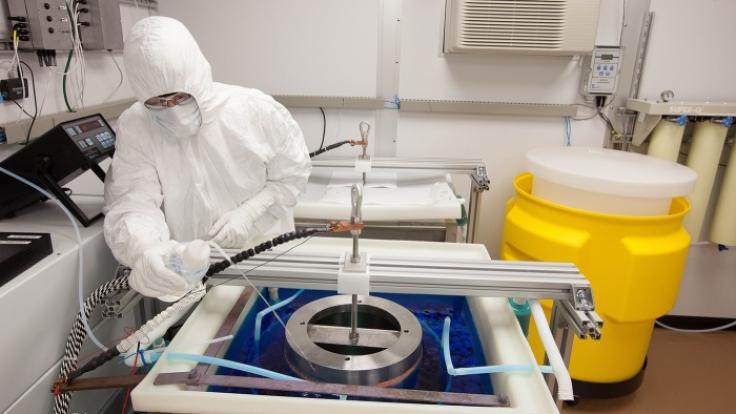
Getting into the Majorana Demonstrator clean room is an adventure. Unless you have to do it every day for work, in which case, it’s probably a chore.
It all starts in Lead, South Dakota, a town once built around and seemingly forever linked to the underground. It’s 10 miles from Sturgis, which celebrated its 75th annual motorcycle rally in August by welcoming almost 1 million bikers. It’s three miles from Deadwood, the 1870s, Wild West version of which is the setting for the eponymous HBO show (though it’s filmed in California).
Lead, pronounced so that it rhymes with reed and not red, is home to a former goldmine turned science lab. A mile below the surface, it hosts an immaculate clean room where scientists are assembling a detector to find what could be one of the rarest processes in nature, if it occurs at all. Their laboratory is 3230 square feet of scrubbed floor and filtered air, filled with glove boxes, a chemistry lab, hand-machined parts and a big shield made of lead bricks that looked like a pizza oven before it was wrapped in a few additional layers of insulation.
It’s a unique environment with a bizarre commute. The road to Sanford Lab winds past old brick and timber buildings and the modern Sanford Lab Visitors Center before climbing a steep hill to Summit Avenue. An abrupt left takes scientists through the gate to the set of brick administration buildings and the gateway to the Yates shaft, a tall, white beacon in the Black Hills.
After descending a few creaky flights of stairs with bright yellow handrails, scientists gear up. Those who didn’t arrive in dark coveralls with reflective yellow bands slide them on, along with a hard hat, lamp, wraparound safety glasses, a belt or backpack with a rescue breather, and (often) steel-toe boots. Backpacks, lunches, laptops and other gear are placed in thick plastic bags to protect them on the trip down the shaft. Scientists take one of their metal tags from the “Out” board and place it in their pocket, while the twin tag goes on the “In” board, a record of those living the mole lifestyle for the day.
Then it’s through a series of heavy sliding doors to the staging area where everyone boards the cage—tall people toward the back, shorties in the front. The cage operator talks to the hoist operator, who frees the box and sends it smoothly down through the rock and timber supports.
It’s a damp yet delightful ride, strangely reminiscent of the Haunted Mansion at Disneyland. For 10 minutes, slabs of wet wood stream past, many with colorful numbers or letters marking repair work or the level of descent. The dizzying streaks are punctuated by black holes, drifts once mined for gold that now disappear into the earth. And for the entire ride, water splatters in, kissing faces and climbing up any coverall leg long and foolish enough to touch the floor.
One can only imagine how it was for miners descending at three times the speed.
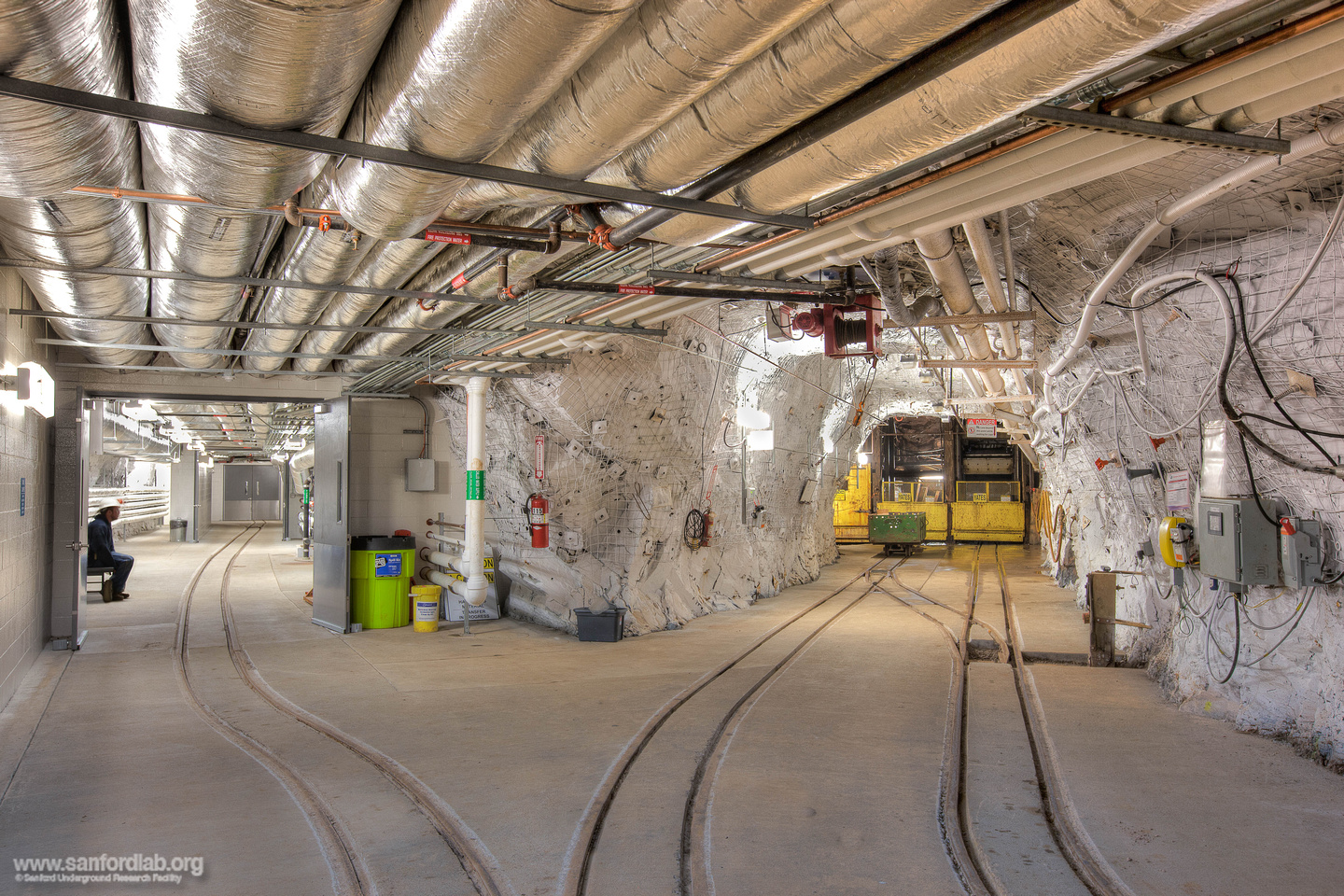
A mile below, the cage slows and gently settles near a spot called The Big X, where pathways split and run deep into the darkness or toward the well-lit lab areas. Researchers—and engineers, construction workers, guides and other myriad folk who pass through—run their feet through a boot wash before heading toward the scientific portion of the underground. Then it’s a quick stripping of the coveralls, a helmet exchange, a slip of two pairs of booties around the shoes, and the debagging process—complete with a brief alcohol swipe for object exteriors.
Another set of doors reveals the shiny brown hallway leading to the experiments. Thin tables run along their exterior in the hallway, the home for researchers working on laptops when not completing the day’s other tasks. A morning meeting to discuss the day’s plan, and then it’s on to the next costume change.
The machinist and his assistant often head in first. Randy Hughes is the sole machinist underground at Majorana (and perhaps the only machinist working a mile underground anywhere in the world, let alone at a scientific experiment), and he has a tight schedule for creating parts out of special copper electroformed underground, away from radiation.
Then the scientists get changed. The clean room is not so different from those on the surface—it has special air filtration and is kept free of particulate matter through special procedures and handy yet unexpected items like clean room paper and clean room pens.
The Majorana lab is a class 100-400 clean room, meaning there can be only 100 to 400 particles larger than half a micron per cubic foot (by comparison, a human hair is 100 microns). Typically, the room has only 100 to 200 particles. Humans are by far the dirtiest things that enter, causing the particle count to spike even with all the precautions.
First, scientists step through plastic sheeting into a space barely large enough to fit a full-size bed. Sticky blue sheets on the ground pull any dirt off the booties, but scientists still pull off the outer pair and replace them with a fresh set. Helmets come off and are swabbed with alcohol, and hairnets go on.
Facemasks slide over the nose and mouth. Because the wraparound safety glasses are still required in the lab, many people opt to tape the upper portion of the facemask down around their nose and cheeks, preventing hot air from rising up the channel and fogging their glasses. Over that goes a full head hood, leaving an oval of space for the glasses to pop out. The hood tucks into a clean pair of white coveralls that zip up. White booties slide up over the legs, the elastic holding them around mid calf, a wrap-around string at the ankles making them vaguely shoe-like.
Then it’s two pairs of white gloves on each hand. The coverall sleeves have button snaps and are taped to the inner pair of gloves. Scientists replace the outer ones fairly often throughout the day.
Finally, the helmet goes back on, and everything that will enter the clean room is attacked with alcohol-soaked pads. Fabrics aren’t friends of the clean room, so most of what goes in is plastic or metal—cameras and what must be the cleanest laptops in South Dakota seem the most common.
And then that’s it. Through the doors onto more blue sticky tape, and the scientists are finally ready for work. That might mean cleaning copper components, assembling detectors in a glove box, calibrating modules, testing cryostats, working on wiring or vacuum systems, or a hundred other things. It’s not the easiest outfit to work in. It’s a little warm, a little hard to breathe, a little like working through a fog. Most agree that the best part of the day is the sweet freedom when they remove their layers, ripping off the face mask and tape like a scientific Bioré pore strip.
Some—like Randy—aren’t real fans of the cumbersome procedures, while others don’t mind all that much. But everyone agrees that there is one cardinal rule to working in a clean room: Go to the bathroom before you head in.

 Frascati Scienza
 Buco Nero
 Io Non Faccio Niente
 Tommaso Dorigo
 Giovanni Mazzitelli
 Barbara Gallavotti
 Keplero Blog
 Research Gate