
Do protons decay?
Is it possible that these fundamental building blocks of atoms have a finite lifetime?

The stuff of daily existence is made of atoms, and all those atoms are made of the same three things: electrons, protons and neutrons.
Protons and neutrons are very similar particles in most respects. They’re made of the same quarks, which are even smaller particles, and they have almost exactly the same mass.
Yet neutrons appear to be different from protons in an important way: They aren’t stable. A neutron outside of an atomic nucleus decays in a matter of minutes into other particles.
What about protons?
A free proton is a pretty common sight in the cosmos. Much of the ordinary matter (as opposed to dark matter) in galaxies and beyond comes in the form of hydrogen plasma, a hot gas made of unattached protons and electrons. If protons were as unstable as neutrons, that plasma would eventually vanish.
But that isn’t happening. Protons—whether inside atoms or drifting free in space—appear to be remarkably stable. We’ve never seen one decay.
However, nothing essential in physics forbids a proton from decaying. In fact, a stable proton would be exceptional in the world of particle physics, and several theories demand that protons decay.
If protons are not immortal, what happens to them when they die, and what does that mean for the stability of atoms?

Following the rules
Fundamental physics relies on conservation laws: certain quantities that are preserved, such as energy, momentum and electric charge. The conservation of energy—combined with the famous equation E=mc2—means that lower-mass particles can’t change into higher-mass ones without an infusion of energy. Combining conservation of energy with conservation of electric charge tells us that electrons are probably stable forever: No lower-mass particle with a negative electric charge exists, to the best of our knowledge.
Protons aren’t constrained the same way: They are more massive than a number of other particles, and the fact that they are made of quarks allows for several possible ways for them to die.
For comparison, a neutron decays into a proton, an electron and a neutrino. Both energy and electric charge are preserved in the decay: A neutron is a wee bit heftier than a proton and electron combined, and the positively-charged proton balances out the negatively-charged electron to make sure the total electric charge is zero both before and after the decay. (The neutrino—or technically an antineutrino, the antimatter version—is necessary to balance other things, but that’s a story for another day.)
Because atoms are stable and we’ve never seen a proton die, perhaps protons are intrinsically stable. However, as Kaladi Babu of Oklahoma State University points out, there’s no “proton conservation law" like charge conservation to preserve a proton.
“You ask this question: What if the proton decays?” he says. “Does it violate any fundamental principle of physics? And the answer is no.”
No GUTs, no glory
So if there’s no rule against proton decay, is there a reason scientists expect to see it? Yes. Proton decay is the strongest testable prediction of several grand unified theories, or GUTs.
GUTs unify three of the four fundamental forces of nature: electromagnetism, the weak force and the strong force. (Gravity isn’t included because we don’t have a quantum theory for it yet.)
The first GUT, proposed in the 1970s, failed. Among other things, it predicted a proton lifetime short enough that experiments should have seen decays when they didn’t. However, the idea of grand unification was still valuable enough that particle physicists kept looking for it. (You might say they had a GUT feeling. Or you might not.)
“The idea of grand unification is really beautiful and explains many things that seem like bizarre coincidences,” says theorist Jonathan Feng, a physicist at the University of California, Irvine.
Feng is particularly interested in a GUT that involves Supersymmetry, a brand of particle physics that potentially could explain a wide variety of phenomena, including the invisible dark matter that binds galaxies together. Supersymmetric GUTs predict some new interactions that, as a pleasant side effect, result in a longer lifetime for protons, yet still leave proton decay within the realm of experimental detection. Because of the differences between supersymmetric and non-supersymmetric GUTs, Feng says the proton decay rate could be the first real sign of Supersymmetry in the lab.
However, Supersymmetry is not necessary for GUTs. Babu is fond of a GUT that shares many of the advantages of the supersymmetric versions. This GUT’s technical name is SO(10), named because its mathematical structure involves rotations in 10 imaginary dimensions. The theory includes important features absent from the Standard Model such as neutrino masses, and might explain why there is more matter than antimatter in the cosmos. Naturally, it predicts proton decay.

The search for proton decay
Much rests on the existence of proton decay, and yet we’ve never seen a proton die. The reason may simply be that protons rarely decay, a hypothesis borne out by both experiment and theory. Experiments say the proton lifetime has to be greater than about 1034 years: That’s a 1 followed by 34 zeroes.
For reference, the universe is only 13.8 billion years old, which is roughly a 1 followed by 10 zeros. Protons on average will outlast every star, galaxy and planet, even the ones not yet born.
The key phrase in that last sentence is “on average.” As Feng says, it’s not like “every single proton will last for 1034 years and then at 1034 years they all boom! poof! in a puff of smoke, they all disappear.”
Because of quantum physics, the time any given proton decays is random, so a tiny fraction will decay long before that 1034-year lifetime. So, “what you need to do is to get a whole bunch of protons together,” he says. Increasing the number of protons increases the chance that one of them will decay while you’re watching.
The second essential step is to isolate the experiment from particles that could mimic proton decay, so any realistic proton decay experiment must be located deep underground to isolate it from random particle passers-by. That’s the strategy pursued by the currently operating Super-Kamiokande experiment in Japan, which consists of a huge tank with 50,000 tons of water in a mine. The upcoming Deep Underground Neutrino Experiment, to be located in a former gold mine in South Dakota, will consist of 40,000 tons of liquid argon.
Because the two experiments are based on different types of atoms, they are sensitive to different ways protons might decay, which will reveal which GUT is correct … if any of the current models is right. Both Super-Kamiokande and DUNE are neutrino experiments first, Feng says, “but we're just as interested in the proton decay possibilities of these experiments as in the neutrino aspects.”
After all, proton decay follows from profound concepts of how the cosmos fundamentally operates. If protons do decay, it’s so rare that human bodies would be unaffected, but not our understanding. The impact of that knowledge would be immense, and worth a tiny bit of instability.

Do protons decay?
Is it possible that these fundamental building blocks of atoms have a finite lifetime?
The stuff of daily existence is made of atoms, and all those atoms are made of the same three things: electrons, protons and neutrons.
Protons and neutrons are very similar particles in most respects. They’re made of the same quarks, which are even smaller particles, and they have almost exactly the same mass.
Yet neutrons appear to be different from protons in an important way: They aren’t stable. A neutron outside of an atomic nucleus decays in a matter of minutes into other particles.
What about protons?
A free proton is a pretty common sight in the cosmos. Much of the ordinary matter (as opposed to dark matter) in galaxies and beyond comes in the form of hydrogen plasma, a hot gas made of unattached protons and electrons. If protons were as unstable as neutrons, that plasma would eventually vanish.
But that isn’t happening. Protons—whether inside atoms or drifting free in space—appear to be remarkably stable. We’ve never seen one decay.
However, nothing essential in physics forbids a proton from decaying. In fact, a stable proton would be exceptional in the world of particle physics, and several theories demand that protons decay.
If protons are not immortal, what happens to them when they die, and what does that mean for the stability of atoms?
Following the rules
Fundamental physics relies on conservation laws: certain quantities that are preserved, such as energy, momentum and electric charge. The conservation of energy—combined with the famous equation E=mc2—means that lower-mass particles can’t change into higher-mass ones without an infusion of energy. Combining conservation of energy with conservation of electric charge tells us that electrons are probably stable forever: No lower-mass particle with a negative electric charge exists, to the best of our knowledge.
Protons aren’t constrained the same way: They are more massive than a number of other particles, and the fact that they are made of quarks allows for several possible ways for them to die.
For comparison, a neutron decays into a proton, an electron and a neutrino. Both energy and electric charge are preserved in the decay: A neutron is a wee bit heftier than a proton and electron combined, and the positively-charged proton balances out the negatively-charged electron to make sure the total electric charge is zero both before and after the decay. (The neutrino—or technically an antineutrino, the antimatter version—is necessary to balance other things, but that’s a story for another day.)
Because atoms are stable and we’ve never seen a proton die, perhaps protons are intrinsically stable. However, as Kaladi Babu of Oklahoma State University points out, there’s no “proton conservation law" like charge conservation to preserve a proton.
“You ask this question: What if the proton decays?” he says. “Does it violate any fundamental principle of physics? And the answer is no.”
No GUTs, no glory
So if there’s no rule against proton decay, is there a reason scientists expect to see it? Yes. Proton decay is the strongest testable prediction of several grand unified theories, or GUTs.
GUTs unify three of the four fundamental forces of nature: electromagnetism, the weak force and the strong force. (Gravity isn’t included because we don’t have a quantum theory for it yet.)
The first GUT, proposed in the 1970s, failed. Among other things, it predicted a proton lifetime short enough that experiments should have seen decays when they didn’t. However, the idea of grand unification was still valuable enough that particle physicists kept looking for it. (You might say they had a GUT feeling. Or you might not.)
“The idea of grand unification is really beautiful and explains many things that seem like bizarre coincidences,” says theorist Jonathan Feng, a physicist at the University of California, Irvine.
Feng is particularly interested in a GUT that involves Supersymmetry, a brand of particle physics that potentially could explain a wide variety of phenomena, including the invisible dark matter that binds galaxies together. Supersymmetric GUTs predict some new interactions that, as a pleasant side effect, result in a longer lifetime for protons, yet still leave proton decay within the realm of experimental detection. Because of the differences between supersymmetric and non-supersymmetric GUTs, Feng says the proton decay rate could be the first real sign of Supersymmetry in the lab.
However, Supersymmetry is not necessary for GUTs. Babu is fond of a GUT that shares many of the advantages of the supersymmetric versions. This GUT’s technical name is SO(10), named because its mathematical structure involves rotations in 10 imaginary dimensions. The theory includes important features absent from the Standard Model such as neutrino masses, and might explain why there is more matter than antimatter in the cosmos. Naturally, it predicts proton decay.
The search for proton decay
Much rests on the existence of proton decay, and yet we’ve never seen a proton die. The reason may simply be that protons rarely decay, a hypothesis borne out by both experiment and theory. Experiments say the proton lifetime has to be greater than about 1034 years: That’s a 1 followed by 34 zeroes.
For reference, the universe is only 13.8 billion years old, which is roughly a 1 followed by 10 zeros. Protons on average will outlast every star, galaxy and planet, even the ones not yet born.
The key phrase in that last sentence is “on average.” As Feng says, it’s not like “every single proton will last for 1034 years and then at 1034 years they all boom! poof! in a puff of smoke, they all disappear.”
Because of quantum physics, the time any given proton decays is random, so a tiny fraction will decay long before that 1034-year lifetime. So, “what you need to do is to get a whole bunch of protons together,” he says. Increasing the number of protons increases the chance that one of them will decay while you’re watching.
The second essential step is to isolate the experiment from particles that could mimic proton decay, so any realistic proton decay experiment must be located deep underground to isolate it from random particle passers-by. That’s the strategy pursued by the currently operating Super-Kamiokande experiment in Japan, which consists of a huge tank with 50,000 tons of water in a mine. The upcoming Deep Underground Neutrino Experiment, to be located in a former gold mine in South Dakota, will consist of 40,000 tons of liquid argon.
Because the two experiments are based on different types of atoms, they are sensitive to different ways protons might decay, which will reveal which GUT is correct … if any of the current models is right. Both Super-Kamiokande and DUNE are neutrino experiments first, Feng says, “but we're just as interested in the proton decay possibilities of these experiments as in the neutrino aspects.”
After all, proton decay follows from profound concepts of how the cosmos fundamentally operates. If protons do decay, it’s so rare that human bodies would be unaffected, but not our understanding. The impact of that knowledge would be immense, and worth a tiny bit of instability.
Hitting the neutrino floor
Hitting the neutrino floor
Dark matter experiments are becoming so sensitive, even the ghostliest of particles will soon get in the way.

The scientist who first detected the neutrino called the strange new particle “the most tiny quantity of reality ever imagined by a human being.” They are so absurdly small and interact with other matter so weakly that about 100 trillion of them pass unnoticed through your body every second, most of them streaming down on us from the sun.
And yet, new experiments to hunt for dark matter are becoming so sensitive that these ephemeral particles will soon show up as background. It’s a phenomenon some physicists are calling the “neutrino floor,” and we may reach it in as little as five years.
The neutrino floor applies only to direct detection experiments, which search for the scattering of a dark matter particle off of a nucleus. Many of these experiments look for WIMPs, or weakly interacting massive particles. If dark matter is indeed made of WIMPs, it will interact in the detector in nearly the same way as solar neutrinos.
We don’t know what dark matter is made of. Experiments around the world are working toward detecting a wide range of particles.
“What’s amazing is now the experimenters are trying to measure dark matter interactions that are at the same strength or even smaller than the strength of neutrino interactions,” says Thomas Rizzo, a theoretical physicist at SLAC National Accelerator Laboratory. “Neutrinos hardly interact at all, and yet we’re trying to measure something even weaker than that in the hunt for dark matter.”
This isn’t the first time the hunt for dark matter has been linked to the detection of solar neutrinos. In the 1980s, physicists stumped by what appeared to be missing solar neutrinos envisioned massive detectors that could fix the discrepancy. They eventually solved the solar neutrino problem using different methods (discovering that the neutrinos weren’t missing; they were just changing as they traveled to the Earth), and instead put the technology to work hunting dark matter.
In recent years, as the dark matter program has grown in size and scope, scientists realized the neutrino floor was no longer an abstract problem for future researchers to handle. In 2009, Louis Strigari, an astrophysicist at Texas A&M University, published the first specific predictions of when detectors would reach the floor. His work was widely discussed at a 2013 planning meeting for the US particle physics community, turning the neutrino floor into an active dilemma for dark matter physicists.
“At some point these things are going to appear,” Strigari says, “and the question is, how big do these detectors have to be in order for the solar neutrinos to show up?”
Strigari predicts that the first experiment to hit the floor will be the SuperCDMS experiment, which will hunt for WIMPs from SNOLAB in the Vale Inco Mine in Canada.
While hitting the floor complicates some aspects of the dark matter hunt, Rupak Mahapatra, a principal investigator for SuperCDMS at Texas A&M, says he hopes they reach it sooner rather than later—a know-thy-enemy kind of thing.
“It is extremely important to know the neutrino floor very precisely,” Mahapatra says. “Once you hit it first, that’s a benchmark. You understand what exactly that number should be, and it helps you build a next-generation experiment.”
Much of the work of untangling a dark matter signal from neutrino background will come during data analysis. One strategy involves taking advantage of the natural ebbs and flows in the amount of dark matter and neutrinos hitting Earth. Dark matter’s natural flux, which arises from the motion of the sun through the Milky Way, peaks in June and reaches its lowest point in December. Solar neutrinos, on the other hand, peak in January, when the Earth is closest to the sun.
“That could help you disentangle how much is signal and how much is background,” Rizzo says.
There’s also the possibility that dark matter is not, in fact, a WIMP. Another potentially viable candidate is the axion, a hypothetical particle that solves a lingering mystery of the strong nuclear force. While WIMP and neutrino interactions look very similar, axion interactions would appear differently in a detector, making the neutrino floor a non-issue.
But that doesn’t mean physicists can abandon the WIMP search in favor of axions, says JoAnne Hewett, a theoretical physicist at SLAC. “WIMPs are still favored for many reasons. The neutrino floor just makes it more difficult to detect. It doesn’t make it less likely to exist.”
Physicists are confident that they’ll eventually be able to separate a dark matter signal from neutrino noise. Next-generation experiments might even be able to distinguish the direction a particle is coming from when it hits the detector, something the detectors being built today just can’t do. If an interaction seemed to come from the direction of the sun, that would be a clear indication that it was likely a solar neutrino.
“There’s certainly avenues to go here,” Strigari says. “It’s not game over, we don’t think, for dark matter direct detection.”
A light in the dark
A light in the dark
The MiniCLEAN dark matter experiment prepares for its debut.
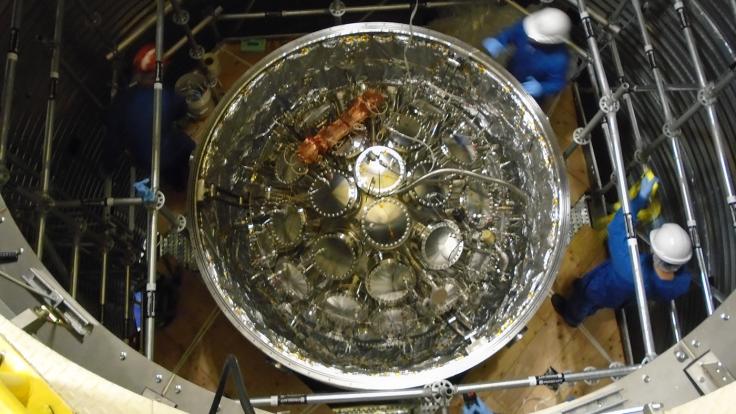
Getting to an experimental cavern 6800 feet below the surface in Sudbury, Ontario, requires an unusual commute. The Cage, an elevator that takes people into the SNOLAB facility, descends twice every morning at 6 a.m. and 8 a.m. Before entering the lab, individuals shower and change so they don’t contaminate the experimental areas.
A thick layer of natural rock shields the clean laboratory where air quality, humidity and temperature are highly regulated. These conditions allow scientists to carry out extremely sensitive searches for elusive particles such as dark matter and neutrinos.
The Cage returns to the surface at 3:45 p.m. each day. During the winter months, researchers go underground before the sun rises and emerge as it sets. Steve Linden, a postdoctoral researcher from Boston University, makes the trek every morning to work on MiniCLEAN, which scientists will use to test a novel technique for directly detecting dark matter.
“It’s a long day,” Linden says.
Scientists and engineers have spent the past eight years designing and building the MiniCLEAN detector. Today that task is complete; they have begun commissioning and cooling the detector to fill it with liquid argon to start its search for dark matter.
Though dark matter is much more abundant than the visible matter that makes up planets, stars and everything we can see, no one has ever identified it. Dark matter particles are chargeless, don’t absorb or emit light, and interact very weakly with matter, making them incredibly difficult to detect.
Spotting the WIMPs
MiniCLEAN (CLEAN stands for Cryogenic Low-Energy Astrophysics with Nobles) aims to detect weakly interacting massive particles, or WIMPs, the current favorite dark matter candidate. Scientists will search for these rare particles by observing their interactions with atoms in the detector.
To make this possible, the detector will be filled with over 500 kilograms of very cold, dense, ultra-pure materials—argon at first, and later neon. If a WIMP passes through and collides with an atom’s nucleus, it will produce a pulse of light with a unique signature. Scientists can collect and analyze this light to determine whether what they saw was a dark matter particle or some other background event.
The use of both argon and neon will allow MiniCLEAN to double-check any possible signals. Argon is more sensitive than neon, so a true dark matter signal would disappear when liquid argon is replaced with liquid neon. Only an intrinsic background signal from the detector would persist. Scientists would like to eventually scale this experiment up to a larger version called CLEAN.
Overcoming obstacles
MiniCLEAN is a small experiment, with about 15 members in the collaboration and the project lead at Pacific Northwest National Laboratory. While working on this experiment underground with few hands to spare, the team has run into some unexpected roadblocks.
One such obstacle appeared while transporting the inner vessel, a detector component that will contain the liquid argon or neon.
“Last November, as we finished assembling the inner vessel and were getting ready to move it to where it needed to end up, we realized it wouldn’t fit between the doors into the hallway we had to wheel it down,” Linden explains.
When this happened, the team was faced with two options: somehow reduce the size of the vessel, or cut away a part of the door—not a simple thing to do in a clean lab. Fortunately, temporarily replacing some of the vessel’s parts reduced the size enough to make it fit. They got it through the doorway with about an eighth of an inch clearance on each side.
“What gives me the energy to persist on this project is that the CLEAN approach is unique, and there isn’t another approach to dark matter that is like it,” says Pacific Northwest National Laboratory scientist Andrew Hime, MiniCLEAN spokesperson and principal investigator. “It’s been eight years since we starting pushing hard on this program, and finally getting real data from the detector will be a breath of fresh air.”
Where the Higgs belongs
Where the Higgs belongs
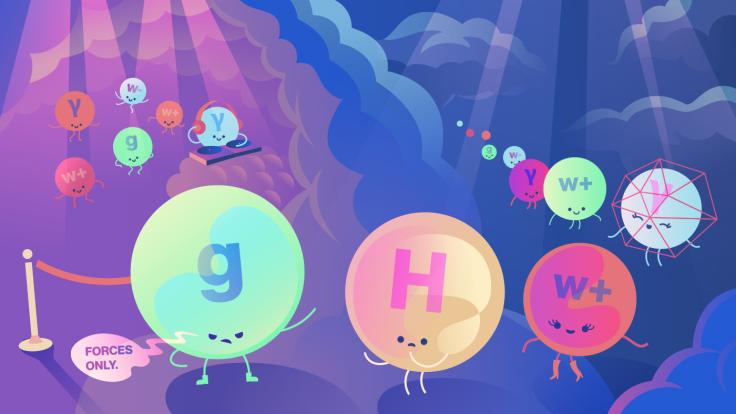
The Higgs doesn’t quite fit in with the other particles of the Standard Model of particle physics.
If you were Luke Skywalker in Star Wars, and you carried a tiny green Jedi master on your back through the jungles of Dagobah for long enough, you could eventually raise your submerged X-wing out of the swamp just by using the Force.
But if you were a boson in the Standard Model of particle physics, you could skip the training—you would be the force.
Bosons are particles that carry the four fundamental forces. These forces push and pull what would otherwise have been an unwieldy soup of particles into the beautiful mosaic of stars and galaxies that permeate the visible universe.
The fundamental forces keep protons incredibly stable (the strong force holds them together), cause compasses to point north (the electromagnetic force attracts the needle), make apples fall off trees (gravity attracts the fruit to the ground), and keep the sun shining (the weak force allows nuclear fusion to occur).
In 2012, the Higgs boson became an officially recognized member of this family of fundamental bosons.
The Higgs is called a boson because of a quantum mechanical property called spin—which represents a particle’s intrinsic angular momentum and characterizes how a particle plays with its Standard Model friends.
Bosons have an integer spin (0, 1, 2) which makes them the touchy-feely types. They have no need for personal space. Fermions, on the other hand, have a non-integer spin (1/2, 3/2, etc.), which makes them a bit more isolated; they prefer to keep their distance from other particles.
The Higgs has a spin of 0, making it officially a boson.
“Every boson is associated with one of the four fundamental forces,” says Kyle Cranmer, an associate professor of physics at New York University. “So if we discover a new boson, it seems natural that we should find a new force.”
Scientists think that a Higgs force does exist. But it’s the Higgs boson’s relationship to that force that makes it a bit of a black sheep. It’s the reason that, when the Higgs is added to the Standard Model of particle physics, it’s often pictured apart from the rest of the boson family.
What the Higgs is for
The Higgs boson is an excitation of the Higgs field, which interacts with some of the fundamental particles to give them mass.
“The way the Higgs field gives masses to particles is its own unique feature, which is different from all other known fields in the universe,” says Matt Strassler, a Harvard University theoretical physicist. “When the Higgs field turns on, it changes the environment for all particles; it changes the nature of empty space itself. The way particles interact with this field is based on their intrinsic properties.”
There are three inherent qualifications required for a field to generate a force: The field must be able to switch on and off. It must have a preferred direction. And it must be able to attract or repel.
Normally the Higgs field fails the first two requirements—it’s always on, with no preferred direction. But in the presence of a Higgs boson, the field is distorted, theoretically allowing it to generate a force.
“We think that two particles can pull on each other using the Higgs field,” Strassler says. “The same equations we used to predict that the Higgs particle should exist, and how it should decay to other particles, also predict this force will exist.”
Just what role that force might play in our greater understanding of the universe is still a mystery.
“We know the Higgs field is essential in the formation of stable matter,” Strassler says. “But the Higgs force—as far as we know—is not.”
The Higgs force could be important in some other way, Strassler says. It could be related to how much dark matter exists in the universe or the huge imbalance between matter and antimatter. “It’s too early to write it off,” he says.
During this run of the Large Hadron Collider, physicists expect to produce roughly 10 times as many Higgs bosons as they did during the first run. This will enable scientists to examine the properties of this peculiar particle more deeply.

 Frascati Scienza
 Buco Nero
 Io Non Faccio Niente
 Tommaso Dorigo
 Giovanni Mazzitelli
 Barbara Gallavotti
 Keplero Blog
 Research Gate