
Q&A with Fermilab’s first artist-in-residence
Q&A with Fermilab’s first artist-in-residence
Symmetry sits down with Lindsay Olson as she wraps up a year of creating art inspired by particle physics.
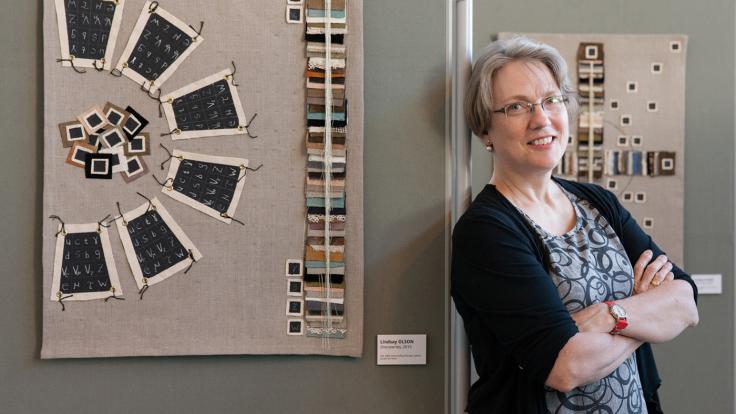
How did you end up at Fermilab?
In March 2014 I had an exhibition of my work at North Park College. Several members of the Fermilab art committee attended my talk. Hearing me speak about one of my residencies, Georgia Schwender, curator of Fermilab’s art gallery, invited me to help her establish a pilot residency that would continue Fermilab’s tradition of nurturing both art and science.
What did you do during your residency?
During a residency, I want to have a full immersion experience. I worked closely with passionate scientists, including Don Lincoln, Sam Zeller and Debbie Harris. I read books and popular science journalism, attended public lectures, and watched videos. This immersive learning is the scaffolding from which I create my art.
What’s your artistic process like?
I want to make engaging, accessible art about real, complicated science: art that will connect with the public and inspire them to ask their own questions about the nature of reality and the origin of the cosmos. When I converse with a scientist, I glean the key points and translate them in an artistic way. Many artists use oil paint, watercolor and other traditional materials. But when I work, I want to use media to reinforce the message in the art. Everyone uses textiles in their daily lives, so creating work in them felt like a natural choice.
What inspired you at Fermilab?
The Standard Model was the first piece of physics I learned. This conceptual tool was not only an appropriate beginning for the project, but a door into a fascinating way to understand reality. Passionate scientists of the present and science heroes of the past, especially Ray Davis, Richard Feynman and Robert Wilson, also inspired me.
What is one of your most memorable experiences at Fermilab?
I took several training courses, including radiation safety training. This allowed me to shadow operators into the guts of several experiments during a recent shutdown. It was thrilling. Accelerator science is about riding a bucking bronco of energetic particles. Understanding how the messy beam behaves showed me that nature is not just about forests, creatures and rocks. At the subatomic level, nature is wild, energetic and mysterious. I plan to make large-scale drawings based on what I have learned in the Accelerator Division.
Did anything surprise you?
I’ve been surprised at every turn. As an artist, I’ve been trained to observe the surface of reality. Everything looks solid and unmoving. But the subatomic realm is far more spacious and energetic than I could have imagined.
How did you become interested in expressing science in your art?
Before I created art about science, I painted landscapes. I created portraits of area waterways. I was editing out all the manmade features and creating idealized images of streams and rivers. One day I was canoeing past an aeration station on the Chicago Canal and became curious about the real story of water in a dense urban area. I approached the District about beginning an art project that would tell this story. I started a residency at the Metropolitan Water Reclamation District of Greater Chicago. Strange as it may sound, I fell in love with science in the middle of a wastewater treatment plant.
How did your residency at Fermilab differ from past residencies?
The most striking difference is the amount of resources available at Fermilab. It’s hard to imagine any other government agency where you will find not only cutting-edge science, but also a buffalo herd, a beautiful art gallery, a concert hall, a restored prairie and a graveyard.
What will you take with you when you leave Fermilab?
One of the most powerful lessons I learned with this residency is that I am not afraid to learn any kind of science. I have limits because I lack the background in math. Despite this, I feel confident about learning enough science to make meaningful art. If I can learn science, others can too.
What’s next?
Once I’ve finished the art, the project is far from over. Finding places to show the work I made while at Fermilab will be the next challenge. I want to use the work to inspire viewers to take a closer look at science in general and particle physics in particular. I hope the project helps people with no technical training, like me, to appreciate the beauty and elegance of our universe.
I have no set plans for my next residency, but I have a few ideas simmering on the back burner. Perhaps I will be surprised by another opportunity. My residency with Fermilab has changed my view of reality enough for me to know that there are surprises out in the universe for any of us who take the time to discover what science can teach us.
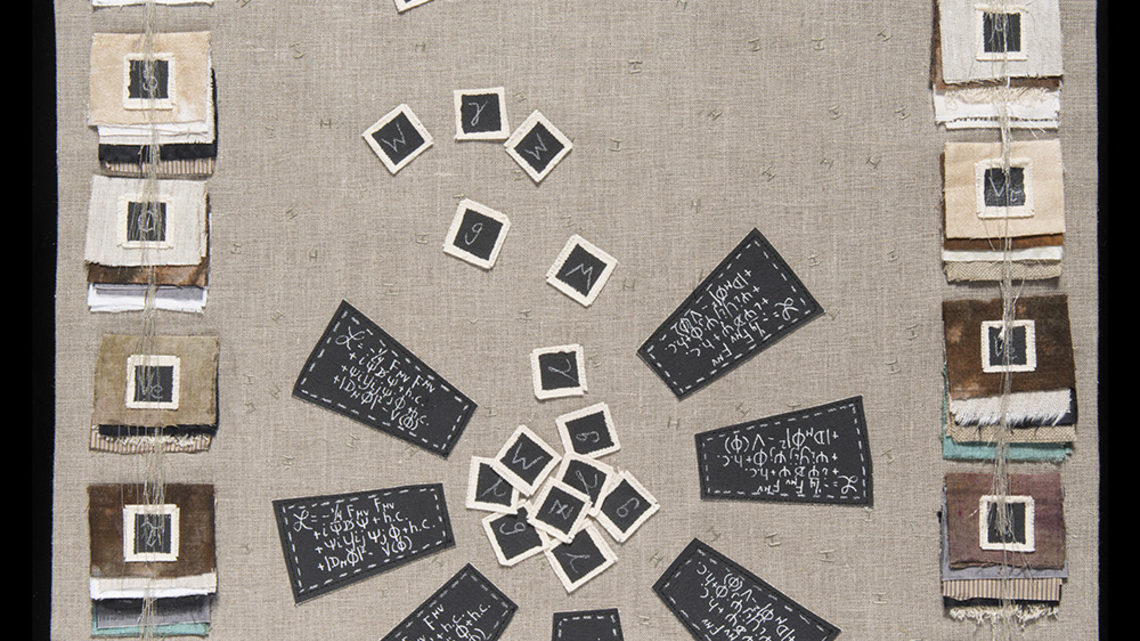
Art by Fermilab artist-in-residence Lindsay Olson.
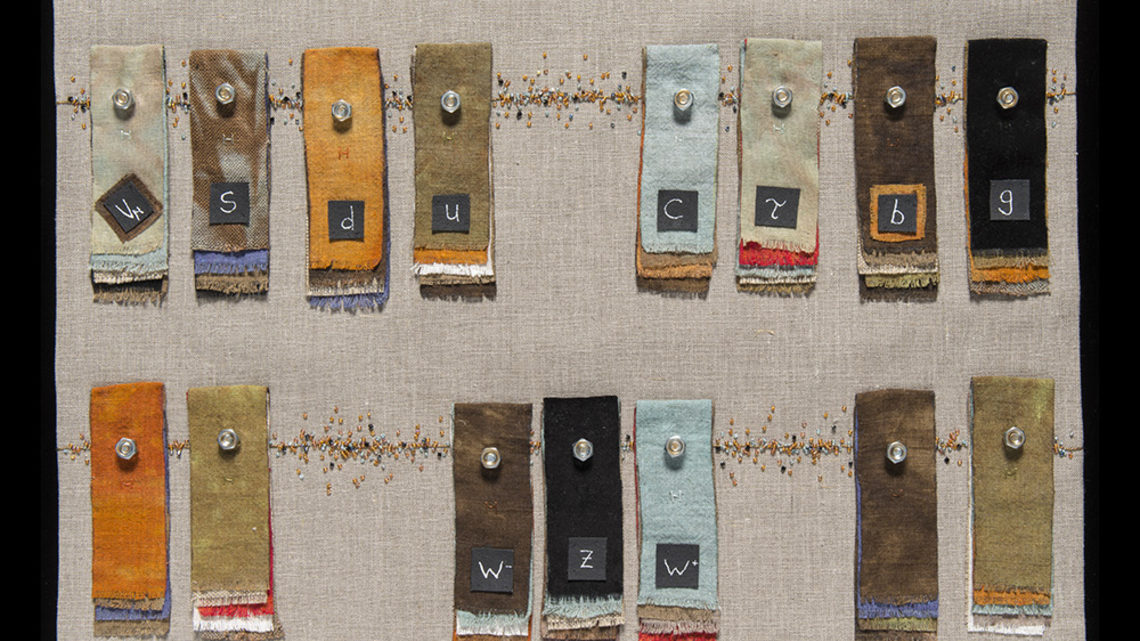
Art by Fermilab artist-in-residence Lindsay Olson.

Art by Fermilab artist-in-residence Lindsay Olson.
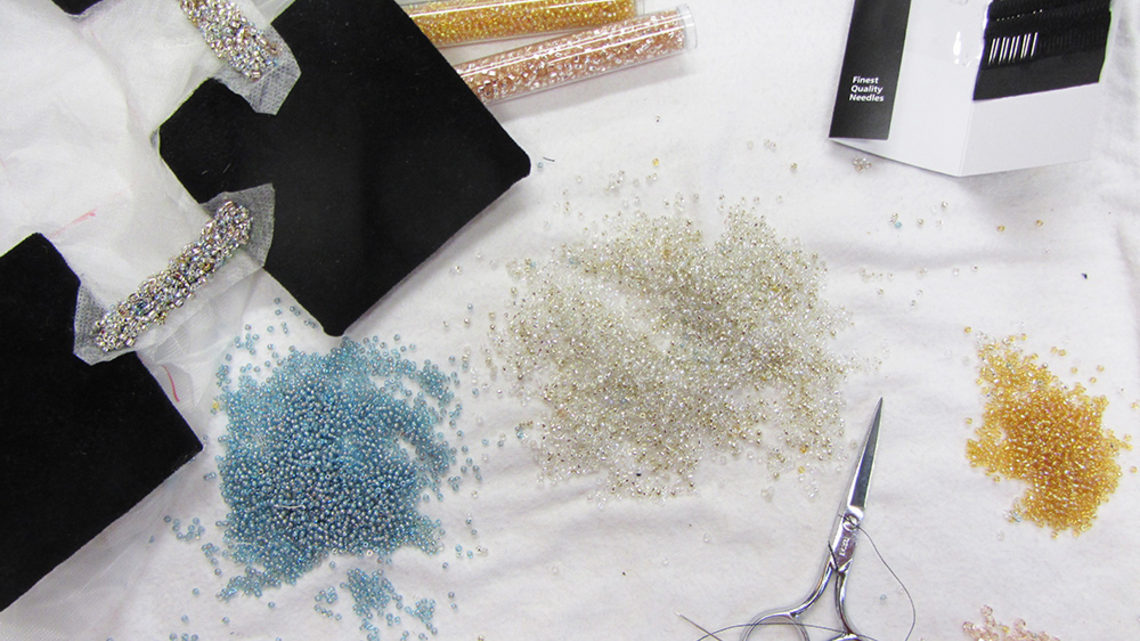
Olson used three colors of beads in a piece inspired by neutrinos to represent the three flavors of neutrinos.
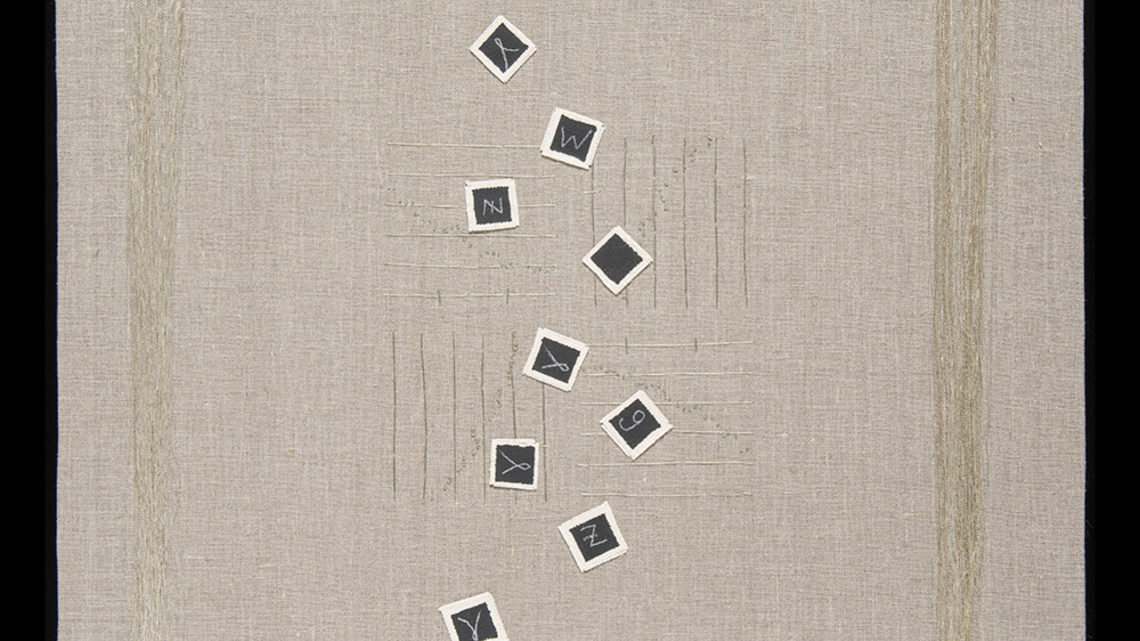
Art by Fermilab artist-in-residence Lindsay Olson.

Art by Fermilab artist-in-residence Lindsay Olson.
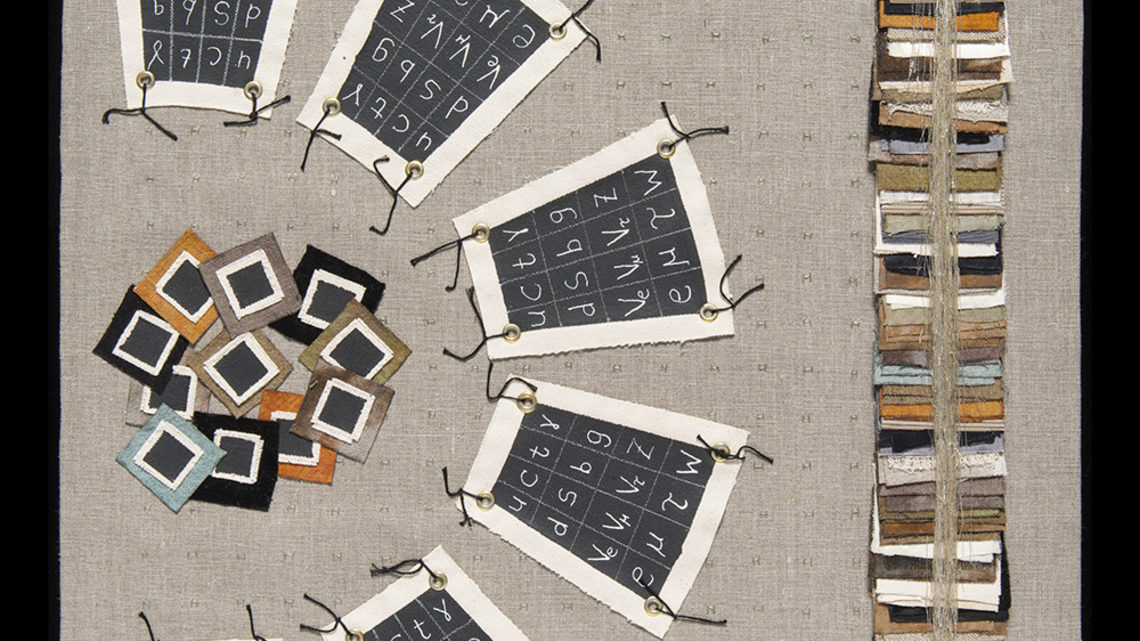
Art by Fermilab artist-in-residence Lindsay Olson.
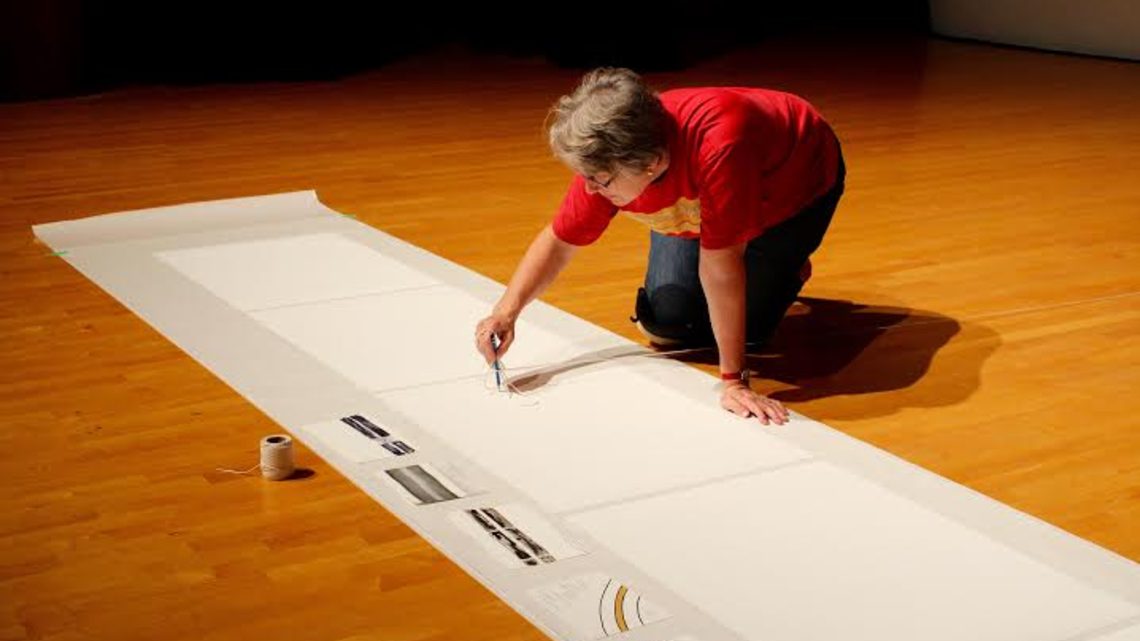
Olson found extra space to work on a large-scale project on Fermilab’s Wilson Hall stage.
New discovery? Or just another bump?
New discovery? Or just another bump?
For physicists, seeing is not always believing.
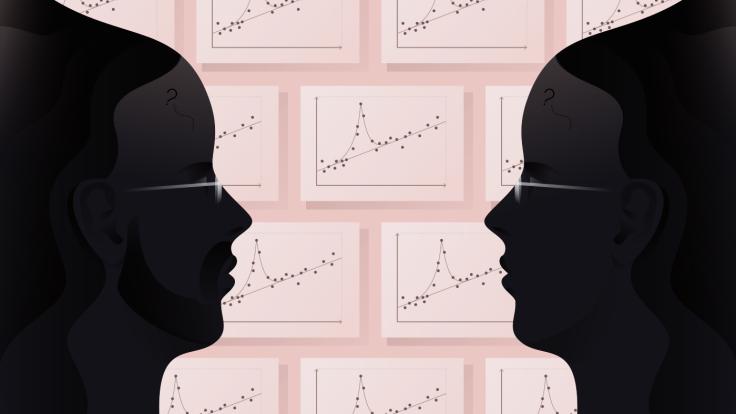
In the 1960s physicists at the University of California, Berkeley saw evidence of new, unexpected particles popping up in data from their bubble chamber experiments.
But before throwing a party, the scientists did another experiment. They repeated their analysis, but instead of using the real data from the bubble chamber, they used fake data generated by a computer program, which assumed there were no new particles.
The scientists performed a statistical analysis on both sets of data, printed the histograms, pinned them to the wall of the physics lounge, and asked visitors to identify which plots showed the new particles and which plots were fakes.
No one could tell the difference. The fake plots had just as many impressive deviations from the theoretical predictions as the real plots.
Eventually, the scientists determined that some of the unexpected bumps in the real data were the fingerprints of new composite particles. But the bumps in the fake data remained the result of random statistical fluctuations.
So how do scientists differentiate between random statistical fluctuations and real discoveries?
Just like a baseball analyst can’t judge if a rookie is the next Babe Ruth after nine innings of play, physicists won’t claim a discovery until they know that their little bump-on-a-graph is the real deal.
After the histogram “social experiment” at Berkeley, scientists developed a one-size-fits-all rule to separate the “Hall of Fame” discoveries from the “few good games” anomalies: the five-sigma threshold.
“Five sigma is a measure of probability,” says Kyle Cranmer, a physicist from New York University working on the ATLAS experiment. “It means that if a bump in the data is the result of random statistical fluctuation and not the consequence of some new property of nature, then we could expect to see a bump at least this big again only if we repeated our experiment a few million more times.”
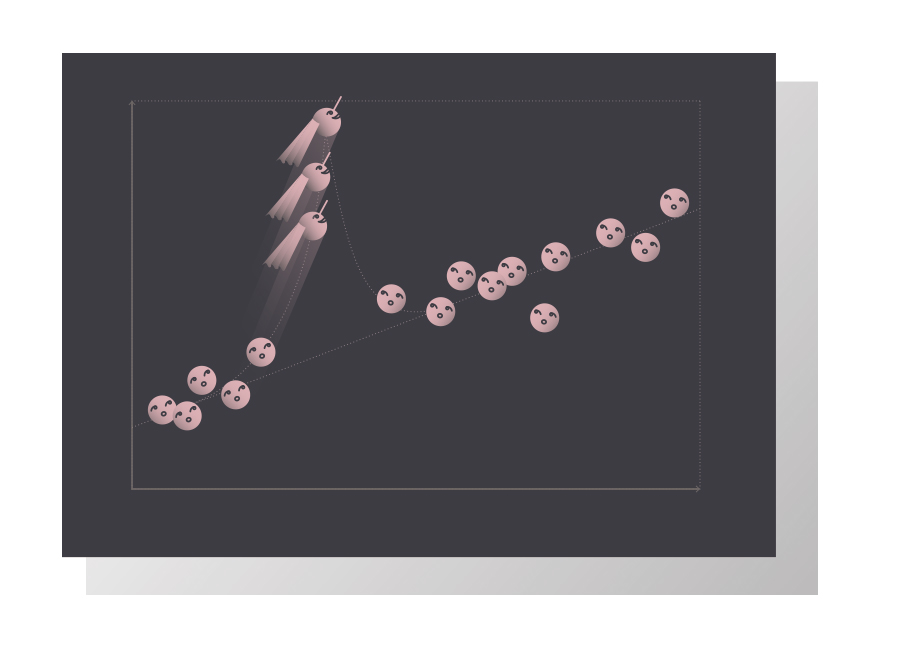
To put it another way, five sigma means that there is only a 0.00003 percent chance scientists would see this result due to statistical fluctuations alone—a good indication that there’s probably something hiding under that bump.
But the five-sigma threshold is more of a guideline than a golden rule, and it does not tell physicists whether they have made a discovery, according to Bob Cousins, a physicist at the University of California, Los Angeles working on the CMS experiment.
“A few years ago scientists posted a paper claiming that they had seen faster-than-light neutrinos,” Cousins says. But few people seemed to believe it—even though the result was six sigma. (A six-sigma result is a couple of hundred times stronger than a five-sigma result.)
The five-sigma rule is typically used as the standard for discovery in high-energy physics, but it does not incorporate another equally important scientific mantra: The more extraordinary the claim, the more evidence you need to convince the community.
“No one was arguing about the statistics behind the faster-than-light neutrinos observation,” Cranmer says. “But hardly anyone believed they got that result because the neutrinos were actually going faster than light.”
Within minutes of the announcement, physicists started dissecting every detail of the experiment to unearth an explanation. Anticlimactically, it turned out to be a loose fiber optic cable.
The “extraordinary claims, extraordinary evidence” philosophy also holds true for the inverse of the statement: If you see something you expected, then you don’t need as much evidence to claim a discovery. Physicists will sometime relax their stringent statistical standards if they are verifying processes predicted by the Standard Model of particle physics—a thoroughly vetted description of the microscopic world.
“But if you don’t have a well-defined hypothesis that you are testing, you increase your chances of finding something that looks impressive just because you are looking everywhere,” Cousins says. “If you perform 800 broad searches across huge mass ranges for new particles, you’re likely to see at least one impressive three-sigma bump that isn’t anything at all.”
In the end, there is no one-size-fits-all rule that separates discoveries from fluctuations. Two scientists could look at the same data, make the same histograms and still come to completely different conclusions.
So which results windup in textbooks and which results are buried in the archive?
“This decision comes down to two personal questions: What was your prior belief, and what is the cost of making an error?” Cousins says. “With the Higgs discovery, we waited until we had overwhelming evidence of a Higgs-like particle before announcing the discovery, because if we made an error it could weaken people’s confidence in the LHC research program.”
Experimental physicists have another way of verifying their results before making a discovery claim: comparable studies from independent experiments.
“If one experiment sees something but another experiment with similar capabilities doesn’t, the first thing we would do is find out why,” Cranmer says. “People won’t fully believe a discovery claim without a solid cross check.”
Like what you see? Sign up for a free subscription to symmetry!
Citizen scientists published
Citizen scientists published
Amateurs and professionals share the credit in the newest publications from the Space Warps project.
When amateur astronomer Julianne Wilcox first moved and traded the star-covered firmament of Petervale, South Africa, for the light-cluttered sky of London, she feared that she would no longer be able to indulge in her passion for astronomy.
Then she discovered a new way of doing what she loves: online citizen science projects that engage amateurs like her in the analysis of real astronomical data.
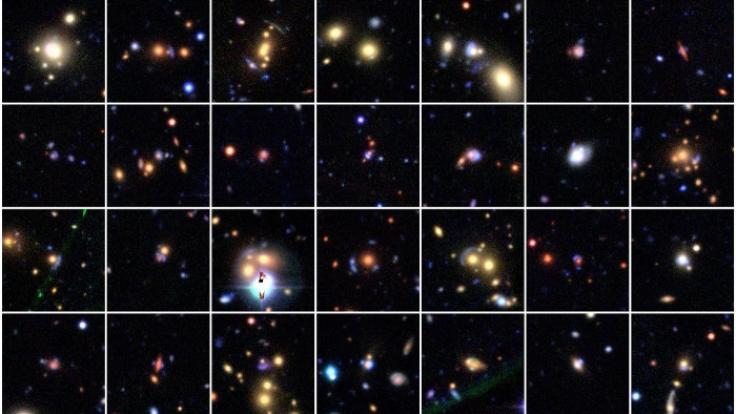
Wilcox is one of 37,000 citizen scientists involved in two papers accepted for publication in the journal Monthly Notices of the Royal Astronomical Society. The papers report the discovery of 29 potential new gravitational lenses—objects such as massive galaxies and galaxy clusters that distort light from faraway galaxies behind them. An additional 30 promising objects may turn out to be lenses, too.
Amateur scientists from all walks of life identified the new objects using Space Warps, a web-based gravitational lens discovery platform. They did so by marking lens-like features in some 430,000 images of the Canada-France-Hawaii Telescope Legacy Survey.
Since gravitational lenses act like cosmic magnifying glasses, they help researchers look at very distant light sources. They also provide information about invisible dark matter, because dark matter affects the way gravitational lenses bend light.
Researchers can now point their telescopes at the newly identified objects and study them in more detail.
“In addition to its immediate scientific output, Space Warps is also a great platform to figure out how to get citizen scientists involved in future large-scale astronomical surveys,” says Phil Marshall, Space Warps principle investigator for the Kavli Institute for Particle Astrophysics and Cosmology, a joint institute of SLAC National Accelerator Laboratory and Stanford University.
The Large Synoptic Survey Telescope, for instance, will begin in the early 2020s to capture images of the entire southern night sky in unprecedented detail. In the process, it’ll generate about 6 million gigabytes of data per year. Researchers hope that the public can help with processing these gigantic streams of information.
Apart from distributing a lot of work among a large number of people, crowdsourcing also appears to be well suited for the analysis of complex data.
“In our experience, humans are doing much better than computer algorithms in identifying faint and complex objects such as gravitational lenses that are not that obvious,” says Anupreeta More, Space Warps principle investigator for the Kavli Institute for the Physics and Mathematics of the Universe in Tokyo. “We can use what we’ve learned about how volunteers identify new objects to develop smarter algorithms.”
Citizen scientists also excel at spotting unexpected things. For example, when asked to look for typically bluish lens-like features in images of another survey, Space Warps users spotted an object with strong red-colored arcs—a gravitational lens bending light from a particularly interesting star-forming galaxy behind it.
“Our users have identified several stunning objects like this,” says Aprajita Verma, Space Warps principal investigator for the University of Oxford. “It shows that citizen scientists are very flexible and understand the larger context of the images they’re shown.”
But crowdsourced science benefits more than just the researchers, says Wilcox, who avidly participates in a variety of astronomy-focused projects.
“Citizen science is a two-way process,” she says. “Getting astronomical objects classified is one aspect, but it also sparks off an interest in research in people without a science background.”
As one of Space Warps’ expert users, Wilcox not only looks for gravitational lenses but also moderates the project’s community discussions and helps further analyze identified objects—contributions that have earned her and her fellow moderators Elisabeth Baeten, Claude Cornen and Christine Macmillan a spot on the author lists of the two Space Warps papers.
“It’s great to be on the papers,” she says. “It really shows the amazing opportunities that are available to citizen scientists.” Wilcox hopes that her example could help getting even more volunteers interested in people-powered research.
The sky’s the limit; try it yourself at spacewarps.org, or get involved in the Zooniverse, a citizen science platform of currently 33 projects covering various scientific disciplines.
Muon g-2 magnet successfully cooled down and powered up
Muon g-2 magnet successfully cooled down and powered up
It survived a month-long journey over 3200 miles, and now the delicate and complex electromagnet is well on its way to exploring the unknown.
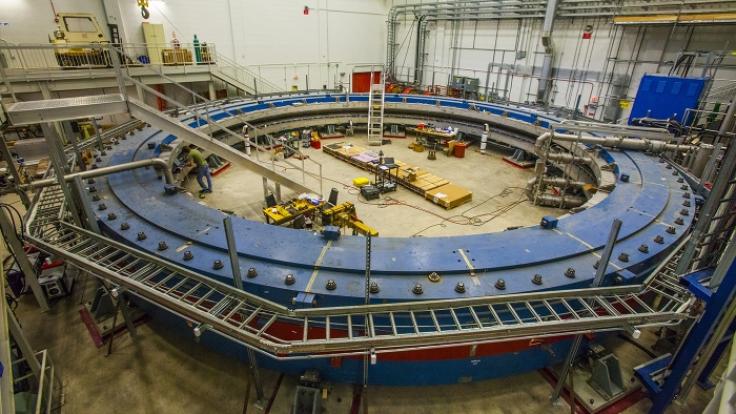
Two years ago, scientists on the Muon g-2 experiment successfully brought a fragile, expensive and complex 17-ton electromagnet on a 3200-mile land and sea trek from Brookhaven National Laboratory in New York to Fermilab in Illinois. But that was just the start of its journey.
Now, the magnet is one step closer to serving its purpose as the centerpiece of an experiment to probe the mysteries of the universe with subatomic particles called muons. This week, the ring—now installed in a new, specially designed building at Fermilab—was successfully cooled down to operating temperature (minus 450 degrees Fahrenheit) and powered up, proving that even after a decade of inactivity, it remains a vital and viable scientific instrument.
Getting the electromagnet to this point took a team of dedicated people more than a year, and the results have that team breathing a collective sigh of relief. The magnet was built at Brookhaven in the 1990s for a similar muon experiment, and before the move to Fermilab, it spent more than 10 years sitting in a building, inactive.
“There were some questions about whether it would still work,” says Kelly Hardin, lead technician on the Muon g-2 experiment. “We didn’t know what to expect, so to see that it actually does work is very rewarding.”
Moving the ring from New York to Illinois cost roughly 10 times less than building a new one. But it was a tricky proposition—the 52-foot-wide, 17-ton magnet, essentially three rings of aluminum with superconducting coils inside, could not be taken apart, nor twisted more than a few degrees without causing irreparable damage.
Scientists sent the ring on a fantastic voyage, using a barge to bring it south around Florida and up a series of rivers to Illinois. A specially designed truck gently drove it the rest of the way to Fermilab.
The Muon g-2 experiment plans to use the magnet to build on the Brookhaven experiment but with a much more powerful particle beam. The experiment will trap muons in the magnetic field and use them to detect theoretical phantom particles that might be present, impacting the properties of the muons. But to do that, the team had to find out whether the machine could generate the needed magnetic field.
The magnet was moved into its own building on the Fermilab site. Over the past year, workers took on the painstaking task of reassembling the steel base. Two dozen 26-ton pieces of steel—and a dozen 11-ton pieces—had to be maneuvered into place with tremendous precision.
“It was like building a 750-ton Swiss watch,” says Chris Polly, project manager for the experiment.
While that assembly was taking place, other members of the team had to completely replace the control system for the magnet, redesigning it from scratch. Del Allspach, the project engineer, and Hogan Nguyen, one of the primary managers of the ring, oversaw much of this effort, as well as the construction of the infrastructure (helium lines, power conduits) needed before the ring could be cooled and powered.
“That work was very challenging,” Nguyen says. “We had to stay within very strict tolerances for the alignment of the equipment.”
The tightest of those tolerances was 10 microns. For comparison, the width of a human hair is 75 microns. A red blood cell is about 5 microns across.
While assembling the components around the ring, the team also tracked down and sealed a significant helium leak, one that had been previously documented at Brookhaven. Hardin says that the team was relieved to discover that the leak was in an area that could be accessed and fixed. The successful cool-down proved that the leak had been plugged.
“That’s where the big relief comes in,” says Hardin. “We had a good team, and we worked together well.”
Bringing the ring down to its operating temperature of minus 450 degrees Fahrenheit required cooling it with a helium refrigeration system and liquid nitrogen for more than two weeks. Polly noted that this was a tricky process, since the magnet as a whole shrank by at least an inch as it cooled down. This could have damaged the delicate coils inside if it was not done slowly.
Once cooling was complete, the ring had to be powered with 5300 amps of current to produce the magnetic field. This was another slow process, with technicians easing the ring up by less than 2 amps per second and stopping every 1000 amps to check the system.
“It proves we started with a good magnet,” Allspach says. “It had been off for more than a decade, then moved across the country, installed, cooled and powered. I’m very happy to be at this point. It’s a big success for all of us.”
The next step for the magnet is a long process of “shimming,” or adjusting the magnetic field to within extraordinarily small tolerances. Fermilab is in the process of constructing a beamline that will provide muons to the magnet, and scientists expect to start measuring those muons in 2017.
For Nguyen, that step—handing the magnet off to early-career scientists, who will help carry out the experiment—is exciting. One of the thrills of the process, he says, was watching these younger members of the team learn and grow as the experiment took shape.
“I can’t wait to see these younger people get to control this beautiful magnet,” he says.

 Frascati Scienza
 Buco Nero
 Io Non Faccio Niente
 Tommaso Dorigo
 Giovanni Mazzitelli
 Barbara Gallavotti
 Keplero Blog
 Research Gate