
Xenon, xenon everywhere
It’s in the air we breathe, but it’s not so easy to get ahold of 10 metric tons of xenon in its liquid form.
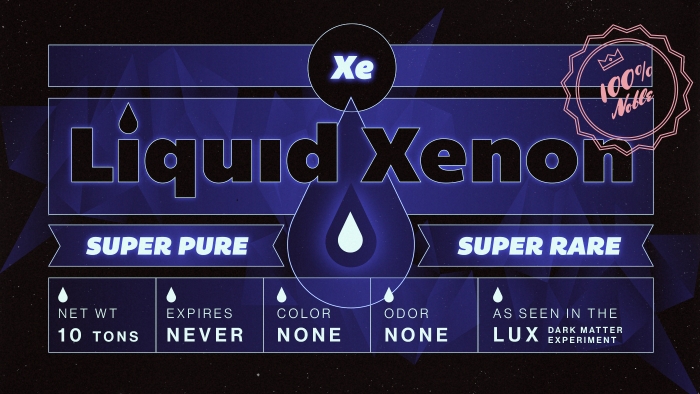
So, you want to buy some xenon to try to detect dark matter deep underground. Not a problem. There’s a market for that, with a few large-scale suppliers.
Wait, what’s that you say? You need 10 metric tons of incredibly pure, liquid xenon for the LUX-ZEPLIN dark matter experiment? That’s a bit trickier.
Looking for large amounts of xenon is a bit like searching for dark matter: It’s all around us, but it’s colorless, odorless and hard to separate from everything else. Xenon is in the air that we breathe, but it’s also one of the rarest elements on Earth.
There is about 1 part xenon in every 11.5 million parts of air. The global industry that extracts liquid xenon produces a total of about 40 tons of xenon per year, so 10 tons is a very tall order.
“Buying several tons per year won’t perturb the market too much,” says Thomas Shutt, a SLAC physicist who, along with physicist Daniel Akerib, left Case Western Reserve University in Ohio last year to join SLAC National Accelerator Laboratory. “If you buy 10 tons in a year that's a quarter of the market.”
Akerib and Shutt are heading up SLAC’s effort in the planned LUX-ZEPLIN, or LZ, experiment, one of the largest-scale efforts to find dark matter particles. Like its smaller predecessor experiment, called LUX (for Large Underground Xenon), LZ will be filled with supercooled liquid xenon.
Xenon, like several other rare gases, can emit flashes of light and electrons when its atoms are hit by other particles. The LZ detector will sit 1 mile underground in a South Dakota mine, shielded from most other particles, and wait to see signals from dark matter particles.
“Xenon has really good stopping power,” Akerib says. Its liquid form is so dense that aluminum can float on it. It is particularly sensitive to passing particles.
Xenon is used in more than just dark matter experiments. It is also in demand as a component in halogen lights such as the bluish headlights in some vehicles, in the bulbs for other specialized lighting such as flash lamps that drive lasers, and as a propellant for satellites and other spacecraft. It is also used in semiconductor manufacturing and medical imaging, and it has been used as an anesthetic.
Xenon is a by-product of the steel-making process, which uses liquid oxygen to wash away contaminants on the surface of molten iron. Russia, South Africa and Saudi Arabia are among the major producers of xenon. Russia became a major player in this market during the era of the Soviet Union, when steel-making was largely centralized.
Industrially produced xenon isn’t nearly pure enough for the exacting requirements of LZ, though.
Shutt says extracting its own xenon from air was not an option. “If we had to start from scratch in refining xenon, it would be vastly more expensive,” he says.
The LZ team plans to acquire xenon over the next 3 to 4 years.
There is no expiration date on xenon, Shutt said; it just needs to be tightly contained so no venting occurs. “The xenon we use we can put back on the market or put to other scientific uses after the LZ experiment is complete,” he says. “It’s around forever.”
To ensure that the dark matter detector is ultrasensitive, the LZ team is building a purification system at SLAC National Accelerator Laboratory to remove krypton, another rare gas that can get mixed in with liquid xenon. LUX started with xenon that had 100 parts of krypton per billion and purified it down to four parts per trillion, and LZ needs xenon purified to a standard of 0.015 parts krypton per trillion—a factor of 300 purer.
Shutt jokes that, while LZ is all about particle physics, “we have become armchair chemical engineers” in the process of putting the experiment together.
The current plan is to purify the xenon in 2018, and to run each batch through the purification process twice. The process is expected to take several months in total. LZ is scheduled to start running in 2019.
Xenon, xenon everywhere
It’s in the air we breathe, but it’s not so easy to get ahold of 10 metric tons of xenon in its liquid form.
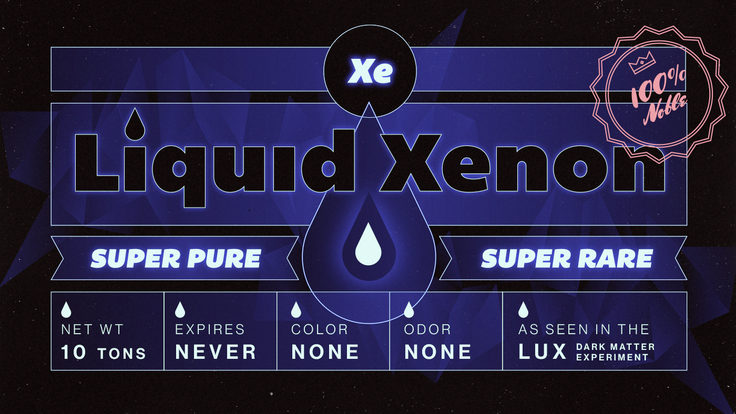
So, you want to buy some xenon to try to detect dark matter deep underground. Not a problem. There’s a market for that, with a few large-scale suppliers.
Wait, what’s that you say? You need 10 metric tons of incredibly pure, liquid xenon for the LUX-ZEPLIN dark matter experiment? That’s a bit trickier.
Looking for large amounts of xenon is a bit like searching for dark matter: It’s all around us, but it’s colorless, odorless and hard to separate from everything else. Xenon is in the air that we breathe, but it’s also one of the rarest elements on Earth.
There is about 1 part xenon in every 11.5 million parts of air. The global industry that extracts liquid xenon produces a total of about 40 tons of xenon per year, so 10 tons is a very tall order.
“Buying several tons per year won’t perturb the market too much,” says Thomas Shutt, a SLAC physicist who, along with physicist Daniel Akerib, left Case Western Reserve University in Ohio last year to join SLAC National Accelerator Laboratory. “If you buy 10 tons in a year that's a quarter of the market.”
Akerib and Shutt are heading up SLAC’s effort in the planned LUX-ZEPLIN, or LZ, experiment, one of the largest-scale efforts to find dark matter particles. Like its smaller predecessor experiment, called LUX (for Large Underground Xenon), LZ will be filled with supercooled liquid xenon.
Xenon, like several other rare gases, can emit flashes of light and electrons when its atoms are hit by other particles. The LZ detector will sit 1 mile underground in a South Dakota mine, shielded from most other particles, and wait to see signals from dark matter particles.
“Xenon has really good stopping power,” Akerib says. Its liquid form is so dense that aluminum can float on it. It is particularly sensitive to passing particles.
Xenon is used in more than just dark matter experiments. It is also in demand as a component in halogen lights such as the bluish headlights in some vehicles, in the bulbs for other specialized lighting such as flash lamps that drive lasers, and as a propellant for satellites and other spacecraft. It is also used in semiconductor manufacturing and medical imaging, and it has been used as an anesthetic.
Xenon is a by-product of the steel-making process, which uses liquid oxygen to wash away contaminants on the surface of molten iron. Russia, South Africa and Saudi Arabia are among the major producers of xenon. Russia became a major player in this market during the era of the Soviet Union, when steel-making was largely centralized.
Industrially produced xenon isn’t nearly pure enough for the exacting requirements of LZ, though.
Shutt says extracting its own xenon from air was not an option. “If we had to start from scratch in refining xenon, it would be vastly more expensive,” he says.
The LZ team plans to acquire xenon over the next 3 to 4 years.
There is no expiration date on xenon, Shutt said; it just needs to be tightly contained so no venting occurs. “The xenon we use we can put back on the market or put to other scientific uses after the LZ experiment is complete,” he says. “It’s around forever.”
To ensure that the dark matter detector is ultrasensitive, the LZ team is building a purification system at SLAC National Accelerator Laboratory to remove krypton, another rare gas that can get mixed in with liquid xenon. LUX started with xenon that had 100 parts of krypton per billion and purified it down to four parts per trillion, and LZ needs xenon purified to a standard of 0.015 parts krypton per trillion—a factor of 300 purer.
Shutt jokes that, while LZ is all about particle physics, “we have become armchair chemical engineers” in the process of putting the experiment together.
The current plan is to purify the xenon in 2018, and to run each batch through the purification process twice. The process is expected to take several months in total. LZ is scheduled to start running in 2019.
A measurement to watch
Finding a small discrepancy in measurements of the properties of neutrinos could show us how they fit into the bigger picture.
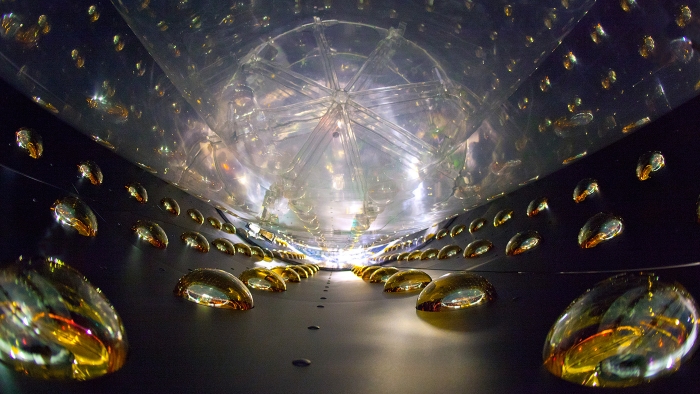
Physics, perhaps more so than any other science, relies on measuring the same thing in multiple ways. Different experiments let scientists narrow in on right answers that satisfy all parties—a scientific system of checks and balances.
That’s why it’s exciting when a difference, even a minute one, appears. It can teach physicists something about their current model – or physics that extends beyond it. It’s possible that just such a discrepancy exists between a certain measurement of neutrinos coming out of accelerator experiments and reactor-based experiments.
Neutrinos are minuscule, neutral particles that don’t interact with much of anything. They can happily pass through a light-year of lead without a peep. Trillions pass through you every second. In fact, they are the most abundant massive particle in the universe—and something scientists are, naturally, quite keen to understand.
The ghostly particles come in three flavors: electron, muon and tau. They transition between these three flavors as they travel. This means that a muon neutrino leaving an accelerator at Fermi National Accelerator Laboratory in Illinois can show up as an electron neutrino in an underground detector in South Dakota.
Not complicated enough for you? These neutrino flavors are made of mixtures of three different “mass states” of neutrinos, masses 1, 2 and 3.
At the end of the day, neutrinos are weird. They hang out in the quantum realm, a land of probabilities and mixing matrices and other shenanigans. But here’s what you should know. There are lots of different things we can measure about neutrinos—and one of them is a parameter called theta13 (pronounced theta one three). Theta13 relates deeply to how neutrinos mix together, and it’s here that scientists have seen the faintest hint of disagreement from different experiments.
Accelerators vs. reactors
There are lots of different ways to learn about neutrinos and things like theta13. Two of the most popular involve particle accelerators and nuclear reactors.
The best measurements of theta13 come from nuclear reactor experiments such as Double Chooz, RENO and Daya Bay Reactor Neutrino Experiment based in China (which released the best measurement to date a few weeks ago).
Detectors located near nuclear reactors provide such wonderful readings of theta13 because reactors produce an extremely pure fountain of electron antineutrinos, and theta13 is closely tied to how electron neutrinos mix. Researchers can calculate theta13 based on the number of electron antineutrinos that disappear as they travel from a near detector to the far detector, transforming into other types.
Accelerators, on the other hand, typically start with a beam of muon neutrinos. And while that beam is fairly pure, it can have a bit of contamination in the form of electron neutrinos. Far detectors can look for both muon neutrinos that have disappeared and electron neutrinos that have appeared, but that variety comes with a price.
“Both the power and the curse of long-baseline neutrino oscillation is that it’s sensitive to all of neutrino oscillation, not just theta13,” says Dan Dwyer, a scientist at Lawrence Berkeley National Laboratory and researcher on Daya Bay.
With that in mind, we come to the source of the disagreement. The results coming out of accelerator-based experiments, such as the United States-based NOvA and Japan-based T2K, see just a few more electron neutrinos than researchers would predict based on what the reactor experiments are saying.
“The theta13 value that fits the beam experiments, that really describes how much electron neutrino you get, is somewhat larger than what Daya Bay, RENO and Double Chooz measure,” says Kate Scholberg, professor of physics at Duke University and researcher on T2K. “So there’s a little bit of tension.”
Many grains of salt
Data coming out of the accelerator experiments is still very young compared to the strong readings from reactor experiments, and it is complicated by the nature of the beam. No one is jumping on the discrepancy yet because it can be explained in different ways. Most importantly, the accelerator experiments just don’t have enough information.
“We have to wait for T2K and NOvA to get sufficient statistics, and that’s going to take a while,” says Stephen Parke, head of the Theoretical Physics Department at Fermilab. Parke, Scholberg and Dwyer all estimated that about five more years of data collection will be required before researchers are able to start saying anything substantial.
“There’s been a lot of pressure on Daya Bay to try to eke out as precise a measurement as we possibly can,” Dwyer says. “Every bit of increased precision we provide further improves the ability of NOvA and T2K and eventually [proposed neutrino experiment] DUNE to measure the other parameters.”
Finding meaning in neutrinos
If the accelerator experiments gather more data and if a clear discrepancy emerges—a big if—what does it mean?
Turns out there are lots of reasons to love theta13. It’s one of the fundamental parameters that can define our universe. From a practical standpoint, it helps design future experiments to better understand neutrinos. And it could help physicists learn something new.
“We don’t expect things not to agree, but we kind of hope that they won’t,” says André de Gouvêa, professor of physics at Northwestern University. “It means that we’re missing something.”
That something could be CP violation, evidence that neutrinos and antineutrinos behave differently. CP violation has never been seen in neutrinos before, but if researchers observed it with accelerator experiments, it could help explain why our universe is made of matter rather than equal parts of matter and antimatter.
Figuring out if CP violation is occurring means nailing down all of the different neutrino mixing parameters, which in turn means building more powerful, next-generation experiments such as Hyper-K in Japan, JUNO in China and the Deep Underground Neutrino Experiment in the United States. DUNE will build on oscillation experiments like NOvA but will be able to better separate background noise from neutrino events, see a broader energy spectrum of neutrinos and find other neutrino characteristics.
DUNE, which will be built in a repurposed gold mine in South Dakota and detect neutrinos passed 800 miles through the Earth from Fermilab in Illinois, will be one of the best ways to see CP violation and rely on expertise gained from smaller neutrino experiments.
“Developing these types of experiments is very complicated,” de Gouvêa says. One of the major challenges of physics experiments is making sure you are measuring what you think you are measuring. “That’s part of the reason why we have a significant number of neutrino oscillation experiments.”
Ultimately, the neutrino puzzle is still missing many pieces. A variety of experiments are ramping up to fill in the gaps, making it an exciting time to be a neutrino physicist.
“We have to untangle the mysteries of the neutrino, and it’s not easy,” Parke says. “The neutrino doesn’t give up her secrets very easily.”
A measurement to watch
Finding a small discrepancy in measurements of the properties of neutrinos could show us how they fit into the bigger picture.
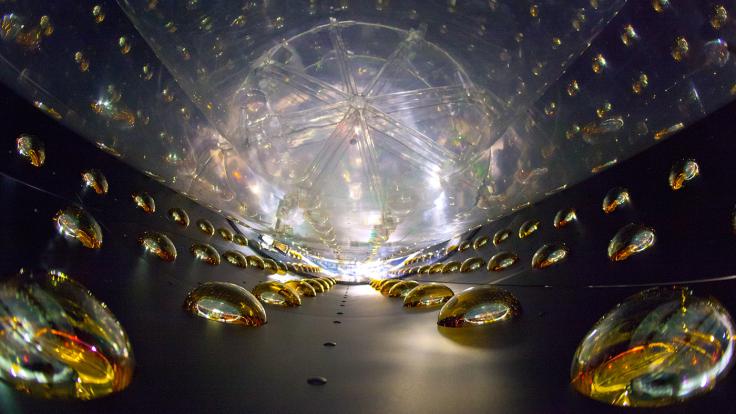
Physics, perhaps more so than any other science, relies on measuring the same thing in multiple ways. Different experiments let scientists narrow in on right answers that satisfy all parties—a scientific system of checks and balances.
That’s why it’s exciting when a difference, even a minute one, appears. It can teach physicists something about their current model – or physics that extends beyond it. It’s possible that just such a discrepancy exists between a certain measurement of neutrinos coming out of accelerator experiments and reactor-based experiments.
Neutrinos are minuscule, neutral particles that don’t interact with much of anything. They can happily pass through a light-year of lead without a peep. Trillions pass through you every second. In fact, they are the most abundant massive particle in the universe—and something scientists are, naturally, quite keen to understand.
The ghostly particles come in three flavors: electron, muon and tau. They transition between these three flavors as they travel. This means that a muon neutrino leaving an accelerator at Fermi National Accelerator Laboratory in Illinois can show up as an electron neutrino in an underground detector in South Dakota.
Not complicated enough for you? These neutrino flavors are made of mixtures of three different “mass states” of neutrinos, masses 1, 2 and 3.
At the end of the day, neutrinos are weird. They hang out in the quantum realm, a land of probabilities and mixing matrices and other shenanigans. But here’s what you should know. There are lots of different things we can measure about neutrinos—and one of them is a parameter called theta13 (pronounced theta one three). Theta13 relates deeply to how neutrinos mix together, and it’s here that scientists have seen the faintest hint of disagreement from different experiments.
Accelerators vs. reactors
There are lots of different ways to learn about neutrinos and things like theta13. Two of the most popular involve particle accelerators and nuclear reactors.
The best measurements of theta13 come from nuclear reactor experiments such as Double Chooz, RENO and Daya Bay Reactor Neutrino Experiment based in China (which released the best measurement to date a few weeks ago).
Detectors located near nuclear reactors provide such wonderful readings of theta13 because reactors produce an extremely pure fountain of electron antineutrinos, and theta13 is closely tied to how electron neutrinos mix. Researchers can calculate theta13 based on the number of electron antineutrinos that disappear as they travel from a near detector to the far detector, transforming into other types.
Accelerators, on the other hand, typically start with a beam of muon neutrinos. And while that beam is fairly pure, it can have a bit of contamination in the form of electron neutrinos. Far detectors can look for both muon neutrinos that have disappeared and electron neutrinos that have appeared, but that variety comes with a price.
“Both the power and the curse of long-baseline neutrino oscillation is that it’s sensitive to all of neutrino oscillation, not just theta13,” says Dan Dwyer, a scientist at Lawrence Berkeley National Laboratory and researcher on Daya Bay.
With that in mind, we come to the source of the disagreement. The results coming out of accelerator-based experiments, such as the United States-based NOvA and Japan-based T2K, see just a few more electron neutrinos than researchers would predict based on what the reactor experiments are saying.
“The theta13 value that fits the beam experiments, that really describes how much electron neutrino you get, is somewhat larger than what Daya Bay, RENO and Double Chooz measure,” says Kate Scholberg, professor of physics at Duke University and researcher on T2K. “So there’s a little bit of tension.”
Many grains of salt
Data coming out of the accelerator experiments is still very young compared to the strong readings from reactor experiments, and it is complicated by the nature of the beam. No one is jumping on the discrepancy yet because it can be explained in different ways. Most importantly, the accelerator experiments just don’t have enough information.
“We have to wait for T2K and NOvA to get sufficient statistics, and that’s going to take a while,” says Stephen Parke, head of the Theoretical Physics Department at Fermilab. Parke, Scholberg and Dwyer all estimated that about five more years of data collection will be required before researchers are able to start saying anything substantial.
“There’s been a lot of pressure on Daya Bay to try to eke out as precise a measurement as we possibly can,” Dwyer says. “Every bit of increased precision we provide further improves the ability of NOvA and T2K and eventually [proposed neutrino experiment] DUNE to measure the other parameters.”
Finding meaning in neutrinos
If the accelerator experiments gather more data and if a clear discrepancy emerges—a big if—what does it mean?
Turns out there are lots of reasons to love theta13. It’s one of the fundamental parameters that can define our universe. From a practical standpoint, it helps design future experiments to better understand neutrinos. And it could help physicists learn something new.
“We don’t expect things not to agree, but we kind of hope that they won’t,” says André de Gouvêa, professor of physics at Northwestern University. “It means that we’re missing something.”
That something could be CP violation, evidence that neutrinos and antineutrinos behave differently. CP violation has never been seen in neutrinos before, but if researchers observed it with accelerator experiments, it could help explain why our universe is made of matter rather than equal parts of matter and antimatter.
Figuring out if CP violation is occurring means nailing down all of the different neutrino mixing parameters, which in turn means building more powerful, next-generation experiments such as Hyper-K in Japan, JUNO in China and the Deep Underground Neutrino Experiment in the United States. DUNE will build on oscillation experiments like NOvA but will be able to better separate background noise from neutrino events, see a broader energy spectrum of neutrinos and find other neutrino characteristics.
DUNE, which will be built in a repurposed gold mine in South Dakota and detect neutrinos passed 800 miles through the Earth from Fermilab in Illinois, will be one of the best ways to see CP violation and rely on expertise gained from smaller neutrino experiments.
“Developing these types of experiments is very complicated,” de Gouvêa says. One of the major challenges of physics experiments is making sure you are measuring what you think you are measuring. “That’s part of the reason why we have a significant number of neutrino oscillation experiments.”
Ultimately, the neutrino puzzle is still missing many pieces. A variety of experiments are ramping up to fill in the gaps, making it an exciting time to be a neutrino physicist.
“We have to untangle the mysteries of the neutrino, and it’s not easy,” Parke says. “The neutrino doesn’t give up her secrets very easily.”
Nobel Prize awarded for discovery of neutrino oscillations
Nobel Prize awarded for discovery of neutrino oscillations
Takaaki Kajita and Arthur B. McDonald received the call from Sweden for their work on the Super-Kamiokande and SNO experiments.


Takaaki Kajita and Arthur B. McDonald
The 2015 Nobel Prize in Physics was awarded this morning to two physicists whose teams discovered a fundamental property of neutrinos. The work of Takaaki Kajita and Arthur B. McDonald showed that the tiny particles, which come in three types, change from one type to another. The discovery has had major implications, and today scientists wonder whether neutrinos are the reason that matter exists in our universe.
Neutrinos are the most numerous matter particles in the universe. They come from a variety of sources, such as cosmic rays, the sun, exploding stars, the center of the Earth, nuclear power plants and even nuclear processes within your body.
“If it wouldn’t be for neutrinos, the sun would not be shining anymore,” says Olga Botner, a member of the Nobel Committee for Physics. “If it wouldn’t be for neutrinos, supernovas would not be exploding the way they explode. The elements that we are all made of would not exist.”
They are neutral and rarely interact with other matter; thousands of trillions of neutrinos pass through you each second.
Neutrinos come in three types: electron, muon and tau. In the 1960s, scientists on an experiment studying neutrinos from the sun found that they were detecting only a third the number of particles they expected to see. This was called the “solar neutrino problem.”
Physicists speculated that the problem lay in their calculations or in the experiment. But Kajita’s and McDonald’s experiments showed that the solar neutrino problem was caused by the extraordinary nature of neutrinos.
Kajita led a team on the Super-Kamiokande experiment near Tokyo, which started operation in 1996. McDonald led a team at Sudbury Neutrino Observatory in Ontario, which began in 1999.
Both experiments used large detectors located underground to catch passing neutrinos. Super-Kamiokande studied muon neutrinos produced by cosmic rays interacting with Earth’s atmosphere. SNO studied electron neutrinos produced by the sun.
Because neutrinos can travel straight through the planet, Super-Kamiokande studied the particles as they approached from above in space and also below through the ground. The neutrinos should have arrived from all directions at the same rate; the only difference between them was the distance they had to travel before they reached the detector.
But scientists found that they detected more muon neutrinos coming from above than from below. They hypothesized that the neutrinos traveling all the way through the Earth had had more time to oscillate, or change to another type of neutrino.
At SNO, scientists used a detector that could identify electron neutrinos from the sun but also take an overall tally of neutrino interactions from all three types of neutrinos.
They saw the solar neutrino problem repeated; they were capturing just a third of the electron neutrinos they expected to see. But their count of all three types of neutrinos together matched their expectations. They concluded that electron neutrinos must have changed into muon and tau neutrinos as they traveled.
Super-Kamiokande and SNO solved the solar neutrino problem. But they also gave scientists another surprising insight into the particles: Because only particles with mass can oscillate, neutrinos must have mass.
The mass of neutrinos is much smaller than the mass of other fundamental particles in the Standard Model of particle physics. Scientists have yet to be able to measure it directly. And they still aren’t sure where neutrino mass comes from—perhaps the Higgs boson, or perhaps another source.
“It is hard to overestimate the importance of this discovery, which opens up new avenues of study for the fields of particle physics and cosmology,” says physicist Rob Plunkett of Fermi National Accelerator Laboratory, home of several neutrino experiments and host of the proposed international neutrino experiment DUNE. “The world program in this field has literally exploded with activity in the past few years.”
Many questions remain about neutrinos. Today’s Nobel recognizes two scientists whose research answered some of them—and raised a few more.
Kajita was born in 1959 in Higashimatsuyama, Japan. He earned his PhD in 1986 from University of Tokyo, Japan. He is currently director of the Institute for Cosmic Ray Research and a professor at University of Tokyo in Kashiwa, Japan.
McDonald was born in 1943 in Sydney, Canada. He earned his PhD in 1969 from California Institute of Technology in Pasadena, California. He is a professor emeritus at Queen’s University in Kingston, Canada.
MicroBooNE sees first accelerator-born neutrinos
The results of the MicroBooNE experiment will be relevant for the forthcoming Deep Underground Neutrino Experiment.
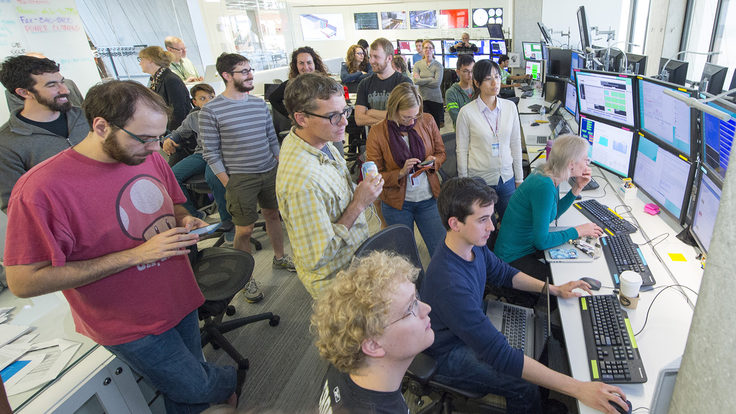
Today the MicroBooNE collaboration announced that it has seen its first neutrinos in the experiment's newly built detector.
“It's nine years since we proposed, designed, built, assembled and commissioned this experiment,” says Bonnie Fleming, MicroBooNE co-spokesperson and a professor of physics at Yale University. “That kind of investment makes seeing first neutrinos incredible.”
After months of hard work and improvements by the Fermi National Accelerator Laboratory Booster team, on October 15, the Fermilab accelerator complex began delivering protons, which are used to make neutrinos, to one of the laboratory's newest neutrino experiments, MicroBooNE. After the beam was turned on, scientists analyzed the data recorded by MicroBooNE's particle detector to find evidence of its first neutrino interactions.
“This was a big team effort,” says Anne Schukraft, a Fermilab postdoc working on MicroBooNE. “More than 100 people have been working very hard to make this happen. It's exciting to see the first neutrinos.”
MicroBooNE's detector is a liquid-argon time projection chamber. It resembles a silo lying on its side, but instead of grain, it's filled with 170 tons of liquid argon.
Liquid argon is 40 percent denser than water, and hence neutrinos are more likely to interact with it. When an accelerator-born neutrino hits the nucleus of an argon atom in the detector, its collision creates a spray of subatomic particle debris. Tracking these particles allows scientists to reveal the type and properties of the neutrino that produced them.
Neutrinos have recently received quite a bit of media attention. The 2015 Nobel Prize in physics was awarded for neutrino oscillations, a phenomenon that is of great importance to the field of elementary particle physics. Intense activity is under way worldwide to capture neutrinos and examine their behavior of transforming from one type into another.
MicroBooNE is an example of a new liquid-argon detector being developed to further probe this phenomenon while reconstructing the particle tracks emerging from neutrino collisions as finely detailed three-dimensional images. Its findings will be relevant for the forthcoming Deep Underground Neutrino Experiment, known as DUNE, which plans to examine neutrino transitions over longer distances and a much broader energy range. Scientists are also using MicroBooNE as an R&D platform for the large DUNE liquid-argon detectors.
“Future neutrino experiments will use this technology,” says Sam Zeller, Fermilab physicist and MicroBooNE co-spokesperson. “We're learning a lot from this detector. It's important not just for us, but for the entire neutrino community.”
In August, MicroBooNE saw its first cosmic ray events, recording the tracks of cosmic ray muons. The recent neutrino sighting brings MicroBooNE researchers much closer to one of their scientific goals, determining whether the excess of low-energy events observed in a previous Fermilab experiment was the footprint of a sterile neutrino or a new type of background.
Before they can do that, however, MicroBooNE will have to collect data for several years.
During this time, MicroBooNE will also be the first liquid-argon detector to measure neutrino interactions from a beam of such low energy. At less than 800 MeV (megaelectronvolts), this beam produces the lowest-energy neutrinos yet to be observed with a liquid-argon detector.
MicroBooNE is part of Fermilab's Short-Baseline Neutrino program, and scientists will eventually add two more detectors (ICARUS and the Short-Baseline Near Detector) to its neutrino beamline.

This display shows a neutrino event candidate in the MicroBooNE detector.
The burgeoning field of neutrino astronomy
A new breed of experiments seeks sources of cosmic rays and other astrophysics phenomena.
Ghostlike subatomic particles called neutrinos could hold clues to some of the greatest scientific questions about our universe: What extragalactic events create ultra-high-energy cosmic rays? What happened in the first seconds following the big bang? What is dark matter made of?
Scientists are asking these questions in a new and fast-developing field called neutrino astronomy, says JoAnne Hewett, director of Elementary Particle Physics at SLAC National Accelerator Laboratory.
“When I was a graduate student I never thought we’d be thinking about neutrino astronomy,” she says. “Now not only are we thinking about it, we’re already doing it. At some point it will be a standard technique.”
Neutrinos, the most abundant massive particles in the universe, are produced in a multitude of different processes. The new neutrino astronomers go after several types of neutrinos: ultra-high-energy neutrinos and neutrinos from supernovae, which they can already detect, and low-energy ones they have only measured indirectly so far.
“Every time we look for these astrophysical neutrinos, we’re hoping to learn two things,” says André de Gouvêa, a theoretical physicist at Northwestern University: what high-energy neutrinos can tell us about the processes that produced them, and what low-energy neutrinos can tell us about the conditions of the early universe.
Ultra-high-energy neutrinos
At the ultra-high-energy end of the spectrum, researchers hope to follow cosmic neutrinos like a trail of bread crumbs back to their sources. They are thought to originate in the universe’s most powerful, natural particle accelerators, such as supermassive black holes.
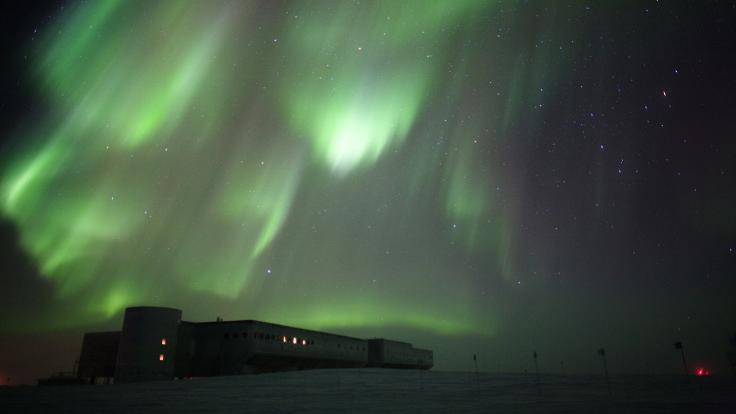
“We’re confident we’ve seen neutrinos coming from outside (our galaxy)—astrophysical sources,” says Kara Hoffman, a physics professor at the University of Maryland. She is a member of the international collaboration for IceCube, the largest neutrino telescope on the planet, which uses a cubic kilometer of South Pole ice as a massive, ultrasensitive detector.
Scientists have been tracking high-energy particles from space for decades. But cosmic neutrinos are different: Because they are neutral particles, they travel in a straight line, unaffected by the magnetic fields of space.
IceCube collaborators are exploring whether there is a correlation between ultra-high-energy neutrino events and observations of incredibly intense releases of energy known as gamma-ray bursts. Scientists also hope to learn whether there is a correlation between these neutrino events and with theorized phenomena known as gravitational waves.
Alexander Friedland, a theorist at SLAC, says high-energy neutrinos (which are less energetic than ultra-high-energy neutrinos) can provide a useful window into physics at the earliest stages of supernovae explosions.
“Neutrinos tell you about the explosion engine, and what happens later when the shock goes through,” Friedland says. “These are very rich conditions that you can never make on Earth. This is an amazing experiment that nature made for us.”
With modern detectors it may be possible to detect thousands of neutrinos and to reconstruct their energy on a second-by-second basis.
“Neutrinos basically give you a different eye to look at the universe and a unique probe of new physics,” Friedland says.
Low-energy neutrinos
At the low-energy end of the spectrum, researchers hope to find “relic” neutrinos produced at the start of the universe, leftovers from the big bang. Their energy is expected to be more than a quadrillion times lower than the highest-energy neutrinos.
The lower the energy of the neutrino, however, the harder it is to detect. So for now, the cosmic neutrino background remains somewhat out of reach.
“We already know a lot about it, even though we’ve never seen it directly,” de Gouvêa says. “If we look at the universe at very large scales, we can only explain things if this background exists. We can safely say: ‘Either this cosmic neutrino background exists, or there is something out there that behaves exactly like neutrinos do.’”
The European Space Agency’s Planck satellite has helped to shape our understanding of this relic neutrino background, and the planned ground-based Large Synoptic Survey Telescope will provide new data. These surveys provide bounds on the quantity and interaction of these relic neutrinos, and can give us information about neutrino mass.
As detectors become more sensitive, researchers may also learn whether a theorized particle called a “sterile neutrino” may be a component in dark matter, the invisible stuff we know accounts for most of the mass of the universe.
Some proposed experiments, such as PTOLEMY at Princeton Plasma Physics Laboratory and the Project 8 collaboration, led by scientists at the Massachusetts Institute of Technology and University of California, Santa Barbara, are working to establish properties of these neutrinos by watching for evidence of their production in a radioactive form of hydrogen called tritium.
Looking ahead
There are several upgrades and new projects in the works in the fledgling field of neutrino astronomy.
A proposal called PINGU would extend the sensitivity of the IceCube array to a broader range of neutrino energies. It could look for neutrinos coming from the center of the sun, a possible sign of dark matter interactions, and could also look for neutrinos produced in Earth’s atmosphere.
Another project would greatly expand an underwater neutrino observatory in the Mediterranean called Antares. A third project would build a large-scale observatory in a lake in Siberia.
Scientists also hope to eventually establish the Askaryan Radio Array, a 100-cubic-kilometer neutrino detector in Antarctica.
The field of neutrino astronomy is young, but it’s constantly growing and improving, Hoffman says.
“It’s kind of like having a Polaroid that you’re waiting to develop, and you just start to see the shadow of something,” she says. “What the picture’s going to look like we don’t really know.”

 Frascati Scienza
 Buco Nero
 Io Non Faccio Niente
 Tommaso Dorigo
 Giovanni Mazzitelli
 Barbara Gallavotti
 Keplero Blog
 Research Gate