
The particle physics personality quiz
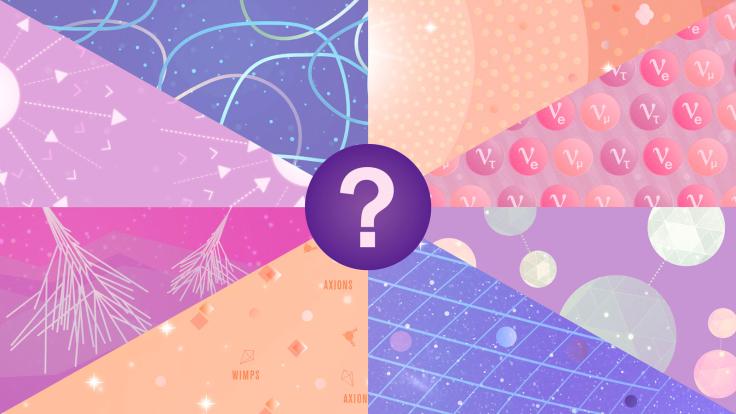
What topic in particle physics are you destined to study? Take the quiz to find out!

Where’s my hoverboard?
Real, levitating hoverboards do exist, thanks to quantum mechanics and the interplay between superconductors and magnetic fields.

Today is the future. Specifically, it’s the day to which Marty McFly and Emmett “Doc” Brown travel in the 1989 film Back to the Future II.
But where are our hoverboards?
It turns out: They do exist! They’re just not exactly what the movie predicted they would be.
Real hoverboards, such as the one the University of Geneva in Switzerland, can levitate a human being. But they can’t travel anywhere that a human wants to go; they need to follow a magnetic track.
Real hoverboards work by exploiting the principles of quantum mechanics and the bizarre interplay between superconductors and magnetic fields.
A superconductor is a material with zero electrical resistance. The superconducting magnets in the Large Hadron Collider, for instance, can carry 1000 times more current than a toaster, but they generate neither heat nor light.
Superconductors also exhibit another bizarre property, thanks to the weird and wonderful laws of quantum mechanics: They expel external magnetic fields.
This standoff between magnets and superconductors is what allows the modern hoverboard to levitate. Here’s how it works:
- Magnets must maintain their North-South magnetic field lines.
- A superconductor placed on a magnet interrupts those field lines.
- The magnet uses its field lines to lift the superconductor out of its way.
- The superconductor locks onto the magnetic field lines shoved between its atoms.
- The superconductor is suspended.
When this happens, the magnet’s North-South poles then become the tracks along which the superconductor slides. Consequently, superconductor hoverboards are less like a skateboard and more like a train.
All known superconducting materials gain their superconducting superpowers only at extremely low temperatures—around minus 230 degrees Fahrenheit (125 Kelvin) or colder. So real-world hoverboards need to be doused with super-cooled liquid nitrogen around every 30 minutes to maintain their extremely low temperature.
Today’s hoverboards are pretty neat, but it turns out they would be of little help in a futuristic chase scene.
Symmetry gets a new look
Welcome to the Symmetry redesign!
Notice something different?
Today marks the launch of a brand new Symmetry magazine. We’ve simplified and updated our webpages to help you find what you’re looking for, to guide your attention to our best art and photography, and to give you a better reading experience.
- We’ve cleared away clutter on the article pages, providing more space for images and videos and creating a smoother reading experience. We think your eyes will appreciate the line breaks we added between paragraphs.
- For our growing smart-phone audience, we paid special attention to the mobile site, moving links that used to crowd the beginning of an article page to the bottom of the text.
- We redesigned the homepage and divided its content into news and feature stories. Links to particle physics articles on other sites, formerly located in a sidebar called “trending on the web,” have been integrated into the news area to give you a quick overview of what’s happening in the world of particle physics.
- You can expand both the news and features sections to look through older articles, and you can find a chronological list of articles of both types in the archive.
- We combined our image bank with the archive and added videos as well. The updated archive allows you to filter searches by content type, topic and date.
- The new subscribe page gives you the option to receive updates from Symmetry via newsletter, social media or RSS feed.
- With this redesign, we fully embrace our identity as an online publication. For our growing audience, we replaced the “masthead” page with an “about” page. We combined the little-used “departments” and “science topics” menus into a single drop-down menu of our most popular topics (with additional filters available on the archive page).
Not everything about the new site is new. We’ll continue to publish great content every week. Symmetry is still the place to hear the latest particle physics news, meet the people behind the science, have fun and get the background you need to understand the language of particle physics.
We hope you’ll enjoy it! Please contact us on social media or by email to let us know what you think.
Frightfully smart jack-o’-lanterns
These physics-themed jack-o’-lanterns come with extra brains.

There are no tricks, only treats, when you add science to your annual pumpkin-carving festivities. That’s why we at Symmetry created designs featuring spooky versions of important figures from the history of physics to adorn your Halloween gourds.
To make a physics jack-o’-lantern:
- Pick out a pumpkin and one of our five designs.
- Using printer settings, resize the design template to fit on your pumpkin.
- Print it out.
- Cut out the shaded sections from the print-out.
- Trace the cut out sections of the print-out onto your gourd.
- Carve.
Alternatively, you can use a ballpoint pen to poke through the paper along the outline of the template. Connect the dots on your pumpkin to mark where to carve.
Albert Frank-Einstein
It’s alive! It’s alive! It’s reciting the general theory of relativity!
Download the template

Mummy Noether
Emmy Noether’s theorems underpin all of modern physics; that’s something we just can’t keep under wraps.
Download the template


Scary Curie
Marie Curie won Nobel Prizes in not one but two fields (chemistry and physics). Now that’s scary smart.
Download the template

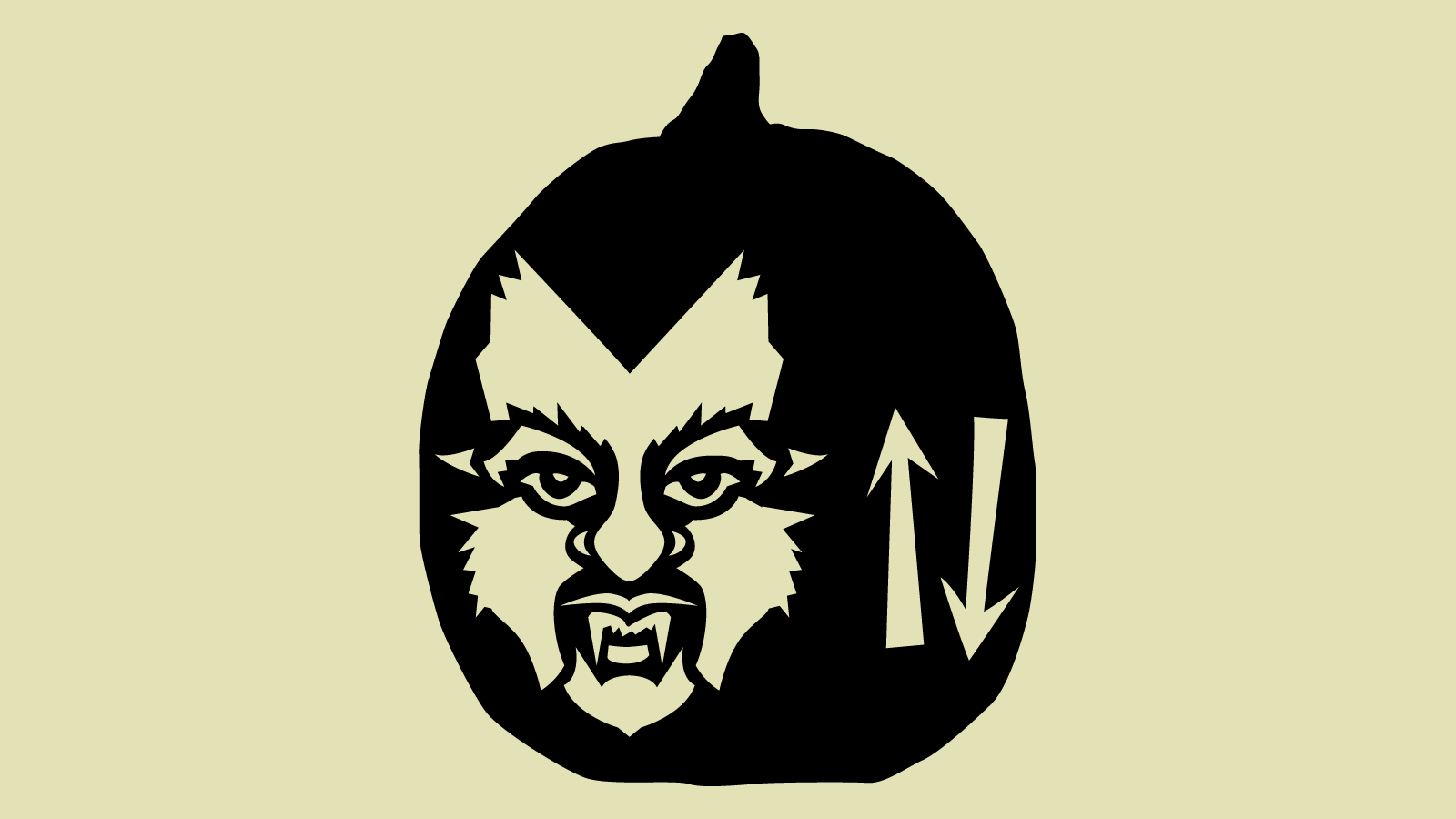
Werewolfgang Pauli
Theories like Wolfgang Pauli’s exclusion principle—which affirms that two identical fermions cannot occupy the same quantum state at the same time—come along only once in a blue moon.
Download the template
From the lab to the classroom
From the lab to the classroom
Physicist Jennifer Gimmell shares her love of physics with her students.
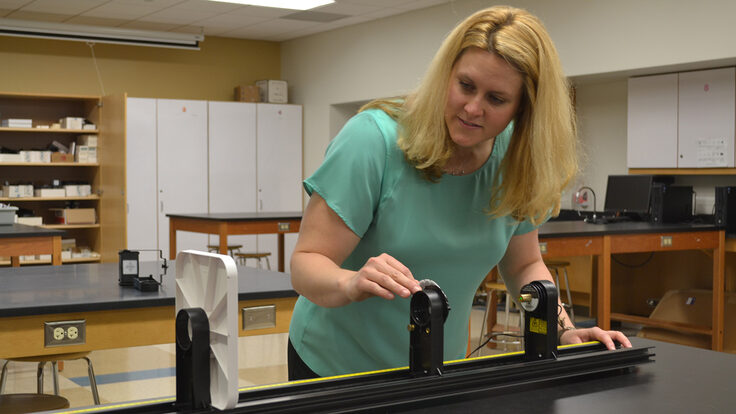
While she was earning her PhD in particle physics, Jennifer Gimmell spent her time developing data analyses. Now she spends her days developing the next generation of scientists.
Gimmell teaches physics at Benet Academy, a private college-preparatory school in Lisle, Illinois, and as an adjunct physics professor at the College of DuPage, a community college in nearby Glen Ellyn.
“To me, this is my way of influencing science almost in the same way that I was before,” Gimmell says. “But now I’m doing it from the inside.”
Life as a particle physicist
Gimmell earned her bachelor’s degrees in physics and mathematics from Hiram College, and she earned her master’s degree and PhD in particle physics from the University of Rochester. She did her graduate work on the CDF experiment at the Tevatron particle accelerator at Fermi National Accelerator Laboratory.
During her time at Fermilab, Gimmell worked in an analysis group specializing in studies of the top quark. She was also responsible for monitoring the CDF detector’s radiation protection and for helping maintain the innermost layer of the detector, the silicon tracker.
Gimmell says the thing she enjoyed most about particle physics was working toward the common goal of better understanding how the universe works.
“Even though my thesis was such a narrow part of the answer to that question, knowing that you’re contributing to the answer is pretty neat,” she says.
As a graduate student at a large national laboratory, Gimmell often struggled to find her place. But this struggle helped to shape her, she says.
“I really think that working in such a large collaboration and always being put on the spot in collaboration meetings helped me to think a little quicker on my feet and be confident in what I do.”
Transitioning into teaching
Gimmell says she always enjoyed teaching. In elementary school, her grandmother would watch her in the afternoons and Gimmell would teach her what she had learned in school.
Her love for teaching continued into adulthood. “There was always something I loved about telling other people something interesting and getting the ‘Wow, really!’ reaction.”
In graduate school, her favorite part was giving presentations. “I felt a real sense of accomplishment when I could put together a story to bring ideas and concepts to life.”
While working as a postdoc at Fermilab, Gimmell took a part-time position teaching an introductory math class at Rasmussen College in Aurora, Illinois. Then, one of her Fermilab colleagues introduced her to Tom Carter, a physics professor at the College of DuPage.
Carter was about to take a year-long sabbatical to work on the Dark Energy Survey experiment and was looking for a replacement. Carter says Gimmell’s energy and confidence when engaging with students made her perfect for the job. Gimmell applied for and was offered the position. She began teaching physics full time.
Gimmell says she fit well in the community college atmosphere. “Your time day-to-day is spent interacting with students, and that was definitely something I really wanted.”
Life as an educator
A typical day for Gimmell now is completely different from when she was a particle physicist. One thing that stands out is the difference between talking to students and talking to fellow physicists.
Gimmell’s colleagues came to the conversation with a shared interest in particle physics; that is not always the case with her students.
“With high school students, you have a blank slate, and you have to spend time on your presentation and in selling your subject,” Gimmell says. “I show passion for my subject when I teach, and because I am excited about it, it’s easy to get my students excited about it.”
When teaching physics, Gimmell helps her students learn to think like scientists. She always stresses the importance of understanding why you are doing something instead of just focusing on the specific steps to solve a particular problem.
“Instead of just telling students whether they are right or not, my question to them is ‘How do you know you are right?’” Gimmell says. “I help them in their line of questions and help them build the way to think problems though.”
An influential educator
At the College of DuPage, Gimmell uses a technique called “flipping the classroom,” in which students work on homework problems with her during class and watch her recorded lectures at home.
“Flipping the classroom is a gutsy thing to do, and not every educator could do it successfully like Jennifer does,” Carter says. “She keeps her students moving and keeps them struggling— she’s got students energetically running to the board arguing about problems in groups.”
One of Gimmell’s Benet Academy students, Joseph A. Popelka, was one of 141 students from across the nation to be named a 2015 US Presidential Scholar. Each scholar was asked to name their their “most influential teacher,” and Popelka named Gimmell. She received a congratulatory letter from US Secretary of Education Arne Duncan.
Gimmell was also recently presented with an Innovation Award by the College of DuPage for her techniques to engage students in the classroom.
“There are three attributes that make Jennifer a great educator,” Carter says. “She knows her subject matter cold, and it shows in her confidence in the classroom. She really cares about her students and truly wants them to succeed. And she’s always willing to try something new.”
Is the universe getting bigger or am I getting smaller?
Physicist Jim Pivarski explains ways to think about the expansion of space.
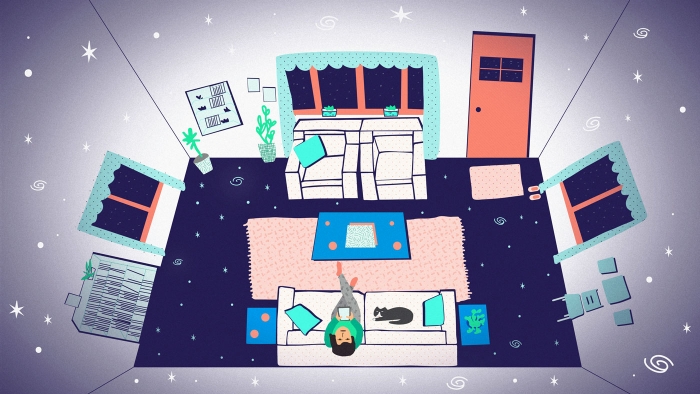
It is a well-established fact that the universe is expanding. It grows without center, like an inflating raisin cake, but an infinite raisin cake filling all of space in all directions. The raisins are the galaxies.
A problem I've had with this explanation is that if everything were to double in size—galaxies, houses, you and me, rulers—then we'd never notice. I might be a towering giant, but if the room is equally huge, I wouldn't know. We can only see relative differences in sizes.
When scientists say the universe is expanding, they don't mean that its occupants are expanding along with it. The raisins do not grow with the cake. Imagine cake batter so full of raisins that they're pressed against each other when you first put the cake in the oven, but by the time it's done, there's only one raisin per mouthful. This would be a better analogy, but it raises another question: How do we know the raisins aren't shrinking?
Putting the question another way, what if the distances between galaxies are fixed, but everything except those distances are getting smaller? Or somewhere in between—the universe grows a little while we shrink a little. For that matter, where should we put the boundary line between the scales that grow relative to the scales that shrink?
Fundamentally, the expansion of the universe is described by one ratio that relates lengths in space with durations in time, sometimes called the cosmic scale factor. As time passes, this ratio changes: the scale of space increases with each second. But since this ratio, length divided by time, is a speed, suppose we think of space as fixed and all speeds slowing down.
What would happen if every object, from particles to planets, suddenly slowed down? Planets would fall in closer to the sun because they would have less angular momentum. Similarly, electrons would get closer to the nuclei of atoms. Molecular bonds would shorten. Every system bound by a force would shrink, but the distances between unconnected systems would stay the same.
Alternatively, what would happen if particle speeds were left alone but everything expanded uniformly, like a plate of marshmallows in the microwave? Again, electron and planetary orbits would then shrink to their natural sizes, like marshmallows taken out of the microwave, but the gaps between them wouldn't.
Regardless of how we interpret the underlying theory, we have the same picture: Distances between bound systems increase relative to the sizes of those systems. But that shouldn't be a surprise, since we're talking about the same physics theory in two different ways. It's all a matter of perspective.
Is the universe getting bigger or am I getting smaller?
Physicist Jim Pivarski explains ways to think about the expansion of space.
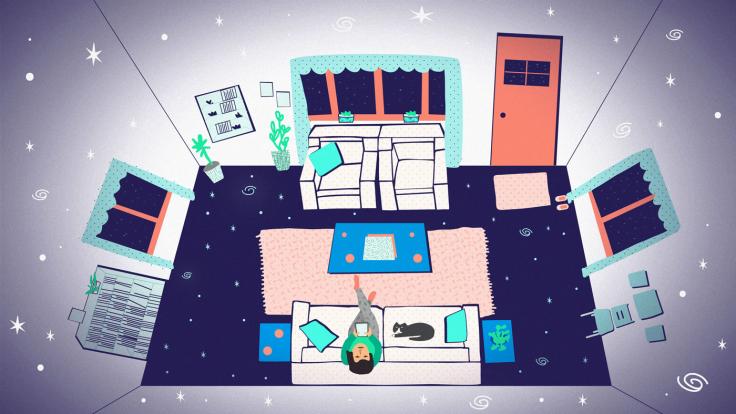
It is a well-established fact that the universe is expanding. It grows without center, like an inflating raisin cake, but an infinite raisin cake filling all of space in all directions. The raisins are the galaxies.
A problem I've had with this explanation is that if everything were to double in size—galaxies, houses, you and me, rulers—then we'd never notice. I might be a towering giant, but if the room is equally huge, I wouldn't know. We can only see relative differences in sizes.
When scientists say the universe is expanding, they don't mean that its occupants are expanding along with it. The raisins do not grow with the cake. Imagine cake batter so full of raisins that they're pressed against each other when you first put the cake in the oven, but by the time it's done, there's only one raisin per mouthful. This would be a better analogy, but it raises another question: How do we know the raisins aren't shrinking?
Putting the question another way, what if the distances between galaxies are fixed, but everything except those distances are getting smaller? Or somewhere in between—the universe grows a little while we shrink a little. For that matter, where should we put the boundary line between the scales that grow relative to the scales that shrink?
Fundamentally, the expansion of the universe is described by one ratio that relates lengths in space with durations in time, sometimes called the cosmic scale factor. As time passes, this ratio changes: the scale of space increases with each second. But since this ratio, length divided by time, is a speed, suppose we think of space as fixed and all speeds slowing down.
What would happen if every object, from particles to planets, suddenly slowed down? Planets would fall in closer to the sun because they would have less angular momentum. Similarly, electrons would get closer to the nuclei of atoms. Molecular bonds would shorten. Every system bound by a force would shrink, but the distances between unconnected systems would stay the same.
Alternatively, what would happen if particle speeds were left alone but everything expanded uniformly, like a plate of marshmallows in the microwave? Again, electron and planetary orbits would then shrink to their natural sizes, like marshmallows taken out of the microwave, but the gaps between them wouldn't.
Regardless of how we interpret the underlying theory, we have the same picture: Distances between bound systems increase relative to the sizes of those systems. But that shouldn't be a surprise, since we're talking about the same physics theory in two different ways. It's all a matter of perspective.

 Frascati Scienza
 Buco Nero
 Io Non Faccio Niente
 Tommaso Dorigo
 Giovanni Mazzitelli
 Barbara Gallavotti
 Keplero Blog
 Research Gate