
Giving physics students options
Many physics degree programs excel at preparing students for an academic career, but more than half of those who complete the programs head to industry instead.
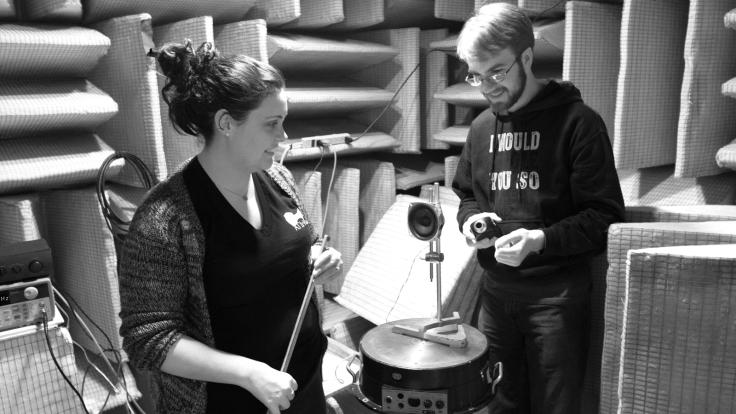
“I was drawn to physics because I thought it was amazing,” says Crystal Bailey, recalling the beginnings of her graduate work in the early 2000s. “There’s a sense of wonder that we’re really understanding something fundamental and elegant about the universe.”
But when she decided that an academic career path wasn’t right for her, she left her degree program. Bailey assumed, like many physics students, that the purpose of earning a physics degree is to remain in academia. In fact, statistics describe a different reality.
The American Institute of Physics states that roughly half of those who enter the workforce with a degree in physics—either a bachelor’s, master’s or doctorate—work in the private sector.
In an AIP survey of PhD recipients who had earned their degrees the previous year, 64 percent of respondents who identified their jobs as potentially permanent positions were working in industry.
Institutions in the United States currently grant around 1700 physics PhDs each year, though only about 350 academic faculty positions become available in that time, according to the AIP.
Most university physics programs are rooted in academic tradition, and some members of the physics community have expressed concern that not enough emphasis is placed on preparing students for potential jobs in industry. Among these members are the professors and students in three physics programs that are bucking this trend, taking a decidedly different approach to prepare aspiring physicists for what awaits beyond graduation.
Scientists at work
By the time Nicholas Sovis graduates in 2016 with his bachelor’s degree in applied physics, he’ll have two and a half years of work experience analyzing fuel injector movements at Argonne National Laboratory. Like the rest of his colleagues at Kettering University in Flint, Michigan, Sovis arranged an industry co-op through his school starting his freshman year. He alternates every three months between full-time school and full-time work. He’ll graduate in four years by taking an accelerated schedule of courses during academic terms.
“There are a lot of people who work in industry who are at—and really need to be at—the PhD level.”
Co-ops and internships are certainly not unique to this program, but the unparalleled emphasis on co-op experience is part of what Kathryn Svinarich, department head of physics at Kettering, calls their “industry-friendly” culture.
The university operated for many years training automotive engineers under the name General Motors Institute. Although the school is now an independent institution, Kettering still produces some of the most industry-oriented physicists in the country.
“We’re really turning heads in the [American Physical Society],” says Svinarich. “We’re the only fully co-op school with strong programs in physics.”
The program’s basic purpose is to provide students marketable skills while offering participating companies access to a talent pipeline. The tandem training at both Kettering and a private company or government institution lets students experience academic and industry life and connect with mentors in each realm.
Sovis says the combination of mentors has broadened his perspective. “I have learned how incredibly diverse the field of physics truly is,” he says.
As he weighs his options for the future, he adds that he is considering working for an agency such as NASA while remaining open to opportunities to do research at academic institutions.
Fueling innovation
In the 1990s, the graduate program in physics at Case Western Reserve University in Cleveland, Ohio, was getting mixed reviews from its alumni. On one hand, many former students were finding success leading innovative start-ups. On the other, they were struggling, finding themselves unprepared to handle the logistics of running a business.
In response, the university formed the Physics Entrepreneurship Program. This terminal masters degree program aims at providing its students skills in market analysis, financing strategies and leadership, while also connecting students to mentors, funding and talent. Students couple courses in physics with courses in business and law.
“Innovation is not speculative,” says Ed Caner, director of science and technology entrepreneurship programs. “You cannot simply write a business plan and get investors on board.”
Nathan Swift, a second-year student in the program, found this lesson valuable. For his thesis, he’s starting his own company. “We're developing a biomimetic [nature-imitating] impact material that could be integrated into helmets in place of conventional foam,” he says.
His business partners are biologists—PhD candidates at the University of Akron. Without Swift, the students didn’t have the business savvy or mechanical background to develop the idea, which they originally sketched out for a class. The team is currently fundraising and testing early prototypes.
Swift says that, though he is excited by the opportunity, participating in the Case Western program isn’t about definitively choosing one career path over another. “I'm doing it to gain the necessary skills so that I can be dangerous with both a technical and business fluency—in whatever I choose to pursue.”
Lessons in leadership
James Freericks, professor and director of graduate studies in physics at Georgetown University, says that 20 years ago, professional organizations were telling him that the universities were overproducing PhDs.
Freericks looked deeper and found that an imbalance had existed for decades. The supply of physics doctorates has far outpaced their academic demand as far back as the 1960s.
“To say the only reason you’re producing PhDs is for academics is a very narrow point of view,” Freericks says. “There are a lot of people who work in industry who are at—and really need to be at—the PhD level.”
Freericks now directs Georgetown’s Industrial Leadership in Physics program, organized in 2001. The program is expressly designed to train physics students to secure advanced positions in industry.
“You have to do a certain amount of problem-solving, a certain amount of head-scratching—and hitting your head against the wall...”
As with a traditional program, students engage in rigorous coursework and original research. But the program also blends in elements similar to those at Case Western and Kettering, such as courses in business and patent law and a yearlong apprenticeship in industry. An advisory committee of scientific leaders representing Lockheed Martin, IBM, BASF Corporation and other companies guides the program and provides mentorship.
The lengthy internships give students time to become fully immersed in the research and methods of a company. Ultimately, such apprenticeships prepare students to manage sophisticated scientific projects—including their significant budgets and groups of other scientists.
Academically industrial or industrially academic
What, then, is the right balance in physics education? Barbara Jones, a theoretical physicist at IBM and an ILP advisory committee member, advocates broad training that prepares students for work in industry as well as at a college or a national lab. She points out that the traditional classroom is not a complete failure in this regard.
“To get a PhD in physics, you have to do a certain amount of problem-solving, a certain amount of head-scratching—and hitting your head against the wall—that’s independent of any job,” Jones says. These skills translate, which is why classically trained physicists have been successfully obtaining and thriving in industry jobs for a long time, she says.
But “students even at more traditional programs can take a pointer from these programs and see about arranging for industrial internships for themselves.”
Perhaps the greatest value of programs such as these, Jones suggests, is giving students options.
Bailey agrees. She eventually completed a PhD in nuclear physics and now serves as the careers program manager at the American Physical Society. She organizes resources to help students navigate the many paths of being a physicist, including a new program now in its pilot stage, APS Industry Mentoring for Physicists (IMPact). The program connects early-career physicists with other physicists working in industry.
Bailey’s job also frequently involves giving talks on pursuing physics as a career. She tells students, “Your career will not always take you where you expect. But you can always find a way to do the things you love.”
Dark matter’s newest pursuer
Scientists have inaugurated the new XENON1T experiment at Gran Sasso National Laboratory in Italy.
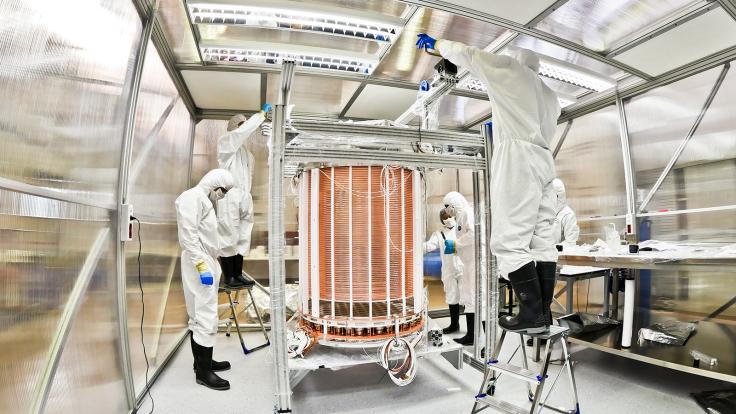
Researchers at a laboratory deep underneath the tallest mountain in central Italy have inaugurated XENON1T, the world’s largest and most sensitive device designed to detect a popular dark matter candidate.
“We will be the biggest game in town,” says Columbia University physicist Elena Aprile, spokesperson for the XENON collaboration, which has over the past decade designed, built and operated a succession of ever-larger experiments that use liquid xenon to look for evidence of weakly interacting massive dark matter particles, or WIMPs, at the Gran Sasso National Laboratory.
Interactions with these dark matter particles are expected to be rare: Just one a year for every 1000 kilograms of xenon. As a result, larger experiments have a better chance of intercepting a WIMP as it passes through the Earth.
XENON1T’s predecessors—XENON 10 (2006 to 2009) and XENON 100 (2010 to the present)—held 25 and 160 kilograms of xenon, respectively. The new XENON11 experiment’s detector measures 1 meter high and 1 meter in diameter and contains 3500 kilograms of liquid xenon, nearly 10 times as much as the next-biggest xenon-filled dark matter experiment, the Large Underground Xenon experiment.
Looking for WIMPs
Should a WIMP collide with a xenon atom, kicking its nucleus or knocking out one of its electrons, the result is a burst of fast ultraviolet light and a bunch of free electrons. Scientists built a strong electric field in the XENON1T detector to direct these freed particles to the top of the chamber, where they will create a second burst of light. The relative timing and brightness of the two flashes will help the scientists determine the type of particle that created them.
“Since our detectors can detect even a single electron or photon, XENON1T will be sensitive to even the most feeble particle interactions,” says Rafael Lang, a Purdue University physicist on the XENON collaboration.
Scientists cool the xenon to minus 163 degrees Fahrenheit to turn it into a liquid three times denser than water. One oddity of xenon is that its boiling temperature is only 7 degrees Fahrenheit above its melting temperature. So “we have to control our temperature and pressure precisely,” Aprile says.
The experiment is shielded from other particles such as cosmic rays by separate layers of water, lead, polyethylene and copper—not to mention 1400 meters of Apennine rock that lie above the Gran Sasso lab’s underground tunnels.
Keeping the xenon free of contaminants is essential to the detector’s sensitivity. Oxygen, for example, can trap electrons. And the decay of some radioactive krypton isotopes, which are difficult to separate from xenon, can obscure a WIMP signal. The XENON collaboration’s solution is to continuously circulate and filter 100 liters of xenon gas every minute from the top of the detector through a filtering system before chilling it and returning it to service.
A matter of scale
XENON researchers hope that their new experiment will finally be the one to see definitive evidence of WIMPs. But just in case, XENON1T was designed to accommodate a swift upgrade to 7000 kilograms of xenon in its next iteration. (At the same time, the LUX and UK-based Zeplin groups joined forces to design a similar-scale xenon detector, LZ.)
“If we see nothing with XENON1T, it will still be worth it to move up to the 7000-kilogram device, since it will be relatively easy to do that,” Aprile says. “If we do see a few events with XENON1T—and we’re sure they are from the dark matter particle—then the best way to prove that it’s real is to confirm that result with a larger, more sensitive experiment.
“In any case,” Aprile says, “we should know whether the WIMP is real or not before 2020.”
Neutrino experiments win big again
Fundamental Physics Prize recognizes five collaborations studying neutrino oscillations.

Hot on the heels of their Nobel Prize recognition, neutrino oscillations have another accolade to add to their list. On Nov. 8, representatives from five different neutrino experiments accepted a joint award for the 2016 Breakthrough Prize in Fundamental Physics.
The Breakthrough Prizes, also given for life sciences and mathematics, celebrate both science itself and the work of scientists. The award was founded by Sergey Brin, Anne Wojcicki, Jack Ma, Cathy Zhang, Yuri and Julia Milner, Mark Zuckerberg and Priscilla Chan with the goal of inspiring more people to pursue scientific endeavors.
This year’s $3 million prize for physics will be shared evenly among five teams: the Daya Bay Reactor Neutrino Experiment based in China, the KamLAND collaboration in Japan, the K2K (KEK to Kamioka) and T2K (Tokai to Kamioka) long-baseline neutrino oscillation experiments in Japan, Sudbury Neutrino Observatory (SNO) in Canada, and the Super-Kamiokande collaboration in Japan. These experiments explored the nature of the ghostly particles that are the most abundant massive particle in the universe, and how they change among three types as they travel.
Almost 1400 people contributed to these experiments that discovered and unraveled neutrino oscillations, “revealing a new frontier beyond, and possibly far beyond, the standard model of particle physics,” according to the Breakthrough Prize’s press release.
This year’s physics Nobel laureates Takaaki Kajita (Super-K) and Arthur B. McDonald (SNO) appeared onstage to accept to the Breakthrough Prize along with Yifang Wang, Kam-Biu Luk, Atsuto Suzuki, Koichiro Nishikawa and Yoichiro Suzuki.
“The quest for the secrets of neutrinos is not finished yet, and many more mysteries are yet to be discovered,” Wang said during the ceremony at Mountain View, California. There are many questions left to answer about neutrinos, including how much mass they have, whether there are more than three types, and whether neutrinos and antineutrinos behave differently.
A broad slate of oscillation experiments are currently studying neutrinos or planned for the future. Daya Bay, Super-K, T2K, and KamLAND continue to research the particles, as does an upgraded version of SNO, SNO+. The US-based MINOS+ and NOvA are currently taking long-baseline neutrino oscillation data. The Jiangmen Underground Neutrino Observatory is under construction in China, and the international Deep Underground Neutrino Experiment is progressing quickly through the planning phase. Many others dot the neutrino experiment landscape, using everything from nuclear reactors to giant chunks of Antarctic ice to learn more about the hard-to-catch particles. With so much left to discover, it seems like there are plenty of prizes left in neutrino research.
Physics Photowalk voting begins
Pick your favorites from among 24 photos taken during the Global Physics Photowalk.
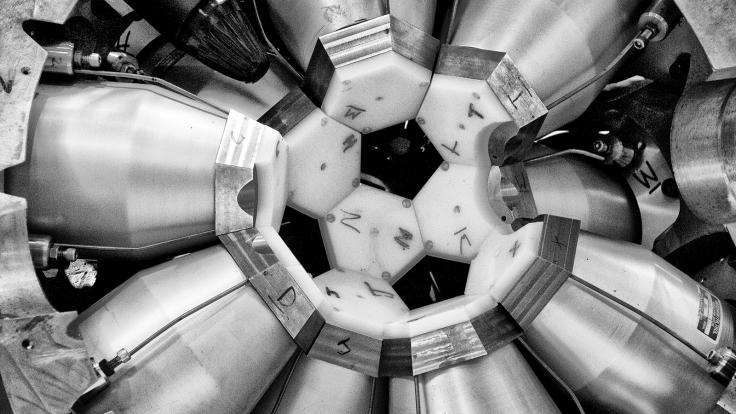
Twenty-four top photos have been selected to enter the next stage of the Global Physics Photowalk competition.
In September, eight world-leading research laboratories invited photographers to take a look behind the scenes at their facilities to share the beauty behind physics. More than 200 photographers collectively participated in the international photowalk, submitting thousands of photos into local competitions. After careful deliberation, each laboratory selected their three winning photos from their local submissions to enter into the global competition.
In the next stage of the global competition, the top 24 photos will be judged in two categories: a jury competition, facilitated through a panel of international judges, and a people’s choice competition, conducted via an online popular vote. Starting today, the public is invited to view and choose their favorite photos on the Interactions Collaboration website. Voting closes November 30.
While voting for the people’s choice selection is underway, an international jury comprised of artists, photographers and scientists will convene to scrutinize the photos and crown the global winners.
Those winners will be announced in December and will have the opportunity to be featured in Symmetry magazine, the CERN Courier, and as part of a traveling exhibit across laboratories in Australia, Asia, Europe and North America.
Visit www.flickr.com/photos/interactions_photos to view additional photographs from each laboratory’s local event.
The light side of dark matter
New technology and new thinking are pushing the dark matter hunt to lower and lower masses.
It’s a seemingly paradoxical but important question in particle physics: Can dark matter be light?
Light in this case refers to the mass of the as-yet undiscovered particle or group of particles that may make up dark matter, the unseen stuff that accounts for about 85 percent of all matter in the universe.
Ever-more-sensitive particle detectors, experimental hints and evolving theories about the makeup of dark matter are driving this expanding search for lighter and lighter particles—even below the mass of a single proton—with several experiments giving chase.
An alternative to WIMPs?
Theorized weakly interacting massive particles, or WIMPs, are counted among the leading candidates for dark matter particles. They most tidily fit some of the leading models.
Many scientists expected WIMPs might have a mass of around 100 billion electronvolts—about 100 times the mass of a proton. The fact that they haven’t definitively showed up in searches covering a range from about 10 billion electronvolts to 1 trillion electronvolts has cracked the door to alternative theories about WIMPs and other candidate dark matter particles.
Possible low-energy signals measured at underground dark matter experiments CoGeNT in Minessota and DAMA/LIBRA in Italy, along with earlier hints of dark matter particles in space observations of our galaxy’s center by the Fermi Gamma-ray Space Telescope, excited interest in a mass range below about 11 billion electronvolts—roughly 11 times the mass of a proton.
Such low-energy particles could be thought of as lighter, “wimpier” WIMPs, or they could be a different kind of particles: light dark matter.
SuperCDMS, an WIMP-hunting experiment in the Soudan Underground Laboratory in Minnesota, created a special search mode, called CDMSlite, to make its detectors sensitive to particles with mass reaching below 5 billion electronvolts. With planned upgrades, CDMSlite should eventually be able to stretch down to detect particles with a mass about 50 times less than this.
In September, the CDMS collaboration released results that narrow the parameters used to search for light WIMPs in a mass range of 1.6 billion to 5.5 billion electronvolts.
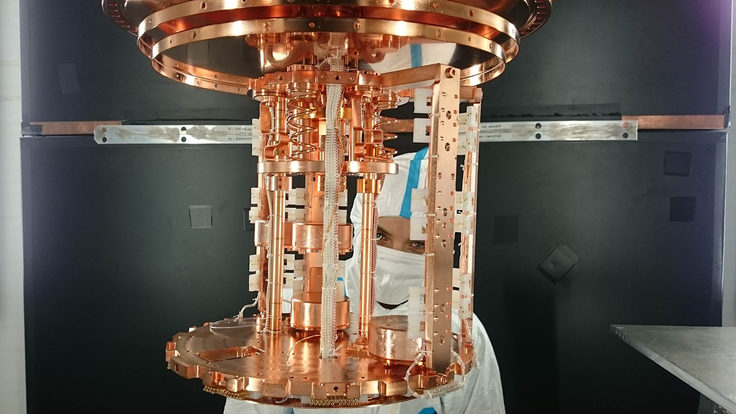
Also in September, collaborators with the CRESST experiment (pictured above) at Gran Sasso laboratory in Italy released results that explored for the first time masses down to 0.5 billion electronvolts.
Other underground experiments, such as LUX at the Sanford Underground Research Facility in South Dakota, EDELWEISS at Modane Underground Laboratory in France, and DAMIC at SNOLAB in Canada, are also working to detect light dark matter particles. Many more experiments, including Earth- and space-based telescopes and CERN’s Large Hadron Collider, are playing a role in the dark matter hunt as well.
This hunt has broadened in many directions, says David Kaplan, a physics professor at Johns Hopkins University.
“Incredible progress has been made—scientists literally gained over 10 orders of magnitude in sensitivity from the beginning of really dedicated WIMP experiments until now,” he says. “In a sense, the WIMP is the most boring possibility. And if the WIMP is ruled out, it’s an extremely interesting time.”
Peter Graham, an assistant professor of physics at Stanford University, says the light dark matter search is especially intriguing because any discovery in the light dark matter range would fly in the face of classical physics theories. “If we find it, it won’t be in the Standard Model,” he says.
Coming attractions
The experiments searching for light dark matter are working together to see through the background particles that can obscure their searches, says Dan Bauer, spokesman for the SuperCDMS collaboration and group leader for the effort at Fermilab.
“In this whole field, it’s competitive but it’s also collaborative,” he says. “We all share information.”
The next few months will bring new results from the CDMSlite experiment and for CRESST.
An upgrade, now in progress, will push the lower limits of the CRESST detectors to about 0.1 billion to 0.2 billion electronvolts, says Federica Petricca, a researcher at the Max Planck Institute for Physics and spokesperson for the CRESST experiment.
“The community has learned to be a bit more open and not to focus on a specific region of the mass range of the dark matter particle,” Petricca says. “I think this is interesting simply because there are motivated theories behind this, and there is no reason to limit the search to some specific model.”
Researchers are also looking out for future results from an experiment called DAMIC. DAMIC searches for signs of dark matter using an array of specialized charge-coupled devices, similar to the light-sensitive sensors found in today’s smartphone cameras.
DAMIC already can search for particles with a mass below 6 billion electronvolts. The experiment’s next iteration, known as DAMIC100, should be able to take measurements below 0.3 billion electronvolts after it starts up in 2016, says DAMIC spokesperson Juan Estrada of Fermilab.
“I think it is very valuable to have several experiments that are looking in the same region,” Estrada says, “because it doesn’t look like any single experiment will be able to confirm a dark matter signal—we will need to have many experiments.
“There is still a lot of room for innovation.”
The particle physics of you
Not only are we made of fundamental particles, we also produce them and are constantly bombarded by them throughout the day.
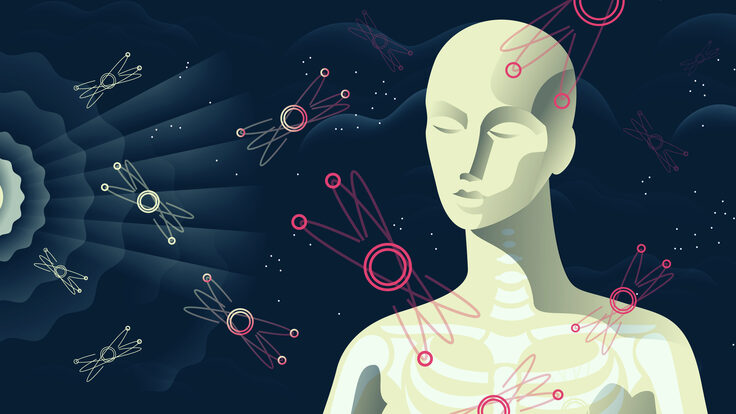
Fourteen billion years ago, when the hot, dense speck that was our universe quickly expanded, all of the matter and antimatter that existed should have annihilated and left us nothing but energy. And yet, a small amount of matter survived.
We ended up with a world filled with particles. And not just any particles—particles whose masses and charges were just precise enough to allow human life. Here are a few facts about the particle physics of you that will get your electrons jumping.

The particles we’re made of
About 99 percent of your body is made up of atoms of hydrogen, carbon, nitrogen and oxygen. You also contain much smaller amounts of the other elements that are essential for life.
While most of the cells in your body regenerate every seven to 15 years, many of the particles that make up those cells have actually existed for millions of millennia. The hydrogen atoms in you were produced in the big bang, and the carbon, nitrogen and oxygen atoms were made in burning stars. The very heavy elements in you were made in exploding stars.
The size of an atom is governed by the average location of its electrons. Nuclei are around 100,000 times smaller than the atoms they’re housed in. If the nucleus were the size of a peanut, the atom would be about the size of a baseball stadium. If we lost all the dead space inside our atoms, we would each be able to fit into a particle of lead dust, and the entire human race would fit into the volume of a sugar cube.
As you might guess, these spaced-out particles make up only a tiny portion of your mass. The protons and neutrons inside of an atom’s nucleus are each made up of three quarks. The mass of the quarks, which comes from their interaction with the Higgs field, accounts for just a few percent of the mass of a proton or neutron. Gluons, carriers of the strong nuclear force that holds these quarks together, are completely massless.
If your mass doesn’t come from the masses of these particles, where does it come from? Energy. Scientists believe that almost all of your body’s mass comes from the kinetic energy of the quarks and the binding energy of the gluons.

The particles we make
Your body is a small-scale mine of radioactive particles. You receive an annual 40-millirem dose from the natural radioactivity originating inside of you. That’s the same amount of radiation you’d be exposed to from having four chest X-rays. Your radiation level can go up by one or two millirem for every eight hours you spend sleeping next to your similarly radioactive loved one.
You emit radiation because many of the foods you eat, the beverages you drink and even the air you breathe contain radionuclides such as Potassium-40 and Carbon-14. They are incorporated into your molecules and eventually decay and produce radiation in your body.
When Potassium-40 decays, it releases a positron, the electron’s antimatter twin, so you also contain a small amount of antimatter. The average human produces more than 4000 positrons per day, about 180 per hour. But it’s not long before these positrons bump into your electrons and annihilate into radiation in the form of gamma rays.
The particles we meet
The radioactivity born inside your body is only a fraction of the radiation you naturally (and harmlessly) come in contact with on an everyday basis. The average person is exposed to 620 millirem of radiation every year. The food you eat, the house you live in and the rocks and soil you walk on all expose you to low levels of radioactivity. Just eating a Brazil nut or going to the dentist can up your radiation level by a few millirem. Smoking cigarettes can increase it up to 16,000 millirem.
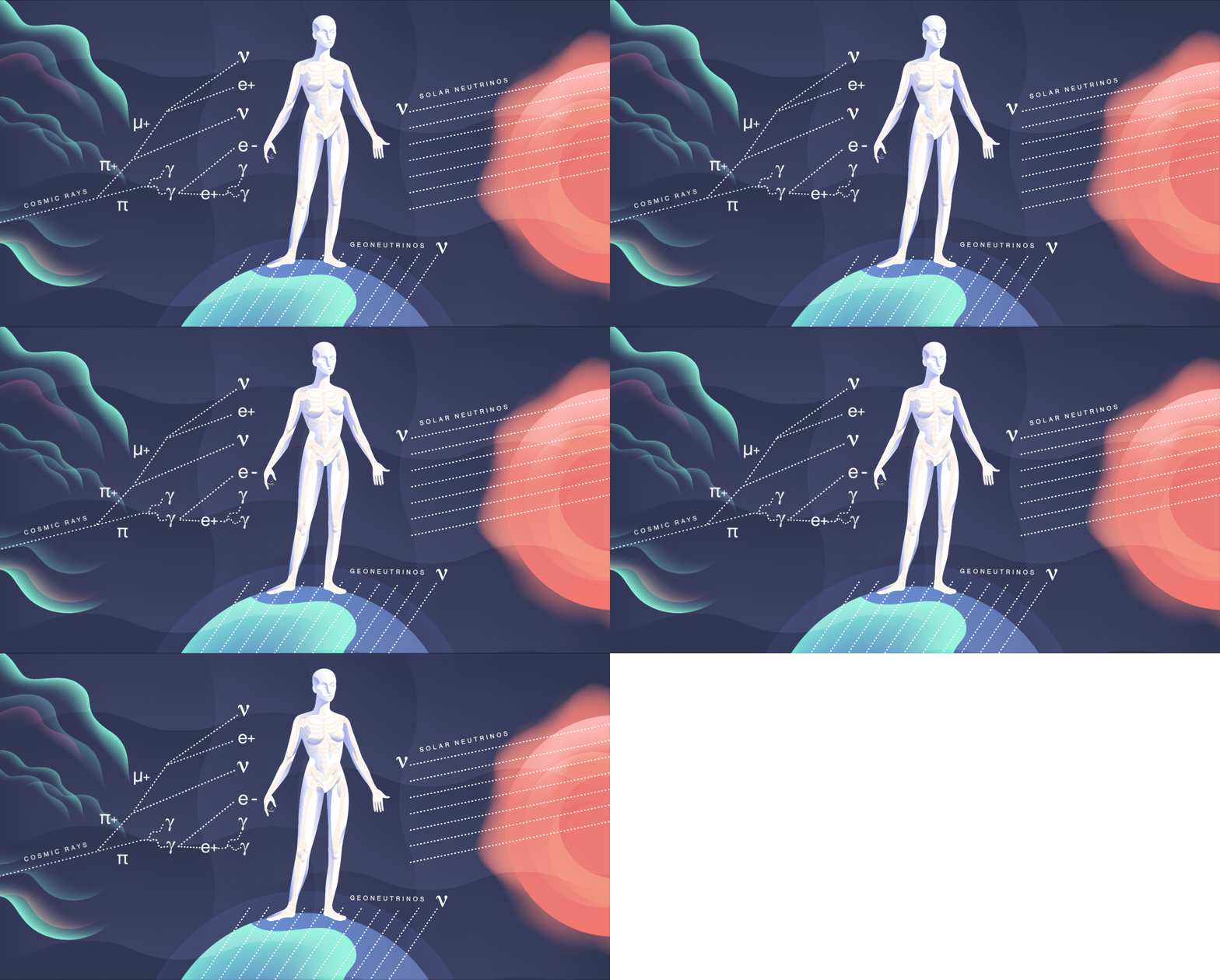
Cosmic rays, high-energy radiation from outer space, constantly smack into our atmosphere. There, they collide with other nuclei and produce mesons, many of which decay into particles such as muons and neutrinos. All of these shower down on the surface of the Earth and pass through you at a rate of about 10 per second. They add about 27 millirem to your yearly dose of radiation. These cosmic particles can sometimes disrupt our genetics, causing subtle mutations, and may be a contributing factor in evolution.
In addition to bombarding us with photons that dictate the way we see the world around us, our sun also releases an onslaught of particles called neutrinos. Neutrinos are constant visitors in your body, zipping through at a rate of nearly 100 trillion every second. Aside from the sun, neutrinos stream out from other sources, including nuclear reactions in other stars and on our own planet.
Many neutrinos have been around since the first few seconds of the early universe, outdating even your own atoms. But these particles are so weakly interacting that they pass right through you, leaving no sign of their visit.
You are also likely facing a constant shower of particles of dark matter. Dark matter doesn’t emit, reflect or absorb light, making it quite hard to detect, yet scientists think it makes up about 80 percent of the matter in the universe.
Looking at the density of dark matter throughout the universe, scientists calculate that hundreds of thousands of these particles might be passing through you every second, colliding with your atoms about once a minute. But dark matter doesn’t interact very strongly with the matter you’re made of, so they are unlikely to have any noticeable effects on your body.
The next time you’re wondering how particle physics applies to your life, just take a look inside yourself.
Gravitational waves and where to find them
Advanced LIGO has just begun its search for gravitational waves.
For thousands of years, astronomy was the province of visible light, that narrow band of colors the human eye can see.
In the 20th century, astronomers pushed into other kinds of light, from radio waves to infrared light to gamma rays. Researchers built neutrino detectors and cosmic ray observatories to study the universe using particles instead. Most recently, another branch of lightless astronomy has been making strides: gravitational wave astronomy.
It’s easy to make gravitational waves: Just flap your arms. Earth’s orbit produces more powerful gravitational waves, but even these are too small to have a measurable effect. This is a good thing: Gravitational waves carry energy, and losing too much energy would cause Earth to spiral into the sun.
Gravitational waves are an important prediction of Einstein’s general theory of relativity. According to that theory, a variety of astronomical objects—such as supernova explosions, pairs of black holes and other mutually orbiting objects with strong gravity—give off energy as disturbances in the structure of space-time that propagate outward at the speed of light.
Even though these waves are ubiquitous and often carry enormous amounts of energy, gravity is so weak that they barely nudge other objects as they pass.
But sufficiently sensitive detectors could measure these waves.
Detecting gravitational waves
Scientists have already measured gravitational waves indirectly. They first saw evidence of their existence in the Hulse-Taylor binary pulsar.
Pulsars are the remnants of stars more massive than the sun. They compress the mass of a star into an object the diameter of an Earth city. Their small size means they can orbit very close to each other, emitting gravitational waves and causing one another to speed up as they lose energy and get closer together.
Astronomers have monitored the Hulse-Taylor binary pulsar since the 1970s, and the amount of speed-up they see is exactly the predicted effect of gravitational waves.
Today’s gravitational wave observatories are based on a different concept. One of these is LIGO, the Laser Interferometer Gravitational-wave Observatory, a powerful instrument that recently began collecting data after a major upgrade.
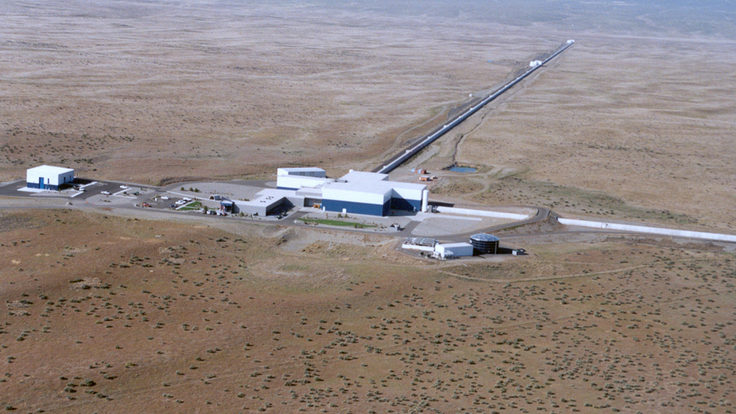
LIGO consists of two detectors, located in Louisiana and Washington in the United States. With the upgrade came an increase in sensitivity, enabling LIGO to look for gravitational waves produced by supernovae, colliding pulsars and other cataclysmic astronomical events hundreds of millions of light-years away.
LIGO has two Ls
Unlike tall observatory buildings and big radio telescope dishes scientists often use to study the cosmos, LIGO hugs the ground. Each detector forms a large L-shape, with arms made of concrete tubes 4 kilometers (2.5 miles) long. The inside of each tube is held at high vacuum. The experiment works by shining a powerful laser down the arms, where the beam bounces off a movable mirror at the far end.
When a gravitational wave passes, it nudges the mirror, slightly shifting the position of the crests and troughs of the laser beam. By comparing the beams between the two arms, LIGO staff can spot the gravitational wave’s effect—and possibly identify what made the wave in the first place.
Gravitational wave detectors must be smaller in size than the source of the waves, but smaller detectors are less sensitive. LIGO is designed to be the right size to see waves from binary pulsars or black holes right as they collide, at which point they are separated by mere kilometers. (For more stable systems, like the Hulse-Taylor binary pulsar, we will need a LIGO-type observatory larger than Earth. That’s the idea behind the proposed Laser Interferometer Space Antenna, or LISA, which would consist of three spacecraft orbiting the sun.)
LIGO also needs to be sensitive. This is because gravity is by far the weakest force in the universe; even very powerful gravitational waves from supernovas or other cataclysms will barely push a thing. As a result, LIGO is capable of measuring nudges to its mirror of about 10-20 meters, or about one ten-thousandth of the width of an atomic nucleus.
That sensitivity is greater than any other experiment in existence, but it comes at a big price. Lots of things can shake the mirror, from earthquakes to trucks to high winds buffeting the buildings in which LIGO sits. That’s part of the reason for having two LIGO antennas, separated by 3000 kilometers. Whatever’s causing noise in one detector will be unrelated to the noise in the other—though earthquakes will typically show up in both, thanks to how well they travel through Earth’s crust.
“Large earthquakes anywhere in the world or smaller earthquakes anywhere in north America or central America can [temporarily] knock us out,” says Sheila Dwyer, a gravitational wave researcher based at Caltech who works at the LIGO facility in eastern Washington.
Significant rumblings like that can happen about once a day, knocking LIGO out of commission for a few hours. Despite that, both detectors are operating about 12 hours out of 24, a substantial amount of time for hunting gravitational wave signals.
Part of Dwyer’s job is to keep the instruments all working together at the right sensitivity, a task that feels as much like engineering as science. In truth, much of gravitational wave astronomy has that hybrid feel. The objects of study—black holes, supernovae, neutron stars—are in the realm of ordinary astronomy. But the scope of the experiments is more akin to particle physics.
The project has drawn together experts in a broad range of fields, from theoretical gravitation research to optical engineers to experts in computer algorithms. LIGO papers have hundreds of authors, showing how many people are needed to make everything work.
Waiting for Godot?
But the real proof of success of any experiment is in the quality of data it produces. The current phase of operation is known as Advanced LIGO, which began observing in September. Dwyer notes that at this sensitivity, the detector could spot a neutron-star collision as far as 260 million light-years away, more than 100 times the distance to the Andromeda Galaxy, our nearest galactic neighbor. But the work isn’t done yet: Once everything is fully operational within the next two years, that range will extend to 650 million light-years, encompassing a large fraction of the nearby universe.
It’s up to the universe to do the rest.
“We've been staring at the sky for 400 years with telescopes,” says Shane Larson, a gravitational wave astronomer at Northwestern University.
Those centuries of observations give scientists a start on estimating how many gravitational wave events LIGO might spot, which conservative guesses estimate to be about 10 per year.
On the other hand, if we don’t see gravitational waves right away at LIGO, it’s not because they aren’t there—the Hulse-Taylor binary and other systems show that they are—it’s because our theories are overestimating how many we should see. As Larson says, “The true answer is what LIGO’s gonna tell us.”
The real excitement lies in what we don’t yet understand, including supernovae. With LIGO, “we will be able to ‘see’ inside a star as it collapses,” says researcher Amber Stuver of Caltech, who works at the LIGO facility in Livingston, Louisiana. “There is no other way to observe how that mass moves inside without detecting gravitational waves.”
And just as X-ray and radio astronomy led to the discovery of surprising new things such as pulsars, gravitational wave astronomy is bound to turn up something entirely new. “Every time humans have observed the universe in a new way, they discovered something they didn't expect to find,” Stuver says. “I’m here to find the unexpected.”
Next up: A turbocharged LHC
Physicists are already preparing upgrades that will increase the physics reach of the Large Hadron Collider in the next decade.
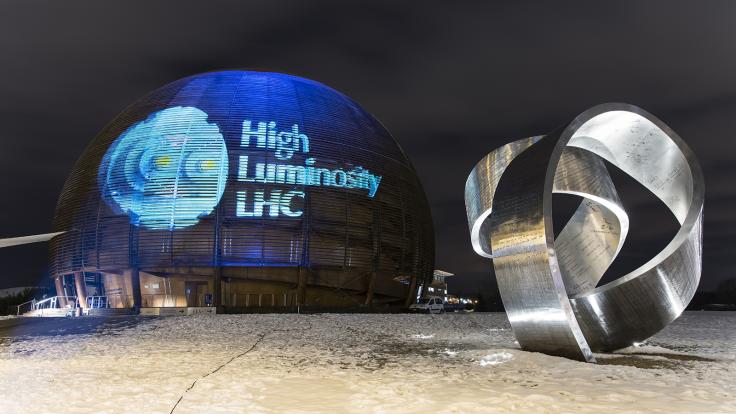
Even though the Large Hadron Collider is at the peak of its performance, currently smashing protons at a record-breaking energy, physicists are already planning for its next iteration, which will make its debut in 2025.
Today, scientists and engineers from more than a dozen institutions around the world met in Geneva to discuss the beginning of construction for the High-Luminosity LHC.
“About halfway through the construction of the LHC, scientists in the United States started developing new magnet and accelerator technologies for the HL-LHC,” says Peter Wanderer, head of the Superconducting Magnet Division at Brookhaven National Laboratory. “This meeting gives us the chance to integrate our work and progress with the efforts at CERN and other organizations involved in the luminosity upgrade.”
Luminosity describes the rate of particle collisions. By increasing the number and density of protons in the LHC, and by manipulating the orientation of the proton bunches when they collide, physicists can maximize the number of proton collisions per second.
“The LHC already delivers proton collisions at the highest energy and the highest luminosity ever achieved by an accelerator,” says Director General of CERN, Rolf Heuer. “Yet the LHC has only delivered 1 percent of the total planned number of collisions.”
Currently, the LHC collides 600 million protons every second. The planned upgrades will increase this rate by at least a factor of five.
The amount of data the HL-LHC will be able to generate in just a few years would take two decades to collect with the existing LHC, says Roger Rusack of the University of Minnesota, who works on the CMS experiment at the LHC. “It’s an exciting, challenging and interesting project for the US and the global physics community.”
More data will allow scientist to continue to push the limits of human knowledge and search for physics beyond the Standard Model—the best model physicists have to describe the fundamental particles and forces that make up everything around us. Many scientists hope that this new data will shed light on dark matter or help them look for evidence of Supersymmetry.
The High-Luminosity LHC will also enable physicists to study the Higgs boson in more detail.
Higgs bosons are produced roughly once in every 10 billion collisions in the LHC. That equals about one Higgs every 17 seconds. Between 2011 and 2012, the LHC generated 1.2 million Higgs bosons. With these upgrades, the LHC will produce 15 million Higgs bosons every year.
Among the upgrades are stronger beam-squeezing magnets and new superconducting radio-frequency cavities, which will flip the orientation of groups of protons to ensure the greatest number of collisions possible.
“We've had to innovate in many fields, inventing brand new technology for the magnets, the optics of the accelerator, superconducting radio-frequency and the superconducting links,” says Lucio Rossi, head of the High-Luminosity LHC project.
Scientists on LHC experiments are also designing and building new detector components that will optimize their experiments for future runs of the LHC.
The University of Minnesota, for example, is working with many other US groups on a new calorimeter to record the energy, direction and time of particles produced during collisions in the CMS detector, Rusack says. “Time is short and we still have a lot to do before these new systems are ready for the huge influx of collisions in 2025.”

 Frascati Scienza
 Buco Nero
 Io Non Faccio Niente
 Tommaso Dorigo
 Giovanni Mazzitelli
 Barbara Gallavotti
 Keplero Blog
 Research Gate