
Casting a net for neutrinos
The KM3NeT experiment will catch the elusive particles using the Mediterranean Sea.
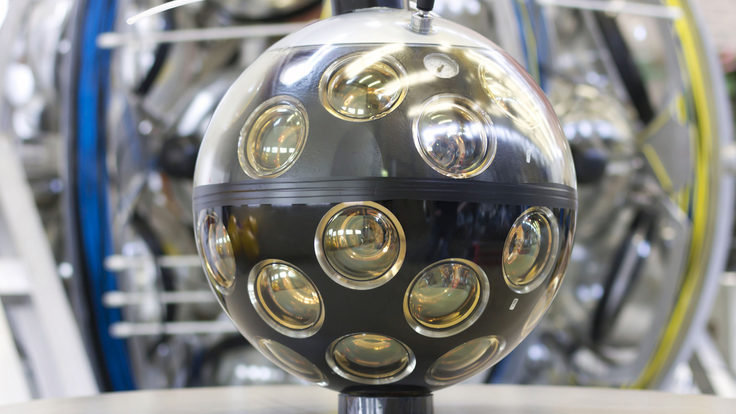
Like ordinary telescopes, KM3NeT operates in darkness—but there the resemblance ends. The Km3 Neutrino Telescope (where km3 means a cubic kilometer) is a suite of detectors that sits at the pitch-black bottom of the Mediterranean Sea, 3.5 kilometers below the waves and strong currents of the surface.
KM3NeT needs this absolute night to see the faint amount of light from ghostly neutrinos striking water molecules. Neutrinos pass through most material as though it weren’t there, which is why detectors need to be so big to spot them—more volume means more chances to see a neutrino interact. When completed, KM3NeT will be the largest neutrino detector in the world, made of about 1.3 trillion gallons of seawater.
Throughout that space will stand 700-meter-long cables anchored to the sea floor, each with glass spheres containing photomultipliers that turn flashes of light into electrical signals scientists can measure. The cables will be spaced far enough apart to keep from tangling up, but close enough together to see signs of passing neutrinos.
There is currently only one string in place, which was installed in December 2015. While the plan is to complete KM3NeT with hundreds of strands off the coasts of Italy, France and Greece in four to five years, it won’t take that long for scientifically useful results.
“As soon as you have a reasonable size detector, it's scientifically relevant,” says KM3NeT spokesperson Maarten de Jong of the Nationaal instituut voor subatomaire fysica (National Institute for Subatomic Physics, or Nikhef) in the Netherlands. As more detector strings are added, KM3NeT will see more neutrinos. “In two years [KM3NeT] will be scientifically relevant in the sense that they'll supersede previous measurements.”

Casting the net
The KM3NeT team installs the detectors using an “inverted yo-yo,” as technical project manager Marco Circella calls it. This rough sphere, about 3 meters across, sinks under the weight of a heavy anchor until landing on the seafloor. Then, operators aboard a ship fire sonic releases. The yo-yo floats back toward the surface, unwinding the string of 18 glass spheres as it goes, and arrives ready for restringing.
The glass spheres can withstand the high water pressure 3.5 kilometers below sea level. In fact, IceCube and other underwater experiments like ANTARES (also in the Mediterranean) and the Lake Baikal Neutrino Observatory in Siberia also use glass spheres, but contain only one photomultiplier per sphere compared to KM3NeT’s 31.
Each sphere is wired separately, so that if any of them fail, the experiment can keep going. Those wires are connected to an undersea cable by robotic submarines controlled from aboard the ship.
Circella, who works at the Istituto Nazionale di Fisica Nucleare (National Institute of Nuclear Physics, or INFN) in Italy, describes the process as being like a video game. “You have a joystick and I think [the operators] have the same level of fun, but this is only possible if they are really well-prepared.”
The cable runs from the detector strings back to shore, where data from the photomultiplier tubes are turned into something scientists can read.

Science with spheres
KM3NeT works similarly to other large neutrino observatories such as the IceCube detector at the South Pole.
When a neutrino comes along, it strikes a water molecule, which reacts by producing a muon. Muons are the heavy cousins of electrons, and these neutrino-made muons are born traveling faster than the speed of light in water. (Nothing can travel faster than the speed of light in a vacuum, but all bets are off in water.) The muons produce flashes of light, akin to sonic booms from airplanes.
Of course, other things can make flashes of light, from cosmic rays to deep-sea organisms. At the depth of KM3NeT, most of these other sources are gone, but to be absolutely sure they’re seeing neutrinos, researchers track the direction the flashes originate.
Because nothing but a neutrino is likely to pass through Earth, the planet itself is the biggest shield from false signals. So KM3NeT searches for sources in the southern part of the sky, whose neutrinos would have to pass through the earth to reach its detectors. IceCube’s position at the South Pole makes it best suited for looking at sources in the northern sky.
“We have a very good view of the central region of the Milky Way,” says Maarten de Jong. “This is of course a region of particular interest, because we know that there is a black hole and other interesting potential sources of high energy neutrinos.”
Additionally, the observatories are designed to look for different neutrino sources. KM3NeT’s detectors are more closely arranged than IceCube’s, so it has a better chance of seeing the large number of low-energy neutrinos coming from various places in the galaxy. IceCube, by contrast, sees the highest energy neutrinos, including those coming from outside the Milky Way.
Both experiments have also proposed expansions. KM3NeT 2.0 could begin construction around 2020 and be able to look for some of the same high-energy neutrinos IceCube can see. IceCube’s Precision IceCube Next Generation Upgrade, or PINGU, would be more sensitive to lower-energy neutrinos.
“In some ways IceCube and KM3NeT are competitors, and that's important,” says Drexel University physicist Naoko Kurahashi Neilson, who works on IceCube. “You don't want just one group doing all the science of one field! I think it's very healthy and in fact it pushes us to do better when we have a competitor.”
The experiments do have some common goals, including finding the sources of cosmic rays coming from deep space. These energetic particles’ paths are curved by magnetic forces, making it hard to pinpoint their sources. But the same phenomena that make cosmic rays—which could include the remnants of supernovas, neutron stars, and possibly hot plasmas around black holes—should make neutrinos too, and those aren’t bothered by magnetic fields.
If researchers can locate the source of deep space neutrinos, they’ll know where at least some cosmic rays come from too.
Test of DUNE tech begins
On the road to the world’s largest neutrino detector, take the “DUNE Buggy.”
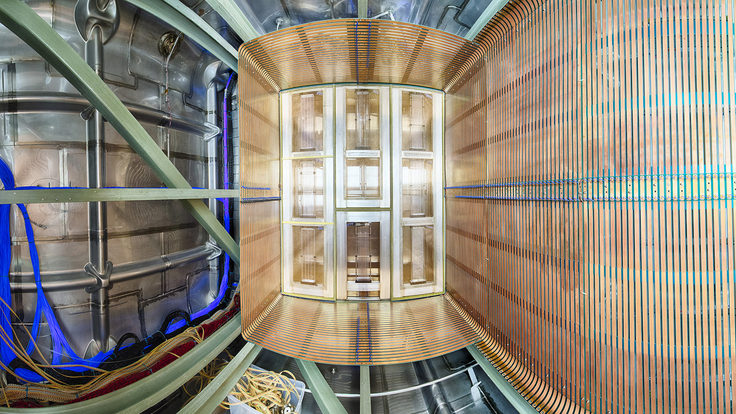
The planned Deep Underground Neutrino Experiment will require 70,000 tons of liquid argon, making it the largest experiment of its kind—100 times larger than the liquid-argon particle detectors that came before it.
Before building this unprecedented machine, scientists understandably want to make sure it’s going to work. That’s why members of the international DUNE collaboration recently began taking data using a test version of their detector.
“How can we be confident that what we want to do for DUNE is going to work?” says Michelle Stancari, co-coordinator of the DUNE prototype. “That’s where the 35-ton comes in.”
The full-size DUNE detectors, which will be built a mile underground at the Sanford Underground Research Facility, will tackle some of the biggest unsolved questions in physics. They will help find out whether neutrinos are the reason our matter-filled universe exists, watch for the formation of a black hole in a nearby galaxy, and search for signs of proton decay, bringing us closer to realizing Einstein’s dream of a unified theory of matter and energy.
“Of the Standard Model particles, neutrinos are some of the least well understood,” says Célio Moura, a professor at the Federal University of ABC in Brazil who works on the prototype. “We need huge experiments to get this difficult information about neutrinos. But we have to start little by little.”
One of those little steps is actually one of the largest liquid-argon time projection chambers ever built. That’s where scientists just saw their first tracks from cosmic rays. Built at the Department of Energy’s Fermi National Accelerator Laboratory, the 35-ton prototype (which could hold a small car in its liquid-argon vessel) picked up the nickname “DUNE Buggy” after a Photoshop artist within the group added monster truck wheels to an image of it.
As cosmic rays pass through the liquid argon, electrons and light are emitted—visible signals that the invisible particles passed through. The location and intensity of these tracks are collected and digitized, giving scientists insight into the particles’ direction, momentum, energy and type.
Now that the prototype is running, researchers will check that the various detector components are working properly and then start doing formal studies. Scientists plan to use the prototype to assess detector components that haven’t been tried before.
“The goal of this is to find out where the weak points are that need to be fixed, and also hopefully figure out the parts that work,” says Fermilab's Alan Hahn, co-coordinator for the 35-ton.
The new parts include redesigned photodetectors, long rectangular prisms with a special coating that change invisible light to a visible wavelength and bounce collected light to the detector’s electronic components.
DUNE scientists are also paying special attention to the prototype’s wire planes, pieces that hold the thin wires strung across the detector to pick up electrons. To ensure the frames will fit down the narrow mine shaft and avoid having to stretch the wires across the long DUNE detectors, risking sagging, scientists plan to use a series of small frames. These wire planes should measure tracks in the liquid argon both in front of and behind them, unlike other detectors.
“No one else has that,” Hahn says. “One of the main goals of the 35-ton run is to show that we can reconstruct tracks from such a wire plane.”

Beautifully strung wire planes sit inside the 35-ton prototype.
Engineers have also moved some of the detector’s electronic bits inside the frigid cryostat, which holds liquid argon at minus 300 degrees Fahrenheit (minus 184 degrees Celsius).
Much like the full detectors, the development of the bits and pieces of the 35-ton prototype depends on teamwork. The DUNE collaboration has about 800 members from 26 countries around the world.
“It has to be really international—otherwise it wouldn’t work,” says Karl Warburton, a PhD student from the University of Sheffield in the UK who works on the prototype. “You need the best minds from everywhere. It’s the same as with the LHC.”
For the 35-ton, Brookhaven and SLAC national laboratories provided much of the electronic equipment; Indiana State University, Colorado State University, Louisiana State University and Massachusetts Institute of Technology worked on the light detectors; and the universities of Oxford, Sussex, and Sheffield helped make special digital cameras that can survive in liquid argon and wrote the software to make sense of the data. Fermilab was responsible for the cryostat and cryogenic support systems.
Scientists will use what they learn from this version to build full-scale modules for a larger, 400-ton prototype at CERN. That will be the final test before construction of the first of four huge detectors for the actual experiment, which is scheduled to start in 2024.
“It’s been very important for the collaboration to have this prototype as a milestone,” says Mark Thomson, co-spokesperson for the DUNE collaboration and professor at the University of Cambridge. “It’s an absolutely essential step.”
Editor's note: A version of this article appeared in the Fermilab Newsroom.
Daya Bay discovers a mismatch
The latest measurements from the Daya Bay neutrino experiment in China don’t align with predictions from nuclear theory.

A new result from the Daya Bay experiment has revealed a possible flaw in predictions from nuclear theory.
“Nobody expected that from neutrino physics,” says Anna Hayes, a nuclear theorist at Los Alamos National Laboratory. “They uncovered something that nuclear physics was unaware of for 40 years.”
Neutrinos are produced in a variety of processes, including the explosion of stars and nuclear fusion in the sun. Closer to home, they’re created in nuclear reactors. The Daya Bay experiment studies neutrinos—specifically, electron antineutrinos—streaming from a set of nuclear reactors located about 30 miles northeast of Hong Kong.
In a paper published this week in Physical Review Letters, Daya Bay scientists provided the most precise measurement ever of the neutrino spectrum—that is, the number of neutrinos produced at different energies—at nuclear reactors. The experiment also precisely measured the flux, the total number of neutrinos emitted.
Neither of these measurements agreed with predictions from established models, causing scientists to scramble for answers from both theory and experiment.
Counting neutrinos
To make the record-breaking measurement, Daya Bay scientists amassed the world’s largest sample of reactor antineutrinos—more than 300,000 collected over the course of 217 days. They used six detectors, each filled with 20 tons of gadolinium-doped liquid scintillator. They were able to measure the particles’ energy to better than 1 percent precision. The experiment is supported by several institutions around the world, including the US Department of Energy and the National Science Foundation.
The Daya Bay scientists found that, overall, the reactors they study produced 6 percent fewer antineutrinos than predicted. This is consistent with past measurements by other experiments. The discrepancy has been called the “reactor antineutrino anomaly.”
This isn’t the first time neutrinos have gone missing. During the Davis experiment, which ran in the 1960s in Homestake Mine in South Dakota, physicists found that the majority of the solar neutrinos they were looking for—fully two-thirds of them—simply weren’t there.
With some help from the SNO experiment in Canada, physicists later discovered the problem: Neutrinos come in three types, and the detector at Homestake could see only one of them. A large fraction of the solar neutrinos they expected to see were changing into the other two types as they traveled to the Earth. The Super-Kamiokande experiment in Japan later discovered oscillations in atmospheric neutrinos as well.
Scientists have wondered whether something similar could explain Daya Bay’s missing 6 percent.
Theorists have predicted the existence of a fourth type of neutrino called a sterile neutrino, which might interact with other matter only through gravity. It could be that the missing neutrinos at Daya Bay are actually transforming away into undetectable sterile neutrinos.
Hitting a bump
However, the other half of today’s Daya Bay result could throw cold water on that idea.
In combining their two measurements—the flux and the spectra—Daya Bay scientists found an unexpected bump, an excess of the particles at around 5 million electronvolts. This represents a deviation from theoretical predictions of about 10 percent.
“Experimentally, this is a tour de force, to show that this bump is not an artifact of their detectors,” says theorist Alexander Friedland of SLAC National Accelerator Laboratory. But, he says, “the need to invoke sterile neutrinos is now in question.”
That’s because the large discrepancy suggests a different story: The neutrinos might not be missing after all; the predictions from nuclear theory could just be incomplete.
“These results do not rule out the sterile neutrino possibility,” Friedland says. “But the foundation on which the original sterile neutrino claims were based has been shaken.”
As Daya Bay co-spokesperson Kam-Biu Luk of the University of California at Berkeley and Lawrence Berkeley National Laboratory said in a press release, “this unexpected disagreement between our observation and predictions strongly suggested that the current calculations would need some refinement.”
What comes next
To investigate further, some scientists have proposed building new detectors near smaller reactors with more refined fuel sources—to cut out ambiguity as to which decay processes are producing the neutrinos.
Others have proposed placing detectors closer to the neutrino source—to avoid giving the particles the chance to escape by oscillating into different types. The Short-Baseline Neutrino Program, currently under construction at Fermi National Accelerator Laboratory, will do just that.
Whatever the cause of the mismatches between experiment and theory, these latest measurements will certainly be useful in interpreting results from future experiments, said Daya Bay co-spokesperson Jun Cao, of the Institute of High Energy Physics in China, in the press release.
“These improved measurements will be essential for next-generation reactor neutrino experiments.”
LIGO sees gravitational waves
The experiment confirms the last piece of Einstein’s general theory of relativity.
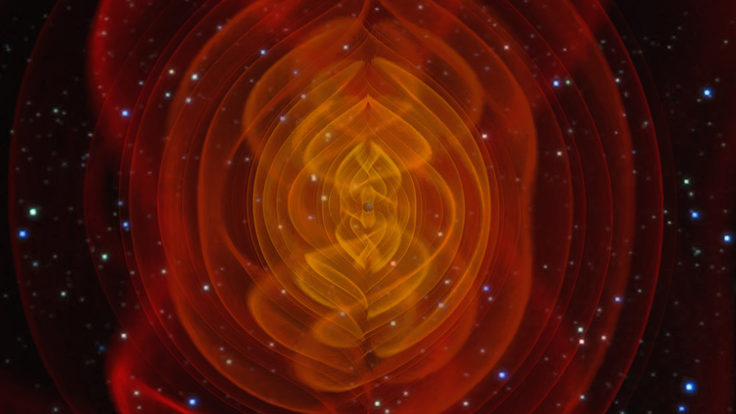
There’s officially a new way to look at the universe, and it’s not with a telescope.
After weeks of speculation, the LIGO Scientific Collaboration confirmed today that their experiment has seen waves in the very fabric of space-time, generated when two orbiting black holes spiraled into one another. So begins an era of gravitational wave astronomy.
These ripples in space were predicted as part of Albert Einstein’s general theory of relativity 100 years ago. While they had been measured indirectly through observation of orbiting pulsars, they had never been directly observed – until now.
“We have detected gravitational waves,” David Reitze, LIGO’s executive director, told a packed room at the National Press Club in Washington, DC, today. “We did it.”
The Advanced Laser Interferometer Gravitational-wave Observatory, or LIGO, picked up signatures of space stretching and warping as the black holes released energy in the form of gravitational waves 1.3 billion years ago. The black holes, 29 and 36 times the mass of the sun and 150 kilometers in diameter, merged to form a larger black hole with 62 solar masses, releasing the rest of the energy in gravitational waves that sped towards Earth when multicellular life there was just developing.
The waves from the black hole merger were brief, lasting mere milliseconds. But the output from that collision was “50 times greater than all the power put out by all the stars in the universe put together,” says Kip Thorne, professor of physics at Caltech.
The signal arrived during an engineering test on Sept. 14 last year, a few days before the formal start of Advanced LIGO’s first observing run, which lasted from Sept. 18 until mid-January.
“The signal took a billion years to come to Earth and produce this tiny distortion in our detectors that we are very proud to measure,” says Gabriela González, Louisiana State University professor and spokesperson for the LIGO Scientific Collaboration.
LIGO uses two identical interferometers in Louisiana and Washington to search for gravitational waves. At each one, a laser beam is split so it travels down a pair of perpendicular arms. At the end of each 4-kilometer-long tube, it bounces off a mirror and heads back toward the origin, where it recombines with the rest of the light.

LIGO uses identical interferometers in Livingston, Louisiana (above), and Hanford, Washington.
Without gravitational waves, the distance remains identical, and the light waves cancel each other. But if a gravitational wave passes through, it stretches space-time in one direction and compresses it in another. This makes one arm of the interferometer longer than the other, and the waves of light don’t match up as they should, revealing the telltale signal. LIGO is so sensitive, it can detect if the distance between its mirrors changes by 1/10,000 the width of a proton – a positively minuscule measurement.
“This was a truly scientific moonshot,” Reitze says. “And we did it. We landed on the moon.”
Reitze says the collaboration took months of rechecking to make sure that the signal was not a test or a false signal. Scientists confirmed that the signal was a gravitational wave that beautifully matched the prediction made by supercomputers and Einstein’s theory. In addition to being the first direct observation of gravitational waves, this also provided the first proof that binary black holes exist in the universe.
The initial installation of LIGO ran for several years without seeing gravitational waves before beginning a five-year upgrade to create Advanced LIGO. The system is currently running four times better than when it turned off in 2010, but there are still improvements to go. At full capacity, LIGO will be 10 times more sensitive. Upgrades include an additional mirror, a more powerful laser source and improved sensors and seismic isolation.
“We are going to have a huge richness of gravitational wave signals in LIGO” over the coming years, Thorne says.

Large optic inspection at the LIGO Livingston Laboratory.
LIGO, which is jointly operated by MIT and Caltech and has collaborators from more than 80 institutions worldwide, is scheduled for a six-month observing run later this year. The project will also eventually be joined later this year by Europe’s Advanced VIRGO, a third interferometer that could help triangulate the location of wave-generating objects in the sky. This will help telescope-based astronomers aim their lenses at the right spot to look for optical counterparts when experiments like LIGO see a signal. Japan and India are also slated to have gravitational wave experiments.
And there’s plenty to study. While this signal emerged from the dance of two black holes, gravitational waves could also come from orbiting neutron stars or a black hole devouring a neutron star. There could even be relic gravitational waves left over from the big bang.
Scientists are interested in learning more about the properties of gravitational waves and using them to figure out just how many neutron stars and black holes are around or how binary systems form and change. But the questions don’t stop there. Data coming out of LIGO could help address how matter behaves in extreme conditions, whether general relativity is the right theory of gravity or if the black holes that actually exist line up with the black holes predicted by Einstein’s theory.
“Now that we have detectors able to detect these systems, now that we know binary black holes are out there, we’ll be listening to the universe,” González says.
Gravitational wave astronomy will help scientists peer into our universe in a new way. The course of history has been expanding from visible light–to radio waves, microwaves, gamma rays and even neutrinos. This first direct observation of gravitational radiation is just the next wave of information from the universe.
“This is a very, very special moment,” says France Córdova, director of the National Science Foundation. “It’s seeing our universe with new eyes in an entirely new way.”

Signals of the binary black hole merger appeared at both LIGO detectors.
Neutrinos on a seesaw
A possible explanation for the lightness of neutrinos could help answer some big questions about the universe.

Mass is a fundamental property of matter, but there’s still a lot about it we don’t understand—especially when it comes to the strangely tiny masses of neutrinos.
An idea called the seesaw mechanism proposes a way to explain the masses of these curious particles. If shown to be correct, it could help us understand a great deal about the nature of fundamental forces and—maybe—why there’s more matter than antimatter in the universe today.
Wibbly-wobbly massy-wassy stuff
The masses of the smallest bits of matter cover a wide range. Electrons are roughly 1800 times less massive than protons and neutrons, which are one hundred times less massive than the Higgs boson. Other rare beasts like the top quark are heavier still.
Then we have the neutrinos, which don’t fit in at all.
According to the Standard Model of particles and forces that emerged in the 1970s, neutrinos were massless. Experiments seemed to concur. However, over the next two decades, physicists showed that neutrinos change their flavor, or type.
Neutrinos come in three varieties: electron, muon and tau. Think of them as Neapolitan ice cream: The strawberry is the electron neutrino; the vanilla is the muon neutrino; and the chocolate is the tau neutrino.
By the late 1980s, physicists were reasonably good at scooping out the strawberry; most experiments were designed to detect electron neutrinos only. But they were seeing far fewer than theory predicted they should.
By 1998, researchers discovered the missing neutrinos could be explained by oscillation—the particles were changing from one flavor to another. By figuring out how to detect the other flavors, they showed they could account for the remainder of the missing neutrinos.
This discovery forced them to reconsider the mass of the neutrino, since neutrinos can oscillate only if they have a tiny—but nonzero—mass.
Today, “just from experimental facts, we know that neutrino masses are way smaller compared to all the other elementary [matter particle] masses,” says Mu-Chun Chen, a theoretical physicist at the University of California, Irvine.
We don’t yet know exactly how much mass they have, but astronomical observations 1 Looking to the heavens for neutrino masses show they’re likely around a millionth of the mass of an electron—or even less. And this small mass could be a product of the seesaw mechanism.

I am not left-handed!
To visualize another important property of neutrinos, make a “thumbs-up” gesture with your left hand. Your fingers will curl the way the neutrino rotates, and your thumb will point in the direction it travels. This combination makes for a “left-handed” particle. Antineutrinos, the antimatter version of neutrinos, are right-handed: Take your right hand and make a thumbs-up to show the relation between their spin and motion.
Some particles such as electrons or quarks don’t spin in any particular direction relative to the way they move; they are neither purely right- nor left-handed. So far, scientists have only ever observed left-handed neutrinos.
But the seesaw mechanism predicts that there are two kinds of neutrinos: the light, left-handed ones we know and—on the other end of the metaphorical seesaw—heavy, right-handed neutrinos that we’ve never seen. The seesaw itself is a ratio: the higher the mass of the right-handed neutrino, the lower the mass of the left-handed neutrinos. Based on experiments, these right-handed neutrinos would be extraordinarily massive, perhaps 10^15 (one quadrillion) times heavier than a proton.
And there’s more: The seesaw mechanism predicts that if right-handed neutrinos exist, then they would be their own antiparticles. This could give us a clue to how our universe came to be full of matter.
One idea is that in the first fraction of a second after the big bang, the universe produced just a tiny bit more matter than antimatter. After most particles annihilated with their antimatter counterparts, that imbalance left us with the matter we have today. Most of the laws of physics don’t distinguish between matter and antimatter, so something beyond the Standard Model must explain the asymmetry.
Particles that are their own antiparticles can produce situations that violate some of the normal rules of physics. If right-handed neutrinos—which are their own antineutrinos—exist, then neutrinos could present the same kind of symmetry violation that might have happened for other types of matter. Exactly how that carries over to matter other than neutrinos, though, is still an area of active research for Chen and other physicists.
Searching for the seesaw
Scientists think they have yet to see these heavy right-handers for two reasons. First, the only force they know to act on neutrinos is the weak force, and the weak force acts only on left-handed particles. Right-handed neutrinos might not interact with any of the known forces.
Second, right-handed neutrinos would be too massive to be stable in our universe, and they would require too much energy to be created in even the most powerful particle accelerator. However, these particles could leave footprints in other experiments.
Today, scientists are studying the light, left-handed neutrinos that we can see to look for signs that could give us a verdict on the seesaw mechanism.
For one, they’re looking to see if neutrinos are their own antiparticles. That wouldn’t necessarily mean that the seesaw mechanism is true, but finding it would be a big point in the seesaw mechanism’s favor.
The seesaw mechanism goes hand-in-hand with grand unified theories—theories that unite the strong, weak and electromagnetic theory into a single force at high energies. If scientists find evidence of the seesaw mechanism, they could learn important things about how the forces are related.
The seesaw mechanism is the most likely way to explain how neutrinos got their mass. However, frustratingly, the nature of the explanation pushes many of its testable consequences out of experimental reach.
The best hope lies in persistent experimentation, and—as with the discovery of neutrino oscillation in the first place—hunting for anything that doesn’t quite fit expectations.
Weighing the lightest particle
Physicists are using one of the oldest laws of nature to find the mass of the elusive neutrino.

Neutrinos are everywhere. Every second, 100 trillion of them pass through your body unnoticed, hardly ever interacting. Though exceedingly abundant, they are the lightest particles of matter, and physicists around the world are attempting the difficult challenge of measuring their mass.
For a long time, physicists thought neutrinos were massless. This belief was overturned by the discovery that neutrinos oscillate between three flavors: electron, muon and tau. This happens because each flavor contains a mixture of three mass types, neutrino-1, neutrino-2 and neutrino-3, which travel at slightly different speeds.
According to the measurements taken so far, neutrinos must weigh less than 2 electronvolts (a minute fraction of the mass of the tiny electron, which weighs 511,000 electronvolts). A new generation of experiments is attempting to lower this limit—and possibly even identify the actual mass of this elusive particle.
Where did the energy go?
Neutrinos were first proposed by the Austrian-born theoretical physicist Wolfgang Pauli to resolve a problem with beta decay. In the process of beta decay, a neutron in an unstable nucleus transforms into a proton while emitting an electron. Something about this process was especially puzzling to scientists. During the decay, some energy seemed to go missing, breaking the well-established law of energy conservation.
Pauli suggested that the disappearing energy was slipping away in the form of another particle. This particle was later dubbed the neutrino, or “little neutral one,” by the Italian physicist Enrico Fermi.
Scientists are now applying the principle of energy conservation to direct neutrino mass experiments. By very precisely measuring the energy of electrons released during the decay of unstable atoms, physicists can deduce the mass of neutrinos.
“The heavier the neutrino is, the less energy is left over to be carried by the electron,” says Boris Kayser, a theoretical physicist at Fermilab. “So there is a maximum energy that an electron can have when a neutrino is emitted.”
These experiments are considered direct because they rely on fewer assumptions than other neutrino mass investigations. For example, physicists measure mass indirectly by observing neutrinos’ imprints on other visible things such as galaxy clustering.
Detecting the kinks
Of the direct neutrino mass experiments, KATRIN, which is based at the Karlsrule Institute for Technology in Germany, is the closest to beginning its search.
“If everything works as planned, I think we'll have very beautiful results in 2017,” says Guido Drexlin, a physicist at KIT and co-spokesperson for KATRIN.

Cleanliness is key inside the main spectrometer.
KATRIN plans to measure the energy of the electrons released from the decay of the radioactive isotope tritium. It will do so by using a giant tank tuned to a precise voltage that allows only electrons above a specific energy to pass through to the detector at the other side. Physicists can use this information to plot the rate of decays at any given energy.
The mass of a neutrino will cause a disturbance in the shape of this graph. Each neutrino mass type should create its own kink. KATRIN, with a peak sensitivity of 0.2 electronvolts (a factor 100 better than previous experiments) will look for a “broad kink” that physicists can use to calculate average neutrino mass.
Another tritium experiment, Project 8, is attempting a completely different method to measure neutrino mass. The experimenters plan to detect the energy of each individual electron ejected from a beta decay by measuring the frequency of its spiraling motion in a magnetic field. Though still in the early stages, it has the potential to go beyond KATRIN’s sensitivity, giving physicists high hopes for its future.
“KATRIN is the furthest along—it will come out with guns blazing,” says Joseph Formaggio, a physicist at MIT and Project 8 co-spokesperson. “But if they see a signal, the first thing people are going to want to know is whether the kink they see is real. And we can come in and do another experiment with a completely different method.”
Cold capture
Others are looking for these telltale kinks using a completely different element, holmium, which decays through a process called electron capture. In these events, an electron in an unstable atom combines with a proton, turning it into a neutron while releasing a neutrino.
Physicists are measuring the very small amount of energy released in this decay by enclosing the holmium source in microscopic detectors that are operated at very low temperatures (typically below minus 459.2 degrees Fahrenheit). Each holmium decay leads to a tiny increase of the detector’s temperature (about 1/1000 degrees Fahrenheit).
“To lower the limit on the electron neutrino mass, you need a good thermometer that can measure these very small changes of temperature with high precision,” says Loredana Gastaldo, a Heidelberg University physicist and spokesperson for the ECHo experiment.
There are currently three holmium experiments, ECHo and HOLMES in Europe and NuMECs in the US, which are in various stages of testing their detectors and producing isotopes of holmium.
The holmium and tritium experiments will help lower the limit on how heavy neutrinos can be, but it may be that none will be able to definitively determine their mass. It will likely require a combination of both direct and indirect neutrino mass experiments to provide scientists with the answers they seek—or, physicists might even find completely unexpected results.
“Don't bet on neutrinos,” Formaggio says. “They’re kind of unpredictable.”
This radioactive life
Radiation is everywhere. The question is: How much?

An overly plump atomic nucleus just can’t keep itself together.
When an atom has too many protons or neutrons, it’s inherently unstable. Although it might sit tight for a while, eventually it can’t hold itself together any longer and it spontaneously decays, spitting out energy in the form of waves or particles.
The end result is a smaller, more stable nucleus. The spit-out waves and particles are known as radiation, and the process of nuclear decay that produces them is called radioactivity.
Radiation is a part of life. There are radioactive elements in most of the materials we encounter on a daily basis, which constantly spray us with radiation. For the average American, this adds up to a dose of about 620 millirem of radiation every year. That’s roughly equivalent to 10 abdominal X-rays.
Scientists use the millirem unit to express how much a radiation dose damages the human body. A person receives 1 millirem during an airline flight from one U.S. coast to the other.
But where exactly does our annual dose of radiation come from? Looking at sources, we can split the dosage in two nearly equal parts: About half comes from natural background radiation and half comes from manmade sources.

Natural background radiation originates from outer space, the atmosphere, the ground, and our own bodies. There’s radon in the air we breathe, radium in the water we drink and miscellaneous radioactive elements in the food we eat. Some of these pass through our bodies without much ado, but some get incorporated into our molecules. When the nuclei eventually decay, our own bodies expose us to tiny doses of radiation.
“We’re exposed to background radiation whether we like it or not,” says Sayed Rokni, radiation safety officer and radiation protection department head at SLAC National Accelerator Laboratory. “That exists no matter what we do. I wouldn’t advise it, but we could choose not to have dental X-rays. But we can’t choose not to be exposed to terrestrial radiation—radiation that is in the crust of the earth, or from cosmic radiation.”
It’s no reason to panic, though.
“The human species, and everything around us, has evolved over the ages while receiving radiation from natural sources. It has formed us. So clearly there is an acceptable level of radiation,” Rokni says.
Any radiation not considered background comes from manmade sources, primarily through diagnostic or therapeutic medical procedures. In the early 1980s, medical procedures accounted for 15 percent of an American’s yearly radiation exposure—they now account for 48 percent.
“The amount of natural background radiation has stayed the same,” says Don Cossairt, Fermilab radiation protection manager. “But radiation from medical procedures has blossomed, perhaps with corresponding dramatic improvements in treating many diseases and ailments.”
Growth in the use of medical imaging has raised the average American’s yearly exposure from its 1980s' average of 360 millirems to 620 millirems. Today’s annual average is not regarded as harmful to health by any regulatory authority.
While medical procedures make up most of the manmade radiation we receive, about 2 percent of the overall annual dose comes from radiation emitted by some consumer products. Most of these products are probably in your home right now. Simply examining the average kitchen, one finds a cornucopia of items that emit enough radiation to detect it with a Geiger counter, in both manmade consumer products and natural foods.
Are there Brazil nuts in your pantry? They’re the most radioactive food there is. A Brazil nut tree’s roots reach far down into the soil to deep underground where there’s more radium, absorb this radioactive element, and pass it on to the nuts. Brazil nuts also contain potassium, which occurs in tandem with potassium-40, a naturally occurring radioactive isotope.
Potassium-40 is the most prevalent radioactive element in the food we eat. Potassium-packed bananas are well known for their radioactivity, so much so that a banana’s worth of radioactivity is used as an informal measurement of radiation. It’s called the Banana Equivalent Dose. One BED is equal to 0.01 millirem. A typical chest x-ray is somewhere around 200 to 1000 BED. A fatal dose of radiation is about 50 million BED in one sitting.
Some other potassium-40-containing munchies that emit radiation include carrots, potatoes, lima and kidney beans and red meat. From food and water alone, the average person receives an annual internal dose of about 30 millirem. That’s 3000 bananas!
Even the dish off of which you’re eating may be giving you a slight dose of radiation. The glaze of some older ceramics contains uranium, thorium or good ol’ potassium-40 to make it a certain color, especially red-orange pottery made pre-1960s. Likewise, some yellowish and greenish antique glassware contains uranium as a colorant. Though this dinnerware might make a Geiger counter click, it’s still safe to eat with.
Your smoke detector, which usually hangs silently on the ceiling until its batteries go dead, is radioactive too. That’s how it can save you from a burning building: A small amount of americium-241 in the device allows it to detect when there’s smoke in the air.
“It’s not dangerous unless you take it out in the garage and beat it up with a hammer to release the radioactivity,” Cossairt says. The World Nuclear association notes that the americium dioxide found in smoke detectors is insoluble and would “pass through the digestive tract without delivering a significant radiation dose.”
Granite countertops also contain uranium and thorium, which decays into radon gas. Most of the gas gets trapped in the countertop, but some can be released and add a small amount to the radon level in a home—which primarily comes from the soil a structure sits on.
Granite doesn’t just emit radiation inside the home. People living in areas with more granite rock receive an extra boost of radiation per year.
Yearly radiation exposure varies significantly depending on where you live. People at higher altitudes receive a greater dose of radiation showered from space per year.
But not to worry if you live in a locale with lots of altitude and granite, like Denver, Colorado. “No health effect due to radiation exposure has ever been correlated with people living at higher altitudes,” Cossairt says. Similarly, no one has noted a correlation between health and the increased dose of radiation from environmental granite rock.
It doesn’t matter if you’re living at altitude or sea level, in the Rocky Mountains or on Maryland’s Eastern Shore—radiation is everywhere. But annual doses from background and manmade sources aren’t enough to worry about. So enjoy your banana and feel free to grab another handful of Brazil nuts.
Check out our printable poster about radioactivity.

A mile-deep campus
Forget wide-open spaces—this campus is in a former gold mine.
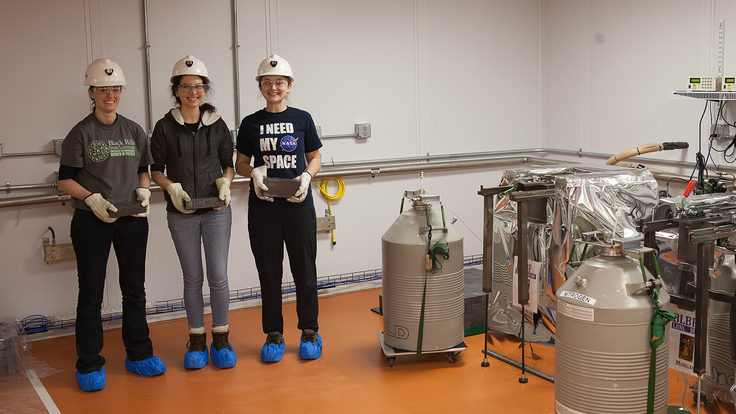
Twice a week, when junior Arthur Turner heads to class at Black Hills State University in Spearfish, South Dakota, he takes an elevator to what is possibly the first nearly mile-deep educational campus in the world.
Groundwater sprinkles on his head as he travels 10 minutes and 4850 feet into a gold-mine-turned-research-facility. His goal is to help physicists there search for the origins of dark matter and the properties of neutrinos.
Sanford Underground Research Facility opened in 2007, five years after the closure of the Homestake Gold Mine. The mile of bedrock above acts as a natural shield, blocking most of the radiation that can interfere with sensitive physics experiments.
“On the surface, there are one or two cosmic rays going through your hand every second,” says Jaret Heise, the science director at Sanford Lab. But if you head underground, you reduce that flux by up to 10 million, to just one or two cosmic rays every month, he says.
Not only do these experiments need to be safeguarded from space radiation, they also need to be safeguarded from their own low levels of radiation.
“Every screw, every piece of material, has to be screened,” says BHSU Underground Campus Lab Director Brianna Mount.
BHSU offered to help Sanford Lab with this in 2014 by funding a cleanroom to maintain the background-radiation-counting detectors used to check incoming materials. Once the materials have been cleared, they can help with current experiments or build the next generation of sensitive instruments.
Heise is particularly excited for the capability to build a new generation of dark matter and neutrino detectors.
“As physics experiments become more and more sensitive, the materials from which they're made need to be that much cleaner,” Heise says. “And that's where these counters come into play, helping us to get the best materials, to fabricate these next-generation experiments."
In return, Sanford Lab offered to host an underground campus for BHSU. Two cleanrooms—one dedicated to physics and the other dedicated to biology—allow students and faculty to conduct a variety of experiments.
The lab finished outfitting the space in September 2015. Even though it’s a mile underground, the counters require their own shielding because the local rock and any nearby ductwork or concrete will give off a small amount of radiation.
Once the lab was fully shielded, a group of students, including Turner, moved in a microscope and two low-background counters. After exiting the freight elevator, also known as the cage, the students walked into an old mine shaft. Then they hiked roughly half a mile to the cleanrooms, meandering through old tunnels with floors that sparkle with mica, a common grain in the bedrock.
“It's just been one of the coolest things that I've ever been a part of … to actually see what physics researchers do,” Turner says.
All three of the instruments the students installed were quickly put to use. Heise expects that they will triple that number this year with the addition of six more detectors from labs and universities across the US.
With the opening of the underground campus, physics students can now work on low-background counting experiments in the mine. And biology students go to sites in the far regions of the mine (the facility extends as far as 8000 feet underground but is mostly buried in water below about 5800 feet) and sample water in order to study the fungi and bacteria that live there with no light and low oxygen. These critters might exist in similar crevasses on Mars or Jupiter’s moons, or they might hold the key to developing new types of antibiotics here on Earth. The students can now bring samples back to the underground laboratory (instead of having to haul them to BHSU’s main campus while packed in dry ice).
Students with non-science majors are using the new campus to their advantage too. “We've also had education majors and even a photography major underground,” Mount says. But that’s not all. Mount welcomes research ideas from students across the US—from different universities down to the littlest scientists, as young as kindergarteners.
Although lab benches are installed in the cleanroom, it can’t easily accommodate 30 students, a typical class size, and students under the age of 18 legally cannot enter the underground lab. But BHSU has found ways to engage the students who can’t make the trek.
A professor can perform an experiment underground while a Swivl—a small robot that supports an iPad—follows him or her around the lab, streaming video back to a classroom. And the cleanroom microscope is hooked up to the Internet, allowing students to view slides in real time, something they will eventually be able to do from several states away.

 Frascati Scienza
 Buco Nero
 Io Non Faccio Niente
 Tommaso Dorigo
 Giovanni Mazzitelli
 Barbara Gallavotti
 Keplero Blog
 Research Gate