
A new pair of lenses for the Mayall
Scientists hope the quarter-ton hunks of glass will help them see dark energy’s effects.

The delicate process of lens crafting takes time and care. For your typical prescription eyeglasses, expect two weeks for proper sizing and glare-resistant coating. For a four-meter telescope with meter-wide lenses, a similar procedure takes well over a year.
The Dark Energy Spectroscopic Instrument project is the latest in a line of sky surveys to obtain custom lenses for an existing telescope. DESI arranged for refurbishments to the Mayall Telescope at the Kitt Peak National Observatory in Arizona, where it will create a three-dimensional map of a third of the sky in a quest to measure dark energy.
“DESI’s ultimate goal is to precisely measure and map the expansion rate of the universe and when it started to accelerate in its expansion,” says Michael Levi, the DESI project director and a physicist at the Department of Energy’s Lawrence Berkeley National Laboratory. “We’re looking back in time about 11 billion years, and we can do this with the help of a new corrector and high-precision lenses.”
The upgrade includes six new lenses, the two heaviest of which are ready for a final coating before integration into the brand new corrector barrel. Those nearly complete lenses, Corrector Lens 1 and Corrector Lens 4 (C1 and C4), have been in production since early 2015. Their journey began as a raw chunk of glass.

(From left to right) Gary Poczulp, Ron Probst, Dick Joyce and Ming Liang of the National Optical Astronomy Observatory and the DESI collaboration are reflected in the giant C4 lens. At NOAO, the four opened and inspect the C1 (not pictured) and C4 lenses after their cross-country road trip.
Adventures of the looking glass
Early last year, a private electro-optical lens company in Pittsburgh began fabricating the two lenses. Machines spun the noncrystalline glass around a central axis while removing material, shaping it into its final form. Each lens is over 1 meter in diameter.
“The lenses must be carefully polished to achieve a surface that’s accurate to tens of nanometers, with errors a fraction of a human hair,” says Tim Miller, an optical engineer for DESI and Berkeley Lab.
C1 and C4 began production earlier than the other four lenses because they have the tightest specification requirements. This is a consequence of their large size: C1 and C4 weigh in at 444 pounds and 522 pounds, respectively. They’ll eventually work in concert with the two aspherical lenses that correct for defects and a pair of lenses with wedges, which hook to motors and rotate to correct for disturbances on Earth.
Once the lenses were precisely shaped, they were ready for the cross-country move to the National Optical Astronomy Observatory in Arizona in January.
C1 and C4 shipped in skid-proof crates with burly security straps for the two-day road trip. The padded crates traveled with monitors called “shock loggers,” which measured bumps and vibrations in the road that could damage the lenses. The loggers previously monitored components for the Dark Energy Camera as they were transported for the Dark Energy Survey.
The lenses arrived safely at NOAO, but their journey is far from over. The next big operation is applying antireflective coating, a process scheduled for April. Then they’ll head to University College London, where a team will install them in a new steel corrector barrel being fabricated by Fermilab.
“The new corrector and lenses won’t help take pictures like the old corrector on Mayall,” says Gaston Gutierrez, the DESI manager of the corrector barrel and cage and a scientist at DOE’s Fermilab. “The lenses will focus on distant galaxies, and the corrector will collect the light in 5000 tiny fibers, which will disperse the light on the spectrograph.”
By early 2018, the entire package will be ready to ship and install into Mayall.

This 2-meter tall corrector barrel was used for imaging in previous surveys at the Mayall Telescope in Arizona. The new corrector barrel for the DESI project will replace this one and perform spectroscopic surveys.
Cosmic cartography
DESI will 3D-map most of the northern sky by collecting redshift data from over 35 million distant galaxies and quasars. A spectrograph shows scientists emission lines, or lines on the color spectrum, with colors linked to wavelengths. Depending on how much the lines have shifted toward the red, scientists can determine how far away a celestial body is from us.
However, redshifts alone cannot make a perfect three-dimensional map, says Daniel Eisenstein, co-spokesperson for DESI and professor of astronomy at Harvard University. “When we collect the spectra of galaxies in DESI, we are making a 3D map, but it only shows relative distances. It's as if we have a detailed map of the United States with no scale,” he says.
DESI scientists use baryon acoustic oscillations, subtle correlations in the way galaxies are spread throughout the cosmos, to infer the scale of the map and our distance from those galaxies. DESI’s precise measurement of that changing distance may reveal how dark energy acts on the universe.
This spectroscopic survey is the next innovation of telescopic observation. Because of the difficulty of 3D mapping large parts of the sky, high-performance optics with a wide field of view are essential.
“The DESI field of view will be 8 square degrees, about 40 times the disk of the full moon and nearly 3,000 times larger than the field of view of the Hubble Space Telescope,” Eisenstein says. “Even with this large field of view, it will take DESI about a year of observing time to cover one-third of the sky.”
Fermilab scientist elected next CMS spokesperson
Joel Butler will lead the LHC experiment starting in September.
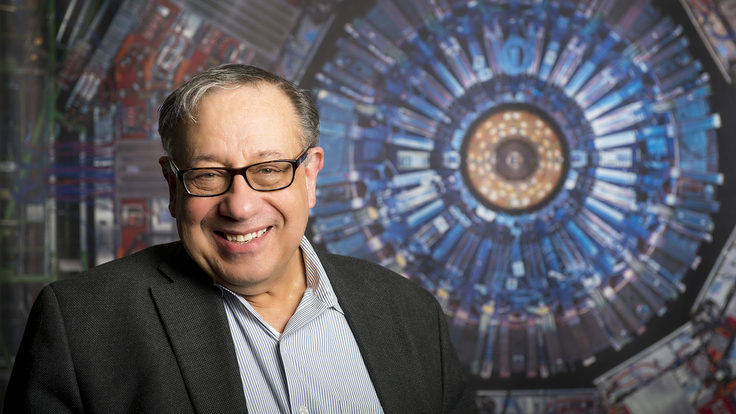
Long before the start-up of the Large Hadron Collider, physicist Joel Butler was helping shape the path of particle physics research in the United States. He led experiments at the Department of Energy’s Fermilab, was one of the co-founders of the lab’s Computing Division, and served on the High Energy Physics Advisory Panel.
Now, more than 30 years into his career as an experimental physicist, Butler’s responsibilities will become global as he takes the helm of one of the world’s largest physics experiments: the CMS experiment based at CERN.
“I am very happy, but I also feel a great sense of responsibility,” Butler says. “It’s a huge collaboration and I am humbled that our collaborators trust me to lead them.”
The CMS (Compact Muon Solenoid) collaboration designed, constructed and is currently operating one of the two LHC detectors that co-discovered the Higgs boson in 2012. The CMS experiment is now searching at an even higher energy for phenomena beyond the Standard Model of particle physics, such as dark matter and new fundamental particles. The collaboration consists of roughly 180 collaborating institutions and 3,000 scientists.
As the spokesperson, Butler will be responsible for guiding the technical and scientific endeavors performed by universities and laboratories in more than 40 countries. He will also represent CMS in its interactions with other organizations and the public.
Tiziano Camporesi is the current spokesperson of CMS experiment. He will lead the collaboration through the LHC’s spring start up and a summer of data collection before passing the baton to Butler in September 2016. He is looking forward to working with Butler through the challenges ahead.
"We are all hoping to see some nice surprises from our data over the course of the next few years,” Camporesi says. “Butler is extremely hardworking and I’m confident he will do a good job leading the collaboration during this exciting time.”
Butler joined the CMS collaboration in 2005. He oversaw the construction of the US-funded forward pixel detector and managed the US CMS Operations Program between 2007 and 2013. He is currently helping develop upgrades that will enable the CMS detector to handle higher collision rates in the future.
During his term, Butler’s main goal is to understand the needs and abilities of CMS’s contributing institutions to maximize the scientific output of the CMS experiment and prepare the detector for the high-luminosity LHC run in 2020.
“Different nations and institutes face different challenges,” Butler says. “We are going to take a huge amount of data and will have a big workload preparing the upgrades for the next generation of the LHC, which is why we need to increase our engagement with all of our collaborators to ensure that everyone is able to contribute effectively.”
Even though Butler has spent nearly a third of his scientific career working on the CMS experiment, he admits that there is still a lot left to learn about the experiment and its collaborators.
“I talked with nearly all of our institutions and explained plans, answered questions and discussed the experiment,” Butler says. “These meetings were incredibly valuable. No matter how much I think I know about CMS, there’s always a lot more to learn.”
Butler’s term will start this fall and bring the CMS collaboration up to the end of LHC Run II in 2018, when the LHC will shut down for another round of upgrades before ramping up for Run III. Butler says he is looking forward to working with a large and diverse population of scientists at an important moment in physics history.
“It’s a fantastic group of people, and my assignment is to help them all do the best job they can for CMS,” he says.
Art of Darkness
The Dark Energy Survey’s art show offers a glimpse of the expanding universe.
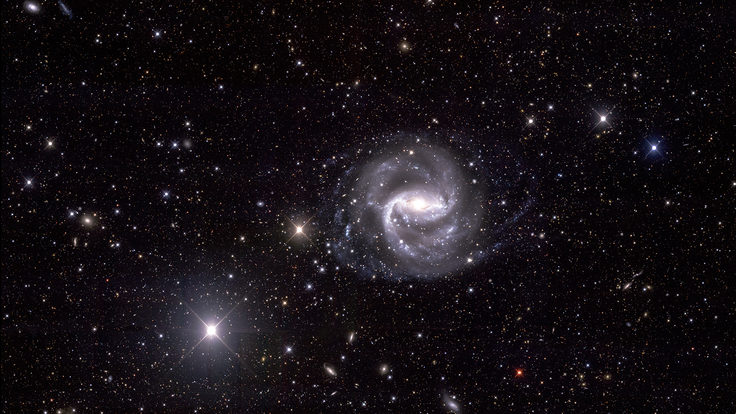
Imagine a clear night in the mountains, away from glaring city lights. In the sky, gleaming speckles from distant stars cascade into the bright streams of the Milky Way. Almost everything in sight is part of our home galaxy.
To provide a glimpse beyond our galaxy and into an ever-expanding universe, the Department of Energy’s Fermilab is hosting the Art of Darkness, an exhibition by Dark Energy Survey collaborators. The exhibit opened Feb. 19 in the Fermilab Art Gallery and showcases images from celestial objects from DES’ Dark Energy Camera, DECam.
“We see so much information in the artwork that ends up being a small part of the whole DES footprint,” says Brian Nord, an astrophysicist and contributor to the DES art exhibit. “This showcase highlights the depth of a universe we don’t completely see with the naked eye.”
DES is a five-year survey that covers one-eighth of the sky to better describe dark energy–the force driving the universe’s accelerated expansion. The collaboration has more than 400 scientists from around 30 institutions. It uses the 570-megapixel DECam, one of the largest digital cameras in the world, perched atop the Blanco Telescope at the Cerro Tololo Inter-American Observatory in Chile.
The select few galaxies in the exhibit are from a narrow swath of the sky survey. Creating these photographs for the gallery requires an image-processing pipeline, a method of “cleaning up” the images by removing artifacts such as satellites, airplane or cosmic ray trails, or defects from the camera hardware, says Nikolay Kuropatkin, a DES computational physics software developer.
“We use this pipeline for our scientific surveys, but it turns out to be a good tool for artwork as well,” says Kuropatkin.
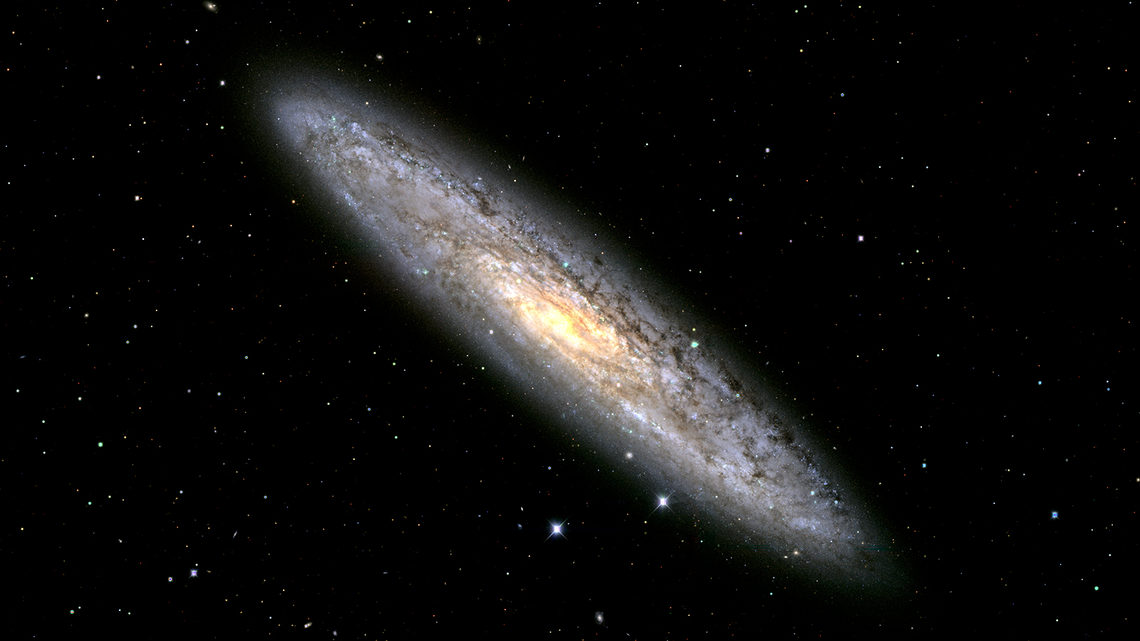
NGC-253: Sculptor Galaxy
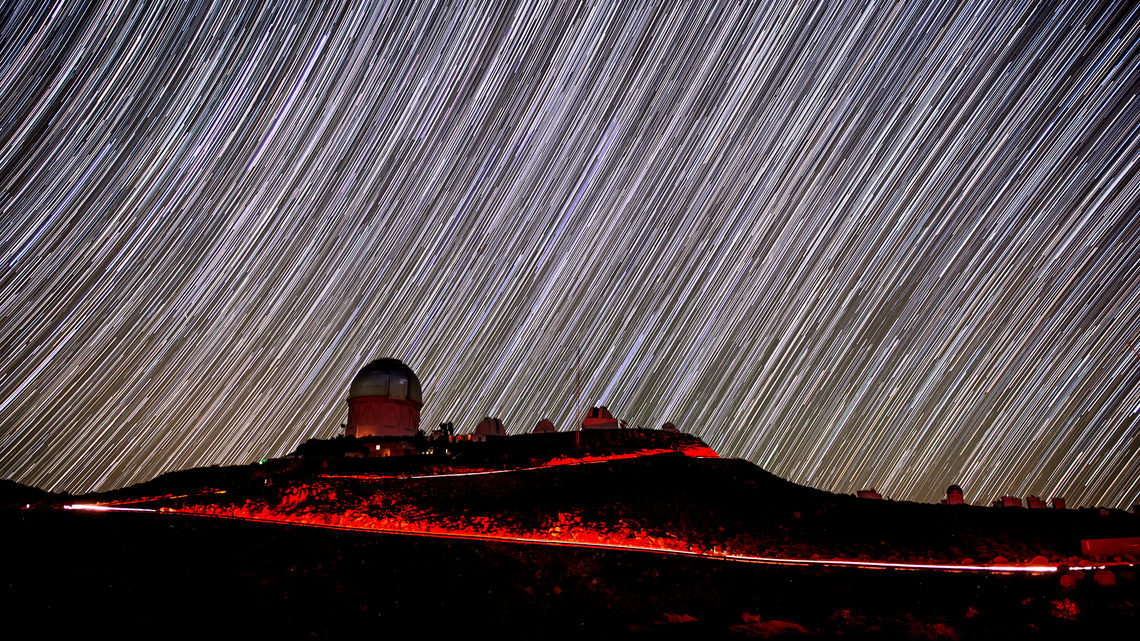
Road to the star trails, featuring the Blanco Telescope
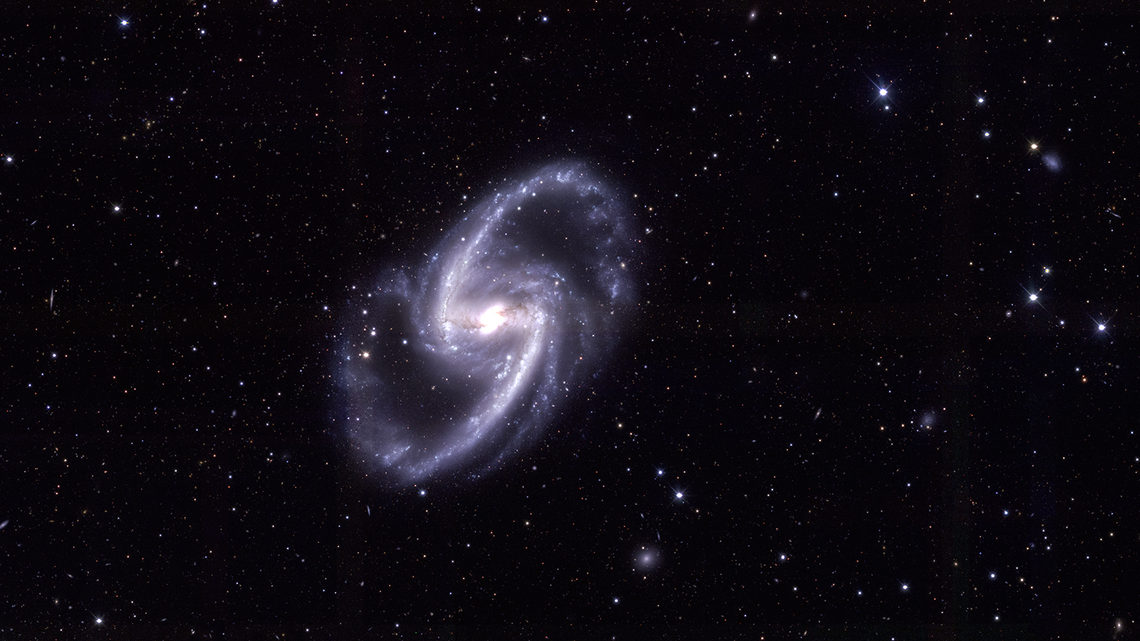
NGC-1365: Great Barred Spiral Galaxy
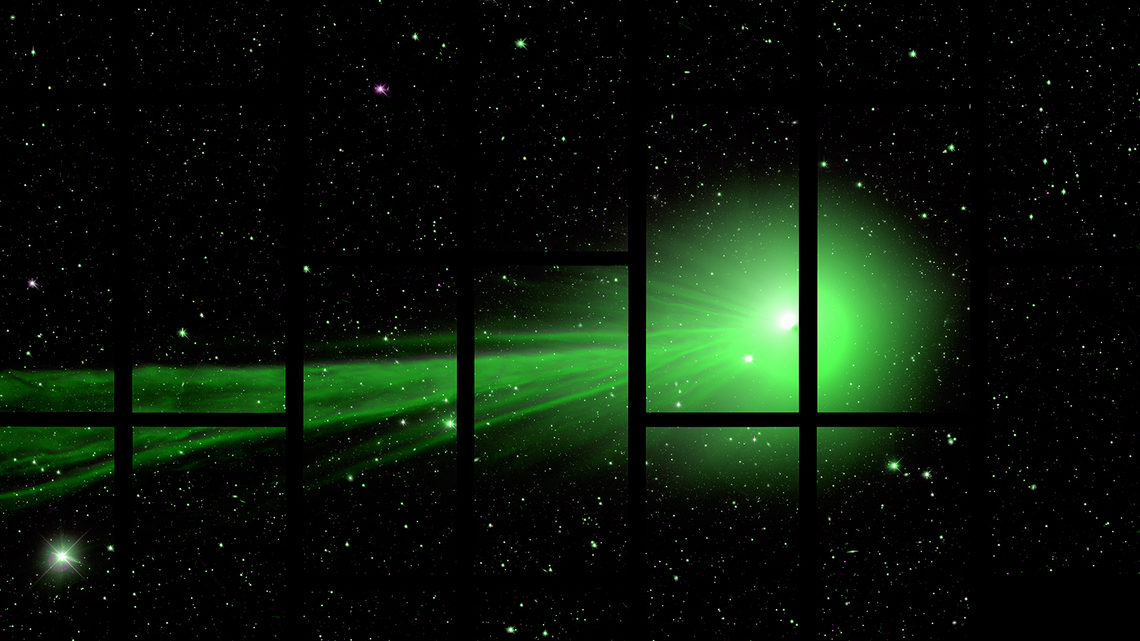
Comet Lovejoy
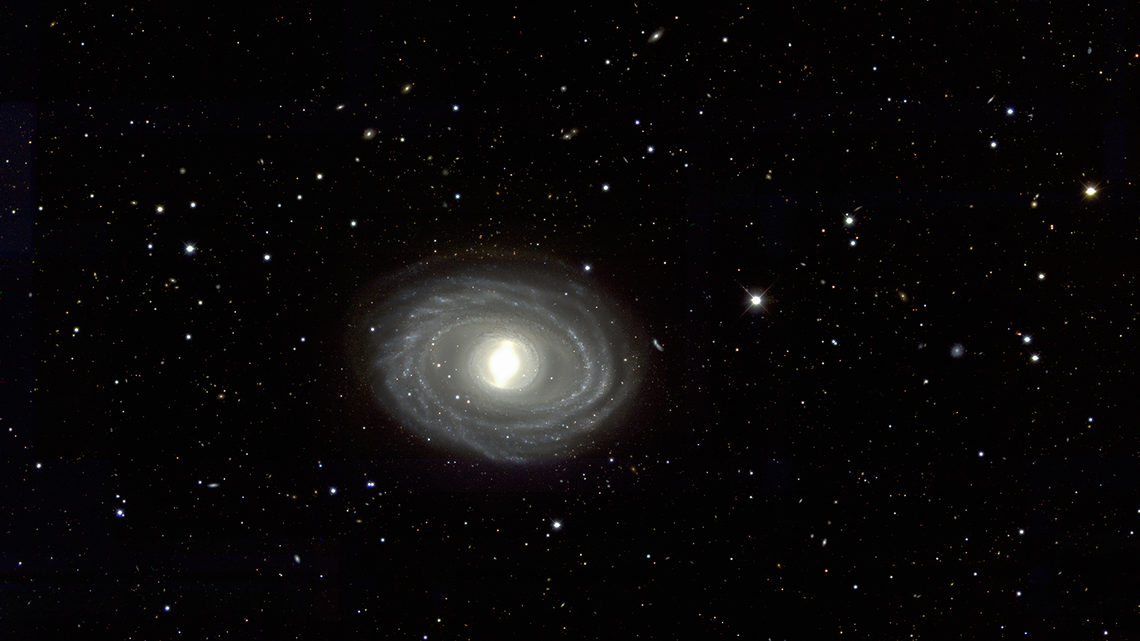
NGC-1398
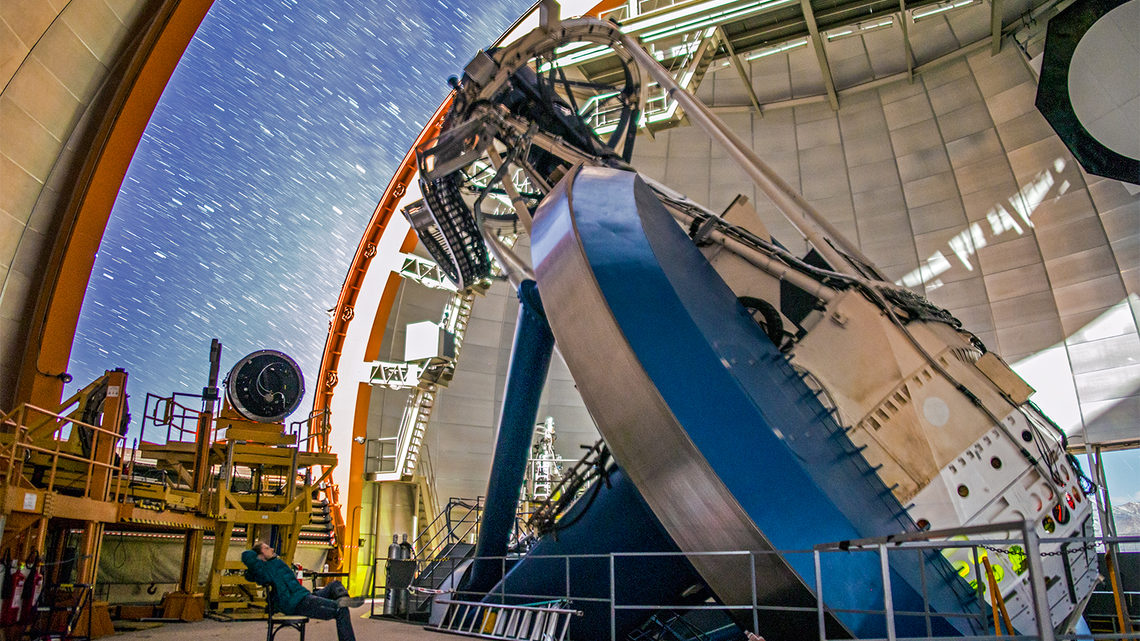
Watching the Dark Energy Camera in action
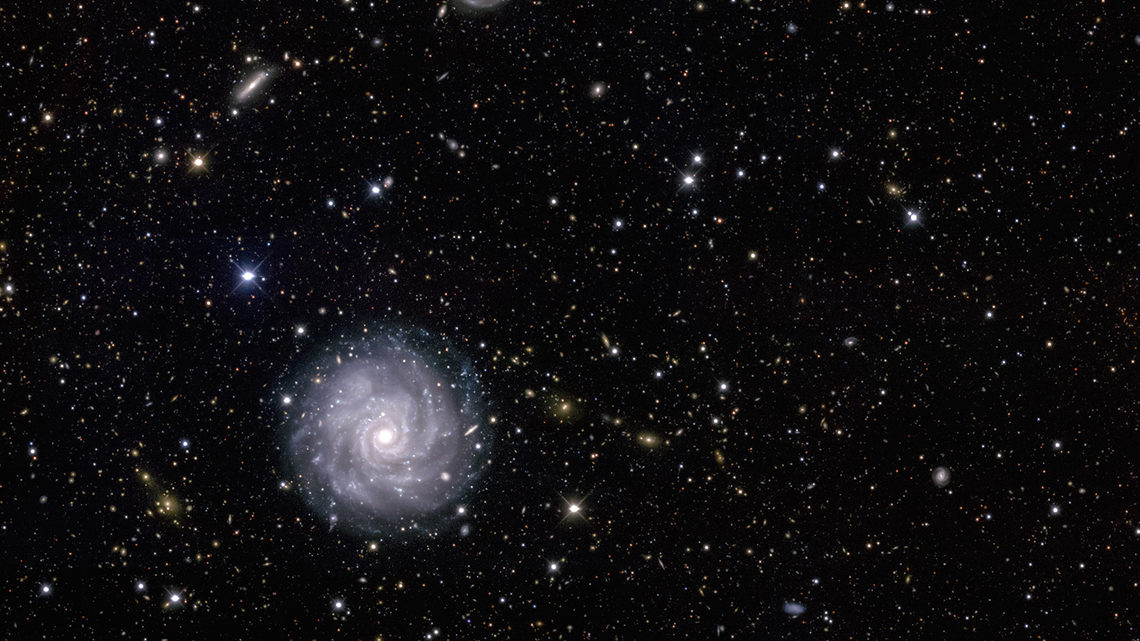
NGC-1703
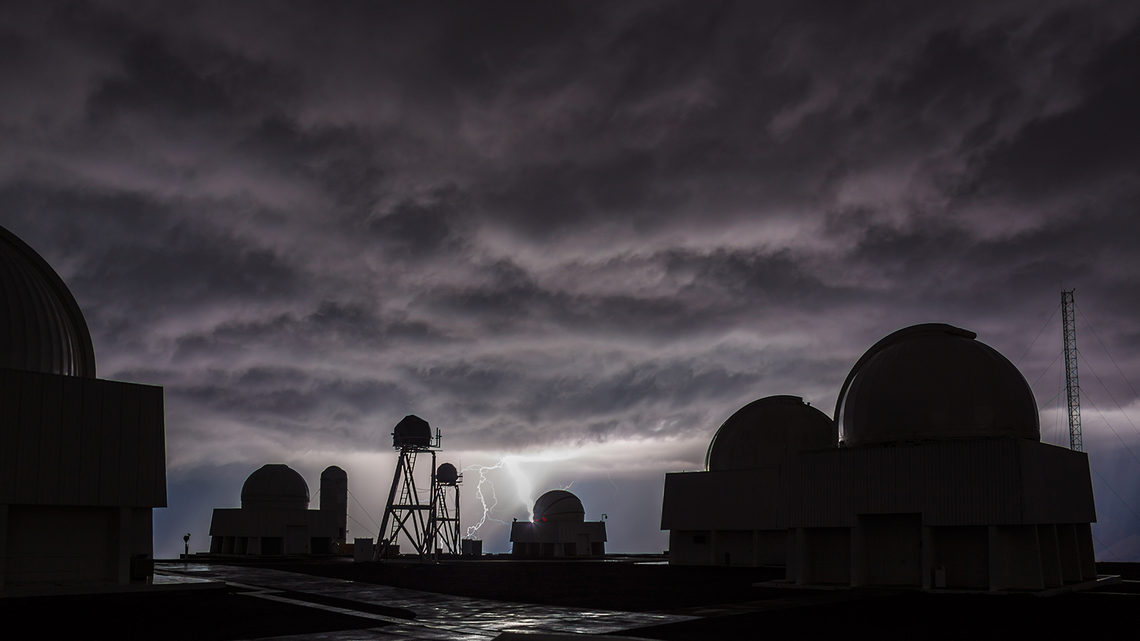
Lightning at the Cerro Tololo summit
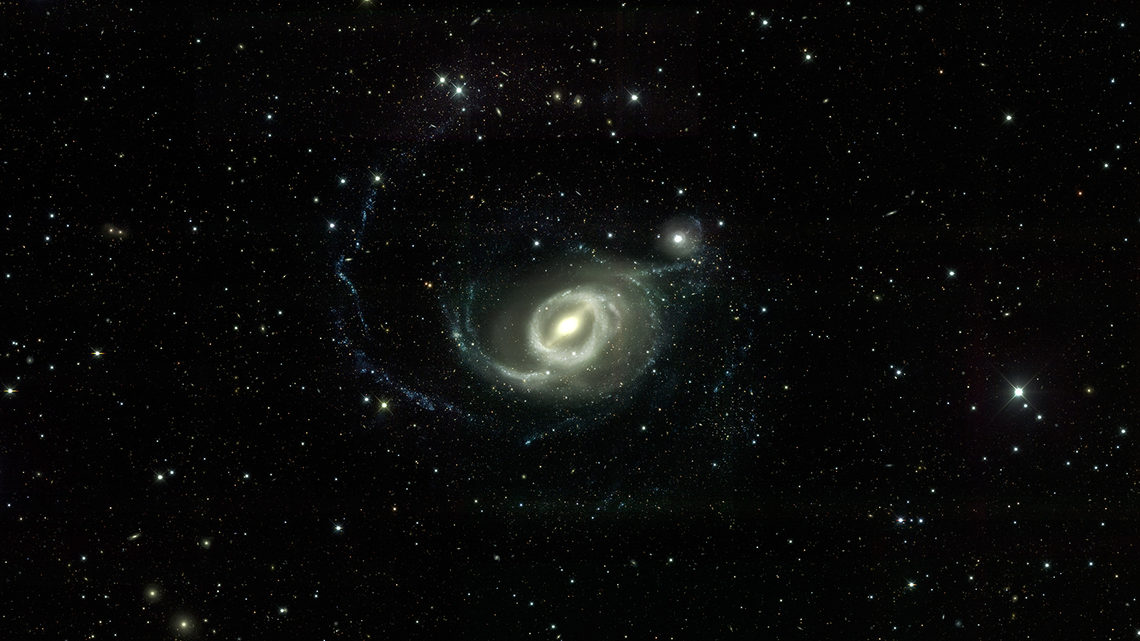
NGC-1512
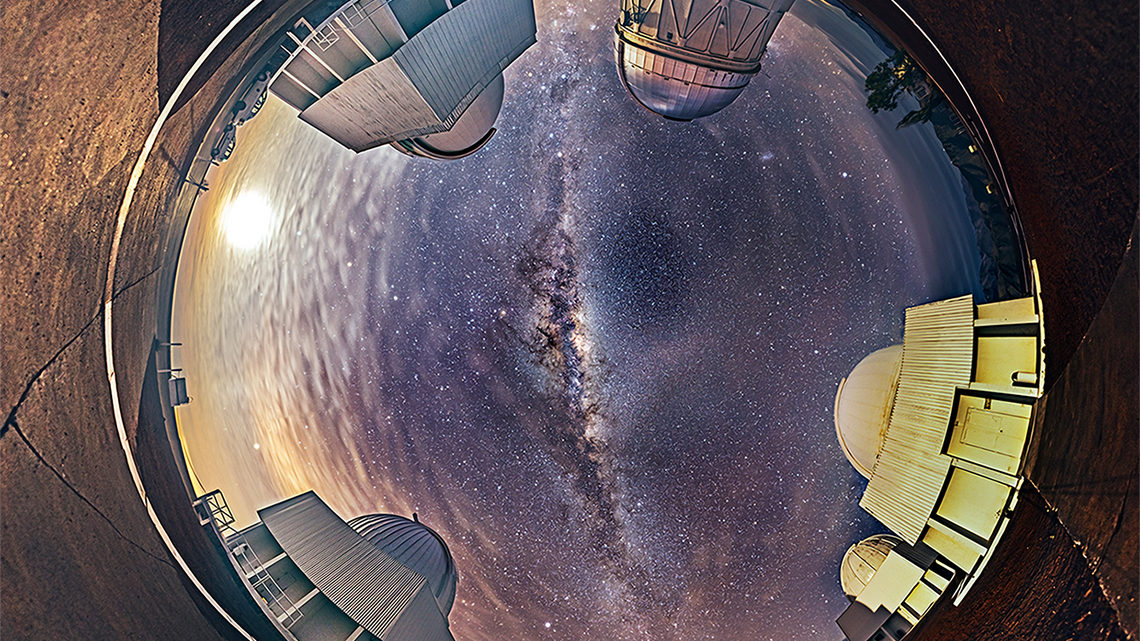
Tiny universe
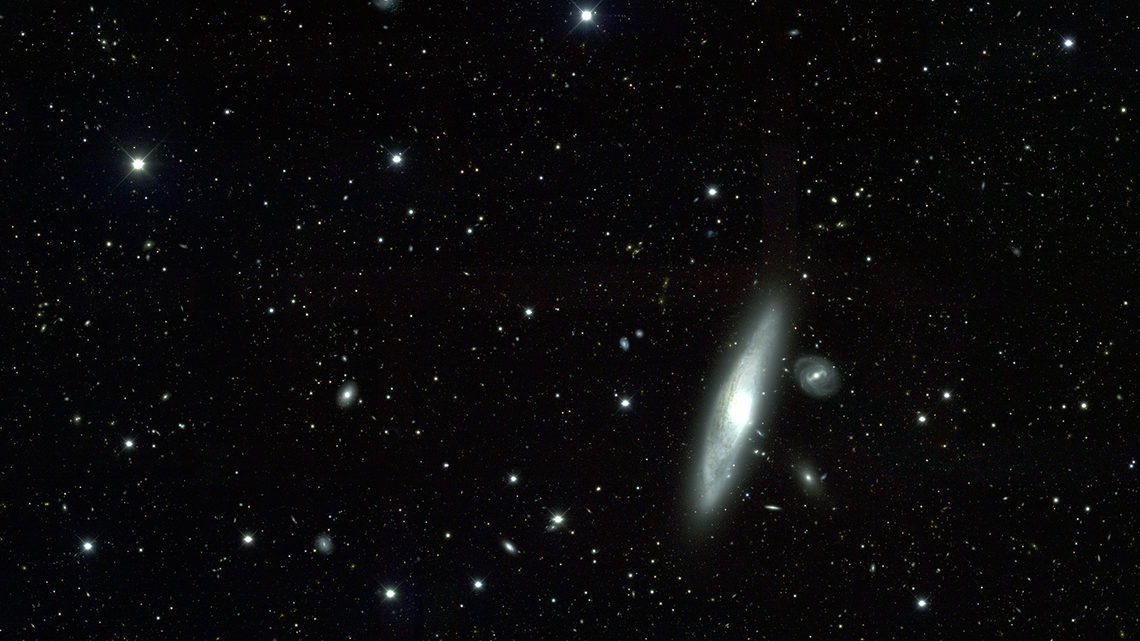
NGC-1515
DECam is a monochromatic camera. Part of the exhibit process required Marty Murphy, an operations specialist in Fermilab’s Accelerator Division, and Nord to add color and further edit the images with an artistic eye.
Five different filters are individually placed between the telescope and camera to gather color information about the galaxy in view. Each filter corresponds to a different bandwidth, or a range of frequencies, on the electromagnetic spectrum. Those single-filter images are then combined to produce a full-color photo.
“A lot of the information in the initial pictures is lost because lots of light emits from the invisible ends of the electromagnetic spectrum,” Murphy says. “We try to bring out colors from the visible spectrum that somewhat represent what’s there and fix any discrepancies between reality and the artwork.”
This close-to-reality representation also helps scientists understand the properties of the galaxies in view. For instance, small clusters that appear red or warmer in color tell us that they are further away from us due to the expansion of the universe, says Brian Yanny, a DES data management project scientist.
“From that we can figure out how big space is and how dark energy might be affecting the size of the universe from the redshift of the object,” he says.
But the art gallery is made of more than just galaxy images. There’s a 3D print of the cosmic web derived from a computer simulation. There’s also a colorful dark matter map of the actual cosmic web that DES observes made using gravitational lensing, a distortion seen when light from background galaxies bends from a massive foreground object.
“Once you know the explanations behind the workings of the cosmos, you realize there are forces out there that make the universe beautiful,” Yanny says. “We’ve come to understand that dark matter holds the shape of spiral galaxies, which have a rapid and unstable spin. Without dark matter, we would not experience the cosmos the way we do now.”
Alongside the DECam photos are images and time-lapse videos from the Blanco Telescope and the surrounding landscapes that provide another perspective of how the very act of research helps bring out the beauty of the universe. The images (on display at Fermilab through April) come from 11 DES collaborators and were collected over the first three seasons of observations, which ended in February. DES will take data for two more years, from August to February.
“I hope the images from the camera combined with the pictures from the site can somehow merge two perspectives,” Nord says. “In essence, it’s humans looking out to the cosmos and the universe looking back at us.”
SuperKEKB reborn
The Japanese accelerator takes its first steps toward resuming its hunt for the universe’s missing antimatter.
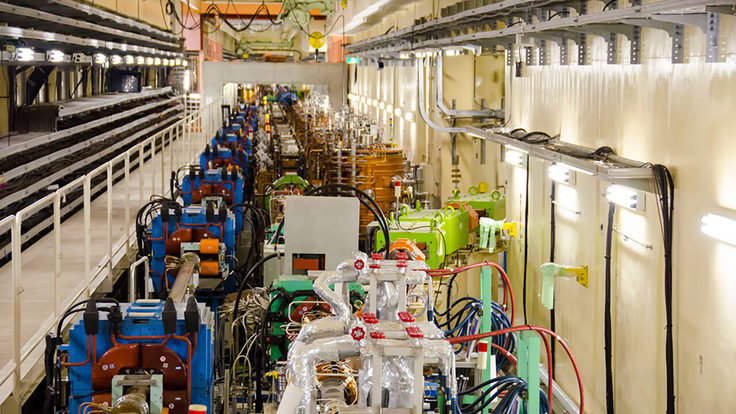
Everyone knows the electron, but in our daily routines of charging laptops and phones, we don’t often think of its antiparticle, the positron. Where has all the antimatter gone, in the long time passing since the dawn of the universe?
That’s what scientists working on Japan’s electron-positron colliding accelerator, SuperKEKB, hope to find out. They’ll accelerate electrons and their antimatter brothers close to the speed of light before slamming them together. By peering into the debris and searching for rare particle decays, they’ll try to figure out why we live in a world full of matter.
Japan’s high-energy accelerator research organization, known as KEK, announced today that scientists successfully accelerated and stored electrons and positrons in their separate rings, each nearly 2 miles around. This is the first in several steps to commission the accelerator after a five-year upgrade that included new beam pipes, new magnets (and magnet power supplies) to guide the beam, and a reinforced radio-frequency system that accelerates the particles. Technicians also added a new positron source for the antimatter particles and a new electron gun.
The improvements should create many more collisions per second than the previous iteration of the accelerator, KEKB, was capable of–and that means a better chance of seeing interesting particle decays. The collisions will create pairs of bottom quarks and bottom antiquarks, hence the “B” in SuperKEKB.
The project will also involve an upgraded version of the Belle detector that previously recorded the collisions. The initial run of the Belle detector yielded some interesting results, including a difference in the way particles called B mesons decayed. The asymmetry, called CP violation, was an intriguing find.
“This is still puzzling,” KEK Director-General Masanori Yamauchi said in a Symmetry interview last year. “We still don’t know how it happens. We need at least 10 times more data to find out. That’s why we started the upgrade of KEKB.”
The rare decays that Belle II will try to capture might also have occurred early in our universe’s history. Replicating them could provide clues to the current matter-antimatter imbalance and help us better understand the physics that underlies our cosmos, which can’t be fully explained by the current Standard Model.
Before that can happen, researchers need to tune the accelerator so it operates perfectly, a process slated to take through June. They’ll also add powerful superconducting magnets that will focus the beam and install the Belle II detector. Once it is in place and working properly, they’ll get back to work on the case of the missing antimatter.
The hidden neutrino
The explanation for some strange experimental results could lie in undiscovered particles called sterile neutrinos.

When physicists finally detected the Higgs boson in 2012, they validated a theoretical prediction made some 50 years earlier. But not every particle that physicists are searching for has such a history. Several experiments are on the hunt for a particle that theory never demanded—but that could wind up answering several open questions in particle physics.
Known as a sterile neutrino, the particle is an even sneakier version of the ghostly neutrino. Neutrinos stream through other matter almost completely unnoticed; about 100 trillion of them pass through your body every second, though only a few will interact in your body over your entire lifetime.
According to the Standard Model of particle physics, neutrinos were originally thought to have no mass. But in 1998, physicists found clear evidence that the three known types of neutrinos—electron, muon and tau—can oscillate, or change, among each other, which is possible only if the particles have mass. (This discovery earned them the 2015 Nobel Prize for Physics.)
The discovery of neutrino mass opened up another possibility: a right-handed neutrino. In particle physics, handedness is a quality that emerges from a particle’s mass and spin. As massless particles, neutrinos wouldn’t be able to change their handedness—but with mass, they can.
Until now, scientists have only observed left-handed neutrinos, but the right-handed version might be lurking out of sight. And while left-handed neutrinos interact in two ways (through gravity and the weak force), right-handed neutrinos are even trickier, interacting perhaps only through gravity.
“Sterile neutrinos were always out there as an idea, but we didn’t have to worry about it because we didn’t even know neutrinos had mass. So we just ignored them,” says Richard Van de Water, a physicist with the US Department of Energy’s Los Alamos National Laboratory. “We now say neutrinos have mass. That means there can be this right-handed, sterile neutrino.”

One in a trillion
Experimentalists found the first hint of the existence of sterile neutrinos two decades ago. If there are three neutrino states, as described in the Standard Model, then there are three different kinds of oscillations that can be measured. Any two measurements should allow scientists to predict the third.
By the early 2000s, physicists thought they had two figured out. They had hoped to confirm the last measurement with experiments run at Los Alamos’ Liquid Scintillator Neutrino Detector. But in 1995, LSND had picked up excess neutrino oscillations where theory predicted there should be none.
“The fact that they saw something says that you can’t put all these different measurements together in a coherent neutrino picture that has only three neutrinos,” says Matt Toups, a neutrino physicist at DOE’s Fermi National Accelerator Laboratory. “That’s why people now talk about sterile neutrinos.”
LSND’s results were so surprising that physicists built a new detector at Fermilab to check their findings. Dubbed MiniBooNE—BooNE stands for Booster Neutrino Experiment—the detector picked up an excess of electron neutrinos in 2006 that conflicted with LSND’s results but still indicates the possibility of sterile neutrinos. (Later runs were more consistent with LSND.)
To further probe these excesses, physicists need to look at interactions in multiple detectors set at different distances from the neutrino source, such as the liquid-argon detectors in Fermilab’s Short-Baseline Neutrino Program. MicroBooNE, the first of three short-baseline detectors to be installed, saw its first neutrino interactions in November.
Even with these new detectors, finding definitive evidence of the existence of sterile neutrinos will be a challenge. The “sterile” in their name comes from their inability to interact with other matter through any of the forces in the Standard Model other than perhaps gravity. That means they can be observed only through their oscillations into active neutrinos, which are themselves incredibly difficult to detect. At LSND, fewer than one in 1 trillion neutrinos will interact with another particle, leaving a footprint for scientists to measure.
“Just detecting neutrinos is difficult,” Van de Water says. “By extension, that makes interpreting the effects of sterile neutrinos on neutrino oscillations difficult.”

An unexpected guest
Because theorists had so long predicted the existence of the Higgs boson, discovering that it didn’t exist would have rewritten the path of particle physics. That’s not the case with sterile neutrinos, which would be a much more unexpected discovery.
“There are all these models that exist out there that tell us we’re not supposed to find any sterile neutrinos,” says André de Gouvêa, a theoretical physicist at Northwestern University. “If you don’t see one, the world doesn’t change.”
Still, the search for these odd particles is gaining momentum, in part because of the many unanswered questions to which sterile neutrinos could be linked. It’s possible they hold the explanation for the source of neutrino mass, one of the biggest puzzles in particle physics today. They could be important in cosmology, lending new insights into the formation of the early universe. And some physicists think that sterile neutrinos could be the particles that make up dark matter, which, like sterile neutrinos, seems to be impervious to all known forces save gravity.
“We know there’s this whole 95 percent of the universe out there we don’t understand,” says Van de Water. “What better way to connect to that than through a particle that hardly interacts with the Standard Model itself? What better way to hide all that physics out there than through a sterile neutrino? It could potentially be a portal to the dark sector, and maybe this is what we’re starting to find.”
No matter what they are, their existence would be solid evidence of physics beyond the Standard Model, Van de Water says. Discovering them would require physicists to fit them into existing theories about the universe and would doubtless create many new questions for physicists to answer.
“It could be just a window into a whole new set of phenomena,” Toups says. “It really would throw open a whole line of research for the field that I think would be prolific for a number of years.”
Fermilab scientists discover new four-flavor particle
DZero announces the newest member of the tetraquark family.

Scientists on the DZero collaboration at the U.S. Department of Energy’s Fermilab have discovered a new particle—the latest member to be added to the exotic species of particle known as tetraquarks.
Quarks are point-like particles that typically come in packages of two or three, the most familiar of which are the proton and neutron (each is made of three quarks). There are six types, or “flavors,” of quark to choose from: up, down, strange, charm, bottom and top. Each of these also has an antimatter counterpart.
Over the last 60 years, scientists have observed hundreds of combinations of quark duos and trios.
In 2008 scientists on the Belle experiment in Japan reported the first evidence of quarks hanging out as a foursome, forming a tetraquark. Since then physicists have glimpsed a handful of different tetraquark candidates, including now the recent discovery by DZero—the first observed to contain four different quark flavors.
DZero is one of two experiments at Fermilab’s Tevatron collider. Although the Tevatron was retired in 2011, the experiments continue to analyze billions of previously recorded events from its collisions.
As is the case with many discoveries, the tetraquark observation came as a surprise when DZero scientists first saw hints in July 2015 of the new particle, called X(5568), named for its mass—5568 megaelectronvolts.
“At first, we didn’t believe it was a new particle,” says DZero co-spokesperson Dmitri Denisov. “Only after we performed multiple cross-checks did we start to believe that the signal we saw could not be explained by backgrounds or known processes, but was evidence of a new particle.”

And the X(5568) is not just any new tetraquark. While all other observed tetraquarks contain at least two of the same flavor, X(5568) has four different flavors: up, down, strange and bottom.
“The next question will be to understand how the four quarks are put together,” says DZero co-spokesperson Paul Grannis. “They could all be scrunched together in one tight ball, or they might be one pair of tightly bound quarks that revolves at some distance from the other pair.”
Four-quark states are rare, and although there’s nothing in nature that forbids the formation of a tetraquark, scientists don’t understand them nearly as well as they do two- and three-quark states.
This latest discovery comes on the heels of the first observation of a pentaquark—a five-quark particle—announced last year by the LHCb experiment at the Large Hadron Collider.
Scientists will sharpen their picture of the quark quartet by making measurements of properties such as the ways X(5568) decays or how much it spins on its axis. Like investigations of the tetraquarks that came before it, the studies of the X(5568) will provide another window into the workings of the strong force that holds these particles together.
And perhaps the emerging tetraquark species will become an established class in the future, showing themselves to be as numerous as their two- and three-quark siblings.
“The discovery of a unique member of the tetraquark family with four different quark flavors will help theorists develop models that will allow for a deeper understanding of these particles,” says Fermilab Director Nigel Lockyer.
Seventy-five institutions from 18 countries collaborated on this result from DZero.

Additional information about the result is available here.
The ABCs of particle physics
Take an interactive animated journey through the particle physics alphabet.

Accelerators and black holes and cryostats, oh my!
We know particle physics can seem daunting at times, but everything’s more fun to learn when it rhymes. So we’re breaking it down, letter by letter, with hopes that you’ll understand physics much better.
That’s right: Inspired by children’s books, we’ve pulled 26 of our favorite particle physics concepts into a short, rhyming collection for folks of all ages. You’ve heard “A is for apple,” but here at Symmetry, A is also for accelerator.
For those wanting a little bonus knowledge beyond the rhyme, we’ve included additional physics info for each letter. This interactive animated journey through the alphabet will lead you to minuscule particles, high-tech equipment, far-out phenomena and fascinating theories.
This interactive trip works best in Chrome and Firefox and at resolutions 1280 x 800 and higher. Ready?
Click to journey through the ABCs of particle physics!
Animations not working? Things running slowly? Click here instead for a non-animated version.
Prefer a hard copy? Print out a PDF.
A new X-ray eye in the sky
The recently launched Hitomi spacecraft will look for answers from the universe's violent phenomena.
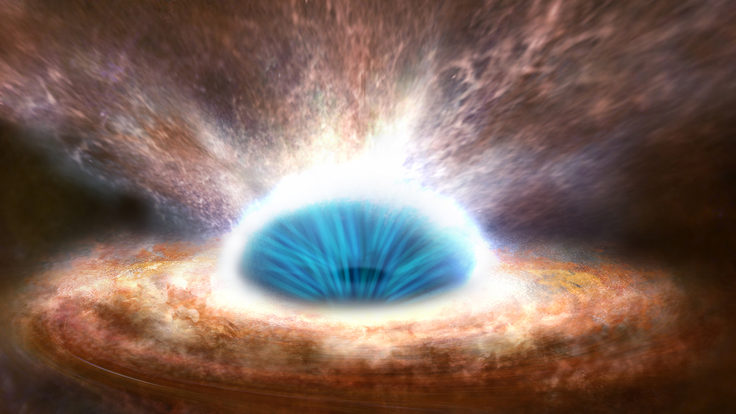
Although the star-covered night sky is regarded by many as a synonym of serenity, the cosmos is in fact a rather hostile place. It hosts many extreme environments that would instantaneously eradicate any life nearby. A new space mission is about to reveal this violent nature in greater detail than ever before: On Feb. 17, the Japan Aerospace Exploration Agency (JAXA) launched its ASTRO-H satellite, a very precise and sensitive eye for X-rays emerging from hot and energetic processes in space. After its successful lift-off, the spacecraft was renamed “Hitomi,” which means “pupil of the eye” in Japanese.
The observatory will collect the X-ray signals of countless cosmic objects from its orbit around the Earth, including hot gas in galaxy clusters, powerful particle streams spit out by black holes, and the remnants of supernova explosions with very dense, rapidly rotating neutron stars at their center. These data will provide new insights into many aspects of astrophysics and cosmology, such as the physics of black holes; the formation of chemical elements, stars and galaxies; and the evolution of the universe itself.
“The launch of Hitomi represents the beginning of a new era for X-ray observatories,” says Roger Blandford from the Kavli Institute for Particle Astrophysics and Cosmology (KIPAC), a joint institute of Stanford University and the Department of Energy’s SLAC National Accelerator Laboratory. “Its novel instruments will allow us to make new discoveries involving dark matter, dark energy, black holes and neutron stars.”
The X-ray satellite was developed by a large international collaboration, led by JAXA and with NASA as a principal partner. KIPAC researchers were involved in the prototyping of one of the observatory’s scientific instruments, the development of methods used for instrument calibration and the planning of the mission’s science program.
Watch the launch of the X-ray satellite ASTRO-H on board H-IIA Launch Vehicle No. 30 from the Tanegashima Space Center in Japan.
Seeing more of the universe with X-rays
X-rays are an energetic form of light. They are emitted by matter under extreme conditions, such as high temperature, strong gravity, fast rotation, violent collisions, tremendous explosions, strong magnetic fields and nuclear reactions. Observations of cosmic X-ray sources provide astrophysicists with the opportunity to identify and study these extreme environments.
X-rays also paint a different and complementary picture of the universe compared to other light. Visible light, for instance, is not powerful enough to shine through dense clouds of dust—seemingly impenetrable curtains for objects behind them. Energetic X-rays, on the other hand, can go right through these clouds and lift the curtain.
Moreover, X-rays can reveal the chemical composition of extreme states of matter because each chemical element leaves a unique fingerprint on the X-ray emission signal. Hitomi will detect these fingerprints with 30 times better resolution than any other X-ray observatory before.
“We’ll now be able to identify specific elements without any doubt, whereas in the past we couldn’t quite tell,” says KIPAC’s Grzegorz Madejski. But researchers will learn even more than that, he says. Hitomi’s superior energy resolution will also reveal tiny shifts in the energy of the X-ray signal —so-called Doppler shifts linked to the speed of the observed material.
Seeking answers to fundamental questions about the universe
Chemical composition and speed are key information for scientists who want to understand the history of our universe.
“We’ll be able to tell whether the motion of hot gas in galaxy clusters is steady or turbulent,” says KIPAC’s Steve Allen. “This motion is an important ingredient in our models of galaxy formation, which, in turn, impact our picture of cosmic evolution.”
Hitomi will also shine light on winds of hot gas in the vicinity of black holes. Astrophysicists believe that the elemental composition of gas might be different near the matter-devouring objects, and unearthing these variations could advance our understanding of how chemical elements have formed in the universe.
The new X-ray observatory’s outstanding energy resolution is also expected to help researchers decide whether or not an X-ray signal with an energy of approximately 3.5 kiloelectronvolts, which has been caught emanating from a number of galaxies and galaxy clusters, could reveal the nature of dark matter, an invisible form of matter that makes up 85 percent of all matter in the universe.
Instruments in orbit
Many of these research capabilities are associated with Hitomi’s Soft X-ray Spectrometer (SXS), which is at the heart of the observatory’s unsurpassed energy resolution and will analyze the energies of X-ray emissions in greater detail than ever before.
SXS is joined by three other instruments: the Soft X-ray Imager (SXI) and Hard X-ray Imager (HXI), which will photograph sources that emit X-rays of low and high energy, respectively, as well as the Soft Gamma-ray Detector (SGD), which will observe light of even higher energies.
“The SGD instrument has a very novel design and will allow us for the first time to measure the polarization of X-ray emissions,” says KIPAC’s Hirokazu Odaka. “This property will tell us more about the shape of the X-ray sources and their magnetic fields.”
A number of KIPAC researchers were involved in developing the SGD instrument and its read-out electronics. Together with SLAC’s Makoto Asai, who leads the lab’s team for Geant4, a toolkit for the simulation of particles passing through matter, they also carefully modeled SGD’s sensitivity and background signals—an important step toward calibrating the instrument for precise X-ray measurements.
Scientists around the world are now getting ready to use Hitomi, which is scheduled to operate for at least three years. Following an initial operation and calibration period of three months, the Hitomi science working group, including KIPAC scientists, will begin first observations. After six months, the observatory will be open to all scientists, and observation time will be based on submitted research proposals.

This illustration shows the locations and energy ranges of ASTRO-H (now Hitomi) science instruments and their associated telescopes. One kiloelectronvolt (keV) is hundreds of times the energy of visible light.
A version of this article appeared in SLAC's News Center.

 Frascati Scienza
 Buco Nero
 Io Non Faccio Niente
 Tommaso Dorigo
 Giovanni Mazzitelli
 Barbara Gallavotti
 Keplero Blog
 Research Gate