
Following LIGO’s treasure maps
Astronomers around the world are looking for visible sources of gravitational waves.

On the morning of September 16, 2015, an email appeared in 63 inboxes scattered around the globe. The message contained a map of the cosmos and some instructions, and everyone who received it knew the most important thing was to keep it secret.
It wasn’t until five months later that the world found out what the owners of those inboxes knew: that two days earlier, on September 14, the Laser Interferometer Gravitational-Wave Observatory (LIGO) detected gravitational waves for the first time. That secret was shared with 63 astronomy collaborations, and it sparked the start of a worldwide treasure hunt. Astronomers searched the skies for rare and faint objects that might be the source of the detected ripples in space-time.
Searching for the optical counterparts to those waves is a crucial step after the initial detection. The additional information can provide interesting scientific results for both gravitational-wave scientists and astronomers. Gravitational waves may be caused by several different phenomena such as neutron stars colliding or, in the case of the first signal, a pair of black holes merging. Studying these objects can be its own reward for astronomers, so they prepare for months or even years to drop everything at a moment’s notice to follow up signals whenever they appear.
But in September, the email from LIGO took most of those astronomers by surprise. In fact, according to LIGO collaboration member Daniel Holz of the University of Chicago, the clear, crisp signal caught just about everyone off guard. Advanced LIGO, the most recent upgrade that had quadrupled their sensitivity, had just begun its engineering run—they had barely turned the machine on when they hit pay dirt.
“It was insane, incredible,” Holz says. “We all worked very hard, and to have what you hope for and dream about land in your lap so fast, so early and so emphatically was like my wildest dreams coming true.”
The signal was detected loud and clear at 4:50 a.m. Chicago time, so Holz was able to see it when he checked email at 7 a.m. His initial thought was that it might have been a mistake, but by the time he’d bicycled to work and had his morning tea, many of the obvious ways the signal could have been an error had been eliminated. By the end of that day, it was likely that the LIGO team had the real thing on their hands.
“We were prepared to do a lot of analysis, and that work can take months,” Holz says. “But this case was so emphatic that within hours we were quite confident that we had something incredibly interesting.”
The collaboration still analyzed the signal for two days before sending it out to astronomy teams. Marica Branchesi, an astronomer who has been part of LIGO and its sister experiment Virgo since 2009, was part of the small group that sent the September 16 email. She says extra care was taken with this first signal.
“Because it was the first candidate, we took the time to do more analysis and be sure it was an event,” she says. “This is something we had dreamed of for a long time.”
While LIGO’s extraordinary sensitivity allows it to detect gravitational waves, which result from warped space-time, pinpointing the source of those waves is another matter. LIGO uses a pair of massive laser interferometers, one located in Washington state, the other in Louisiana. With two detectors, LIGO can figure out which direction the waves are coming from, but a third detector (the Advanced VIRGO detector, located in Italy and coming online later this year) will enable them to triangulate the signal.
What Branchesi and the LIGO/Virgo team sent to astronomers on September 16 was a sky map that covered 600 square degrees, an area 6000 times larger than the full moon, with probabilities assigned to pixels.
“The region of sky is huge,” Branchesi says. “It’s a challenge to cover. With such a large region, you can find many objects that look like they might be the counterpart, but aren’t.”

The LIGO team also did not know at the time what we know now—that this particular gravitational wave was caused by a pair of black holes, which are unlikely to be visible with telescopes (though the Fermi Gamma-ray Space Telescope did pick up a burst of gamma rays in the same area). But Marcelle Soares-Santos, an astrophysicist who works on the Dark Energy Survey at the US Department of Energy’s Fermilab, says she would have followed up on the LIGO email regardless.
“There may be something,” she says, “but we don’t know unless we look. We don’t expect a pair of black holes to be visible, but if the area near the black holes is full of matter, maybe we can detect that.”
Soares-Santos is part of a roughly 25-member team within the Dark Energy Survey called DES-GW, dedicated to following up signals from LIGO. The effort began in 2013, when LIGO put out an open invitation to astronomers to search for optical counterparts.
“It seemed like a challenging thing to do, to find a transient object in a huge area of sky,” she says. “But then I realized that the Dark Energy Camera is a perfect tool for a discovery like this.”
That camera, the main instrument of the survey, has several advantages, Soares-Santos says: It has a wide field of view, it’s on a large telescope (the 4-meter Blanco telescope at the Cerro Tololo Inter-American Observatory in Chile), and it has a particular sensitivity to the red end of the spectrum, which helps astronomers chase down the faint objects they’re looking for.
DES-GW has an agreement with the main Dark Energy Survey: If a signal from LIGO comes in, astronomers drop everything and use the camera to chase it. That’s because the objects that are likeliest to be found are neutron stars, the smallest and densest types of stars known to exist. They are thought to form when a massive star collapses, creating a supernova, and they fade quickly, rapidly rendering them undetectable.
When two neutron stars are formed side by side, the theory goes, these stars create detectable gravitational waves. Spotting two neutron stars (or a neutron star paired with a black hole) would be like finding buried treasure. And it would be just as difficult, according to Stephen Smartt of the Panoramic Survey Telescope and Rapid Response System (Pan-STARRS) collaboration, which also followed up this first signal.
“The sky maps we receive are 500 to 1000 square degrees, which is a big chunk of sky,” he says. “Only a small number of facilities are able to map out that area to faint limits.”
Most of the teams working on these optical follow-ups expect the counterparts to be faint, Smartt says, because if they were bright and common, then the currently running surveys would probably have spotted them already.
“They could have already been discovered and we haven’t recognized them,” he says, “but most astronomers think that is unlikely.”
Essentially, Smartt says, astronomers are looking for something bright, fleeting and newly formed—something that hasn’t shown up on previous sweeps of the survey area. Soares-Santos notes that astronomers are essentially looking for an object like a supernova, but fainter, redder and decaying faster.
“A supernova lasts about a month,” she says. “These last about 10 days. That’s why we want to be quick.”
The initial sky map sent to astronomers showed two areas of high probability, one in the northern part of the region and one in the southern part. Pan-STARRS, based in Hawaii, concentrated on the northern one, finding roughly 60 transient objects and analyzing them. They discovered nothing unusual and, as more analysis was done on LIGO’s end, learned that they were looking in an area less likely to be the source. But Smartt’s very happy to keep following up these signals.
“It was an amazing discovery,” he says. “These follow-ups are a high-risk project, and we don’t know if we will hit gold or find nothing.”
But finding the sought-for objects would open up doors to new science, from probing the origin of heavy elements to high-energy physics and even constraining theories of modified gravity.
“The payoff is so great, it’s worth pursuing,” he says.
DES scanned the southern area and similarly found nothing unusual. More detailed maps were provided later, showing that they too were off the mark somewhat, but as the system improves, this should be less of an issue. And there will be plenty of opportunity to put it through its paces in the future.
“At first [DES-GW] was seen as high-risk,” Soares-Santos says. “Now the perception is that there is still a risk involved, but there will not be a lack of events. Everybody is very happy we did this.”
And the results of following these signals will be beneficial to astronomy as well. DES scientists will learn more about objects they rarely observe, like binary neutron stars, but they could also potentially use that information to aid in their main mission to learn more about dark energy. Soares-Santos explained that they could use neutron stars the same way they are using supernovae now, to study how the universe has expanded over time.
“In principle, if the rates are as high as we think they could be, we could have another probe for DES,” she says.
Branchesi agreed that the system, though currently working well, will improve. In particular, the LIGO/Virgo team wants to get the alerts to astronomers sent out no more than a few minutes after gravitational waves are detected. And with the Advanced VIRGO detector coming online soon, the probability maps will get much more exact.
But she says she was happy with how well such a vast and diverse group of physicists and astronomers worked together not only to detect gravitational waves for the first time, but also to follow up that detection with solid observation. That, she says, will only get better as well.
“There’s a lot of us, and it’s important that we work together,” she says.
LIGO is still holding an open call for astronomy collaborations that would like to look for optical counterparts to gravitational wave signals. It’s a chance, Holz says, to be part of something that has captivated the world.
“Our community is very excited, the broader scientific community is excited and the public is excited,” he says. “It’s similar to the Higgs discovery, but different, because it’s opening up an entirely new window. It’s enabling the first step in a whole new way to probe the universe, and the excitement is about where we're headed. It’s revolutionary.”
EXO-200 resumes its underground quest
The upgraded experiment aims to discover if neutrinos are their own antiparticles.
Science is often about serendipity: being open to new results, looking for the unexpected.
The dark side of serendipity is sheer bad luck, which is what put the Enriched Xenon Observatory experiment, or EXO-200, on hiatus for almost two years.
Accidents at the Department of Energy’s underground Waste Isolation Pilot Project (WIPP) facility near Carlsbad, New Mexico, kept researchers from continuing their search for signs of neutrinos and their antimatter pairs. Designed as storage for nuclear waste, the site had both a fire and a release of radiation in early 2014 in a distant part of the facility from where the experiment is housed. No one at the site was injured. Nonetheless, the accidents, and the subsequent efforts of repair and remediation, resulted in a nearly two-year suspension of the EXO-200 effort.
Things are looking up now, though: Repairs to the affected area of the site are complete, new safety measures are in place, and scientists are back at work in their separate area of the site, where the experiment is once again collecting data. That’s good news, since EXO-200 is one of a handful of projects looking to answer a fundamental question in particle physics: Are neutrinos and antineutrinos the same thing?
The neutrino that wasn't there
Each type of particle has its own nemesis: its antimatter partner. Electrons have positrons—which have the same mass but opposite electric charge—quarks have antiquarks and protons have antiprotons. When a particle meets its antimatter version, the result is often mutual annihilation. Neutrinos may also have antimatter counterparts, known as antineutrinos. However, unlike electrons and quarks, neutrinos are electrically neutral, so antineutrinos look a lot like neutrinos in many circumstances.
In fact, one hypothesis is that they are one and the same. To test this, EXO-200 uses 110 kilograms of liquid xenon (of its 200kg total) as both a particle source and particle detector. The experiment hinges on a process called double beta decay, in which an isotope of xenon has two simultaneous decays, spitting out two electrons and two antineutrinos. (“Beta particle” is a nuclear physics term for electrons and positrons.)
If neutrinos and antineutrinos are the same thing, sometimes the result will be neutrinoless double beta decay. In that case, the antineutrino from one decay is absorbed by the second decay, canceling out what would normally be another antineutrino emission. The challenge is to determine if neutrinos are there or not, without being able to detect them directly.
“Neutrinoless double beta decay is kind of a nuclear physics trick to answer a particle physics problem,” says Michelle Dolinski, one of the spokespeople for EXO-200 and a physicist at Drexel University. It’s not an easy experiment to do.
EXO-200 and similar experiments look for indirect signs of neutrinoless double beta decay. Most of the xenon atoms in EXO-200 are a special isotope containing 82 neutrons, four more than the most common version found in nature. The isotope decays by emitting two electrons, changing the atom from xenon into barium. Detectors in the EXO-200 experiment collect the electrons and measure the light produced when the beta particles are stopped in the xenon. These measurements together are what determine whether double beta decay happened, and whether the decay was likely to be neutrinoless.
EXO-200 isn’t the only neutrinoless double beta decay experiment, but many of the others use solid detectors instead of liquid xenon. Dolinski got her start on the CUORE experiment, a large solid-state detector, but later changed directions in her research.
“I joined EXO-200 as a postdoc in 2008 because I thought that the large liquid detectors were a more scalable solution,” she says. "If you want a more sensitive liquid-state experiment, you can build a bigger tank and fill it with more xenon.”
Neutrinoless or not, double beta decay is very rare. A given xenon atom decays randomly, with an average lifetime of a quadrillion times the age of the universe. However, if you use a sufficient number of atoms, a few of them will decay while your experiment is running.
“We need to sample enough nuclei so that you would detect these putative decays before the researcher retires,” says Martin Breidenbach, one of the EXO-200 project leaders and a physicist at the Department of Energy’s SLAC National Accelerator Laboratory.
But the experiment is not just detecting neutrinoless events. Heavier neutrinos mean more frequent decays, so measuring the rate reveals the neutrino mass — something very hard to measure otherwise.
Prior runs of EXO-200 and other experiments failed to see neutrinoless double beta decay, so either neutrinos and antineutrinos aren’t the same particle after all, or the neutrino mass is small enough to make decays too rare to be seen during the experiment’s lifetime. The current limit for the neutrino mass is less than 0.38 electronvolts—for comparison, electrons are about 500,000 electronvolts in mass.

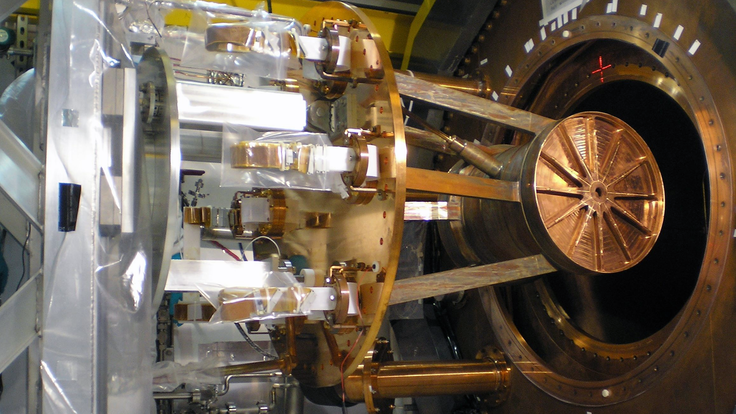
SLAC National Accelerator Laboratory's Jon Davis checks the enriched xenon storage bottles before the refilling of the TPC.
Working in the salt mines
Cindy Lin is a Drexel University graduate student who spends part of her time working on the EXO-200 detector at the mine. Getting to work is fairly involved.
“In the morning we take the cage elevator half a mile down to the mine,” she says. Additionally, she and the other workers at WIPP have to take a 40-hour safety training to ensure their wellbeing, and wear protective gear in addition to normal lab clothes.
“As part of the effort to minimize salt dust particles in our cleanroom, EXO-200 scientists also cover our hair and wear coveralls,” Lin adds.
The sheer amount of earth over the detector shields it from electrons and other charged particles from space, which would make it too hard to spot the signal from double beta decay. WIPP is carved out of a sodium chloride deposit—the same stuff as table salt—that has very little uranium or the other radioactive minerals you find in solid rock caverns. But it has its drawbacks, too.
“Salt is very dynamic: It moves at the level of centimeters a year, so you can't build a nice concrete structure,” says Breidenbach. To compensate, the EXO-200 team has opted for a more modular design.
The inadvertent shutdown provided extra challenges. EXO-200, like most experiments, isn’t well suited for being neglected for more than a few days at a time. However, Lin and other researchers worked hard to get the equipment running for new data this year, and the downtime also allowed researchers to install some upgraded equipment.
The next phase of the experiment, nEXO, is at a conceptual stage based on what has been learned from EXO200. Experimenters are considering the benefits of moving the project deeper underground, perhaps at a facility like the Sudbury Neutrino Observatory (SNOlab) in Canada. Dolinski is optimistic that if there are any neutrinoless double beta decays to see, nEXO or similar experiments should see them in the next 15 years or so.
Then, maybe we’ll know if neutrinos and antineutrinos are the same and find out more about these weird low-mass particles.
A GUT feeling about physics
Scientists want to connect the fundamental forces of nature in one Grand Unified Theory.
The 1970s were a heady time in particle physics. New accelerators in the United States and Europe turned up unexpected particles that theorists tried to explain, and theorists in turn predicted new particles for experiments to hunt. The result was the Standard Model of particles and interactions, a theory that is essentially a catalog of the fundamental bits of matter and the forces governing them.
While that Standard Model is a very good description of the subatomic world, some important aspects—such as particle masses—come out of experiments rather than theory.
“If you write down the Standard Model, quite frankly it's a mess,” says John Ellis, a particle physicist at King’s College London. “You've got a whole bunch of parameters, and they all look arbitrary. You can't convince me that's the final theory!”
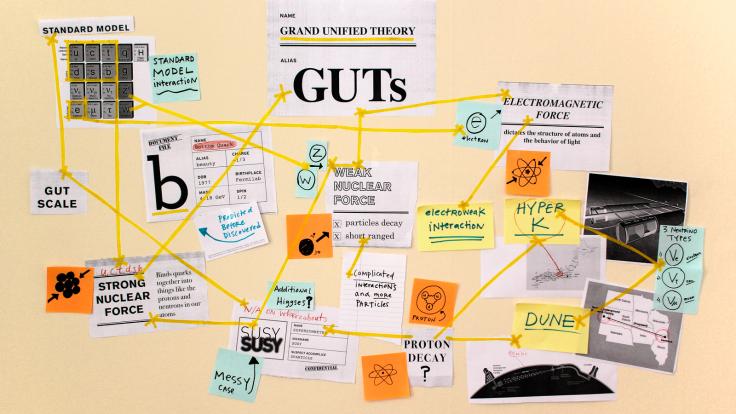
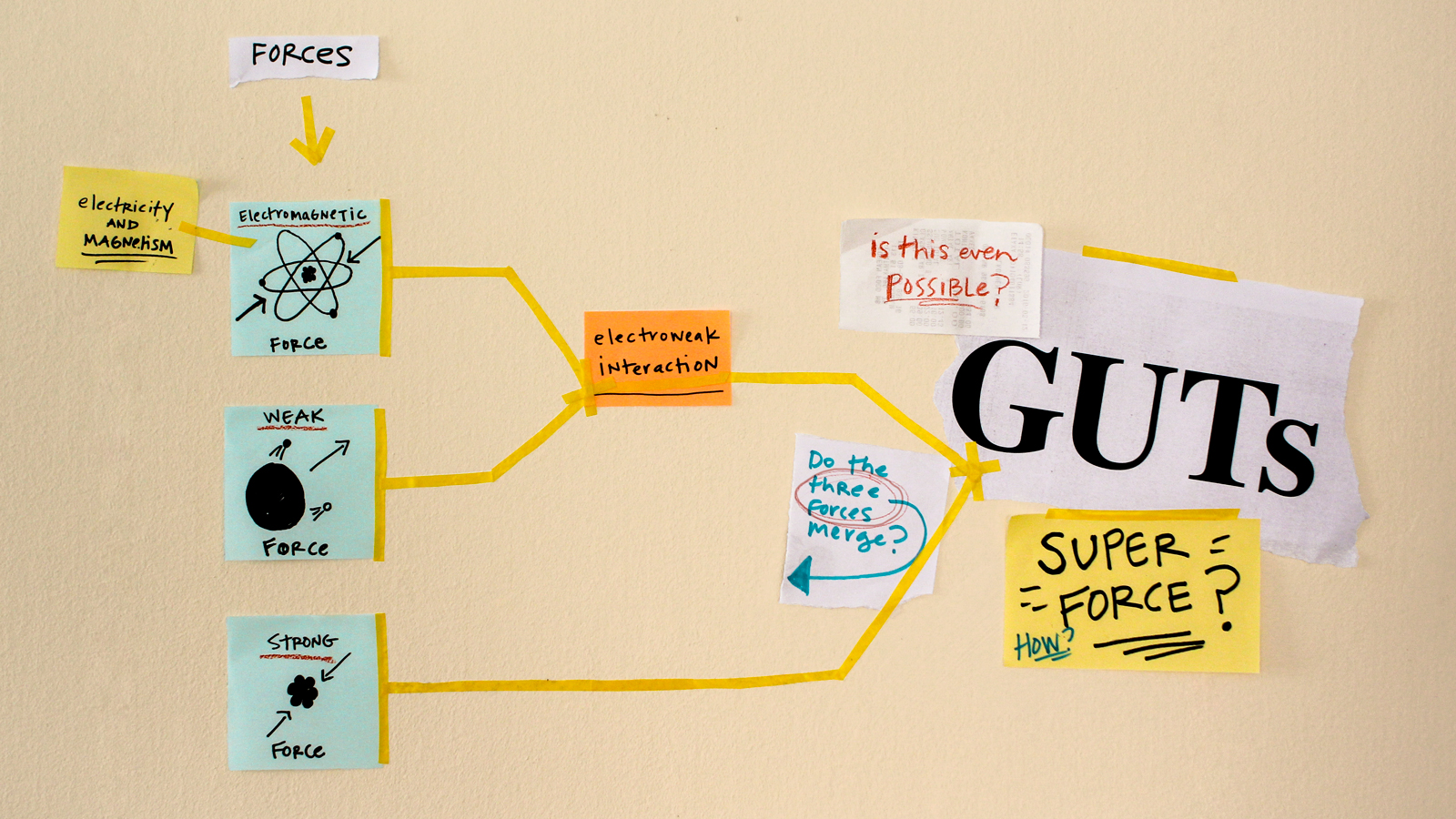
The hunt was on to create a grand unified theory, or GUT, that would elegantly explain how the universe works by linking three of the four known forces together. Physicists first linked the electromagnetic force, which dictates the structure of atoms and the behavior of light, and the weak nuclear force, which underlies how particles decay.
But they didn’t want to stop there. Scientists began working to link this electroweak theory with the strong force, which binds quarks together into things like the protons and neutrons in our atoms. (The fourth force that we know, gravity, doesn’t have a complete working quantum theory, so it's relegated to the realm of Theories of Everything, or ToEs.)
Linking the different forces into a single theory isn’t easy, since each behaves a different way. Electromagnetism is long-ranged, the weak force is short-ranged, and the strong force is weak in high-energy environments such as the early universe and strong where energy is low. To unify these three forces, scientists have to explain how they can be aspects of a single thing and yet manifest in radically different ways in the real world.
The electroweak theory unified the electromagnetic and weak forces by proposing they were aspects of a single interaction that is present only at very high energies, as in a particle accelerator or the very early universe. Above a certain threshold known as the electroweak scale, there is no difference between the two forces, but that unity is broken when the energy drops below a certain point.
The GUTs developed in the mid-1970s to incorporate the strong force predicted new particles, just as the electroweak theory had before. In fact, the very first GUT showed a relationship between particle masses that allowed physicists to make predictions about the second-heaviest particle before it was detected experimentally.
“We calculated the mass of the bottom quark before it was discovered,” says Mary Gaillard, a particle physicist at University of California, Berkeley. Scientists at Fermilab would go on to find the particle in 1977.
GUTs also predicted that protons should decay into lighter particles. There was just one problem: Experiments didn’t see that decay.
The problem with protons
GUTs predicted that all quarks could potentially change into lighter particles, including the quarks making up protons. In fact, GUTs said that protons would be unstable over a period much longer than the lifetime of the universe. To maximize the chances of seeing that rare proton decay, physicists needed to build detectors with a lot of atoms.
However, the first Kamiokande experiment in Japan didn't detect any proton decays, which meant a proton lifetime longer than that predicted by the simplest GUT theory. More complicated GUTs emerged with longer predicted proton lifetimes – and more complicated interactions and additional particles.
Most modern GUTs mix in supersymmetry (SUSY), a way of thinking about the structure of space-time that has profound implications for particle physics. SUSY uses extra interactions to adjust the strength of the three forces in the Standard Model so that they meet at a very high energy known as the GUT scale.
“Supersymmetry gives more particles that are involved via virtual quantum effects in the decay of the proton,” says JoAnne Hewett, a physicist at the Department of Energy’s SLAC National Accelerator Laboratory. That extends the predicted lifetime of the proton beyond what previous experiments were able to test. Yet SUSY-based GUTs also have some problems.
“They're kinda messy,” Gaillard says. Particularly, these theories predict more Higgs-like particles and different ways the Higgs boson from the Standard Model should behave. For that reason, Gaillard and other physicists are less enamored of GUTs than they were in the 1970s and '80s. To make matters worse, no supersymmetric particles have been found yet. But the hunt is still on.
“The basic philosophical impulse for grand unification is still there, just as important as ever,” Ellis says. “I still love SUSY, and I also am enamored of GUTs.”
Hewett agrees that GUTs aren't dead yet.
“I firmly believe that an observation of proton decay would affect how every person would think about the world,” she says. “Everybody can understand that we're made out of protons and ‘Oh wow! They decay.’”
Upcoming experiments like the proposed Hyper-K in Japan and the Deep Underground Neutrino Experiment in the United States will probe proton decay to greater precision than ever. Seeing a proton decay will tell us something about the unification of the forces of nature and whether we ultimately can trust our GUTs.
The hottest job in physics?
Accelerator scientists are in demand at labs and beyond.
While the supply of accelerator physicists in the United States has grown modestly over the last decade, it hasn’t been able to catch up with demand fueled by industry interest in medical particle accelerators and growing collaborations at the national labs.
About 15 PhDs in accelerator physics are granted by US universities each year. That’s up from around 12 per year, a rate that held relatively steady from 1985 to 2005. But accelerator physicists often come to the field without a specialized degree. For people like Yunhai Cai of the US Department of Energy's SLAC National Accelerator Laboratory, this has been a blessing and a curse. A blessing because high demand meant Cai found a ready job after his post doctoral studies, even though his expertise was in particle theory and he had never worked on accelerators. A curse because now, despite the growth, his field is still in need of more experts.
“Eleven of DOE’s seventeen national laboratories use large particle accelerators as one of their primary scientific instruments,” says Eric Colby, senior technical advisor for the Office of High Energy Physics at DOE. That means plenty of job opportunities for those coming out of special training programs or eager to transfer from another field. “These are major projects that will require hundreds of accelerator physicists and engineers to successfully complete.”
Transition mettle
Cai, now a senior staff scientist at SLAC and head of the Free-Electron Laser and Beam Physics Department, is one of many scientists recruited from other fields. The transition is intensive, and Cai considers himself fortunate that his academic background taught him the mathematical principles behind his first job.
Notwithstanding, “the most valuable help was the trust of many leaders in the field of accelerators,” Cai says. “They offered me a position knowing I had no experience in the field.”
Training specialists from other fields is a common and successful practice, says Lia Merminga, associate lab director for accelerators at SLAC. A planned upgrade to SLAC's Linac Coherent Light Source is creating a high demand for specialized accelerator experts, such as cryogenics engineers and superconducting radio frequency (SRF) physicists and engineers.
“Instead of hiring trained cryogenics engineers who are in short supply, we hire mechanical engineers and train them in cryogenics either by providing for hands-on experience or with coursework,” Merminga says.
New funds catalyze university research
The National Science Foundation has recently provided a boost to university research, which could help produce more accelerator scientists. In 2014 NSF launched their Accelerator Science program, distributing a total of $18.8 million in research funds, divided among approximately 30 awards in 2014 and 2015. The grants seed and support fundamental accelerator science at universities independent of government projects. Additionally, the program aims to entice students to accelerator science by challenging recipients to develop potentially disruptive technologies and ideas that could lead to breakthrough discoveries, as well as by supporting student travel to major accelerator science conferences.
“We are looking for high-risk, transformational ideas cross-cutting with other academic disciplines, with the goal of attracting the best students and postdocs,” says Vyacheslav Lukin, accelerator science program director at NSF. “Such students tend to gravitate toward the truly challenging problems with potential for novel solutions.”
Significantly, the NSF program recognizes accelerator science as a distinct field, which many institutions have been slow to do.
“There are few universities offering disciplines in the field of accelerators,” Cai says. “Most importantly, many people think it is [only] an engineering field.” Similar concerns were raised in responses to a 2015 Request for Information posted by DOE on the issue of too few accelerator physicists. Multiple respondents pointed out that many research awards don’t include work with accelerators.
Others believe solutions lie in outreach. SLAC has instituted programs to introduce undergraduates to research opportunities in accelerator science and plans to extend partnerships and internships to more schools and industries. Some respondents have pushed even further, supporting K-12 outreach as well.
Colby says that DOE will be implementing some of the suggestions over the next few years to strengthen its decades-long tradition of sponsoring accelerator science that supports its mission.
DOE labs partnering with universities
The NSF funding is not the only effort to foster growth. An adequate accelerator for students to train on can be an enormous boon to a university, so DOE has historically supported university programs by granting access to beams at national labs.
Northern Illinois University has supported its Northern Illinois Center for Accelerator and Detector Development this way for fifteen years. NICADD fosters development of a new generation of accelerator and detector technologies. Faculty and students at NICADD also have access to Fermilab and Argonne National Laboratory facilities for research and instruction. The labs, in turn, work with the jointly appointed faculty on major projects such as Muon g-2, Mu2e and DUNE at Fermilab or CERN’s ATLAS experiment through Argonne. The program has also collaborated on international experiments such as CERN’s AWAKE and ALPHA in its own right. University and labs may share the costs of hiring new faculty, enabling the parties to develop a world-class accelerator research enterprise and generate significant research income.
NICADD “has done quite well recruiting graduate students in accelerator physics,” says David Hedin, acting director. “We attribute this to the scarcity of graduate programs in the subfield and to our close connection to Fermilab.”
NIU has granted eight PhDs in accelerator physics since 2009, all without an accelerator on its campus.
A similar partnership formed between Old Dominion University and Thomas Jefferson National Accelerator Facility in 2008. The Facility for Rare Isotope Beams, a joint project between DOE and Michigan State University, promises to boost an already strong NSF-supported program at the school, and Brookhaven National Laboratory partnering with Stony Brook University has formed the Center for Accelerator Studies and Education. SLAC partners primarily with Stanford University, but also works with other schools, including the University of California, Los Angeles.
“Labs such as SLAC, with a broad accelerator research portfolio, guidance from world-renowned accelerator physicists, leading test facilities where students can get hands-on training, and connections to Stanford and Silicon Valley, offer an ideal environment for student training in accelerator science,” Merminga says.
USPAS expands the traditional classroom
University programs don’t have faculty dedicated to every topic that falls under the umbrella of accelerator science: particle sources, accelerating structures, cryogenics, superconducting radio frequency cavities, magnets, beam dynamics, and instrumentation and controls, to name a few.
DOE fills those gaps with the US Particle Accelerator School (USPAS). The semi-annual, traveling two-week session of rigorous courses trains students and professionals alike in both general and specialized courses.
“US accelerator school provides a critical service to schools that do have PhD programs in accelerator physics by essentially providing all the advanced courses,” says Bill Barletta, who directs the program. Universities give their students credit for coursework completed through USPAS that often is not offered at their own institution.
Barletta says roughly a third of participants are non-accelerator specialists transitioning into accelerator roles. Cai, who is familiar with that path from his own career change, has taught at USPAS twice – offering his mentorship in special topics such as charged particle optics and beam dynamics.
An industry perspective
Creating more accelerator scientists is valuable for both academia and industry, where particle accelerators are used for work in energy and medicine. The value of the accelerator science industry is estimated to be growing by approximately 10 percent each year.
“The real increase has been in medical accelerators, with a number of new companies getting into the proton therapy business,” says Robert Hamm, CEO of R&M Technical Enterprises, an accelerator consulting group. “This has been the most significant factor in the industrial demand for accelerator physicists.”
Most private companies only have the training resources to specialize new hires on their products. Thus, most companies want to recruit individuals trained at universities or national labs. Industry can, however, partner with these institutions through internships and collaborations to commercialize technology.
“Accelerator [science] has many applications, ranging from high energy physics, nuclear physics, and material and medical sciences,” Cai says. Both within the field of high-energy physics and beyond, the high demand illustrates the immense value of accelerator scientists and of the institutions helping to train them.
LHC data at your fingertips
The CMS collaboration has released 300 terabytes of research data.
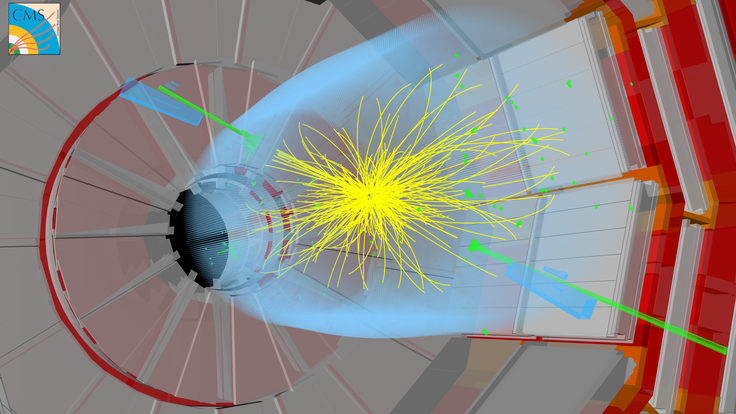
Today the CMS collaboration at CERN released more than 300 terabytes (TB) of high-quality open data. These include more than 100 TB of data from proton collisions at 7 TeV, making up half the data collected at the LHC by the CMS detector in 2011. This release follows a previous one from November 2014, which made available around 27 TB of research data collected in 2010.
The data are available on the CERN Open Data Portal and come in two types. The primary datasets are in the same format used by the collaboration to perform research. The derived datasets, on the other hand, require a lot less computing power and can be readily analyzed by university or high school students.
CMS is also providing the simulated data generated with the same software version that should be used to analyze the primary datasets. Simulations play a crucial role in particle physics research. The data release is accompanied by analysis tools and code examples tailored to the datasets. A virtual machine image based on CernVM, which comes preloaded with the software environment needed to analyze the CMS data, can also be downloaded from the portal.

“Once we’ve exhausted our exploration of the data, we see no reason not to make them available publicly,” says Kati Lassila-Perini, a CMS physicist who leads these data preservation efforts. “The benefits are numerous, from inspiring high school students to the training of the particle physicists of tomorrow. And personally, as CMS’s data preservation coordinator, this is a crucial part of ensuring the long-term availability of our research data.”
The scope of open LHC data has already been demonstrated with the previous release of research data. A group of theorists at MIT wanted to study the substructure of jets—showers of hadron clusters recorded in the CMS detector. Since CMS had not performed this particular research, the theorists got in touch with the CMS scientists for advice on how to proceed. This blossomed into a fruitful collaboration between the theorists and CMS.
“As scientists, we should take the release of data from publicly funded research very seriously,” says Salvatore Rappoccio, a CMS physicist who worked with the MIT theorists. “In addition to showing good stewardship of the funding we have received, it also provides a scientific benefit to our field as a whole. While it is a difficult and daunting task with much left to do, the release of CMS data is a giant step in the right direction.”
Further, a CMS physicist in Germany tasked two undergraduates with validating the CMS Open Data by reproducing key plots from some highly cited CMS papers that used data collected in 2010. Using openly available documentation about CMS’s analysis software and with some guidance from the physicist, the students were able to recreate plots that look nearly identical to those from CMS, demonstrating what can be achieved with these data.
“We are very pleased that we can make all these data publicly available,” adds Lassila-Perini. “We look forward to how they are utilized outside our collaboration, for research as well as for building educational tools.”
A version of this article was originally published on the CMS website.
Eight things you might not know about light
Light is all around us, but how much do you really know about the photons speeding past you?
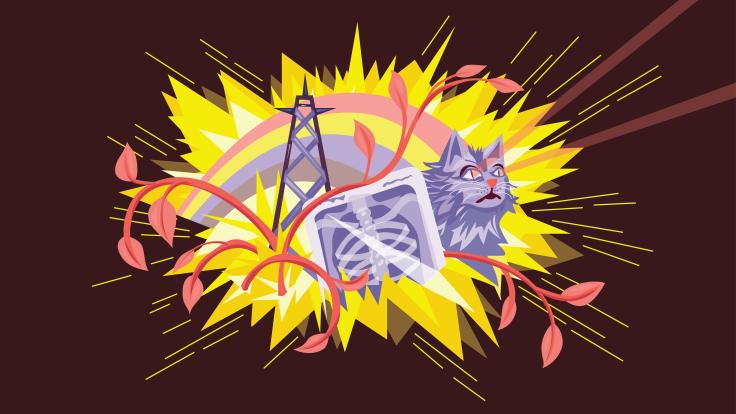
There’s more to light than meets the eye. Here are eight enlightening facts about photons:

1. Photons can produce shock waves in water or air, similar to sonic booms.
Nothing can travel faster than the speed of light in a vacuum. However, light slows down in air, water, glass and other materials as photons interact with atoms, which has some interesting consequences.
The highest-energy gamma rays from space hit Earth’s atmosphere moving faster than the speed of light in air. These photons produce shock waves in the air, much like a sonic boom, but the effect is to make more photons instead of sound. Observatories like VERITAS in Arizona look for those secondary photons, which are known as Cherenkov radiation. Nuclear reactors also exhibit Cherenkov light in the water surrounding the nuclear fuel.

2. Most types of light are invisible to our eyes.
Colors are our brains’ way of interpreting the wavelength of light: how far the light travels before the wave pattern repeats itself. But the colors we see—called “visible” or “optical” light—are only a small sample of the total electromagnetic spectrum.
Red is the longest wavelength light we see, but stretch the waves more and you get infrared, microwaves (including the stuff you cook with) and radio waves. Wavelengths shorter than violet span ultraviolet, X-rays and gamma rays. Wavelength is also a stand-in for energy: The long wavelengths of radio light have low energy, and the short-wavelength gamma rays have the highest energy, a major reason they’re so dangerous to living tissue.

3. Scientists can perform measurements on single photons.
Light is made of particles called photons, bundles of the electromagnetic field that carry a specific amount of energy. With sufficiently sensitive experiments, you can count photons or even perform measurements on a single one. Researchers have even frozen light temporarily.
But don’t think of photons like they are pool balls. They’re also wave-like: they can interfere with each other to produce patterns of light and darkness. The photon model was one of the first triumphs of quantum physics; later work showed that electrons and other particles of matter also have wave-like properties.

4. Photons from particle accelerators are used in chemistry and biology.
Visible light’s wavelengths are larger than atoms and molecules, so we literally can’t see the components of matter. However, the short wavelengths of X-rays and ultraviolet light are suited to showing such small structure. With methods to see these high-energy types of light, scientists get a glimpse of the atomic world.
Particle accelerators can make photons of specific wavelengths by accelerating electrons using magnetic fields; this is called “synchrotron radiation.” Researchers use particle accelerators to make X-rays and ultraviolet light to study the structure of molecules and viruses and even make movies of chemical reactions.

5. Light is the manifestation of one of the four fundamental forces of nature.
Photons carry the electromagnetic force, one of the four fundamental forces (along with the weak force, the strong force, and gravity). As an electron moves through space, other charged particles feel it thanks to electrical attraction or repulsion. Because the effect is limited by the speed of light, other particles actually react to where the electron was rather than where it actually is. Quantum physics explains this by describing empty space as a seething soup of virtual particles. Electrons kick up virtual photons, which travel at the speed of light and hit other particles, exchanging energy and momentum.

6. Photons are easily created and destroyed.
Unlike matter, all sorts of things can make or destroy photons. If you’re reading this on a computer screen, the backlight is making photons that travel to your eye, where they are absorbed—and destroyed.
The movement of electrons is responsible for both the creation and destruction of the photons, and that’s the case for a lot of light production and absorption. An electron moving in a strong magnetic field will generate photons just from its acceleration.
Similarly, when a photon of the right wavelength strikes an atom, it disappears and imparts all its energy to kicking the electron into a new energy level. A new photon is created and emitted when the electron falls back into its original position. The absorption and emission are responsible for the unique spectrum of light each type of atom or molecule has, which is a major way chemists, physicists, and astronomers identify chemical substances.

7. When matter and antimatter annihilate, light is a byproduct.
An electron and a positron have the same mass, but opposite quantum properties such as electric charge. When they meet, those opposites cancel each other, converting the masses of the particles into energy in the form of a pair of gamma ray photons.

8. You can collide photons to make particles.
Photons are their own antiparticles. But here’s the fun bit: the laws of physics governing photons are symmetric in time. That means if we can collide an electron and a positron to get two gamma ray photons, we should be able to collide two photons of the right energy and get an electron-positron pair.
In practice that’s hard to do: successful experiments generally involve other particles than just light. However, inside the LHC, the sheer number of photons produced during collisions of protons means that some of them occasionally hit each other.
Some physicists are thinking about building a photon-photon collider, which would fire beams of photons into a cavity full of other photons to study the particles that come out of collisions.
Five fascinating facts about DUNE
One: The Deep Underground Neutrino Experiment will look for more than just neutrinos.
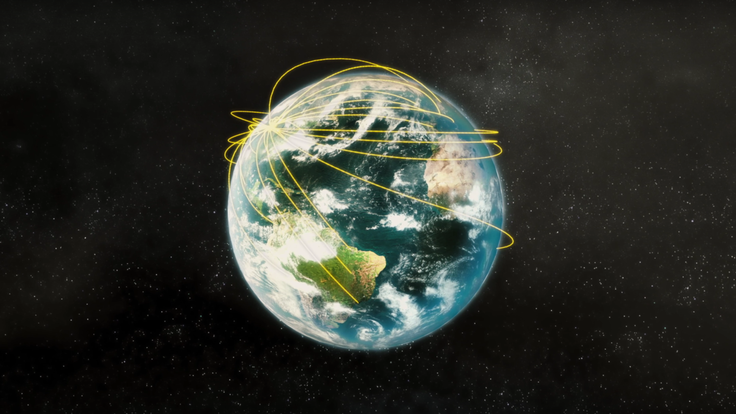
The Deep Underground Neutrino Experiment is a project of superlatives. It will use the world’s most intense neutrino beam and largest neutrino detector to study the weirdest and most abundant matter particles in the universe. More than 800 scientists from close to 30 countries are working on the project to crack some long-unanswered questions in physics. It’s part of a worldwide push to discover the missing pieces that could explain how the known particles and forces created the universe we live in. Here’s a two-minute animation that shows how the project will work:
Here are a few more surprising facts about DUNE you might not know:
1. Engineers will use a mile-long fishing line to aim the neutrino beam from Illinois to South Dakota.
DUNE will aim a neutrino beam 800 miles (1300 kilometers) straight through the Earth from Fermilab to the Sanford Underground Research Facility—no tunnel necessary. Although the beam spreads as it travels, like a flashlight beam, it’s important to aim the center of the beam as precisely as possible at DUNE so that the maximum number of neutrinos can create a signal. Since neutrinos are electrically neutral, they can’t be steered by magnets after they’ve been created. Hence everything must be properly aligned—to within a fraction of a millimeter—when the neutrinos are made, emerging from the collisions of protons with carbon atoms.
Properly aligning the neutrino beam means using the Global Positioning System (GPS) to relate Sanford Lab’s underground map to the coordinates of Fermilab’s geographic system, making sure everything speaks the same location language. Part of the process requires mapping points underground to points on the Earth’s surface. To do this, the alignment crew will drop what might be the longest plumb line in the world down the 4850-foot (1.5-kilometer) mineshaft. The current plan is to use very strong fishing line—a mile of it—attached to a heavy weight that is immersed in a barrel of oil to dampen the movement of the pendulum. A laser tracker will record the precise location of the line.
2. Mining crews will move enough rock for two Empire State Buildings up a 14-by-20-foot shaft.
To create caverns that are large enough to host the DUNE detectors, miners need to blast and remove more than 800,000 tons of rock from a mile underground. That’s the equivalent of 8 Nimitz-class aircraft carriers, a comparison often made by Chris Mossey, project director for the Long-Baseline Neutrino Facility (the name of the facility that will support DUNE). Mossey knows a thing or two about aircraft carriers: He happens to be a retired commander of the US Navy's Naval Facilities Engineering Council and oversaw the engineering, construction and maintenance services of US Navy facilities. But not everyone is that familiar with aircraft carriers, so alternatively you can impress your friends by saying that crews will move the weight equivalent of 2.2 Empire State Buildings, 80 Eiffel Towers, 4700 blue whales or 18 billion(ish) Twinkies.
3. The interior of the DUNE detectors will have about the same average temperature as Saturn’s atmosphere.
Argon, an element that makes up almost one percent of the air we breathe, will be the material of choice to fill the DUNE detectors, albeit in its liquid form. As trillions of neutrinos pass through the transparent argon, a handful will interact with an argon nucleus and produce other particles. Those, in turn, will create light and knock loose electrons. Both can be recorded and turned into data that show exactly when and how a neutrino interacted. To keep the argon liquid, the cryogenics system will have to maintain a temperature of around minus 300 degrees Fahrenheit, or minus 184 degrees Celsius. That’s slightly colder than the average temperature of the icy ammonia clouds on the upper layer of Saturn’s atmosphere.
4. The design of DUNE’s detector vessels is inspired by huge transport ships for gas.
DUNE’s set of four detectors will be the largest cryogenic instrument ever installed deep underground. You know who else needs to store and cool large volumes of liquid? The gas industry, which liquefies natural gas to transport it around the world using huge ships with powerful refrigerators. DUNE’s massive, insulated vessels will feature a membrane system that is similar to that used by liquid natural gas transport ships. A stainless steel frame sits inside an insulating layer, sandwiched between aluminum sheets. Multiple layers provide the strength to keep the liquid argon right where it should be—interacting with neutrinos.
5. DUNE will look for more than just neutrinos.
Then why did they name the experiment after the neutrino? Well, most of the experiment is designed to study neutrinos—how they change as they move through space, how they arrive from exploding stars, how neutrinos differ from their antimatter partners, and how they interact with other matter particles. At the same time, the large size of the DUNE detectors and their shielded location a mile underground also make them the perfect tool to continue the search for signs of proton decay. Some theories predict that protons (one of the building blocks that make up the atoms in your body) have a very long but finite lifetime. Eventually they will decay into other particles, creating a signal that DUNE hopes to discover. Fortunately for our atoms, the proton’s estimated lifespan is much longer than the time our universe has existed so far. Because proton decay is expected to be such a rare event, scientists need to monitor lots of protons to catch one in the act—and seventy thousand tons of argon atoms means around 1034 protons (that’s a 1 with 34 zeroes after it), which isn’t too shabby.
Art draws out the beauty of physics
Labs around the world open their doors to aesthetic creation.
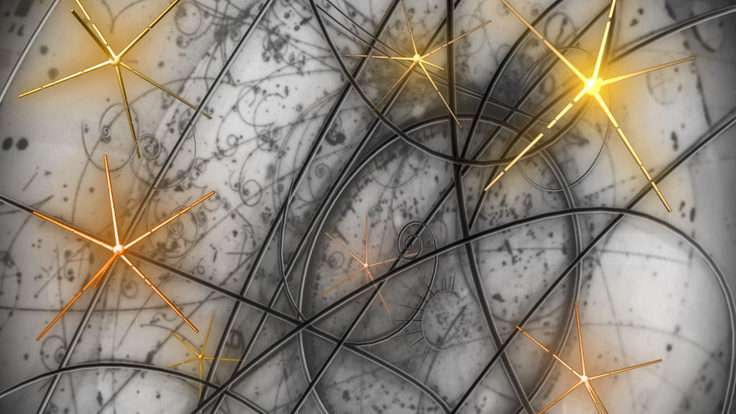
When it comes to quantum mechanics, it’s easier to show than tell.
That’s why artist residencies at particle physics labs play an important part in conveying their stories, according to CERN theorist Luis Alvarez-Gaume.
He recently spent some time demonstrating physics concepts to Semiconductor, a duo of visual artists from England known for exploring matter through the tools and processes of science. They’ve done multiple short films, museum pieces and festivals all over the world. In July they were awarded a CERN residency as part of the Collide@CERN Ars Electronica Award.
“I tried to show them how we develop an intuition for quantum mechanics by applying the principles and getting used to the way it functions,” Alvarez-Gaume says. “Because honestly, I cannot explain quantum mechanics even to a scientist.”
The physicist laughed when he made that statement, but the artists, Ruth Jarman and Joe Gerhardt, are comforted by the sentiment. They soaked up all they could during their two-month stay in late 2015 and are still processing interviews and materials they’ll use to develop a major work based on their experiences.
“Particle physics is the most challenging subject we’ve ever worked with because it’s so difficult to create a tangible idea about it, and that’s kind of what we are all about,” Jarman says, adding that they are fully up for the challenge.
Besides speaking with theorists and experimentalists, the artists explored interesting spaces at CERN and filmed both the construction of a new generation of magnets and a workshop where scientists were developing prototypes of instruments.
“We also dug around a lot in the archives,” Gerhardt says. “It’s such an amazing place and we only really touched the surface.”
But they have a lot of faith in the process based on past experiences working in scientific settings.
A 2007 work called “Magnetic Movie” was based on a similar stay at NASA’s Space Sciences Laboratories at UC Berkeley, where the artists captured the "secret lives of invisible magnetic fields." In the film, brightly colored streams and blobs emanate from various rooms at the lab to the sounds of VLF (very low frequency) audio recordings and scientists talking.
“Are we observing a series of scientific experiments, the universe in flux or a documentary of a fictional world?” the artists ask on their website.
The piece won multiple awards at international film festivals. But, just as importantly to the artists, the scientists were excited about the way it celebrated their work, “even though it was removed from their context,” Jarman says.
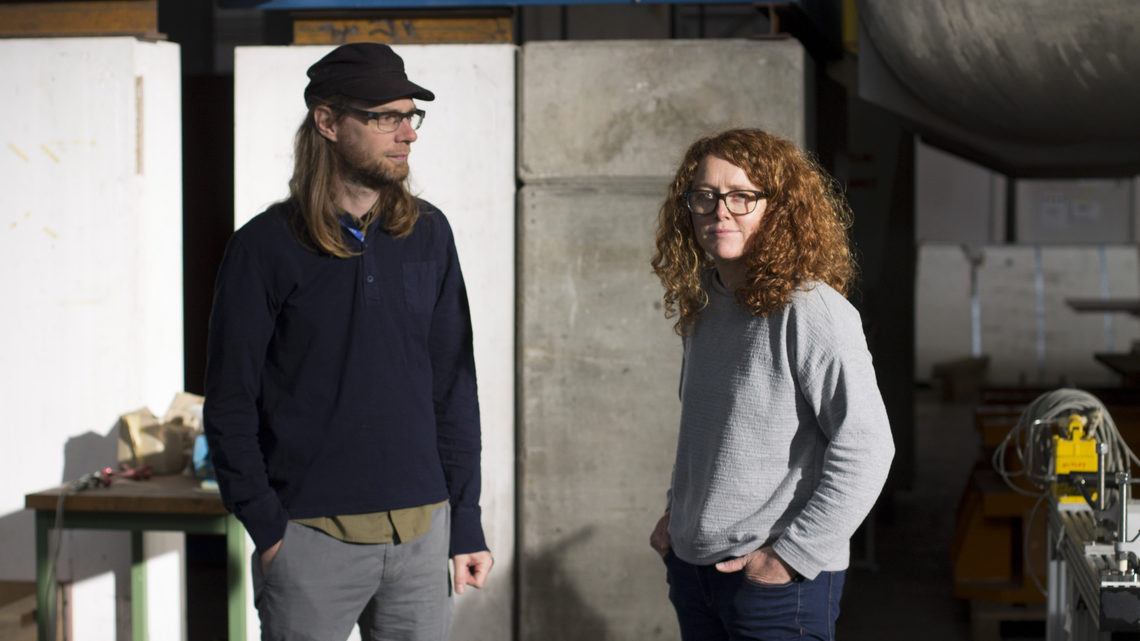
Semiconductor's Joe Gerhardt and Ruth Jarman at CERN.
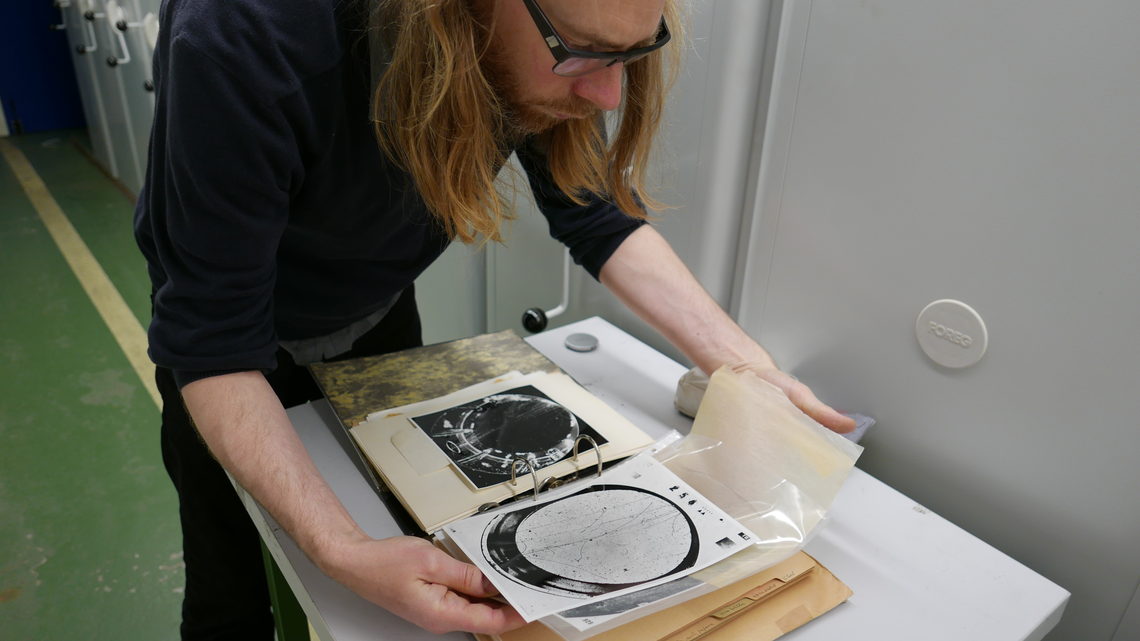
Semiconductor’s Joe Gerhardt at the CERN archives.
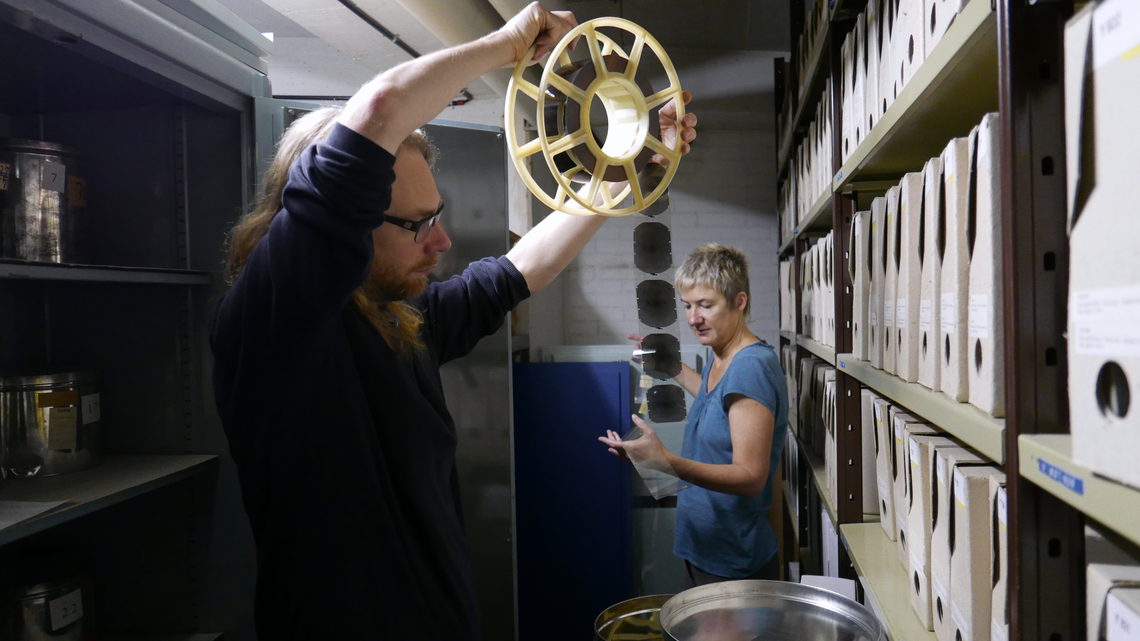
Semiconductor’s Joe Gerhardt at the CERN archives with Anita Hollier.
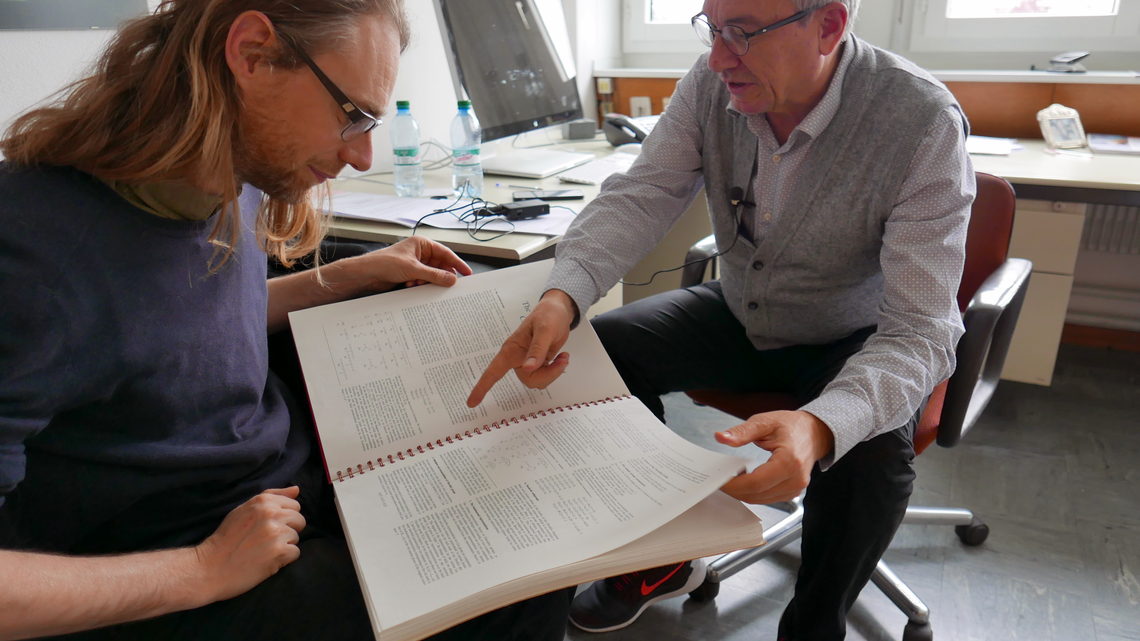
Semiconductor’s Joe Gerhardt with theorist Luis Alvarez-Gaume.
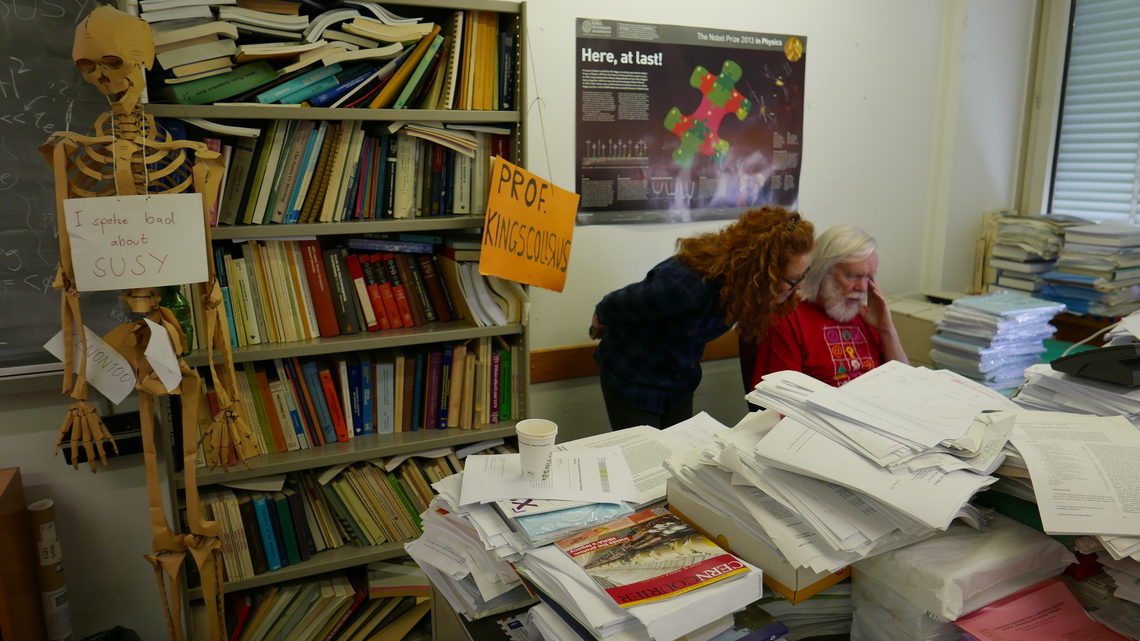
Semiconductor’s Ruth Jarman with theorist John Ellis.
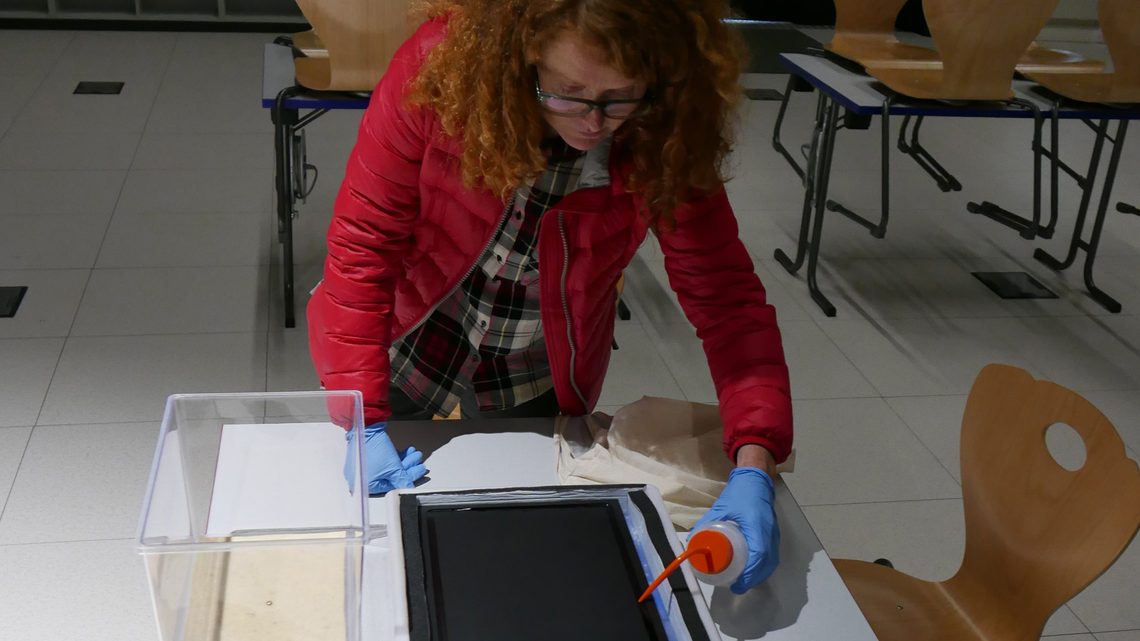
Semiconductor’s Ruth Jarman making a cloud chamber at CERN.
Picturing the invisible
At the Department of Energy’s Fermilab, another group of artists has taken on the challenge of “visualizing the invisible.” Current artist-in-residence Ellen Sandor and her collaborative group (art)n have been brushing up on neutrinos and the machines that study them.
Their goal is to put their own cutting-edge technologies to use in scientifically accurate and “transcendent” artworks that tell the story of Fermilab’s past, present and future, the artist says.
Sandor is known as a pioneer of virtual photography. In the 1980s she invented a new medium called PHSColograms, 3-D images that combine photography, holography, sculpture and computer graphics to create what she calls “immersive” experiences.
The group will use PHSColograms, sculpture, 3D printing, virtual reality and projection mapping in a body of work that will eventually be on display at the lab.
“We want to tell the story with scientific visualization and also with abstraction,” Sandor says. “But all of the images will be exciting and artistic.”
The value of such rich digital visuals lies in what Sandor calls their “wow factor,” according to Sam Zeller, neutrino physicist and science advisor for the artist-in-residence program.
“We scientists don’t always know how to hit that mark, but she does,” Zeller says. “These three-dimensional immersive images come closer to the video game environment. If we want to capture the imagination of school-age children, we can’t just stand in front of a poster and talk anymore.”
As co-spokesperson of the MicroBooNE experiment, Zeller and team are collaborating with the artists on virtual reality visualizations of a new detector technology called a liquid-argon time projection chamber. The detector components, as well as the reactions it detects, are sealed inside a stainless steel vessel out of view.
“Because she strives for scientific accuracy, we can use Sandor’s art to help us explain how our detector works and demonstrate it to the public,” Zeller says.
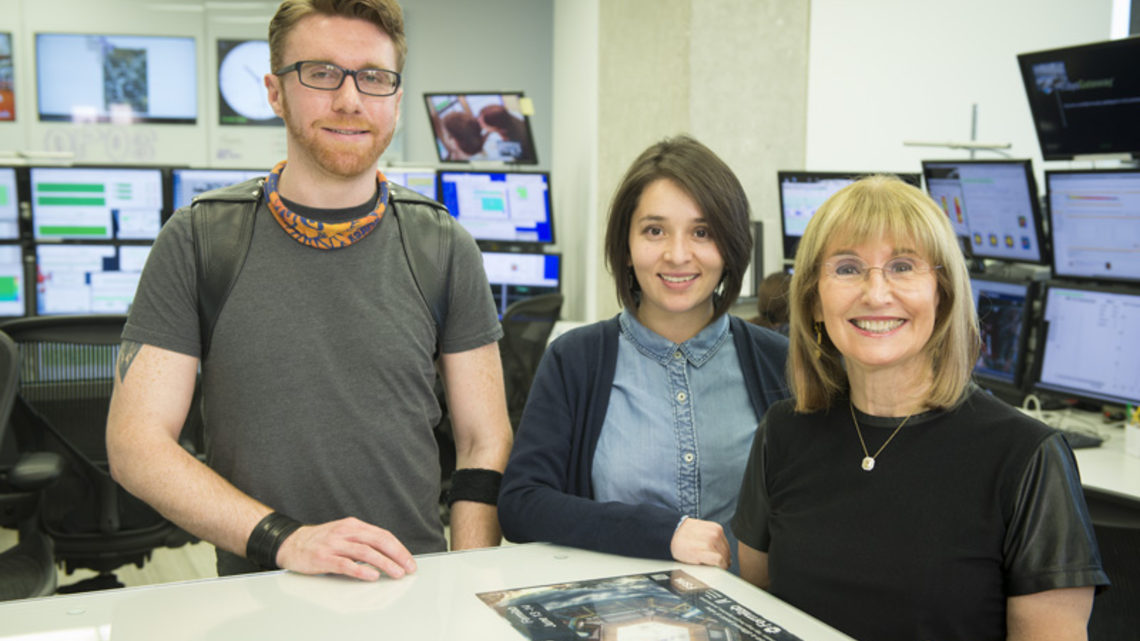
Chris Kemp, Diana Torres and Ellen Sandor at Fermilab.
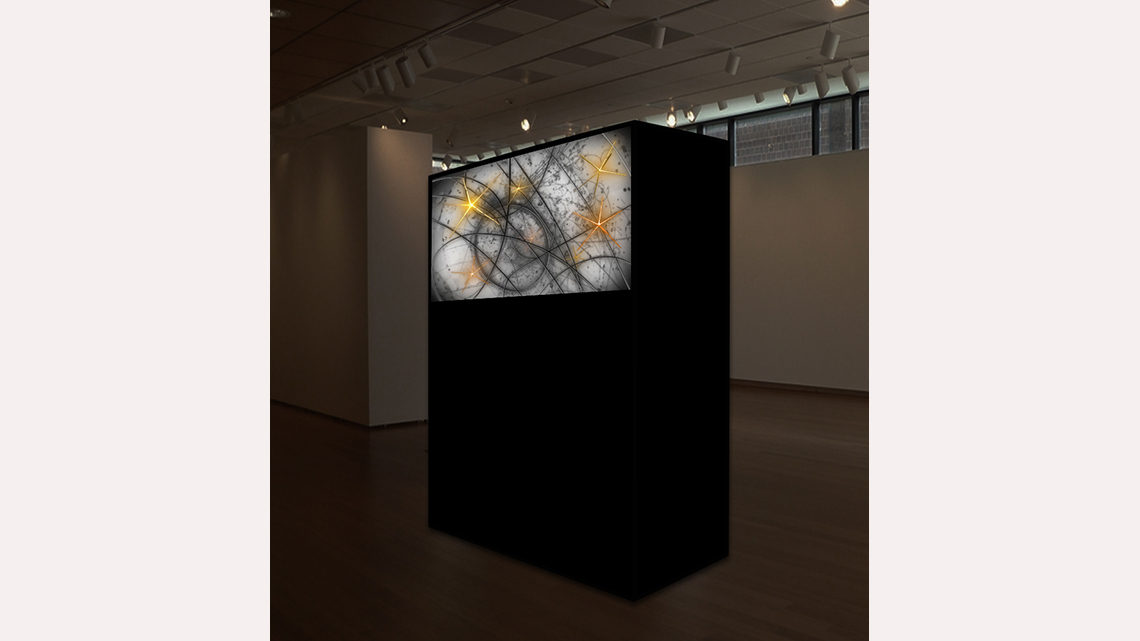
“Vintage Point: Inside the Bubble Chamber,” a PHSCologram sculpture by Ellen Sandor, Chris Kemp, Diana Torres, and (art)n. 42”x12”x72”

“AIDS Virus Third Edition,” a digital PHSCologram by Ellen Sandor, Stephan Meyers, and (art)n. 20”x24”. Dan Sandin and Tom DeFanti, Electronic Visualization Lab, School of Art and Design, University of Illinois at Chicago.
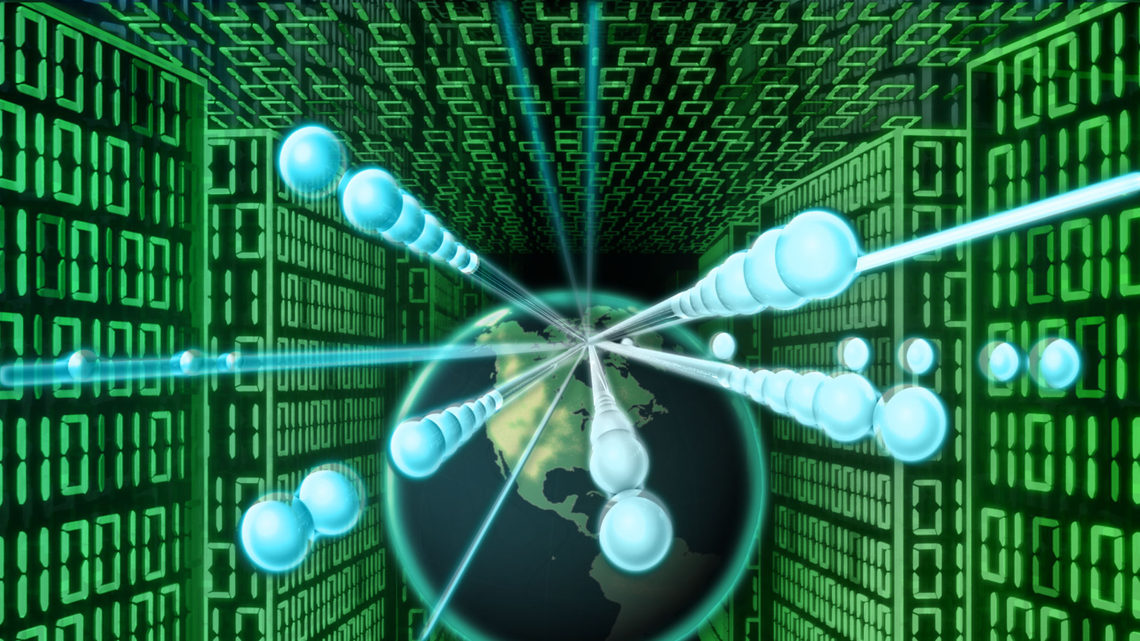
“Binary Bypass: Neutrinos for Faster Communication,” a PHSCologram sculpture by Ellen Sandor, Chris Kemp, Diana Torres, and (art)n. 42”x12”x72”
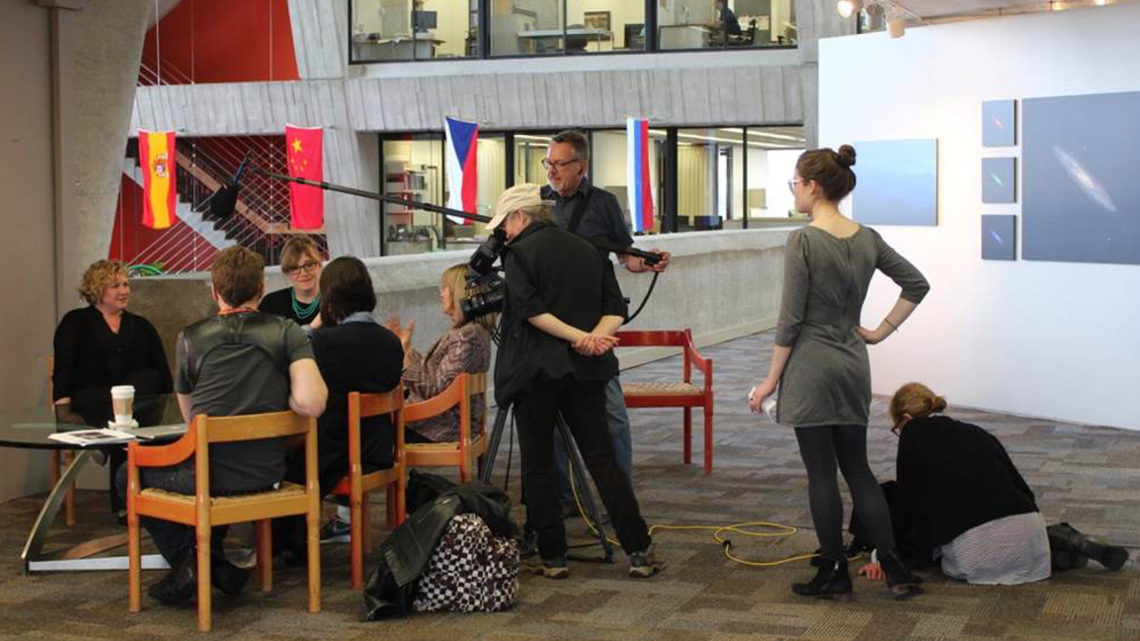
Ellen Sandor and (art)n meet with scientists at Fermilab.

Fermilab founding director Robert Wilson’s Mobius Strip sculpture atop Ramsey Auditorium.
Growing collaborations
According to Monica Bello, head of Arts@CERN, programs that combine art and science are a growing trend around the globe.
Organizations such as the Arts Catalyst Centre for Art, Science & Technology in London commission science-related art worldwide, and galleries like Kapelica Gallery in Ljubljana, Slovenia, present contemporary art focused largely on science and technology.
US nonprofit Leonardo, The International Society for the Arts, Sciences and Technology, supports cross-disciplinary research and international artist and scientist residencies and events.
“However, programs of this kind founded within scientific institutions and with full support are still rare,” Bello says. Yet, many labs, including TRIUMF in Canada and INFN in Italy, host art exhibits, events or occasional artist residencies.
“While we don’t bring on full-time artists continually, TRIUMF offers a suite of initiatives that explore the intersection of art and science,” says Melissa Baluk, communications coordinator at TRIUMF. “A great example is our ongoing partnership with artist Ingrid Koenig of Emily Carr University of Art + Design here in Vancouver. Koenig tailors some of her fine art classes to these intersections, for example, courses called ‘Black Holes and Other Transformations of Energy’ and ‘Quantum Entanglements: Manifestations in Practice.’”
The collaboration invites physicists to Koenig’s studio and draws her students to the lab. “It’s a wonderful partnership that allows all involved to discover news ways of thinking about the interconnections between art, science, and culture on a scale that works for us,” Baluk says.
Fermilab’s robust commitment to the arts reaches back to founding director, physicist and artist Robert Wilson. His sculptures are still exhibited around the lab, says Georgia Schwender, curator of the Fermilab Art Gallery.
Schwender finds that art-science programs attract the community through the unconventional pairing of subjects; events such as the international Art@CMS exhibit last year at Fermilab are very well received.
“It’s not just a physics or an art class,” she says. “People who might be a little afraid of the art or a little afraid of the science are less intimidated when you bring them together.”
Fermilab recently complemented its tradition of cultural engagement with a new artist residency, which began in 2014 with mixed media artist Lindsay Olson.
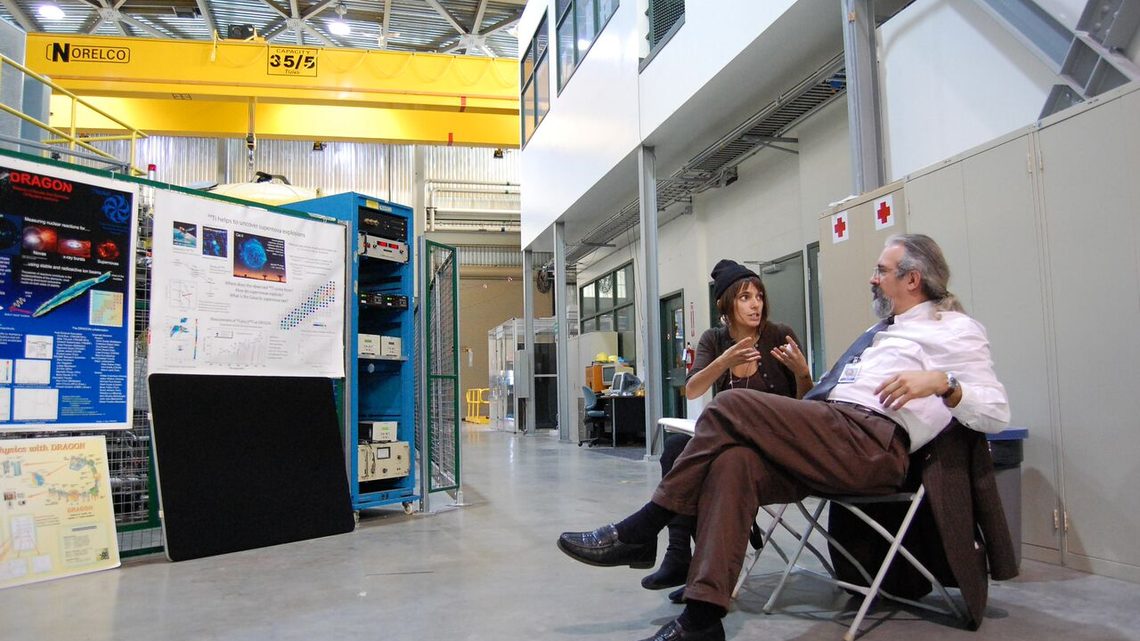
Emily Carr University of Art & Design students at TRIUMF.
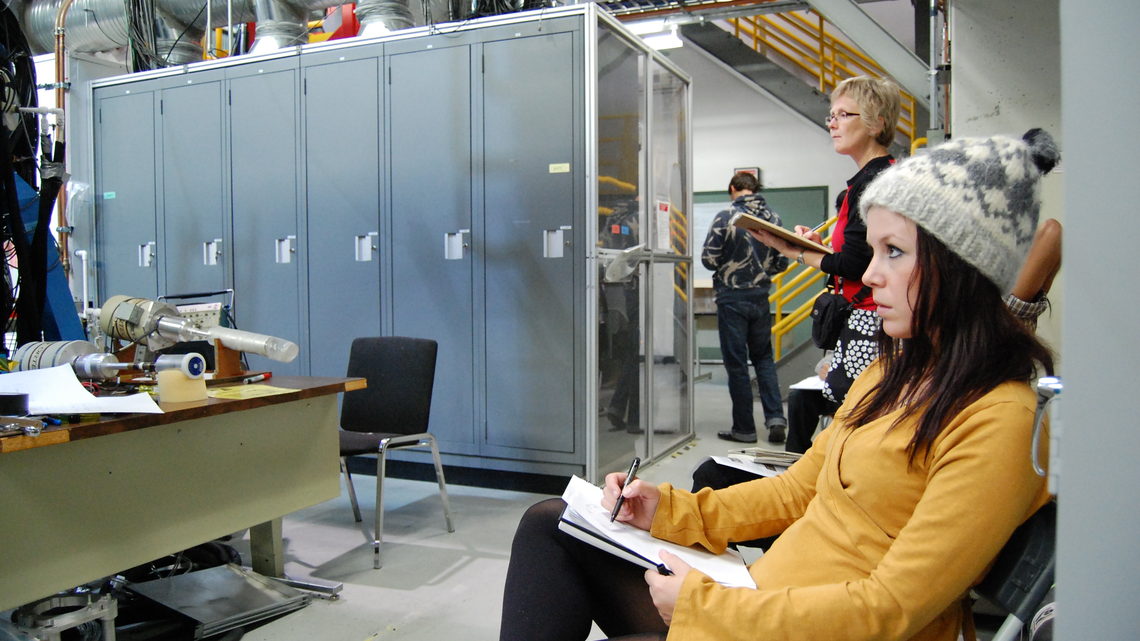
Emily Carr University of Art & Design students at TRIUMF.
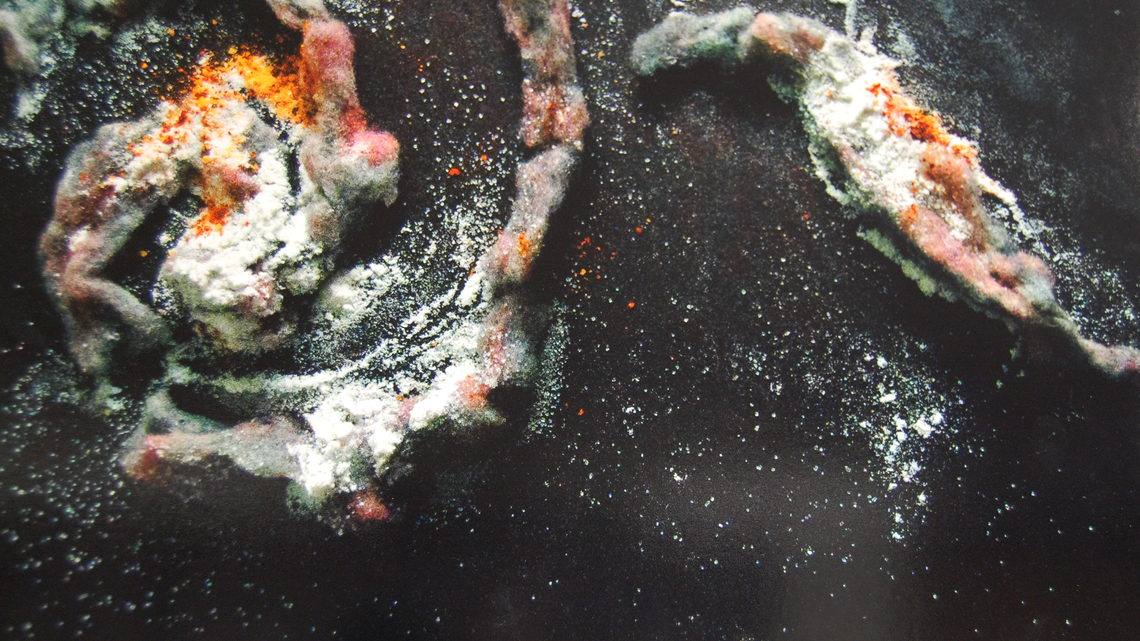
“A Spiral Galaxy,” art and photography by Waan Mahawanitwong. Flour, lint and sugar. Black Holes and Other Transformations of Energy class, Emily Carr University of Art & Design in partnership with TRIUMF.

“My Periodic Table of Gloriously Cosmic Events” by Glenda Bartosh of Emily Carr University of Art & Design in partnership with TRIUMF.
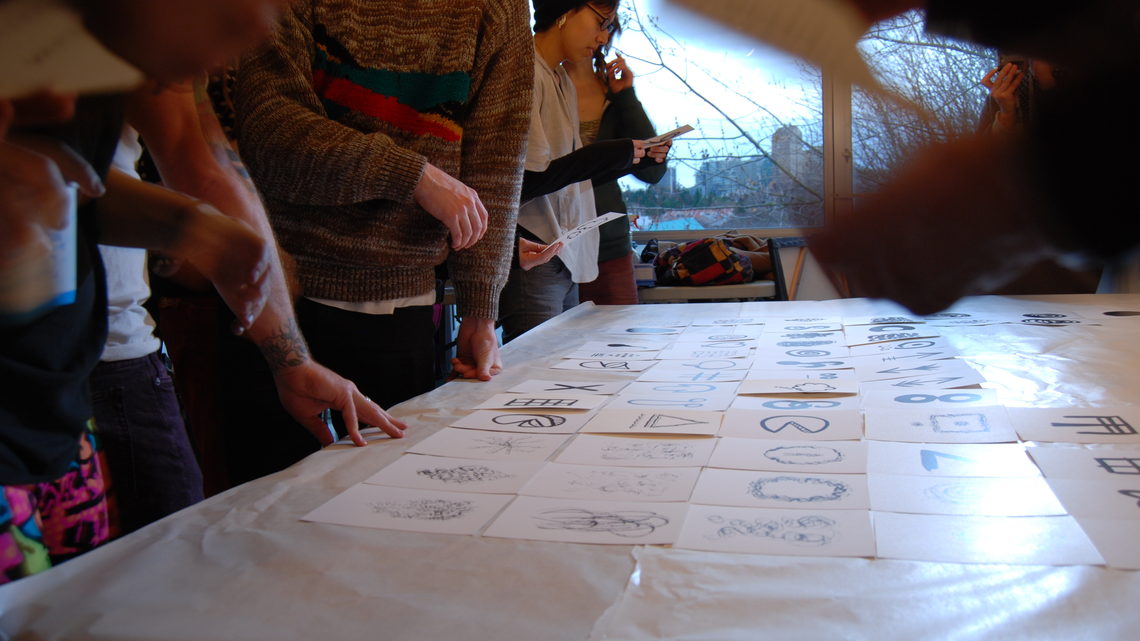
“My Periodic Table of Gloriously Cosmic Events” by Glenda Bartosh of Emily Carr University of Art & Design in partnership with TRIUMF.

“Tigress,” by Nick Morrison of Emily Carr University of Art & Design in partnership with TRIUMF.
Art-physics interactions
Science as a subject for art has grown since Sandor’s first PHSCologram of the AIDS virus bloomed into a career of art-science collaborations.
“In the beginning it was almost practical. People were dying, and we wanted to bring everything to the surface and leave nothing hidden,” the artist says. “By the 1990s I realized that scientists were the rock stars of the future, and that’s even truer today.”
Sandor relishes being part of the scientific process. Drawing out the hidden beauty of particle physics to create something scientifically accurate and artistically stunning has been one of the most satisfying projects to date, she says.
Like Sandor, Semiconductor works with authentic scientific data, but they also emphasize how the language of science influences our experience of nature.
“The data represents something we can’t actually see, feel or touch,” Jarman says. “We reference the tools and processes of science and encourage the noise and the artifact to constantly remind people that it is man observing nature, but not actually how it is.”
Both Zeller and Alvarez-Gaume have personal interests in art and find value in the similarities and differences between the fields.
“Our objectives are very different, but our paths are similar,” Alvarez-Gaume says. “We experience inspiration, passion and frustration. We work through trial and error, failing most of the time.”
Like art, science is abstract but enjoyable, he adds. “Theoretical physicists will tell you there is beauty in science—a sense of awe. Art helps bring this to the surface. People are not interested in the details: They want to get a vision, a picture about why we think particle physics is interesting or exciting.”
Zeller finds her own inspiration in art-science collaborations.
“One of the things that surprised me the most in working with artists was the fact that they could articulate much better than I could what it is that my research achieves for humankind, and this reinvigorated me with excitement about my work,” she says.
Yet, one key difference between art and science speaks for the need to nurture their growing intersections, Alvarez-Gaume says.
“Science is inevitable; art is fragile. Without Einstein it may have taken many, many years, and many people working on it, but we still would have come up with his theories. If Beethoven died at age 5, we would not have the sonatas; art is not repeatable.”
And a world without art is not a world he would like to imagine.

 Frascati Scienza
 Buco Nero
 Io Non Faccio Niente
 Tommaso Dorigo
 Giovanni Mazzitelli
 Barbara Gallavotti
 Keplero Blog
 Research Gate