What is a “particle”?
Quantum physics says everything is made of particles, but what does that actually mean?

“Is he a dot or is he a speck? When he's underwater, does he get wet? Or does the water get him instead? Nobody knows.” —They Might Be Giants, “Particle Man”
We learn in school that matter is made of atoms and that atoms are made of smaller ingredients: protons, neutrons and electrons. Protons and neutrons are made of quarks, but electrons aren’t. As far as we can tell, quarks and electrons are fundamental particles, not built out of anything smaller.
It’s one thing to say everything is made of particles, but what is a particle? And what does it mean to say a particle is “fundamental”? What are particles made of, if they aren’t built out of smaller units?
“In the broadest sense, ‘particles’ are physical things that we can count,” says Greg Gbur, a science writer and physicist at the University of North Carolina in Charlotte. You can’t have half a quark or one-third of an electron. And all particles of a given type are precisely identical to each other: they don’t come in various colors or have little license plates that distinguish them. Any two electrons will produce the same result in a detector, and that’s what makes them fundamental: They don’t come in a variety pack.
It’s not just matter: light is also made of particles called photons. Most of the time, individual photons aren’t noticeable, but astronauts report seeing flashes of light even with their eyes closed, caused by a single gamma ray photon moving through the fluid inside the eyeball. Its interactions with particles inside creates blue-light photons known as Cherenkov light—enough to trigger the retina, which can “see” a single photon (though a lot more are needed to make an image of anything).
Particle fields forever
That’s not the whole story, though: We may be able to count particles, but they can be created or destroyed, and even change type in some circumstances. During a type of nuclear reaction known as beta decay, a nucleus spits out an electron and a fundamental particle called an antineutrino while a neutron inside the nucleus changes into a proton. If an electron meets a positron at low velocities, they annihilate, leaving only gamma rays; at high velocities, the collision creates a whole slew of new particles.
Everyone has heard of Einstein’s famed E=mc2. Part of what that means is that making a particle requires energy proportional to its mass. Neutrinos, which are very low mass, are easy to make; electrons have a higher threshold, while heavy Higgs bosons need a huge amount of energy. Photons are easiest of all to make, because they don't have mass or electric charge, so there’s no energy threshold to overcome.
But it takes more than energy to make new particles. You can create photons by accelerating electrons through a magnetic field, but you can't make neutrinos or more electrons that way. The key is how those particles interact using the three fundamental quantum forces of nature: electromagnetism, the weak force and the strong force. However, those forces are also described using particles in quantum theory: electromagnetism is carried by photons, the weak force is governed by the W and Z bosons, and the strong force involves the gluons.
All of these things are described together by an idea called “quantum field theory.”
“Field theory encompasses quantum mechanics, and quantum mechanics encompasses the rest of physics,” says Anthony Zee, a physicist at the Kavli Institute for Theoretical Physics and the University of California, Santa Barbara. Zee, who has written several books on quantum field theory both for scientists and nonscientists, admits, “If you press a physicist to say what a field is, they’ll say a field is whatever a field does.”
Despite the vagueness of the concept, fields describe everything. Two electrons approach each other and they stir up the electromagnetic field, creating photons like ripples in a pond. Those photons then push the electrons apart.
What waves?
Waves are the best metaphor to understand particles and fields. Electrons, in addition to being particles, are simultaneously waves in the “electron field.” Quarks are waves in the “quark field” (and since there are six types of quark, there are six quark fields), and so forth. Photons are like water ripples: they can be big or small, violent or barely noticeable. The fields describing matter particles are more like waves on a guitar string. If you don’t pluck the string hard enough, you don’t get any sound at all: You need the threshold energy corresponding to an electron mass to make one. Enough energy, though, and you get the first harmonic, which is a clear note (for the string) or an electron (for the field).
As a result of all this quantum thinking, it’s often unhelpful to think of particles as being like tiny balls.
“Photons [and matter particles] travel freely through space as a wave,” says Gbur, even though they can be counted as though they were balls.
The metaphor isn’t perfect: The fields for electrons, electromagnetism and everything else fill all of space-time, rather than being like a one-dimensional string or two-dimensional pond surface. As Zee says, “What is waving when an electromagnetic wave goes through space? Nothing is waving! There doesn't need to be water like with a water wave.”
And of course, we’re still left asking: If particles come from fields, are those fields themselves fundamental, or is there deeper physics involved? Until such time as theory comes up with something better, the particle description of matter and forces is something we can count on.
1,000 meters below
Meet the world’s deepest underground physics facilities.

A constant shower of energetic subatomic particles rains down on Earth’s surface. Born from cosmic ray interactions in the upper atmosphere, this invisible drizzle creates noisy background radiation that obscures the signatures of new particles or forces that scientists seek. The solution is to move experiments under the best natural umbrella we have: the Earth’s crust.
Underground facilities, while difficult to build and access, are ideal hubs for observing rare particle interactions. The rock overhead shields experiments from the pesky particle precipitation, preventing things like muons from interfering. For the last few decades, underground physics facilities have laid claim to some of the world’s largest, most complex detection experiments, contributing to important physics discoveries.
“In the early 1960s, researchers at the Kolar Gold Fields in India and the East Rand Gold Mine in South Africa realized if they go deep enough underground, it might be possible to clearly detect high-energy particles from atmospheric cosmic ray collisions,” says Henry Sobel, a co-US-spokesperson on the Super-Kamiokande experiment at the Kamioka Observatory. “Both groups reported the first observation of atmospheric neutrinos at various depths underground.”
Even with entire facilities sitting below the surface, extremely sensitive detectors often require additional shielding against stray particles and the small amount of radiation from the rock and equipment. One example is the Sanford Underground Research Facility’s Large Underground Xenon (LUX) experiment, which seeks dark matter particles called WIMPs, or weakly interacting massive particles.
“Going underground eliminates most of the radioactivity, but not all of it, so we used a 72,000-gallon water shield to keep neutrons and gamma rays out of the LUX experiment,” says Harry Nelson, a LUX researcher and spokesperson for the upcoming LUX-Zeplin experiment at Sanford Lab.
Scientists at underground facilities around the world—and their creative colleagues closer to the surface—maintain different experiments working toward a common goal: answering questions about the nature of matter and energy. Learn more about the facilities 1000 meters or more below the surface that are digging deep into the secrets of the universe.
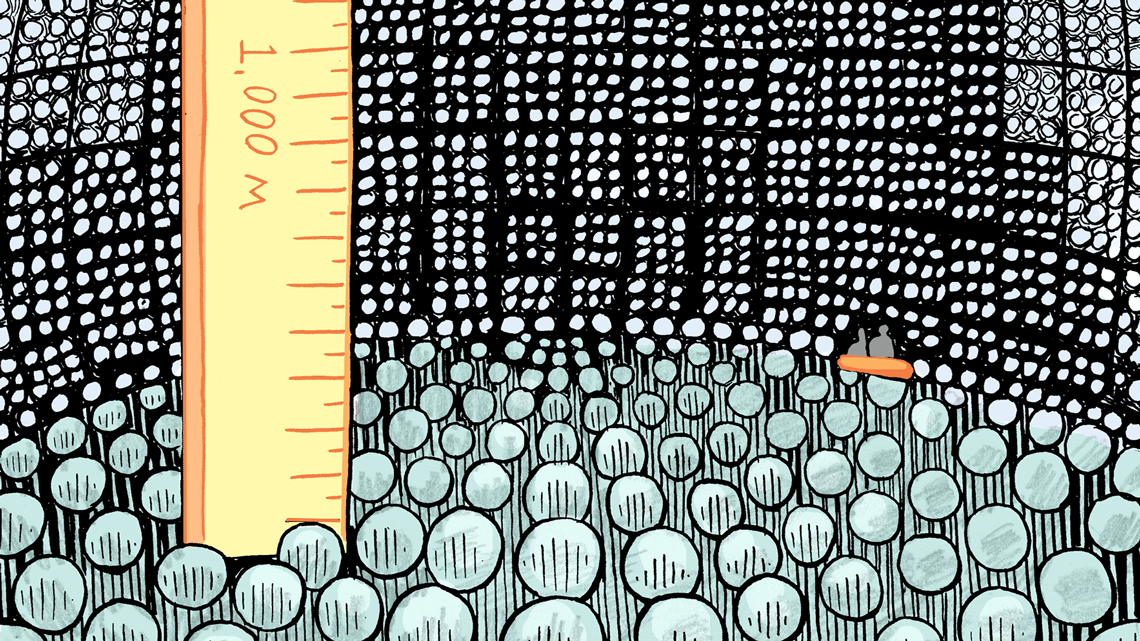
Kamioka Observatory
Kamioka Observatory
1000 meters below, est. 1983
Previously known as the Kamioka Underground Observatory, the facility dwells in the Mozumi Mine in Hida, Gifu Prefecture, Japan. Operational or former mines actually make great homes for underground facilities because it is cost-effective to use existing giant holes inside mountains or the earth rather than dig new ones.
Kamioka’s original focus was on understanding the stability of matter through a search for the spontaneous decay of protons using an experiment called Kamiokande. Since neutrinos are a major background to the search for proton decay, the study of neutrinos also became a major effort for the observatory.
Now known as the Kamioka Observatory, the facility detects neutrinos coming from supernovae, the sun, our atmosphere and accelerators. In 2015, Takaaki Kajita was awarded the Nobel Prize in physics for the discovery of atmospheric neutrino oscillation by the Super-Kamiokande experiment. The Nobel Prize is shared with the Sudbury Neutrino Observatory in Canada.

Stawell Underground Physics Laboratory
Stawell Underground Physics Laboratory
1000 meters below, under construction
SUPL is under construction at the active Stawell Gold Mine in Victoria, Australia. The facility will work in close collaboration with the Gran Sasso National Laboratory in Italy, which made significant strides in dark matter research through a possible detection of WIMPs. SUPL will see whether the amount of dark matter in certain galaxies changes depending on Earth’s position.
Because Australia is in the Southern Hemisphere and has opposite seasons to Italy, this seasonal dark matter experiment will also test Italy’s results to learn more about WIMPs and dark matter. There are two proposed dark matter experiments for SUPL: SABRE (Sodium-iodide with Active Background REjection) and DRIFT-CYGNUS (Directional Recoil Identification From Tracks - CosmoloGY with NUclear recoilS).
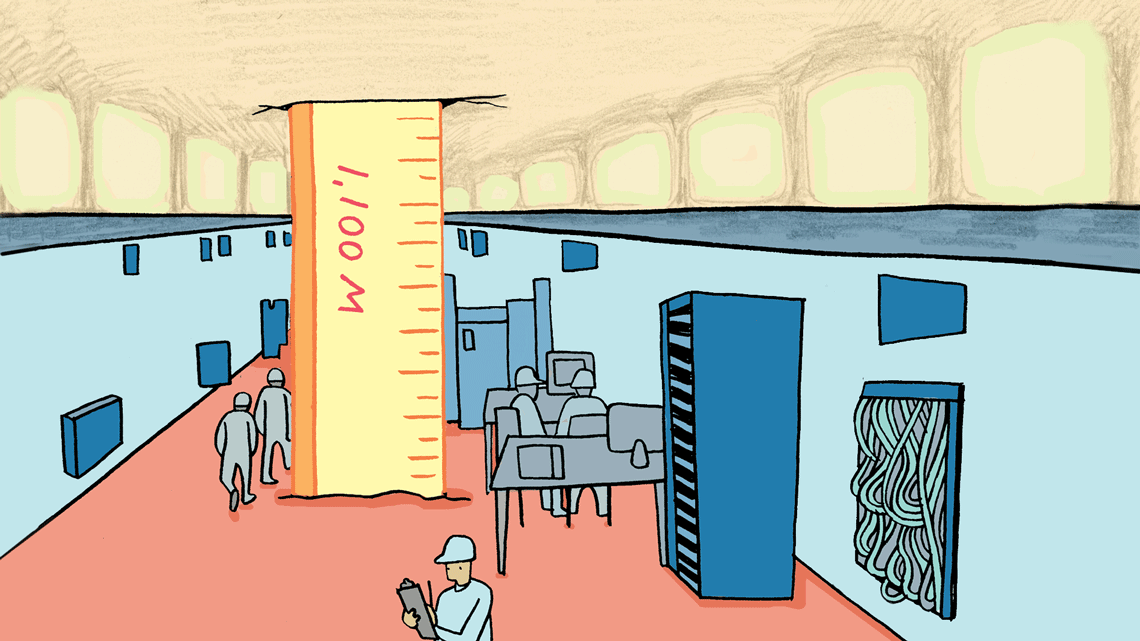
Boulby Underground Laboratory
Boulby Underground Laboratory
1100 meters below, est. 1998
Inside the operational Boulby Potash and Salt Mine on the northeast coast of England sits the Boulby Lab. It is a multidisciplinary, deep underground science facility operated by the UK’s Science and Technology Facilities Council. The depth and the support infrastructure make the facility well-suited for traditional low-background underground studies such as dark matter searches and cosmic ray experiments. Scientists also study a wide range of sciences beyond physics, for example geology and geophysics, environmental and climate studies, life in extreme environments on Earth, and the development of rover instrumentation for exploration of life beyond Earth.
The dark matter search currently underway at Boulby is DRIFT-II – a directional dark matter search detector. The lab previously hosted the ZEPLIN-II and III experiments, predecessors to the upcoming LUX-ZEPLIN experiment at Sanford Lab. Boulby still supports the LZ experiment with ultralow-background material activity measurements, which is important to all sensitive dark matter and rare-event studies.
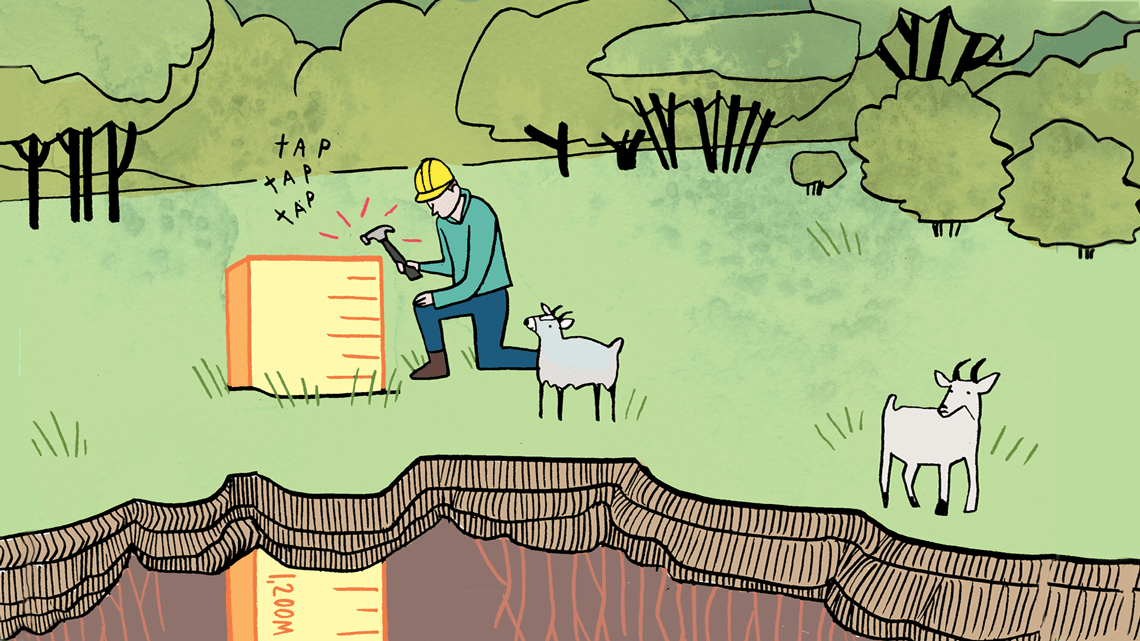
India-based Neutrino Observatory
India-based Neutrino Observatory
1200 meters below, proposed
INO, a collaboration of about 25 national institutes and universities hosted by the Tata Institute of Fundamental Research, will primarily be an underground facility for non-accelerator-based high-energy physics. The observatory will focus its study on atmospheric muon neutrinos using a 50-kiloton iron calorimeter to measure certain characteristics of the elusive particles.
INO will also expand into a more general science facility and host studies in geological, biological and hydrological research. Construction of the INO underground observatory in Pottipuram, Tamil Nadu, India is awaiting approvals by the state government.
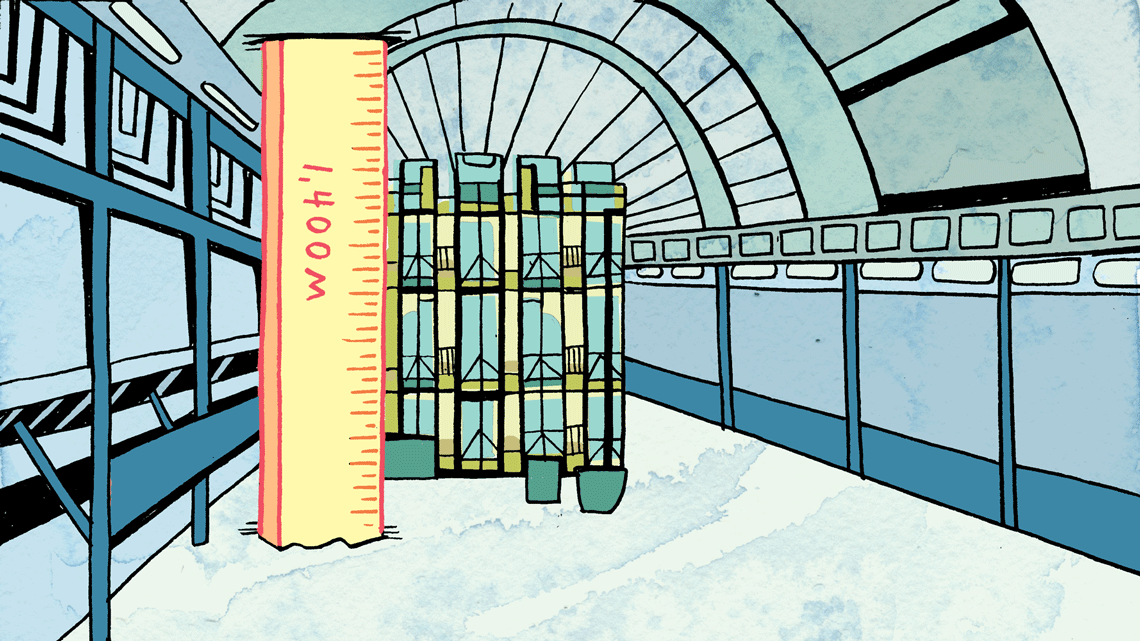
Gran Sasso National Laboratory
Gran Sasso National Laboratory
1400 meters below, est. 1987
The Gran Sasso National Laboratory in Italy is the largest underground laboratory in the world. It is a high-energy physics lab that conducts many long-term neutrino, dark matter and nuclear astrophysical experiments.
The lab’s OPERA experiment is especially noteworthy for detecting the first tau neutrino candidates that emerged (through oscillation) from a muon neutrino beam sent by CERN in 2010. From 2012 to 2015, the experiment at Gran Sasso subsequently announced the detection of the second, third, fourth and fifth tau neutrinos, confirming their initial result.
Gran Sasso also collaborates with the Department of Energy’s Fermi National Accelerator Laboratory on a short-distance neutrino program. After it is refurbished at CERN, the ICARUS experiment from Gran Sasso will join two other experiments at Fermilab to search for a fourth proposed kind of neutrino, the sterile neutrino.
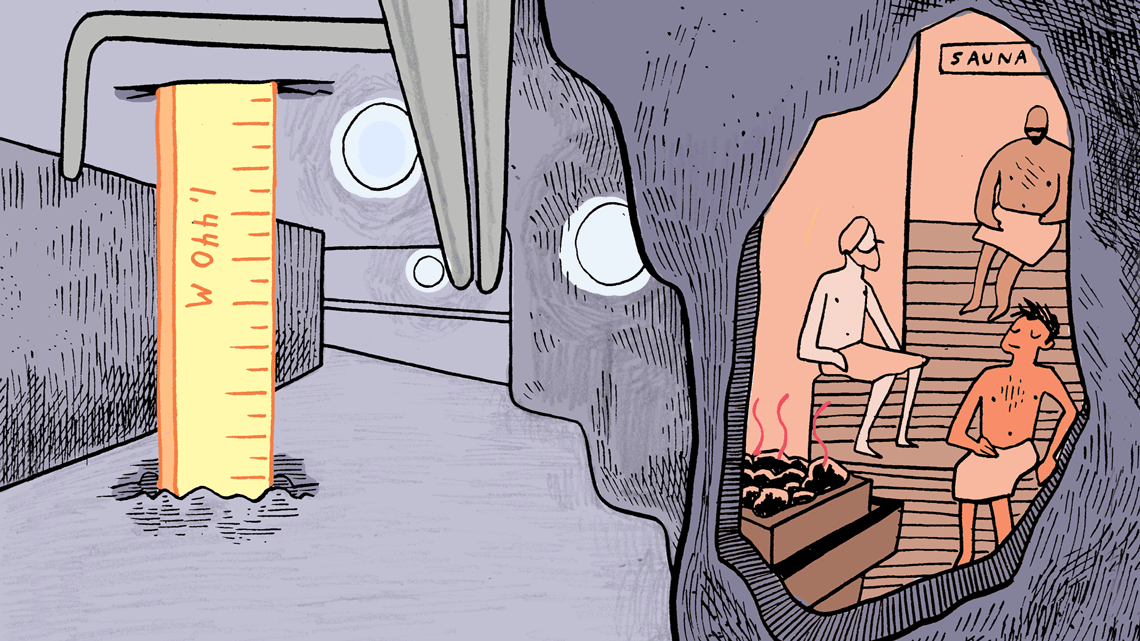
Centre for Underground Physics in Pyhäsalmi
Centre for Underground Physics in Pyhäsalmi
1440 meters below, est. 1997
The University of Oulu in Finland operates CUPP in Europe’s deepest metal mine—the Pyhäsalmi Mine. As the mine prepares to close by the end of this decade, the local community established Callio Lab (CLab) to rent out space to science and industrial operators, CUPP being one of them. The main level, at 1420 meters, houses all of the equipment, offices and restaurants. It also houses the world’s deepest sauna.
The facility’s main experiment is EMMA, the Experiment with MultiMuon Array, in Lab 1 at 75 meters. EMMA is used to study cosmic rays and high-energy muons that pass through the Earth to better understand atmospheric and cosmic particle interactions. CUPP also conducts some low-background muon flux measurements and radiocarbon research for future liquid scintillators in Lab 2 at 1430 meters.
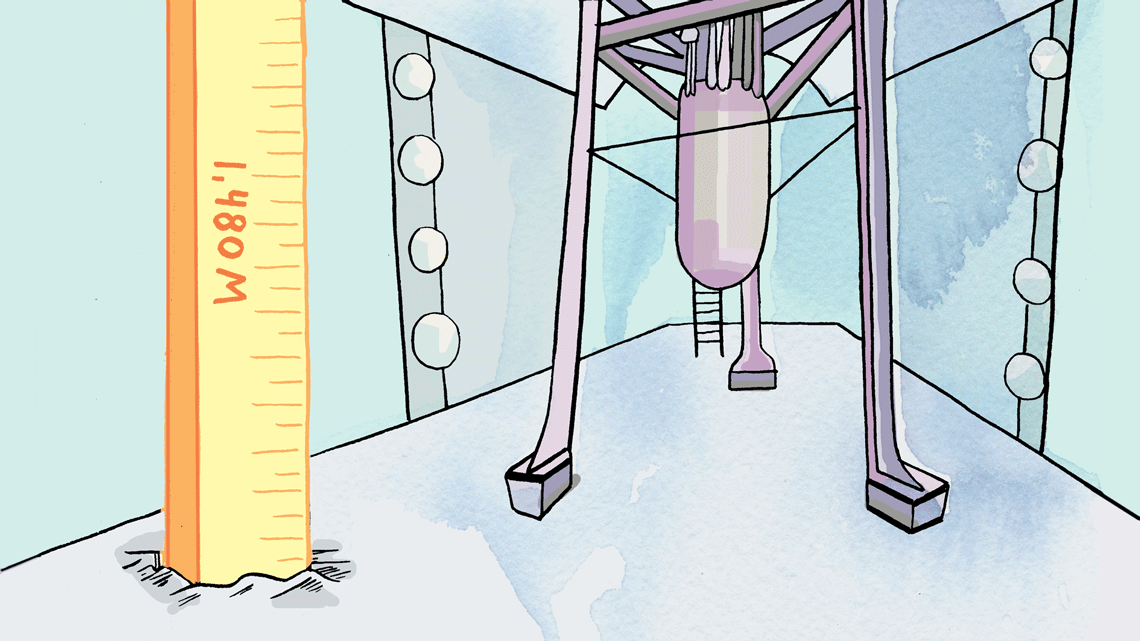
Sanford Underground Research Facility
Sanford Underground Research Facility
1480 meters below, est. 2011
Sanford Lab is the deepest underground physics lab in the United States and sits in the former Homestake Gold Mine in the Black Hills of South Dakota. It was the site of Ray Davis’ solar neutrino experiment, which used dry cleaning fluid to count neutrinos from the sun. The experiment found only one-third of the neutrinos expected, the result known as the solar neutrino problem. In 1998, SNO and Kamioka discovered neutrino oscillations, which proved that neutrinos were changing type as they traveled. Davis won the Nobel Prize in physics in 2002.
The facility now houses the LUX experiment (looking for dark matter), Majorana Demonstrator (researching the properties of neutrinos), and geological, engineering and biological studies. Sanford Lab will also host the Deep Underground Neutrino Experiment, which will use detectors filled with 70,000 tons of liquid argon to study neutrinos sent from Fermilab, 800 miles away.
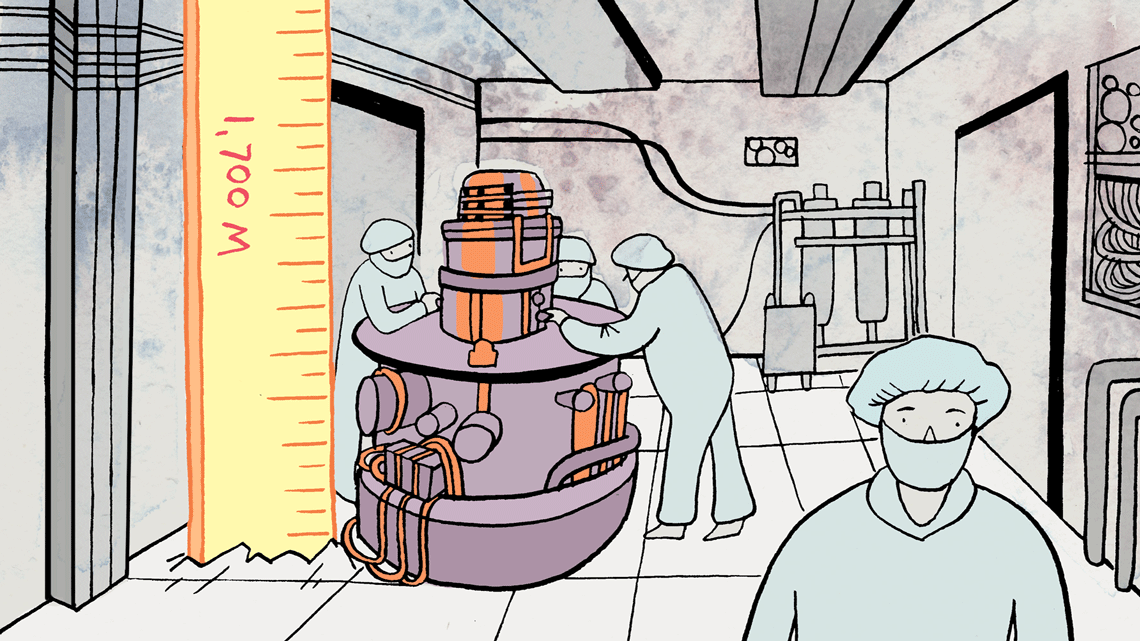
Modane Underground Laboratory
Modane Underground Laboratory
1700 meters below, est. 1982
Located in Modane, France, and situated in the middle of the Frejús Road Tunnel, the multidisciplinary lab hosts experiments in particle, nuclear and astroparticle physics, environmental sciences, biology and nano- and microelectronics.
Headed by the French National Center for Scientific Research and the Genoble-Alpes University, Modane Lab’s main fundamental physics activities include SuperNEMO and EDELWEISS, which study neutrino physics and dark matter detection, respectively.
The lab also hosts international experiments with the Joint Institute for Nuclear Research in Dubna, Russia, and the Czech Technical University in Prague, Czech Republic.

Baksan Neutrino Observatory
Baksan Neutrino Observatory
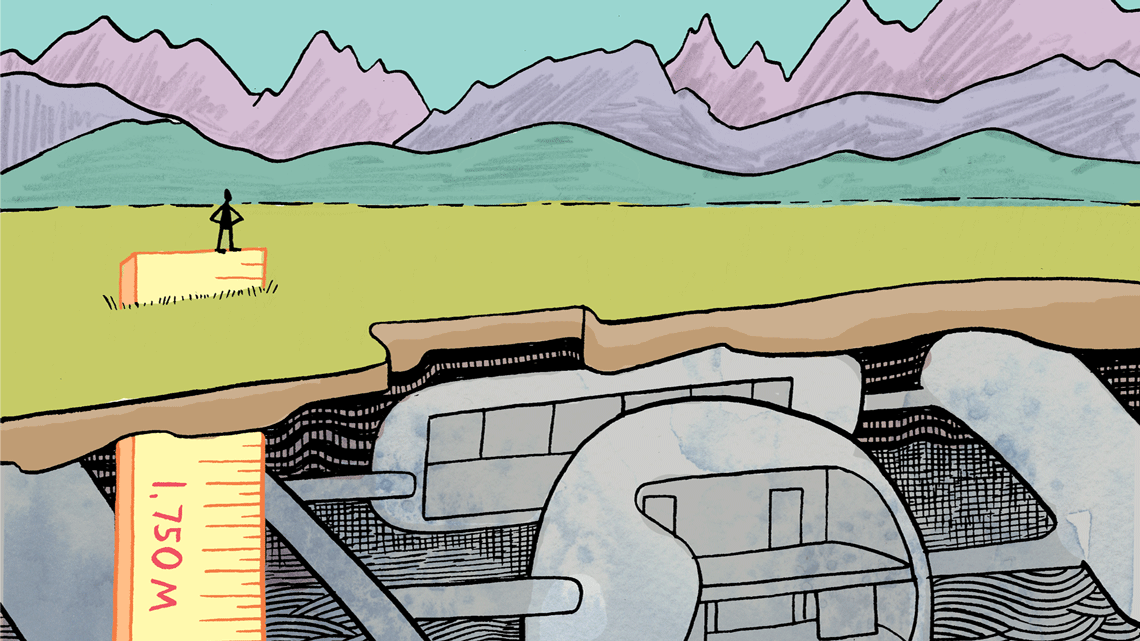
1750 meters below, est. 1973
Hidden beneath the Caucasus Mountains and next to the Baksan River, BNO began working as one of the first underground particle physics observatories in the then Soviet Union. Like other underground facilities, BNO wanted to reduce the amount of background radiation as much as possible. The lab’s location is not only underground but also far from nuclear power plants—another source of background noise for experiments.
BNO’s current neutrino experiments are the Soviet-American Gallium Experiment (SAGE), the Baksan Underground Scintillation Telescope (BUST) and the upcoming Baksan Experiment on Sterile Transitions (BEST). There is also a new search for hypothesized particles called axions, candidates for dark matter.
Agua Negra Deep Experiment Site
Agua Negra Deep Experiment Site
1750 meters below, proposed
Situated in the mountains on the border of Chile and Argentina, ANDES will study neutrinos and dark matter, as well as plate tectonics, biology, nuclear astrophysics and the environment. Along with SUPL, it is one of two proposed deep underground labs in the Southern Hemisphere.
ANDES is an international laboratory, not just a host for international experiments. It will become home to a large neutrino detector and aims to detect supernovae neutrinos and geoneutrinos, complementing results of the Northern Hemisphere labs and experiments. This location is ideal as the site is far from nuclear facilities and extremely deep in the mountains, both of which help reduce background noise.

SNOLAB
SNOLAB
2070 meters below, est. 2009
SNOLAB is the deepest physics facility in North America and operates in a working nickel mine in Ontario, Canada. The entire 5000m2 facility is a class 2000 cleanroom with fewer than 2000 particles per cubic foot. Everyone who enters the lab must shower on the way in and put on a clean set of special cleanroom clothes.
SNOLAB conducts highly sensitive experiments for research on dark matter and neutrinos. Among them are DEAP-3600, PICO, HALO, MiniCLEAN and SNO+. Scientists also plan to install the next generation of a cryogenic dark matter search, SuperCDMS, in the lab once testing is complete.
Late last year, Arthur McDonald was awarded the Nobel Prize in physics for the discovery of neutrino oscillation made in 1998 at the Sudbury Neutrino Observatory, the predecessor of SNOLAB. The Nobel Prize is shared with the Kamioka Observatory in Japan for their Super-K neutrino experiment.
China Jinping Underground Laboratory
China Jinping Underground Laboratory
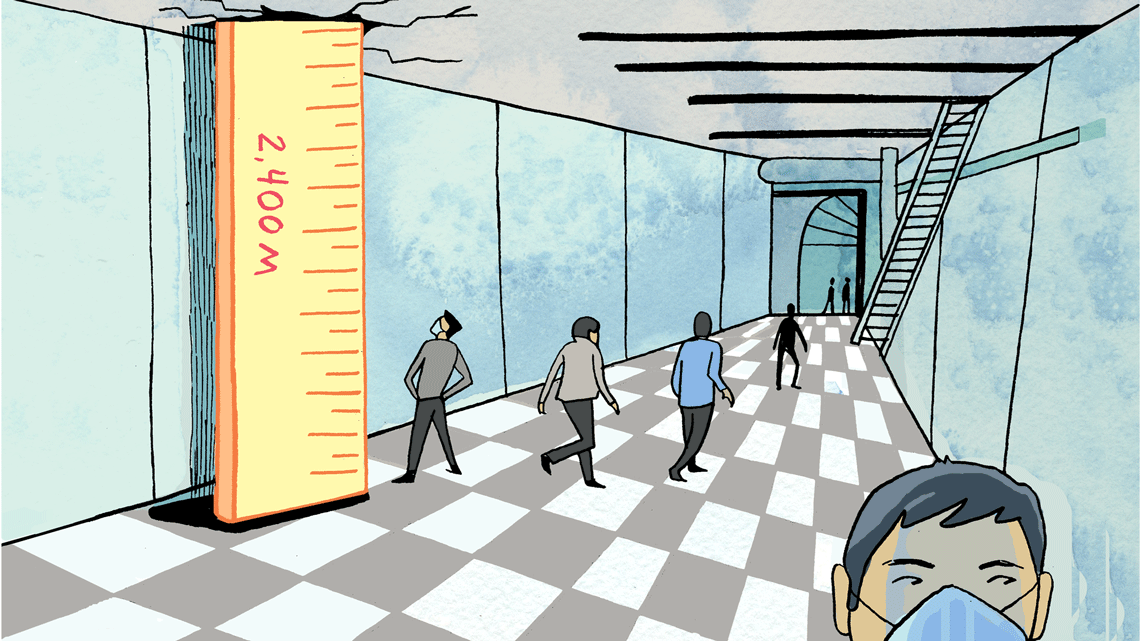
2400 meters below, est. 2010
CJPL is the deepest physics facility in the world, tucked inside the Jinping Mountain in the Sichuan province in southwest China. The site is ideal for its low cosmic-ray muon flux, which means the facility has far less noise from background radiation than many other underground facilities. And because the facility is built under a mountain, there is horizontal access (for things like vehicles) rather than vertical access (through a mine shaft).
Two experiments housed at the facility are trying to directly detect dark matter: the China Dark Matter Experiment (CDEX) and PandaX. CJPL will also observe neutrinos from different sources, such as the sun, Earth, atmosphere, supernova bursts and potentially dark matter annihilations, in hopes of better understanding the elusive particles’ properties. In the coming months, an astronuclear physics study and a one-ton prototype of a neutrino detector will move into CJPL-II.
Low-mass particles that make high-mass stars go boom
Simulations are key to showing how neutrinos help stars go supernova.
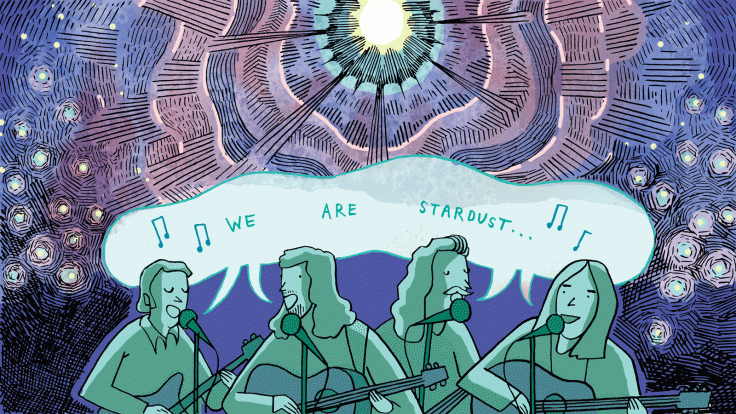
When some stars much more massive than the sun reach the end of their lives, they explode in a supernova, fusing lighter atoms into heavier ones and dispersing the products across space—some of which became part of our bodies. As Joni Mitchell wrote and Crosby Stills Nash & Young famously sang, “We are stardust, we are golden, we are billion-year-old carbon.”
However, knowing this and understanding all the physics involved are two different things. We can’t make a true supernova in the lab or study one up close, even if we wanted to. For that reason, computer simulations are the best tool scientists have. Researchers program equations that govern the behavior of the ingredients inside the core of a star to see how they behave and whether the outcomes reproduce behavior we see in real supernovae. There are many ingredients, which makes the simulations extraordinarily complicated—but one type of particle could ultimately drive supernova explosion: the humble neutrino.
Neutrinos are well known for being hard to detect because they barely interact with other particles. However, the core of a dying star is a remarkably dense environment, and the nuclear reactions produce vast numbers of neutrinos. Both these things increase the likelihood of neutrinos hitting other particles and transferring energy.
“We can estimate on a sheet of paper roughly how much energy neutrinos may deliver,” says Hans-Thomas Janka, a supernova researcher at the Max Planck Institute for Astrophysics in Garching, Germany. “The question still remains: Is that compatible with the detailed picture? What we need is to combine all the physics ingredients which play a role in the core of a collapsing star.”

Things fall apart, the center cannot hold
Typically, all the nuclear fusion in a star happens in its core: That’s the only place hot and dense enough. In turn, the nuclear fusion supplies enough energy to keep the core from compressing under its own gravity. But when a star heavier than eight times the mass of our sun exhausts its nuclear fuel and fusion halts, the core collapses catastrophically. The result is a core-collapse supernova: a shock wave from the collapse tears the star apart while the core shrinks into a neutron star or black hole. The explosion leads to more nuclear fusion and the spread of nuclei into interstellar space, where it can eventually be used in making new stars and planets. (The other major supernova type involves an exploding white dwarf, the source of many other common atoms.)
Core-collapse supernovae are rare and extremely violent phenomena, sometimes outshining whole galaxies at their peak. The last relatively close-by supernova appeared in the sky in 1987, in the neighboring galaxy known as the Large Magellanic Cloud. Even if a supernova exploded close enough to observe in detail (while being far enough to be safe), we can't see deep inside to where the action is.
However, 24 neutrinos from the 1987 supernova showed up in particle detectors (built for studying proton decay). These neutrinos were likely born in nuclear reactions deep in the exploding star's interior and confirmed theoretical predictions from the 1960s, when astrophysicists first began to study exploding stars.
Supernova research really took off in the 1980s with growing computer power and the realization that a full understanding of core collapse would need to incorporate a lot of complicated physics.
“Core-collapse supernovae involve a huge variety of effects involving all four fundamental forces,” says Joshua Dolence of the US Department of Energy’s Los Alamos National Laboratory. “The predicted outcome of collapse—even the most basic question of ‘Does this star explode?’—can depend on how these effects are incorporated into simulations.”
In other words, if you don’t do the simulations right, the supernova never happens. While some stars may collapse directly into black holes instead of exploding, astronomers see both supernova explosions and their aftermaths (the most famous example being the Crab Nebula). Some simulations don’t ever show a kaboom, which is a problem: The energy released during the burst of neutrinos is enough to stall out the supernova before it explodes.
If neutrinos cause the problem, they may also solve it. They carry energy away from one part of the dying star, but they may also transfer it to the stalled-out shockwave, breaking the stalemate and making the supernova happen. It’s not the only hypothesis, but currently it’s the best guess astrophysicists have, and most of the large computer simulations seem to support it so far. However, some of the most energetic supernovae—known as hypernovae—don’t seem to abide by the same rules, so it’s possible something other than neutrinos are responsible. What that something else might be is anyone’s guess.

Explosions in the sky
Core-collapse supernovae are natural laboratories for extreme physics. They involve particle physics, strong gravity as described by general relativity and nuclear physics, all mixed up with strong magnetic fields. All of those aspects must be implemented in computer code, which necessarily involves tough decisions about what details to include and what to leave out.
“The major open questions revolve around understanding which physical effects are crucial to a quantitative understanding of supernova explosions,” Dolence says. His own work at Los Alamos involves testing the assumptions going into the various theoretical models for explosions and developing faster code to save on precious computer time. Janka’s work in Europe, by contrast, involves modeling the neutrino behavior as exactly as possible.
Currently, both detailed and simplified approaches are needed, until researchers know exactly what physical processes are involved deep inside the dying star. Both methods use tens of millions of hours of computer time, distributed across multiple computers working in parallel. Even with certain simplifying assumptions, these simulations are some of the biggest around, meaning they require supercomputers at large research centers: the Leibniz Computing Center in Germany; the Barcelona Supercomputing Center in Spain; Los Alamos, Oak Ridge National Laboratory and Princeton University in the United States, and just a handful of others.
“We have no proof so far except our calculations that neutrinos are the cause of the explosion,” Janka says. “We need to compare models with [astronomical] observations in the future.”
The world’s current neutrino experiments are poised to catch neutrinos from the next event and are connected by the Supernova Early Warning System. But in the absence of a nearby supernova, massive supercomputer simulations are all we have. In the meantime, those simulations could still teach us about the extreme physics of dying stars and what role neutrinos play in their deaths.
Of bison and bosons
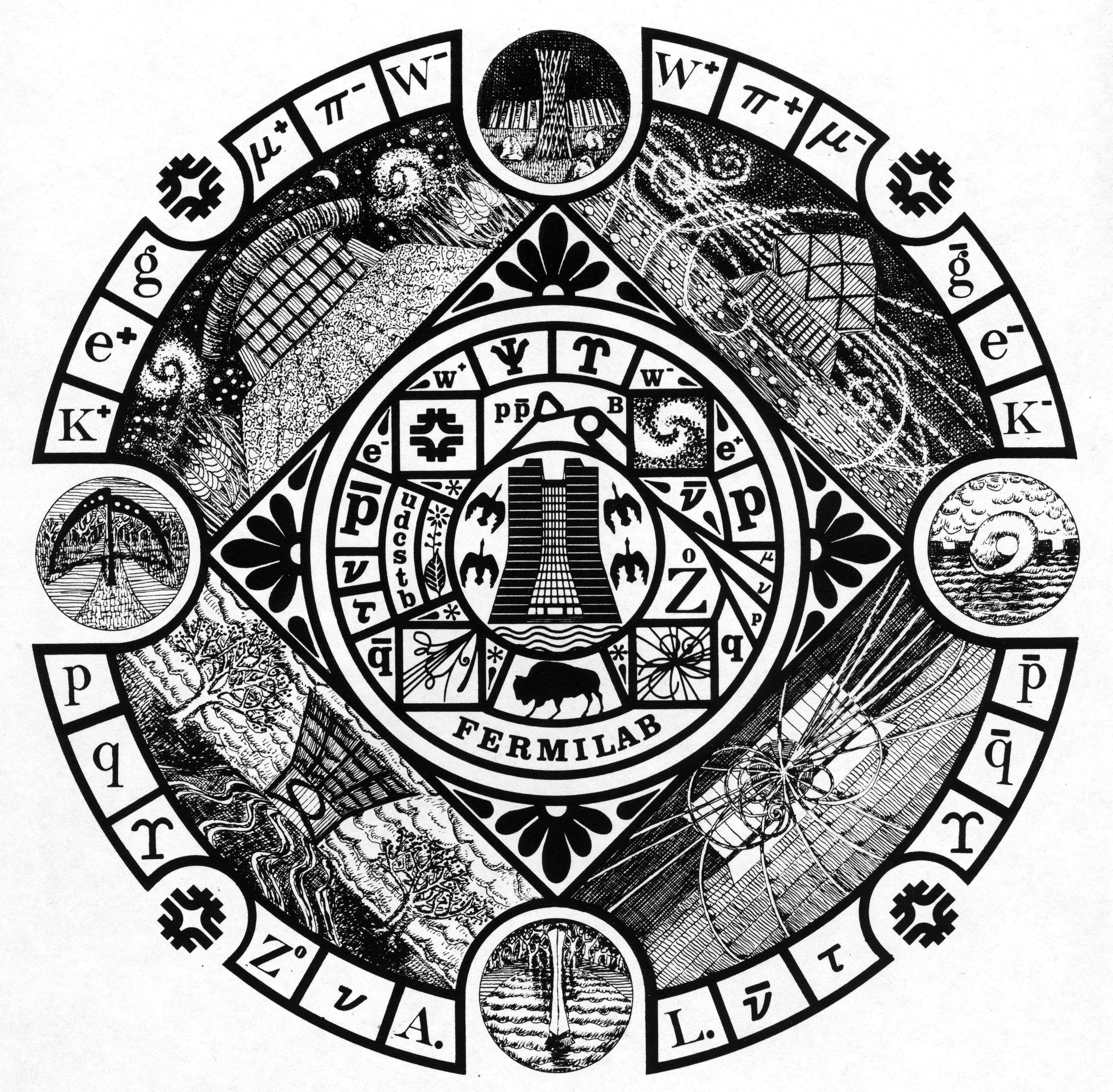
What are all of the symbols in Fermilab’s unofficial seal?

When talking about Fermilab’s distinct visual and artistic aesthetic, it’s impossible not to mention Angela Gonzales. The artist – Fermilab’s 11th employee – joined the lab in 1967 and immediately began connecting the lab’s cutting-edge science with an artistic flair to match. She picked a color palette of bold blues and oranges and reds that would go on to adorn the campus’ buildings, and illustrated hundreds of posters, signs and report covers for the lab.
She also designed the iconic logo and a beautiful graphic that has become an unofficial seal for the laboratory, most commonly found on the back of T-shirts. But what do all of the symbols mean?


Wilson Hall
Perhaps the most iconic image related to Fermilab is the silhouette of the 16-story Wilson Hall. The building is named after Fermilab’s founding director, Robert Wilson, who (among many other responsibilities, such as overseeing the design and construction of the new particle accelerator complex) took a helicopter up to plot out the best aesthetic height for the central building on Fermilab’s 6800-acre campus. The concrete building has two independent, freestanding towers that are connected by a series of crossovers that rest on rollers.


Logo
Gonzales worked with Wilson to create Fermilab’s logomark. It unifies a dipole magnet, represented by two horizontal straight lines that indicate the north and south poles of the magnet, and a quadrupole magnet (represented by the four curved lines). Dipole and quadrupole magnets help guide and focus particle beams as they move through accelerators.


Tracks
These three boxes show different kinds of sights researchers at Fermilab encounter as they explore the building blocks of the universe. In the bottom left are the swirls of tracks created as particles smash into a fixed target and the resulting debris passes through a particle detector (such as a bubble chamber, pictured). In the lower right are tracks from a head-on particle collision created by Fermilab’s Tevatron collider and recorded by its CDF and DZero experiments. In the upper right box are the swirling arms of a galaxy, representing Fermilab’s particle astrophysics program. The smallest particles of matter build up to create the largest structures in the universe.


Accelerator complex
Hidden within this piece of art is something that even some Fermilab employees might not have picked up on: the lab’s particle accelerator chain. It started with protons in the Fermilab Linear Accelerator, the straight line leading into the small circle representing the Booster accelerator. From there, protons entered the Main Ring and then the Tevatron, or were fed to the triangular Antiproton Source, a nickel target that produced antiprotons when struck. Those protons (p) and antiprotons (p̄) would then collide in one of the two detectors on the Tevatron or head down the beamlines to the fixed-target areas, where researchers studied protons, neutrinos and mesons. Today Fermilab’s largest and most powerful accelerator is the Main Injector (pictured), a 2-mile ring that powers a new suite of particle experiments.


Prairie symbols
Fermilab is one of a handful of National Environmental Research Parks in the United States. The site contains hundreds of acres of ecosystems native to the Midwest, including tall grass prairie, oak savanna, woodlands and wetlands. The site is also home to coyotes, deer, birds (including the Canadian geese depicted in the artwork), and, of course, bison. Wilson was a cowboy from Frontier, Wyoming, and he brought the first members of Fermilab’s bison herd to the site to represent the “frontier” of physics and the lab’s strong ties to the prairie.


Quarks
Quarks (q) are some of the fundamental building blocks of matter. The six known kinds are up, down, charm, strange, top and bottom (u, d, c, s, t, b), which combine to form different subatomic particles. (There is also an antiquark version (q̄) of each quark variety). The protons and neutrons that make up your atoms comprise a combination of up and down quarks. Researchers at Fermilab discovered the bottom quark in 1977 and the top quark in 1995. The above image shows then-director John Peoples discussing the top quark discovery with reporters. Today scientists use the SeaQuest experiment at Fermilab to study the presence of strange quarks in protons.


Leptons
Leptons make up another class of elementary particles. This class includes the electron (e) that powers your electronics and its heavier cousins, the muon (μ) and the tau (τ). It also includes the neutrino (ν), a lightweight, electrically neutral particle. Neutrinos are among the most abundant particles in the universe, second only to photons (particles of light), and pass through you all the time without interacting. Neutrinos have been a part of Fermilab’s fixed-target experiments (where they left tracks such as the pictured bubble chamber event) for decades and are the focus of the upcoming Deep Underground Neutrino Experiment. Fermilab is also constructing two new muon experiments, Muon g-2 and Mu2e.


Bosons
Our world is governed by various subatomic forces, which are transmitted by particles called bosons. The charged W+ and W- bosons and the neutral Z boson are the carriers of the weak force, which is responsible for how particles decay. Researchers were able to learn more about those carriers first by using fixed-target experiments and later by colliding protons and antiprotons in the CDF (pictured) and DZero detectors. Better understanding these particles and their characteristics (such as mass) helped physicists hunt for other particles predicted by theory, such as the Higgs boson.


Mesons
The two symbols at the top of the artwork represent types of mesons, which are particles made of one quark and one antiquark. The left is the J/Ψ, pronounced jay-psi, made of a charm quark and an anticharm quark. It was given two different names, both of which stuck, by the discoverers at Brookhaven and SLAC national laboratories. It revealed the existence of a fourth type of quark, the charm, and became an important part of research projects exploring theories of quark physics at laboratories around the world. The right symbol is the Υ, pronounced upsilon, a meson made of a bottom quark and an antibottom quark. The discovery of the Υ at Fermilab in 1977 by a team led by Leon Lederman (pictured) was the first experimental proof for the existence of the bottom quark.
Explore the symbols in this piece of Fermilab artwork
- Wilson Hall
- Logo
- Tracks
- Accelerator complex
- Prairie symbols
- Quarks
- Leptons
- Bosons
- Mesons
If all this symbolism isn’t enough for you—or if you’re a part of the coloring book craze and want to shade in a science drawing—fear not. Gonzales made an expanded version of this graphic. The buildings (clockwise from the top left) are the Meson Lab (now the Fermilab Test Beam Facility), the Geodesic Dome (now part of the Silicon Detector Facility), the CDF building (now part of the Illinois Accelerator Research Center) and the Pagoda (a small building that hosted a control room). She also incorporated four of the outdoor sculptures on the Fermilab site (clockwise from top): Tractricious, the Mobius Strip, Acqua Alle Funi and Broken Symmetry. You’ll also find some of the particle symbols from the core graphic, along with the symbols for π mesons, K mesons and gluons (g).
Download a high resolution version of the expanded artwork.

The Planck scale
The Planck scale sets the universe’s minimum limit, beyond which the laws of physics break.
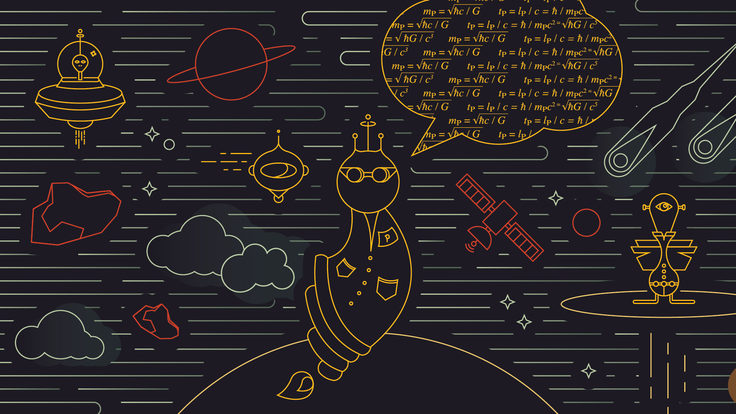
In the late 1890s, physicist Max Planck proposed a set of units to simplify the expression of physics laws. Using just five constants in nature (including the speed of light and the gravitational constant), you, me and even aliens from Alpha Centauri could arrive at these same Planck units.
The basic Planck units are length, mass, temperature, time and charge.
Let’s consider the unit of Planck length for a moment. The proton is about 100 million trillion times larger than the Planck length. To put this into perspective, if we scaled the proton up to the size of the observable universe, the Planck length would be a mere trip from Tokyo to Chicago. The 14-hour flight may seem long to you, but to the universe, it would go completely unnoticed.
The Planck scale was invented as a set of universal units, so it was a shock when those limits also turned out to be the limits where the known laws of physics applied. For example, a distance smaller than the Planck length just doesn’t make sense—the physics breaks down.
Physicists don’t know what actually goes on at the Planck scale, but they can speculate. Some theoretical particle physicists predict all four fundamental forces—gravity, the weak force, electromagnetism and the strong force—finally merge into one force at this energy. Quantum gravity and superstrings are also possible phenomena that might dominate at the Planck energy scale.
The Planck scale is the universal limit, beyond which the currently known laws of physics break. In order to comprehend anything beyond it, we need new, unbreakable physics.
Why do objects feel solid?
The way you think about atoms may not be quite right.
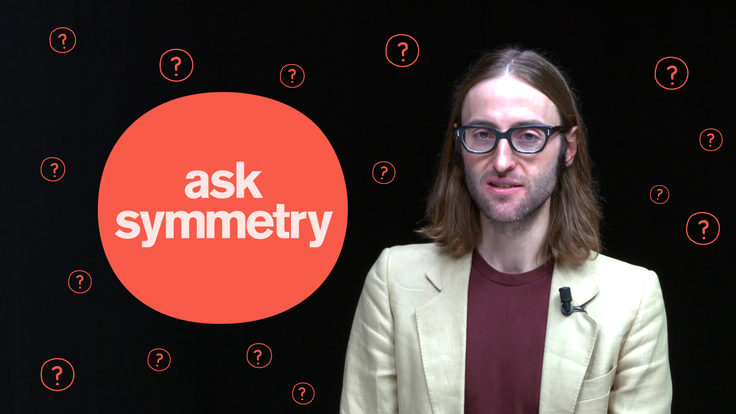
A reader asks: "If atoms are mostly empty space, then why does anything feel solid?" James Beacham, a post-doctoral researcher with the ATLAS Experiment group of The Ohio State University, explains.
Have a burning question about particle physics? Let us know via email or Twitter (using the hashtag #AskSymmetry). We might answer you in a future video!
Mommy, Daddy, where does mass come from?
The Higgs field gives mass to elementary particles, but most of our mass comes from somewhere else.

The story of particle mass starts right after the big bang. During the very first moments of the universe, almost all particles were massless, traveling at the speed of light in a very hot “primordial soup.” At some point during this period, the Higgs field turned on, permeating the universe and giving mass to the elementary particles.
The Higgs field changed the environment when it was turned on, altering the way that particles behave. Some of the most common metaphors compare the Higgs field to a vat of molasses or thick syrup, which slows some particles as they travel through.
Others have envisioned the Higgs field as a crowd at a party or a horde of paparazzi. As famous scientists or A-list celebrities pass through, people surround them, slowing them down, but less-known faces travel through the crowds unnoticed. In these cases, popularity is synonymous with mass—the more popular you are, the more you will interact with the crowd, and the more “massive” you will be.
But why did the Higgs field turn on? Why do some particles interact more with the Higgs field than others? The short answer is: We don’t know.
“This is part of why finding the Higgs field is just the beginning—because we have a ton of questions,” says Matt Strassler, a theoretical physicist and associate of the Harvard University physics department.
The strong force and you
The Higgs field gives mass to fundamental particles—the electrons, quarks and other building blocks that cannot be broken into smaller parts. But these still only account for a tiny proportion of the universe’s mass.
The rest comes from protons and neutrons, which get almost all their mass from the strong nuclear force. These particles are each made up of three quarks moving at breakneck speeds that are bound together by gluons, the particles that carry the strong force. The energy of this interaction between quarks and gluons is what gives protons and neutrons their mass. Keep in mind Einstein’s famous E=mc2, which equates energy and mass. That makes mass a secret storage facility for energy.
“When you put three quarks together to create a proton, you end up binding up an enormous energy density in a small region in space,” says John Lajoie, a physicist at Iowa State University.
A proton is made of two up quarks and a down quark; a neutron is made of two down quarks and an up quark. Their similar composition makes the mass they acquire from the strong force nearly identical. However, neutrons are slightly more massive than protons—and this difference is crucial. The process of neutrons decaying into protons promotes chemistry, and thus, biology. If protons were heavier, they would instead decay into neutrons, and the universe as we know it would not exist.
“As it turns out, the down quarks interact more strongly with the Higgs [field], so they have a bit more mass,” says Andreas Kronfeld, a theoretical physicist at Fermilab. This is why the tiny difference between proton and neutron mass exists.
But what about neutrinos?
We’ve learned that the elementary particles get their mass from the Higgs field—but wait! There may be an exception: neutrinos. Neutrinos are in a class by themselves; they have extremely tiny masses (a million times smaller than the electron, the second lightest particle), are electrically neutral and are rarely interact with matter.
Scientists are puzzled as to why neutrinos are so light. Theorists are currently considering multiple possibilities. It might be explained if neutrinos are their own antiparticles—that is, if the antimatter version is identical to the matter version. If physicists discover that this is the case, it would mean that neutrinos get their mass from somewhere other than the Higgs boson, which physicists discovered in 2012.
Neutrinos must get their mass from a Higgs-like field, which is electrically neutral and spans the entire universe. This could be the same Higgs that gives mass to the other elementary particles, or it could be a very distant cousin. In some theories, neutrino mass also comes from an additional, brand new source that could hold the answers to other lingering particle physics mysteries.
“People tend to get excited about this possibility because it can be interpreted as evidence for a brand new energy scale, naively unrelated to the Higgs phenomenon,” says André de Gouvêa, a theoretical particle physicist at Northwestern University.
This new mechanism may also be related to how dark matter, which physicists think is made up of yet undiscovered particles, gets its mass.
“Nature tends to be economical, so it's possible that the same new set of particles explains all of these weird phenomena that we haven't explained yet,” de Gouvêa says.
LHC prepares to deliver six times the data
Experiments at the Large Hadron Collider are once again recording collisions at extraordinary energies.
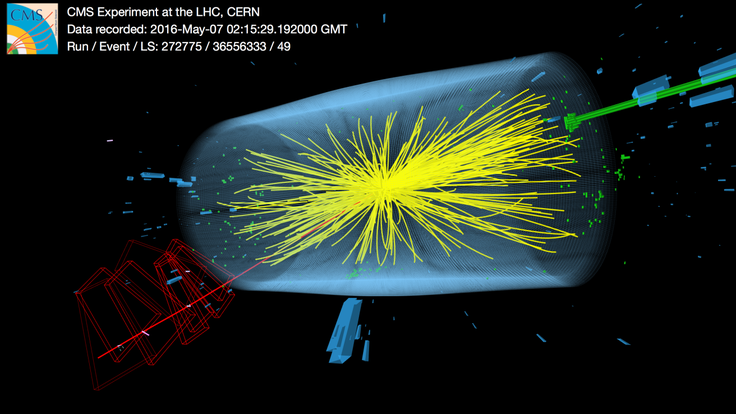
After months of winter hibernation, the Large Hadron Collider is once again smashing protons and taking data. The LHC will run around the clock for the next six months and produce roughly 2 quadrillion high-quality proton collisions, six times more than in 2015 and just shy of the total number of collisions recorded during the nearly three years of the collider’s first run.
“2015 was a recommissioning year. 2016 will be a year of full data production during which we will focus on delivering the maximum number of data to the experiments,” says Fabiola Gianotti, CERN director general.
The LHC is the world’s most powerful particle accelerator. Its collisions produce subatomic fireballs of energy, which morph into the fundamental building blocks of matter. The four particle detectors located on the LHC’s ring allow scientists to record and study the properties of these building blocks and look for new fundamental particles and forces.
“We’re proud to support more than a thousand US scientists and engineers who play integral parts in operating the detectors, analyzing the data and developing tools and technologies to upgrade the LHC’s performance in this international endeavor,” says Jim Siegrist, associate director of science for high-energy physics in the US Department of Energy’s Office of Science. “The LHC is the only place in the world where this kind of research can be performed, and we are a fully committed partner on the LHC experiments and the future development of the collider itself.”
Between 2010 and 2013 the LHC produced proton-proton collisions with 8 Tera-electronvolts of energy. In the spring of 2015, after a two-year shutdown, LHC operators ramped up the collision energy to 13 TeV. This increase in energy enables scientists to explore a new realm of physics that was previously inaccessible. Run II collisions also produce Higgs bosons—the groundbreaking particle discovered in LHC Run I—25 percent faster than Run I collisions and increase the chances of finding new massive particles by more than 40 percent.
Almost everything we know about matter is summed up in the Standard Model of particle physics, an elegant map of the subatomic world. During the first run of the LHC, scientists on the ATLAS and CMS experiments discovered the Higgs boson, the cornerstone of the Standard Model that helps explain the origins of mass. The LHCb experiment also discovered never-before-seen five-quark particles, and the ALICE experiment studied the near-perfect liquid that existed immediately after the Big Bang. All these observations are in line with the predictions of the Standard Model.
“So far the Standard Model seems to explain matter, but we know there has to be something beyond the Standard Model,” says Denise Caldwell, director of the Physics Division of the National Science Foundation. “This potential new physics can only be uncovered with more data that will come with the next LHC run.”
For example, the Standard Model contains no explanation of gravity, one of the four fundamental forces in the universe. It also does not explain astronomical observations of dark matter, a type of matter that interacts with our visible universe only through gravity, nor does it explain why matter prevailed over antimatter during the formation of the early universe. The small mass of the Higgs boson also suggests that matter is fundamentally unstable.
The new LHC data will help scientists verify the Standard Model’s predictions and push beyond its boundaries. Many predicted and theoretical subatomic processes are so rare that scientists need billions of collisions to find just a small handful of events that are clean and scientifically interesting. Scientists also need an enormous amount of data to precisely measure well-known Standard Model processes. Any significant deviations from the Standard Model’s predictions could be the first step towards new physics.
The United States is the largest national contributor to both the ATLAS and CMS experiments, with 45 US universities and laboratories working on ATLAS and 49 working on CMS.
A version of this article was published by Fermilab.

 Frascati Scienza
 Buco Nero
 Io Non Faccio Niente
 Tommaso Dorigo
 Giovanni Mazzitelli
 Barbara Gallavotti
 Keplero Blog
 Research Gate