
LHCb discovers family of tetraquarks
Researchers found four new particles made of the same four building blocks.
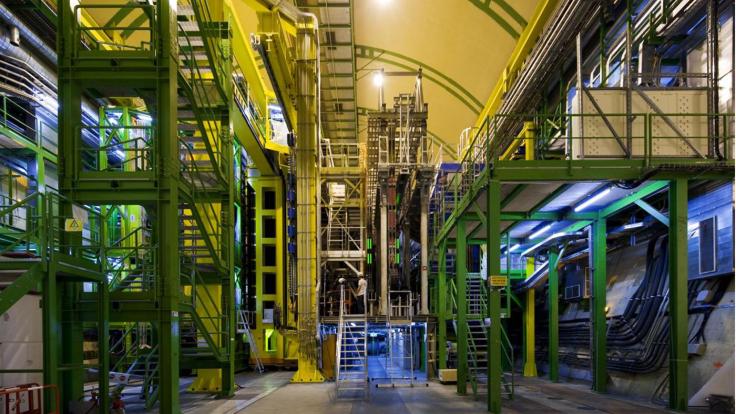
It’s quadruplets! Syracuse University researchers on the LHCb experiment confirmed the existence of a new four-quark particle and serendipitously discovered three of its siblings.
Quarks are the solid scaffolding inside composite particles like protons and neutrons. Normally quarks come in pairs of two or three, but in 2014 LHCb researchers confirmed the existence four-quark particles and, one year later, five-quark particles.
The particles in this new family were named based on their respective masses, denoted in mega-electronvolts: X(4140), X(4274), X(4500) and X(4700). Each particle contains two charm quarks and two strange quarks arranged in a unique way, making them the first four-quark particles composed entirely of heavy quarks. Researchers also measured each particle’s quantum numbers, which describe their subatomic properties. Theorists will use these new measurements to enhance their understanding of the formation of particles and the fundamental structures of matter.
“What we have discovered is a unique system,” says Tomasz Skwarnicki, a physics professor at Syracuse University. “We have four exotic particles of the same type; it’s the first time we have seen this and this discovery is already helping us distinguish between the theoretical models.”
Evidence of the lightest particle in this family of four and a hint of another were first seen by the CDF experiment at the US Department of Energy’s Fermi National Accelerator Lab in 2009. However, other experiments were unable to confirm this observation until 2012, when the CMS experiment at CERN reported seeing the same particle-like bumps with a much greater statistical certainty. Later, the D0 collaboration at Fermilab also reported another observation of this particle.
“It was a long road to get here,” says University of Iowa physicist Kai Yi, who works on both the CDF and CMS experiments. “This has been a collective effort by many complementary experiments. I’m very happy that LHCb has now reconfirmed this particle’s existence and measured its quantum numbers.”
The US contribution to the LHCb experiment is funded by the National Science Foundation.
LHCb researcher Thomas Britton performed this analysis as his PhD thesis at Syracuse University.
“When I first saw the structures jumping out of the data, little did I know this analysis would be such an aporetic saga,” Britton says. “We looked at every known particle and process to make sure these four structures couldn’t be explained by any pre-existing physics. It was like baking a six-dimensional cake with 98 ingredients and no recipe—just a picture of a cake.”
Even though the four new particles all contain the same quark composition, they each have a unique internal structure, mass and their own sets of quantum numbers. These characteristics are determined by the internal spatial configurations of the quarks.
“The quarks inside these particles behave like electrons inside atoms,” Skwarnicki says. “They can be ‘excited’ and jump into higher energy orbitals. The energy configuration of the quarks gives each particle its unique mass and identity.”
According to theoretical predictions, the quarks inside could be tightly bound (like three quarks packed inside a single proton) or loosely bound (like two atoms forming a molecule.) By closely examining each particle’s quantum numbers, scientists were able to narrow down the possible structures.
“The molecular explanation does not fit with the data,” Skwarnicki says. “But I personally would not conclude that these are definitely tightly bound states of four quarks. It could be possible that these are not even particles. The result could show the complex interplays of known particle pairs flippantly changing their identities.”
Theorists are currently working on models to explain these new results—be it a family of four new particles or bizarre ripple effects from known particles. Either way, this study will help shape our understanding of the subatomic universe.
“The huge amount of data generated by the LHC is enabling a resurgence in searches for exotic particles and rare physical phenomena,” Britton says. “There’s so many possible things for us to find and I’m happy to be a part of it.”
Preparing for their magnetic moment
Scientists are using a plastic robot and hair-thin pieces of metal to ready a magnet that will hunt for new physics.
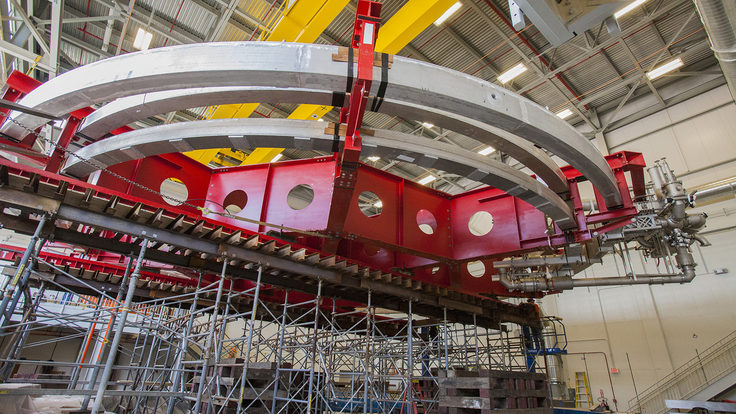
Three summers ago, a team of scientists and engineers on the Muon g-2 experiment moved a 52-foot-wide circular magnet 3200 miles over land and sea. It traveled in one piece without twisting more than a couple of millimeters, lest the fragile coils inside irreparably break. It was an astonishing feat that took years to plan and immense skill to execute.
As it turns out, that was the easy part.
The hard part—creating a magnetic field so precise that even subatomic particles see it as perfectly smooth—has been under way for seven months. It’s a labor-intensive process that has inspired scientists to create clever, often low-tech solutions to unique problems, working from a road map written 30 years ago as they drive forward into the unknown.
The goal of Muon g-2 is to follow up on a similar experiment conducted at the US Department of Energy’s Brookhaven National Laboratory in New York in the 1990s. Scientists there built an extraordinary machine that generated a near-perfect magnetic field into which they fired a beam of particles called muons. The magnetic ring serves as a racetrack for the muons, and they zoom around it for as long as they exist—usually about 64 millionths of a second.
That’s a blink of an eye, but it’s enough time to measure a particular property: the precession frequency of the muons as they hustle around the magnetic field. And when Brookhaven scientists took those measurements, they found something different than the Standard Model, our picture of the universe, predicted they would. They didn’t quite capture enough data to claim a definitive discovery, but the hints were tantalizing.
Now, 30 years later, some of those same scientists—and dozens of others, from 34 institutions around the world—are conducting a similar experiment with the same magnet, but fed by a more powerful beam of muons at the US Department of Energy’s Fermi National Accelerator Laboratory in Illinois. Moving that magnet from New York caused quite a stir among the science-interested public, but that’s nothing compared with what a discovery from the Muon g-2 experiment would cause.
“We’re trying to determine if the muon really is behaving differently than expected,” says Dave Hertzog of the University of Washington, one of the spokespeople of the Muon g-2 experiment. “And, if so, that would suggest either new particles popping in and out of the vacuum, or new subatomic forces at work. More likely, it might just be something no one has thought of yet. In any case, it’s all very exciting.”
Shimming to reduce shimmy
To start making these measurements, the magnetic field needs to be the same all the way around the ring so that, wherever the muons are in the circle, they will see the same pathway. That’s where Brendan Kiburg of Fermilab and a group of a dozen scientists, post-docs and students come in. For the past six months, they have been “shimming” the magnetic ring, shaping it to an almost inconceivably exact level.
“The primary goal of shimming is to make the magnetic field as uniform as possible,” Kiburg says. “The muons act like spinning tops, precessing at a rate proportional to the magnetic field. If a section of the field is a little higher or a little lower, the muon sees that, and will go faster or slower.”
Since the idea is to measure the precession rate to an extremely precise degree, the team needs to shape the magnetic field to a similar degree of uniformity. They want it to vary by no more than ten parts in a billion per centimeter. To put that in perspective, that’s like wanting a variation of no more than one second in nearly 32 years, or one sheet in a roll of toilet paper stretching from New York to London.
How do they do this? First, they need to measure the field they have. With a powerful electromagnet that will affect any metal object inside it, that’s pretty tricky. The solution is a marriage of high-tech and low-tech: a cart made of sturdy plastic and quartz, moved by a pulley attached to a motor and continuously tracked by a laser. On this cart are probes filled with petroleum jelly, with sensors measuring the rate at which the jelly’s protons spin in the magnetic field.
The laser can record the position of the cart to 25 microns, half the width of a human hair. Other sensors measure how far apart the top and bottom of the cart are to the magnet, to the micron.
“The cart moves through the field as it is pulled around the ring,” Kiburg says. “It takes between two and two-and-a-half hours to go around the ring. There are more than 1500 locations around the path, and it stops every three centimeters for a short moment while the field is precisely measured in each location. We then stitch those measurements into a full map of the magnetic field.”
Erik Swanson of the University of Washington is the run coordinator for this effort, meaning he directs the team as they measure the field and perform the manually intensive shimming. He also designed the new magnetic resonance probes that measure the field, upgrading them from the technology used at Brookhaven.
“They’re functionally the same,” he says of the probes, “but the Brookhaven experiment started in the 1990s, and the old probes were designed before that. Any electronics that old, there’s the potential that they will stop working.”
Swanson says that the accuracy to which the team has had to position the magnet’s iron pieces to achieve the desired magnetic field surprised even him. When scientists first turned the magnet on in October, the field, measured at different places around the ring, varied by as much as 1400 parts per million. That may seem smooth, but to a tiny muon it looks like a mountain range of obstacles. In order to even it out, the Muon g-2 team makes hundreds of minuscule adjustments by hand.
Physical physics
Stationed around the ring are about 1000 knobs that control the ways the field could become non-uniform. But when that isn’t enough, the field can be shaped by taking parts of the magnet apart and inserting extremely small pieces of steel called shims, changing the field by thousandths of an inch.
There are 12 sections of the magnet, and it takes an entire day to adjust just one of those sections.
This process relies on simulations, calibrations and iterations, and with each cycle the team inches forward toward their goal, guided by mathematical predictions. Once they’re done with the process of carefully inserting these shims, some as thin as 12.5 microns, they reassemble the magnet and measure the field again, starting the process over, refining and learning as they go.
“It’s fascinating to me how hard such a simple-seeming problem can be,” says Matthias Smith of the University of Washington, one of the students who helped design the plastic measuring robot. “We’re making very minute adjustments because this is a puzzle that can go together in multiple ways. It’s very complex.”
His colleague Rachel Osofsky, also of the University of Washington, agrees. Osofsky has helped put in more than 800 shims around the magnet, and says she enjoys the hands-on and collaborative nature of the work.
“When I first came aboard, I knew I’d be spending time working on the magnet, but I didn’t know what that meant,” she says. “You get your hands dirty, really dirty, and then measure the field to see what you did. Students later will read the reports we’re writing now and refer to them. It’s exciting.”
Similarly, the Muon g-2 team is constantly consulting the work of their predecessors who conducted the Brookhaven experiment, making improvements where they can. (One upgrade that may not be obvious is the very building that the experiment is housed in, which keeps the temperature steadier than the one used at Brookhaven and reduces shape changes in the magnet itself.)
Kiburg says the Muon g-2 team should be comfortable with the shape of the magnetic field sometime this summer. With the experiment’s beamline under construction and the detectors to be installed, the collaboration should be ready to start measuring particles by next summer. Swanson says that while the effort has been intense, it has also been inspiring.
“It’s a big challenge to figure out how to do all this right,” he says. “But if you know scientists, when a challenge seems almost impossible, that’s the one we all go for.”
The Higgs-shaped elephant in the room
Higgs bosons should mass-produce bottom quarks. So why is it so hard to see it happening?
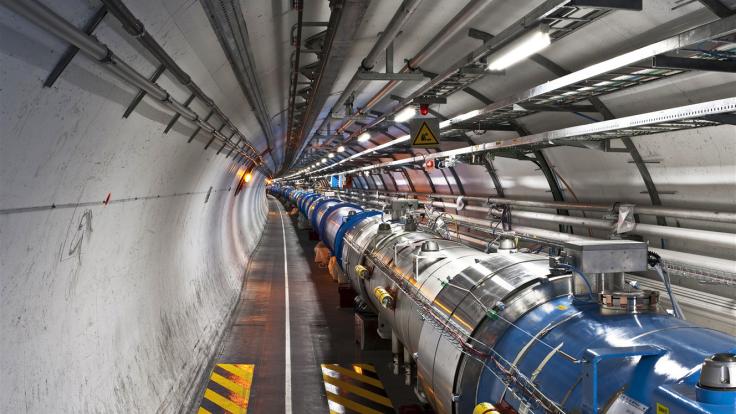
Higgs bosons are born in a blob of pure concentrated energy and live only one-septillionth of a second before decaying into a cascade of other particles. In 2012, these subatomic offspring were the key to the discovery of the Higgs boson.
So-called daughter particles stick around long enough to show up in the CMS and ATLAS detectors at the Large Hadron Collider. Scientists can follow their tracks and trace the family trees back to the Higgs boson they came from.
But the particles that led to the Higgs discovery were actually some of the boson’s less common progeny. After recording several million collisions, scientists identified a handful of Z bosons and photons with a Higgs-like origin. The Standard Model of particle physics predicts that Higgs bosons produce those particles 2.5 and 0.2 percent of the time. Physicists later identified Higgs bosons decaying into W bosons, which happens about 21 percent of the time.
According to the Standard Model, the most common decay of the Higgs boson should be a transformation into a pair of bottom quarks. This should happen about 60 percent of the time.
The strange thing is, scientists have yet to discover it happening (though they have seen evidence).
According to Harvard researcher John Huth, a member of the ATLAS experiment, seeing the Higgs turning into bottom quarks is priority No. 1 for Higgs boson research.
“It would behoove us to find the Higgs decaying to bottom quarks because this is the largest interaction,” Huth says, “and it darn well better be there.”
If the Higgs to bottom quarks decay were not there, scientists would be left completely dumbfounded.
“I would be shocked if this particle does not couple to bottom quarks,” says Jim Olsen, a Princeton researcher and Physics Coordinator for the CMS experiment. “The absence of this decay would have a very large and direct impact on the relative decay rates of the Higgs boson to all of the other known particles, and the recent ATLAS and CMS combined measurements are in excellent agreement with expectations.”
To be fair, the decay of a Higgs to two bottom quarks is difficult to spot.
When a dying Higgs boson produces twin Z or W bosons, they each decay into a pair of muons or electrons. These particles leave crystal clear signals in the detectors, making it easy for scientists to spot them and track their lineage. And because photons are essentially immortal beams of light, scientists can immediately spot them and record their trajectory and energy with electromagnetic detectors.
But when a Higgs births a pair of bottom quarks, they impulsively marry other quarks, generating huge unstable families which bourgeon, break and reform. This chaotic cascade leaves a messy ancestry.
Scientists are developing special tools to disentangle the Higgs from this multi-generational subatomic soap opera. Unfortunately, there are no cheek swabs or Maury Povich to announce, Higgs, you are the father! Instead, scientists are working on algorithms that look for patterns in the energy these jets of particles deposit in the detectors.
“The decay of Higgs bosons to bottom quarks should have different kinematics from the more common processes and leave unique signatures in our detector,” Huth says. “But we need to deeply understand all the variables involved if we want to squeeze the small number of Higgs events from everything else.”
Physicist Usha Mallik and her ATLAS team of researchers at the University of Iowa have been mapping the complex bottom quark genealogies since shortly after the Higgs discovery in 2012.
“Bottom quarks produce jets of particles with all kinds and colors and flavors,” Mallik says. “There are fat jets, narrow gets, distinct jets and overlapping jets. Just to find the original bottom quarks, we need to look at all of the jet’s characteristics. This is a complex problem with a lot of people working on it.”
This year the LHC will produce five times more data than it did last year and will generate Higgs bosons 25 percent faster. Scientists expect that by August they will be able to identify this prominent decay of the Higgs and find out what it can tell them about the properties of this unique particle.
All four one and one for all
A theory of everything would unite the four forces of nature, but is such a thing possible?

Over the centuries, physicists have made giant strides in understanding and predicting the physical world by connecting phenomena that look very different on the surface.
One of the great success stories in physics is the unification of electricity and magnetism into the electromagnetic force in the 19th century. Experiments showed that electrical currents could deflect magnetic compass needles and that moving magnets could produce currents.
Then physicists linked another force, the weak force, with that electromagnetic force, forming a theory of electroweak interactions. Some physicists think the logical next step is merging all four fundamental forces—gravity, electromagnetism, the weak force and the strong force—into a single mathematical framework: a theory of everything.
Those four fundamental forces of nature are radically different in strength and behavior. And while reality has cooperated with the human habit of finding patterns so far, creating a theory of everything is perhaps the most difficult endeavor in physics.
“On some level we don't necessarily have to expect that [a theory of everything] exists,” says Cynthia Keeler, a string theorist at the Niels Bohr Institute in Denmark. “I have a little optimism about it because historically, we have been able to make various unifications. None of those had to be true.”
Despite the difficulty, the potential rewards of unification are great enough to keep physicists searching. Along the way, they’ve discovered new things they wouldn’t have learned had it not been for the quest to find a theory of everything.

United we hope to stand
No one has yet crafted a complete theory of everything.
It’s hard to unify all of the forces when you can’t even get all of them to work at the same scale. Gravity in particular tends to be a tricky force, and no one has come up with a way of describing the force at the smallest (quantum) level.
Physicists such as Albert Einstein thought seriously about whether gravity could be unified with the electromagnetic force. After all, general relativity had shown that electric and magnetic fields produce gravity and that gravity should also make electromagnetic waves, or light. But combining gravity and electromagnetism, a mission called unified field theory, turned out to be far more complicated than making the electromagnetic theory work. This was partly because there was (and is) no good theory of quantum gravity, but also because physicists needed to incorporate the strong and weak forces.
A different idea, quantum field theory, combines Einstein’s special theory of relativity with quantum mechanics to explain the behavior of particles, but it fails horribly for gravity. That’s largely because anything with energy (or mass, thanks to relativity) creates a gravitational attraction—including gravity itself. To oversimplify somewhat, the gravitational interaction between two particles has a certain amount of energy, which produces an additional gravitational interaction with its own energy, and so on, spiraling to higher energies with each extra piece.
“One of the first things you learn about quantum gravity is that quantum field theory probably isn’t the answer,” says Robert McNees, a physicist at Loyola University Chicago. “Quantum gravity is hard because we have to come up with something new.”

An evolution of theories
The best-known candidate for a theory of everything is string theory, in which the fundamental objects are not particles but strings that stretch out in one dimension.
Strings were proposed in the 1970s to try to explain the strong force. This first string theory proved to be unnecessary, but physicists realized it could be joined to the another theory called Kaluza-Klein theory as a possible explanation of quantum gravity.
String theory expresses quantum gravity in two dimensions rather than the four, bypassing all the problems of the quantum field theory approach but introducing other complications, namely an extra six dimensions that must be curled up on a scale too small to detect.
Unfortunately, string theory has yet to reproduce the well-tested predictions of the Standard Model.
Another well-known idea is the sci-fi-sounding “loop quantum gravity,” in which space-time on the smallest scales is made of tiny loops in a flexible mesh that produces gravity as we know it.
The idea that space-time is made up of smaller objects, just as matter is made of particles, is not unique to the theory. There are many others with equally Jabberwockian names: twistors, causal set theory, quantum graphity and so on. Granular space-time might even explain why our universe has four dimensions rather than some other number.
Loop quantum gravity’s trouble is that it can’t replicate gravity at large scales, such as the size of the solar system, as described by general relativity.
None of these theories has yet succeeded in producing a theory of everything, in part because it's so hard to test them.
“Quantum gravity is expected to kick in only at energies higher than anything that we can currently produce in a lab,” says Lisa Glaser, who works on causal set quantum gravity at the University of Nottingham. “The hope in many theories is now to predict cumulative effects,” such as unexpected black hole behavior during collisions like the ones detected recently by LIGO.
Today, many of the theories first proposed as theories of everything have moved beyond unifying the forces. For example, much of the current research in string theory is potentially important for understanding the hot soup of particles known as the quark-gluon plasma, along with the complex behavior of electrons in very cold materials like superconductors—something seemingly as far removed from quantum gravity as could be.
“On a day-to-day basis, I may not be doing a calculation that has anything directly to do with string theory,” Keeler says. “But it’s all about these ideas that came from string theory.”
Finding a theory of everything is unlikely to change the way most of us go about our business, even if our business is science. That’s the normal way of things: Chemists and electricians don't need to use quantum electrodynamics, even though that theory underlies their work. But finding such a theory could change the way we think of the universe on a fundamental level.
Even a successful theory of everything is unlikely to be a final theory. If we’ve learned anything from 150 years of unification, it’s that each step toward bringing theories together uncovers something new to learn.
Second gravitational wave detection announced
For a second time, scientists from the LIGO and Virgo collaborations saw gravitational waves from the merger of two black holes.
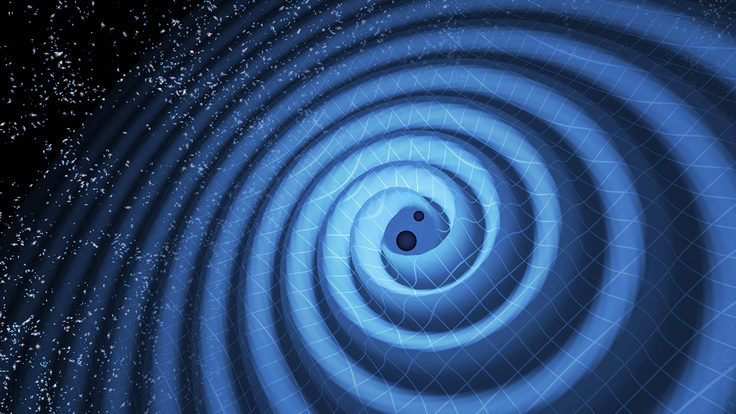
Scientists from the LIGO and Virgo collaborations announced today the observation of gravitational waves from a set of merging black holes.
This follows their previous announcement, just four months ago, of the first ever detection of gravitational waves, also from a set of merging black holes.
The detection of gravitational waves confirmed a major prediction of Albert Einstein’s 1915 general theory of relativity. Einstein posited that every object with mass exerts a gravitational pull on everything around it. When a massive object moves, its pull changes, and that change is communicated in the form of gravitational waves.
Gravity is by far the weakest of the known forces, but if an object is massive enough and accelerates quickly enough, it creates gravitational waves powerful enough to be observed experimentally. LIGO, or Laser Interferometer Gravitational-wave Observatory, caught the two sets of gravitational waves using lasers and mirrors.
LIGO consists of two huge interferometers in Livingston, Louisiana, and Hanford, Washington. In an interferometer, a laser beam is split and sent down a pair of perpendicular arms. At the end of each arm, the split beams bounce off of mirrors and return to recombine in the center. If a gravitational wave passes through the laser beams as they travel, it stretches space-time in one direction and compresses it in another, creating a mismatch between the two.
Scientists on the Virgo collaboration have been working with LIGO scientists to analyze their data.
With this second observation, “we are now a real observatory,” said Gabriela Gonzalez, LIGO spokesperson and professor of physics and astronomy at Louisiana State University, in a press conference at the annual meeting of the American Astronomical Society.
The latest discovery was accepted for publication in the journal Physical Review Letters.
On Christmas evening in 2015, a signal that had traveled about 1.4 billion light years reached the twin LIGO detectors. The distant merging of two black holes caused a slight shift in the fabric of space-time, equivalent to changing the distance between the Earth and the sun by a fraction of an atomic diameter.
The black holes were 14 and eight times as massive as the sun, and they merged into a single black hole weighing 21 solar masses. That might sound like a lot, but these were relative flyweights compared to the black holes responsible for the original discovery, which weighed 36 and 29 solar masses.
“It is very significant that these black holes were much less massive than those observed in the first detection,” Gonzalez said in a press release. “Because of their lighter masses compared to the first detection, they spent more time—about one second—in the sensitive band of the detectors.”
The LIGO detectors saw almost 30 of the last orbits of the black holes before they coalesced, Gonzalez said during the press conference.
LIGO’s next data-taking run will begin in the fall. The Virgo detector, located near Pisa, Italy, is expected to come online in early 2017. Additional gravitational wave detectors are in the works in Japan and India.
Additional detectors will make it possible not only to find evidence of gravitational waves, but also to triangulate their origins.
On its own, LIGO is “more of a microphone,” capturing the “chirps” from these events, Gonzalez said.
The next event scientists are hoping to “hear” is the merger of a pair of neutron stars, said Caltech’s David Reitze, executive director of the LIGO laboratory, at the press conference.
Whereas two black holes merging are not expected to release light, a pair of neutron stars in the process of collapsing into one another could release a plethora of observable gamma rays, X-rays, infrared light and even neutrinos.
In the future, gravitational wave hunters hope to be able to alert astronomers to an event with enough time and precision to allow them to train their instruments on the area and see those signals.
The neutrino turns 60
Project Poltergeist led to the discovery of the ghostly particle. Sixty years later, scientists are confronted with more neutrino mysteries than ever before.

In 1930, Wolfgang Pauli proposed the existence of a new tiny particle with no electric charge. The particle was hypothesized to be very light—or possibly have no mass at all—and hardly ever interact with matter. Enrico Fermi later named this mysterious particle the “neutrino” (or “little neutral one”).
Although neutrinos are extremely abundant, it took 26 years for scientists to confirm their existence. In the 60 years since the neutrino’s discovery, we’ve slowly learned about this intriguing particle.
“At every turn, it seems to take a decade or two for scientists to come up with experiments to start to probe the next property of the neutrino,” says Keith Rielage, a neutrino researcher at the Department of Energy’s Los Alamos National Laboratory. “And once we do, we’re often left scratching our heads because the neutrino doesn’t act as we expect. So the neutrino has been an exciting particle from the start.”
We now know that there are actually three types, or “flavors,” of neutrinos: electron, muon and tau. We also know that neutrinos change, or “oscillate,” between the three types as they travel through space. Because neutrinos oscillate, we know they must have mass.
However, many questions about neutrinos remain, and the search for the answers involves scientists and experiments around the world.
The mystery of the missing energy
Pauli thought up the neutrino while trying to solve the problem of energy conservation in a particular reaction called beta decay. Beta decay is a way for an unstable atom to become more stable—for example, by transforming a neutron into a proton. In this process, an electron is emitted.
If the neutron transformed into only a proton and an electron, their energies would be well defined. However, experiments showed that the electron did not always emerge with a particular energy—instead, electrons showed a range of energies. To account for this range, Pauli hypothesized that an unknown neutral particle must be involved in beta decay.
“If there were another particle involved in the beta decay, all three particles would share the energy, but not always exactly the same way,” says Jennifer Raaf, a neutrino researcher at DOE’s Fermi National Accelerator Laboratory. “So sometimes you could get an electron with a high energy and sometimes you could get one with a low energy.”
In the early 1950s, Los Alamos physicist Frederick Reines and his colleague Clyde Cowan set out to detect this tiny, neutral, very weakly interacting particle.
At the time, neutrinos were known as mysterious “ghost” particles that are all around us but mostly pass straight through matter and take away energy in beta decays. For this reason, Reines and Cowan’s search to detect the neutrino came to be known as “Project Poltergeist.”
“The name seemed logical because they were basically trying to exorcise a ghost,” Rielage says.
Catching the ghost particle
“The story of the discovery of the neutrino is an interesting one, and in some ways, one that could only happen at Los Alamos,” Rielage says.
It all started in the early 1950s. Working at Los Alamos, Reines had led several projects testing nuclear weapons in the Pacific, and he was interested in fundamental physics questions that could be explored as part of the tests. A nuclear explosion was thought to create an intense burst of antineutrinos, and Reines thought an experiment could be designed to detect some of them. Reines convinced Cowan, his colleague at Los Alamos, to work with him to design such an experiment.
Reines and Cowan’s first idea was to put a large liquid scintillator detector in a shaft next to an atmospheric nuclear explosion test site. But then they came up with a better idea—to put the detector next to a nuclear reactor.
So in 1953, Reines and Cowan headed to the large fission reactor in Hanford, Washington with their 300-liter detector nicknamed “Herr Auge” (German for “Mr. Eye”).
Although Reines and Cowan did detect a small increase in neutrino-like signals when the reactor was on versus when it was off, the noise was overwhelming. They could not definitively conclude that the small signal was due to neutrinos. While the detector’s shielding succeeded in blocking the neutrons and gamma rays from the reactor, it could not stop the flood of cosmic rays raining down from space.
Over the next year, Reines and Cowan completely redesigned their detector into a stacked three-layer configuration that would allow them to clearly differentiate between a neutrino signal and the cosmic ray background. In late 1955, they hit the road again with their new 10-ton detector—this time to the powerful fission reactor at the Savannah River Plant in South Carolina.
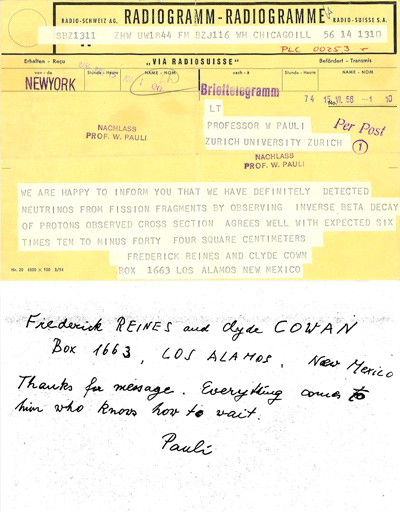
For more than five months, Reines and Cowan collected data and analyzed the results. In June 1956, they sent a telegram to Pauli. It said, “We are happy to inform you that we have definitively detected neutrinos.”
Major milestones in the history of neutrino research
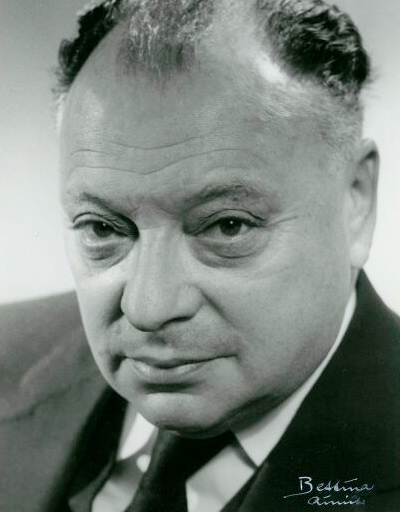
1930
Wolfgang Pauli hypothesizes the existence of the neutrino to explain the problem of energy conservation in beta decay.
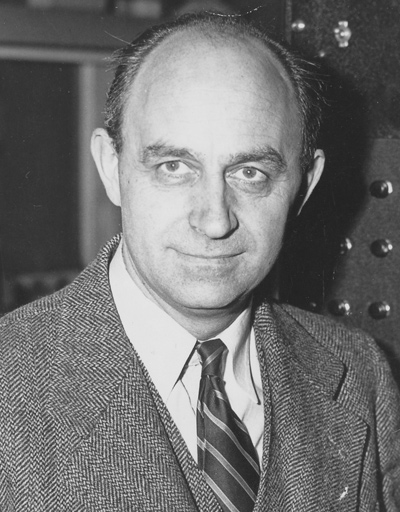
1934
Enrico Fermi proposes a theory that includes Pauli’s hypothesized particle, which he calls the “neutrino” (Italian for “little neutral one”).
Hans Bethe and Rudolf Peierls calculate that the probability of neutrinos interacting with matter is extremely small and conclude there is no practical way of observing the neutrino.
1956
A team of scientists led by physicists Frederick Reines and Clyde Cowan observe the first evidence of neutrinos by detecting electron antineutrinos produced by a nuclear reactor at the Savannah River Plant.
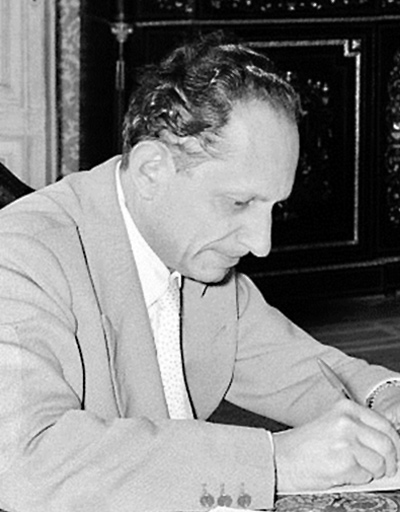
1957
Bruno Pontecorvo hypothesizes that neutrinos may oscillate, or change from one type to another.
1958
Scientists at Brookhaven National Laboratory determine that neutrinos always have left-handed helicity (the direction of their spin is the opposite direction of their motion).
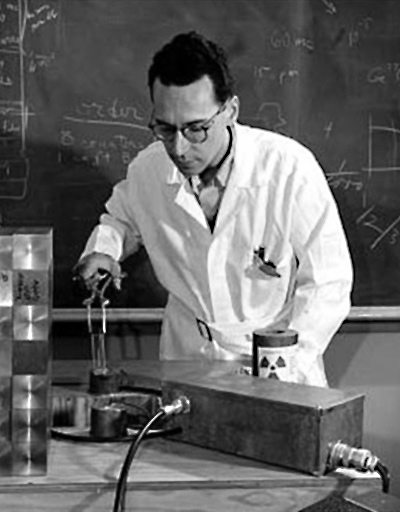
1962
A team of scientists led by Leon Lederman, Mel Schwartz and Jack Steinberger discover the existence of a second type of neutrino, the muon neutrino, in an experiment at Brookhaven National Laboratory.
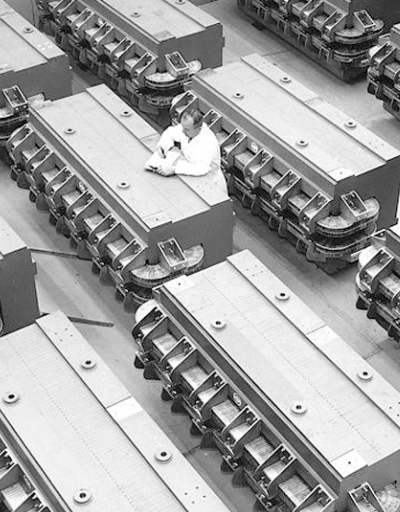
1968
Chemist Ray Davis is the first to detect electron neutrinos produced by the sun. However, his experiment in the Homestake mine only detects one-third the number of solar neutrinos predicted, leading to the “solar neutrino problem.”
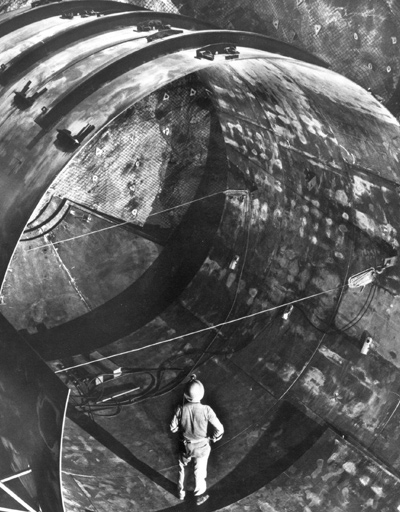
1973
Scientists of the Gargamelle collaboration at CERN observe for the first time the neutral-current scattering of a neutrino off an electron, indicating the existence of a new force carrier, later discovered to be the Z boson.
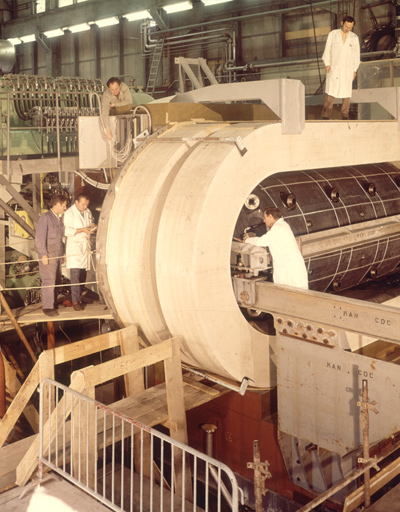
1975
The existence of the tau neutrino is postulated after Martin Perl and colleagues at SLAC National Accelerator Laboratory first detect the charged tau lepton.
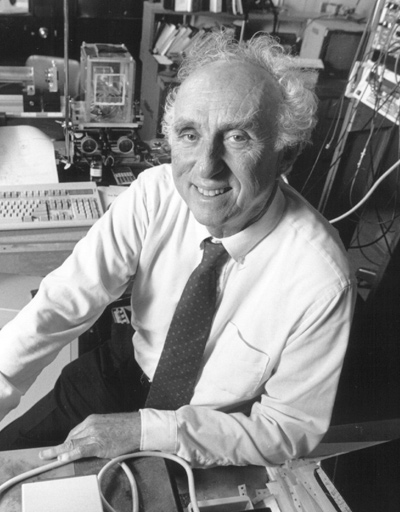
1985
The Kamiokande collaboration in Japan and the IMB collaboration in the United States detect atmospheric neutrinos, which are produced when cosmic rays interact with particles in the atmosphere. However, the experiments detect a smaller ratio of muon neutrinos to electron neutrinos than predicted, leading to the “atmospheric neutrino anomaly.”
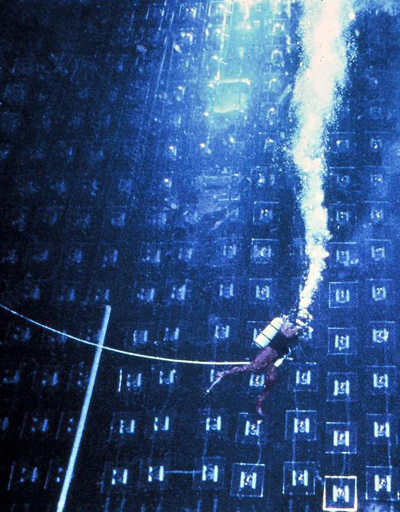
1987
The Kamiokande and IMB collaborations detect neutrinos emitted by an exploding star, Supernova 1987A, for the first time.
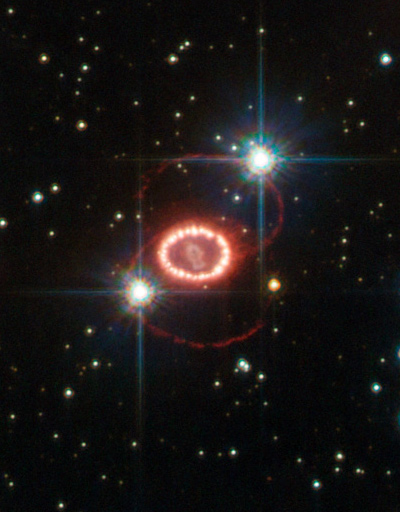
1988
Leon Lederman, Mel Schwartz, and Jack Steinberger are awarded the Nobel Prize in Physics for the discovery of the muon neutrino.
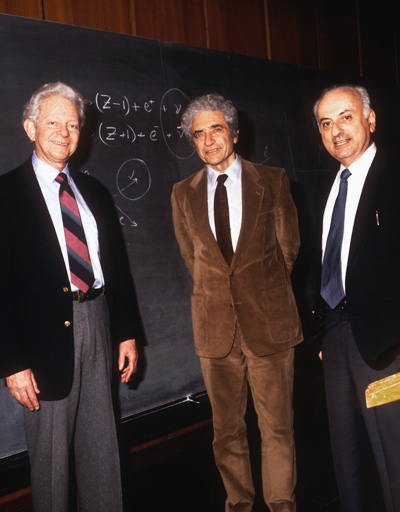
1989
Scientists at CERN and SLAC National Accelerator Laboratory announce evidence that there can only be three types of light neutrinos (electron, muon, and tau).
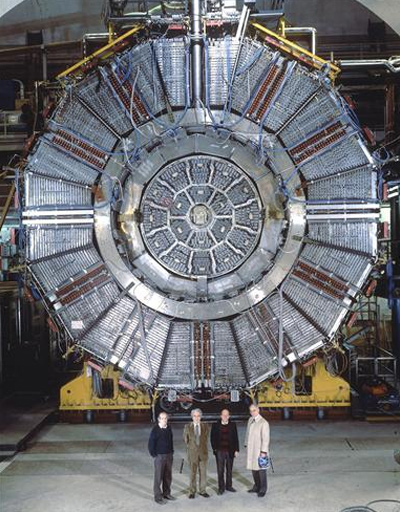
1995
Frederick Reines is awarded a share of the Nobel Prize in Physics for the discovery of the electron neutrino.
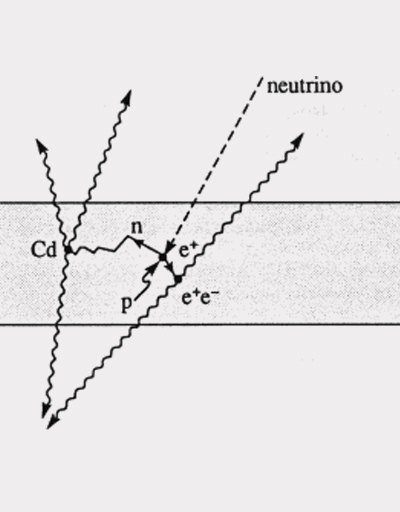
1998
The Super-Kamiokande collaboration in Japan announces the first evidence of neutrino oscillations, which implies that neutrinos have mass. The experiment shows the disappearance of atmospheric muon neutrinos as they travel from their point of origin to an underground detector.
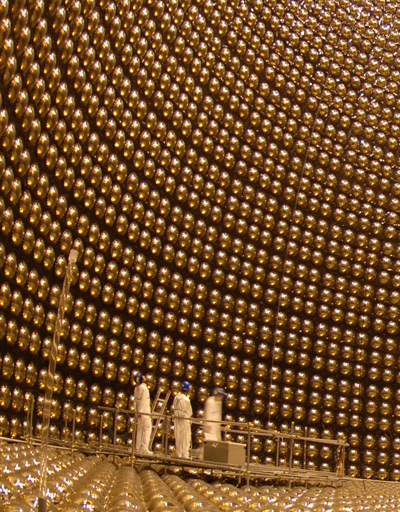
2000
Scientists on the DONUT experiment at Fermi National Accelerator Laboratory are the first to observe the third type of neutrino, the tau neutrino.
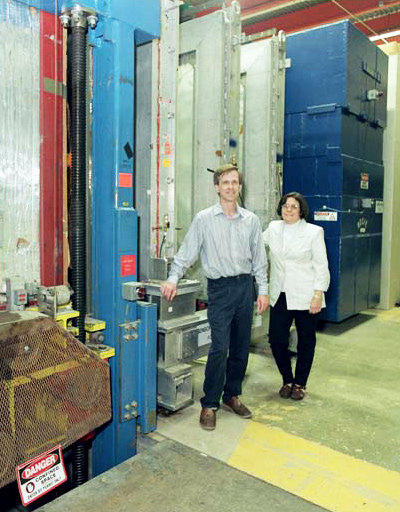
2001
The SNO collaboration in Canada announces the first evidence of solar neutrino oscillation.
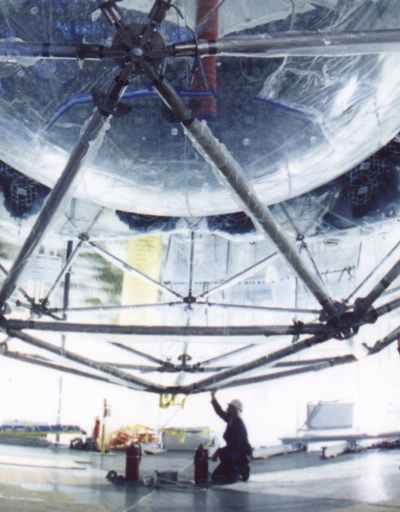
2002
The SNO collaboration announces conclusive evidence of solar neutrino oscillation.
Ray Davis and Masatoshi Koshiba are awarded a share of the Nobel Prize in Physics for the first detection of neutrinos of cosmic origin.
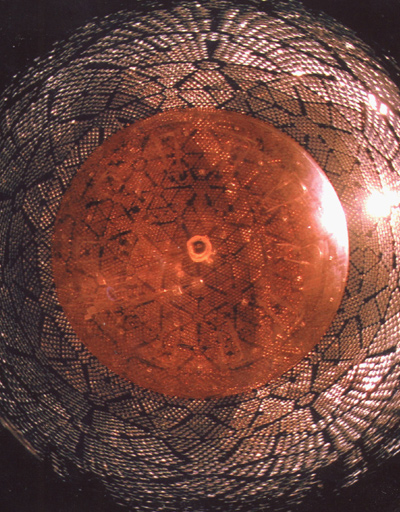
2004
The KamLAND collaboration in Japan announces evidence of electron antineutrino reappearance when recording antineutrinos produced by a nuclear reactor, an indication of antineutrino oscillation.
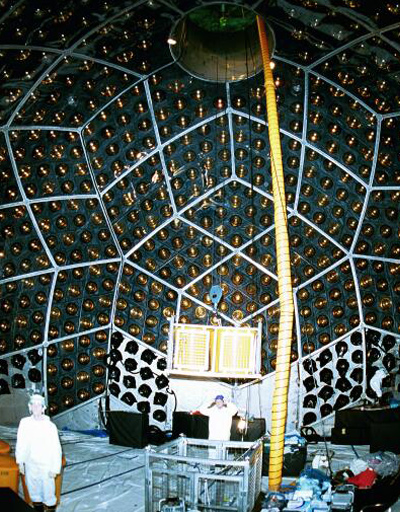
2005
The KamLAND collaboration announces the first detection of geoneutrinos, which are neutrinos produced inside the Earth.
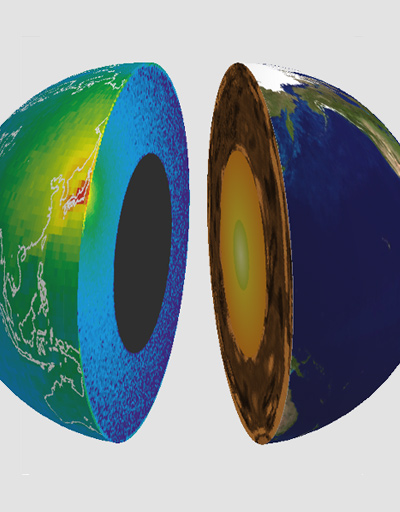
2010
The OPERA collaboration at the Laboratori Nazionali del Gran Sasso in Italy is the first to detect a tau neutrino in a muon neutrino beam. The muon neutrino oscillated on its path from CERN to Gran Sasso.
2015
Takaaki Kajita of the Super-Kamiokande experiment and Arthur McDonald of the SNO experiment are awarded the Nobel Prize in Physics for their contributions to detecting neutrino oscillations.

- 1930
- 1934
- 1956
- 1957
- 1958
- 1962
- 1968
- 1973
- 1975
- 1985
- 1987
- 1988
- 1989
- 1995
- 1998
- 2000
- 2001
- 2002
- 2004
- 2005
- 2010
- 2015
Solving the next neutrino mystery
In the 1960s, a new mystery involving the neutrino began—this time in a gold mine in South Dakota.
Ray Davis, a nuclear chemist at the DOE’s Brookhaven National Laboratory, had designed an experiment to detect neutrinos produced in reactions in the sun, also known as solar neutrinos. It featured a large chlorine-based detector located a mile underground in the Homestake Mine, which provided shielding from cosmic rays.
In 1968, the Davis experiment detected solar neutrinos for the first time, but the results were puzzling. Astrophysicist John Bahcall had calculated the expected flux of neutrinos from the sun—that is, the number of neutrinos that should be detected over a certain area in a certain amount of time. However, the experiment was only detecting about one-third the number of neutrinos predicted. This discrepancy came to be known as the “solar neutrino problem.”
At first, scientists thought there was a problem with Davis’ experiment or with the model of the sun, but no problems were found. Slowly, scientists began to suspect that it was actually an issue with the neutrinos.
“Neutrinos always seem to surprise us,” Rielage says. “We think something is fairly straightforward, and it turns out not to be.”
Scientists theorized that neutrinos might oscillate, or change from one type to another, as they travel through space. Davis’ experiment was only sensitive to electron neutrinos, so if neutrinos oscillated and arrived at the Earth as a mixture of the three types, it would explain why the experiment was only detecting one-third of them.
In 1998, the Super-Kamiokande experiment in Japan first detected atmospheric neutrino oscillations. Then, in 2001, the Sudbury Neutrino Observatory in Canada announced the first evidence of solar neutrino oscillations, followed by conclusive evidence in 2002. After more than 30 years, scientists were able to confirm that neutrinos oscillate, thus solving the solar neutrino problem.
“The fact that neutrinos oscillate is interesting, but the critical thing is that it tells us that neutrinos must have mass,” says Gabriel Orebi Gann, a neutrino researcher at the University of California, Berkeley, and the DOE’s Lawrence Berkley National Laboratory and a SNO collaborator. “This is huge because there was no expectation in the Standard Model that the neutrino would have mass.”
Mysteries beyond the Standard Model
The Standard Model—the theoretical model that describes elementary particles and their interactions—does not include a mechanism for neutrinos to have mass. The discovery of neutrino oscillation put a serious crack into an otherwise extremely accurate picture of the subatomic world.
“It’s important to poke at this picture and see which parts of it hold up to experimental testing and which parts still need additional information filled in,” Raaf says.
After 60 years of studying neutrinos, several mysteries remain that could provide windows into physics beyond the Standard Model.
Is the neutrino its own antiparticle?
The neutrino is unique in that it has the potential to be its own antiparticle. “The only thing we know at the moment that distinguishes matter from antimatter is electric charge,” Orebi Gann says. “So for the neutrino, which has no electric charge, it’s sort of an obvious question – what is the difference between a neutrino and its antimatter partner?”
If the neutrino is not its own antiparticle, there must be something other than charge that makes antimatter different from matter. “We currently don’t know what that would be,” Orebi Gann says. “It would be what we call a new symmetry.”
Scientists are trying to determine if the neutrino is its own antiparticle by searching for neutrinoless double beta decay. These experiments look for events in which two neutrons decay into protons at the same time. The standard double beta decay would produce two electrons and two antineutrinos. However, if the neutrino is its own antiparticle, the two antineutrinos could annihilate, and only electrons would come out of the decay.
Several upcoming experiments will look for neutrinoless double beta decay. These include the SNO+ experiment in Canada, the CUORE experiment at the Laboratori Nazionali del Gran Sasso in Italy, the EXO-200 experiment at the Waste Isolation Pilot Plant in New Mexico, and the MAJORANA experiment at the Sanford Underground Research Facility in the former Homestake mine in South Dakota (the same mine in which Davis conducted his famous solar neutrino experiment).
What is the order, or “hierarchy,” of the neutrino mass states?
We know that neutrinos have mass and that the three neutrino mass states differ slightly, but we do not know which is the heaviest and which is the lightest. Scientists are aiming to answer this question through experiments that study neutrinos as they oscillate over long distances.
For these experiments, a beam of neutrinos is created at an accelerator and sent through the Earth to far-away detectors. Such long-baseline experiments include Japan’s T2K experiment, Fermilab’s NOvA experiment and the planned Deep Underground Neutrino Experiment.
What is the absolute mass of neutrinos?
To try to measure the absolute mass of neutrinos, scientists are returning to the reaction that first signaled the existence of the neutrino—beta decay. The KATRIN experiment in Germany aims to directly measure the mass of the neutrino by studying tritium (an isotope of hydrogen) that decays through beta decay.
Are there more than three types of neutrinos?
Scientists have hypothesized another even more weakly interacting type of neutrino called the “sterile” neutrino. To look for evidence of sterile neutrinos, scientists are studying neutrinos as they travel over short distances.
As part of the short baseline neutrino program at Fermilab, scientists will use three detectors to look for sterile neutrinos: the Short Baseline Neutrino Detector, MicroBooNE and ICARUS (a neutrino detector that previously operated at Gran Sasso). Gran Sasso will also host an upcoming experiment called SOX that will look for sterile neutrinos.
Do neutrinos violate “charge parity (CP) symmetry”?
Scientists are also using long-baseline experiments to search for something called CP violation. If equal amounts of matter and antimatter were created in the Big Bang, it all should have annihilated. Because the universe contains matter, something must have led to there being more matter than antimatter. If neutrinos violate CP symmetry, it could help explain why there is more matter.
“Not having all the answers about neutrinos is what makes it exciting,” Rielage says. “The problems that are left are challenging, but we often joke that if it were easy, someone would have already figured it out by now. But that’s what I enjoy about it—we have to really think outside the box in our search for the answers.”
CERN grants beam time to students
Contest winners will study special relativity and an Egyptian pyramid using a CERN beamline.
Two groups of high school teams have beat out nearly 150 others from around the world to secure a highly prized opportunity: the chance to do a science project—at CERN.
After sorting through a pool of teams that represented more than a thousand students from 37 countries, today CERN announced the winners of its third Beamline for Schools competition. The two teams, “Pyramid Hunters” from Poland and “Relatively Special” from the United Kingdom, will travel to Geneva in September to put their experiments to the test.
“We honestly couldn’t be more thrilled to have been given this opportunity,” said Henry Broomfield, a student on the “Relatively Special” team, in an email. “The prospect of winning always seemed like something that would only occur in a parallel universe, so at first we didn’t believe it.”
“Relatively Special” consists of 17 students from Colchester Royal Grammar School in the United Kingdom. Nine of the students will travel to CERN for the competition. They plan to test the Lorentz factor, an input used in calculations related to Einstein’s theory of special relativity.
According to the theory, the faster an object moves, the higher its apparent mass will be and the slower its time will pass relative to our own. This concept, known as time dilation, is most noticeable at speeds approaching the speed of light and is the reason GPS satellites have to adjust their clocks to match the time on Earth. At CERN, “Relatively Special” will measure the decay of pions, particles containing a quark and an antiquark, to see if the particles moving closer to the speed of light decay at the slower rate predicted by time dilation.
The other team, “Pyramid Hunters,” is a group of seven students from Liceum Ogólnokształcące im. Marsz. St. Małachowskiego in Poland. These students plan to use particle physics to strengthen the archeological knowledge of the Pyramid of Khafre, one of the largest and most iconic of the Egyptian pyramids.
The pyramid was mapped in the 1960s using muon tomography, a technique similar to X-ray scanning that uses heavy particles called muons to generate images of a target. “Pyramid Hunters” will attempt to improve the understanding of that early data by firing muons into limestone, the material that was used to build the pyramids. They will observe the rate at which the muons are absorbed. The absorption rate can tell researchers about the thickness of the material they scanned.
The Beamline for Schools competition began two years ago, coinciding with CERN’s 60th anniversary. Its purpose was to give students the opportunity to run an experiment on a CERN beamline in the same way its regular researchers do. For the competition, students submitted written proposals for their projects, as well as creative one-minute videos to explain their goals for their projects and the experience in general.
A CERN committee selected the students based on “creativity, motivation, feasibility and scientific method,” according to a press release. CERN recognized the projects of nearly 30 other teams, rewarding them with certificates, t-shirts and pocket-size cosmic ray detectors for their schools.
“I am impressed with the level of interest within high schools all over Europe and beyond, as well as with the quality of the proposals,” Claude Vallee, the chairperson of the CERN committee that chose the winning teams, said in a press release.
The previous winning teams hailed from the Netherlands, Italy, Greece and South Africa. Some of their projects have included examining the weak force and testing calorimeters and particle detectors made from different materials.
“I can't imagine better way of learning physics than doing research in the largest particle physics laboratory in the world,” said Kamil Szymczak, a student on the “Pyramid Hunters” team, in a press release. “I still can't believe it.”
The neutrino cocktail
Neutrinos are a puzzling mixture of three flavors and three masses. Scientists want to measure it down to the last drop.

For a neutrino, travel is truly life-changing. When one of the tiny particles ends its 500-mile journey from Fermilab’s neutrino source to the NOvA experiment’s detector in Minnesota, it may arrive in an entirely different state than when it started. The particles, which zip through most matter without any interaction at all, can change from one of the three known neutrino varieties into another, a phenomenon known as oscillation.
Due to quantum mechanics, a traveling neutrino is actually in several different states at once. This is a result of a property known as mixing, and though it sounds esoteric, it’s necessary for some of the most important reactions in the universe—and studying it may hold the key to one of the biggest puzzles in particle physics.
Though mixing happens with several types of particles, physicists are focusing on lepton mixing, which occurs in one kind of lepton, the elusive neutrino. There are three known types, or flavors, of neutrinos—electron, muon and tau—and also three mass types, or mass states. But unlike objects in our everyday world, where an apple is always heavier than a grape, neutrino mass states and flavors do not have a one-to-one correspondence.
“When we say there’s mixing between the masses and the flavors, what we mean is that the electron flavor is not only one mass of neutrino,” says Kevin McFarland, a physics professor at Rochester University and co-spokesperson for the MINERvA neutrino experiment at the Department of Energy’s Fermilab.
At any given point in time, a neutrino is some fraction of all three different mass states, adding up to 1. There is more overlap between some flavors and some mass states. When neutrinos are in a state of definite mass, scientists say they’re in their mass eigenstates. Physicists use the term mixing angle to describe this overlap. A small mixing angle means there is little overlap, while maximum mixing angle describes a situation where the parameters are as evenly mixed as possible.
Mixing angles have constant values, and physicists don't know why those particular values are found in nature.

“This is given by nature,” says Patrick Huber, a theoretical physicist at Virginia Tech. “We very much would like to understand why these numbers are what they are. There are theories out there to try to explain them, but we really don’t know where this is coming from.”
In order to find out, physicists need large experiments where they can control the creation of neutrinos and study their interactions in a detector. In 2011, the Daya Bay experiment in China began studying antineutrinos produced from nuclear power plants, which generate tens of megawatts of power in antineutrinos. That’s an astonishing number; for comparison, beams of neutrinos created at labs are in the kilowatt range. Just a year later, scientists working there nailed down one of the mixing angles, known as theta13 (pronounced theta one three).
The discovery was a crucial one, confirming that all mixing angles are greater than zero. That property is necessary for physicists to begin using neutrino mixing as a probe for one of the greatest mysteries of the universe: why there is any matter at all.
According to the Standard Model of cosmology, the Big Bang should have created equal amounts of matter and antimatter. Because the two annihilate each other upon contact, the fact that any matter exists at all shows that the balance somehow tipped in favor of matter. This violates a rule known as charge-parity symmetry, or CP symmetry.
One way to study CP violation is to look for instances where a matter particle behaves differently than its antimatter counterpart. Physicists are looking for a specific value in a mixing parameter, known as a complex phase, in neutrino mixing, which would be evidence of CP violation in neutrinos. And the Daya Bay result paved the way.
“Now we know, OK, we have a nonzero value for all mixing angles,” says Kam Biu-Luk, spokesperson for the Daya Bay collaboration. “As a result, we know we have a chance to design a new experiment to go after CP violation.”
Information collected from Daya Bay, as well as ongoing neutrino experiments such as NOvA at Fermilab and T2K in Japan, will be used to help untangle the data from the upcoming international Deep Underground Neutrino Experiment (DUNE). This will be the largest accelerator-based neutrino experiment yet, sending the particles on an 800-mile odyssey into massive detectors filled with 70,000 total tons of liquid argon. The hope is that the experiment will yield precise data about the complex phase, revealing the mechanism that allowed matter to flourish.
“Neutrino oscillation is in a sense new physics, but now we’re looking for new physics inside of that,” Huber says. “In a precision experiment like DUNE we’ll have the ability to test for these extra things beyond only oscillations.”
Neutrinos are not the only particles that exhibit mixing. Building blocks called quarks exhibit the property too.
Physicists don’t yet know if mixing is an inherent property of all particles. But from what they know so far, it’s clear that mixing is fundamental to powering the universe.
“Without this mixing, without these reactions, there are all sorts of critical processes in the universe that just wouldn’t happen,” McFarland says. “It seems nature likes to have that happen. And we don’t know why.”

 Frascati Scienza
 Buco Nero
 Io Non Faccio Niente
 Tommaso Dorigo
 Giovanni Mazzitelli
 Barbara Gallavotti
 Keplero Blog
 Research Gate