
The most important website in particle physics
The first website to be hosted in the US has grown to be an invaluable hub for open science.
With tens of thousands of particle physicists working in the world today, the biggest challenge a researcher can have is keeping track of what everyone else is doing. The articles they write, the collaborations they form, the experiments they run—all of those things are part of being current. After all, high-energy particle physics is a big enterprise, not the province of a few isolated people working out of basement laboratories.
Particle physicists have a tool that helps them with that. The INSPIRE database allows scientists to search for published papers by topic, author, scholarly journal, what previous papers the authors cited and which newer papers have used it as a reference.
“I don't know any other discipline with such a central tool as INSPIRE,” says Sünje Dallmeier-Tiessen, an information scientist at CERN who manages INSPIRE’s open-access initiative. If you’re a high-energy physicist, “everything that relates to your daily work-life, you can find there.”
Researchers in high-energy physics and related fields use INSPIRE for their professional profiles, job-hunting and promotional materials. They use it to keep track of other people’s research in their disciplines and for finding good resources to cite in their own papers.
INSPIRE has been around in one form or another since 1969, says Bernard Hecker, who is in charge of SLAC’s portion of INSPIRE. “So we have a high level of credibility with people who use the service.”
INSPIRE contains up-to-date information about over a million papers, including those published in the major journals. INSPIRE's database also interacts with the arXiv, a free-access site that hosts papers independently of whether they're published in journals or not. “We text-mine everything [on the arXiv], and then provide search to the content, and search based on specific algorithms we run,” Dallmeier-Tiessen says.
In that way, INSPIRE is a powerful addition to the arXiv, which itself provides access to many articles that would otherwise require expensive journal subscriptions or exorbitant one-time fees.
A lot of human labor is involved. The arXiv, for example, doesn’t distinguish between two people with the same last name and same first initial. “We have a strong interest in keeping dynamic profiles and disambiguating different researchers with similar names,” Hecker says.
To that end, the INSPIRE team looks at author lists on published papers to match individual researchers with their correct institutions. This includes collaborating with the Institute of High Energy Physics in China, as well as cross-checking other databases.
The goal, Hecker says, is “trying to find the stuff that’s directly relevant and not stuff that’s not relevant.” After all, researchers will only use the site if its useful, a complicated challenge that INSPIRE has met consistently. “We’re trying to optimize the time researchers spend on the site.”
Now That's What I Call Physics
Every January, the INSPIRE team releases a list of the top 40 most cited articles in high-energy physics that year.
Looking over the list for 2015, you might be forgiven for thinking it was a slow year. The most commonly referenced articles were papers from previous years, some just a few years old, a few going back several decades.
But even in years without a blockbuster discovery such as the Higgs boson or gravitational waves, INSPIRE’s list is still useful a snapshot of where the minds of the research community are focused.
In 2015, researchers prioritized studying the Higgs boson. The two most widely referenced articles of 2015 were the papers announcing its discovery by researchers at the ATLAS and CMS detectors at the Large Hadron Collider. The INSPIRE “top 40” for 2015 also includes the original 1964 theoretical papers by Peter Higgs, François Englert, and Robert Brout predicting the existence of the Higgs.
Another topic that stood out in 2015 was the cosmic microwave background, a pattern of light that could tell us about conditions in the universe just after the Big Bang. Four highly cited papers, including the third most-referenced, came from the Planck cosmic microwave background experiment, with a fifth devoted to the final WMAP cosmic microwave background data.
It seems that cosmology was on physicists’ minds. Two more top papers were the first measurements of dark energy from the late ’90s, while yet two more described results from the dark matter experiments LUX and XENON100.

Open science, open data, open code
INSPIRE grew out of the Stanford Public Information Retrieval System (SPIRES), a database started at SLAC National Accelerator Laboratory in 1969 when the internet was in its infancy.
After Tim Berners-Lee developed the World Wide Web at CERN, SPIRES was the first US-hosted website.
Like high-energy physics itself, the database is international and cooperative. SLAC joined with Fermi National Accelerator Laboratory in the United States, DESY in Germany, and CERN in Switzerland, which now hosts the site, to create the modern version of INSPIRE. The newest member of the collaboration is IHEP Beijing in China. Institutions in France and Japan also collaborate on particular projects.
INSPIRE has changed a lot since its inception, and a new version is coming out soon. The biggest change will extend INSPIRE’s database to include repositories for data and computer code.
Starting later this year, INSPIRE will integrate with the HEPDATA open-data archive and the github code-collaboration system to increase visibility for both data and code that scientists write. The INSPIRE team will also roll out a new interface, so it looks “less like something from 1995,” Hecker says.
From its inception as a way to share printed articles by mail, INSPIRE continues to be a valuable resource to the community. With more papers coming out every year and no sign of decrease in the number of particle physicists working, the need to build on past research—and construct collaborations—is more important than ever.
Dark matter evades most sensitive detector
In its final run, the LUX experiment increased its sensitivity four-fold, but dark matter remains elusive.
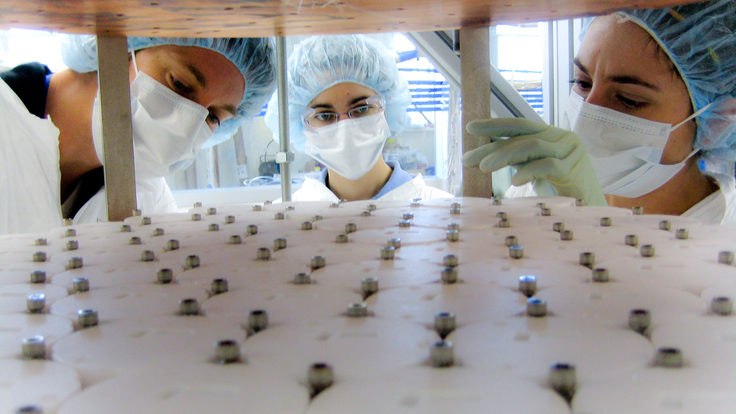
After completing its final run, scientists on the Large Underground Xenon (LUX) experiment announced they have found no trace of dark matter particles.
The new data, which were collected over more than 300 days from October 2014 to May 2016, improved the experiment’s previous sensitivity four-fold.
“We built an experiment that has delivered world-leading sensitivity in multiple new results over the last three years,” says Brown University’s Rick Gaitskell, co-spokesperson for the LUX collaboration. “We gave dark matter every opportunity to show up in our experiment, but it chose not to.”
Although the LUX scientists haven’t found WIMPs, their results allow them to exclude many theoretical models for what these particles could have been, narrowing down future dark matter searches with other experiments.
“I’m very proud of what we’ve accomplished,” says LUX co-founder Tom Shutt from the Kavli Institute for Particle Astrophysics and Cosmology, a joint institute of Stanford University and the Department of Energy’s SLAC National Accelerator Laboratory. “The experiment performed even better than initially planned, and we set a new standard as to how well we can take measurements, calibrate the detector and determine its background signals.”
Scientists have yet to directly detect dark matter, but they have seen indirect evidence of its existence in astronomical studies.
Located one mile underground at the Sanford Underground Research Facility in South Dakota, LUX had been searching since 2012 for what are called weakly interacting massive particles, or WIMPs. These hypothetical particles are top contenders to be the building blocks of dark matter, but their existence has yet to be demonstrated.
WIMPs are believed to barely interact with normal matter other than through gravity. However, researchers had hoped to detect their rare collisions with LUX’s detector material—a third of a ton of liquid xenon.
With the latest gain in sensitivity, LUX has “enabled us to probe dark matter candidates that would produce signals of only a few events per century in a kilogram of xenon,” says Aaron Manalaysay, the analysis working group coordinator of the LUX experiment from the University of California, Davis. Manalaysay presented the new results today at IDM2016, an international dark matter conference in Sheffield in the UK.
After LUX was first proposed in 2007, it became an R&D activity with limited funding and only a handful of participating groups. Over the years it grew from a detector that included parts bought for a few bucks on eBay into a major project involving researchers from 20 universities and national labs in the US, the UK and Portugal.
Over the next months, the LUX experiment will be decommissioned to make room for its successor experiment. The next-generation LUX-ZEPLIN (LZ) detector will use 10 tons of liquid xenon and will be 100 times more sensitive to WIMPs.
“LZ is based on lessons learned from LUX,” Shutt says. “It has been a great advantage to have LUX collect data while designing the new experiment, and some of LZ’s new features are enabled through our experience with LUX.”
Once LZ turns on in 2020, researchers will have another big shot at finding mysterious WIMPs.
Pokémon Go shakes up the lab routine
At Fermilab and CERN, students, lab employees and visitors alike are on the hunt for virtual creatures.

At Fermi National Accelerator Laboratory near Chicago, the normal motions of people going about their days have shifted.
People who parked their cars in the same spot for years have moved. People are rerouting their paths through the buildings of the laboratory campus and striking off to explore new locations. They can be seen on lunch breaks hovering around lab landmarks, alone or in small clumps, flicking their fingers across their smartphones.
The augmented reality phenomenon of Pokémon Go has made its way into the world of high-energy particle physics. Based on the Nintendo franchise that launched in the ’90s, Pokémon Go sends players exploring their surrounding areas in the real world, trying to catch as many of the virtual creatures as possible.
Not only is the game affecting the movements of lab regulars, it’s also brought new people to the site, says Beau Harrison, an accelerator operator and a member of the game’s blue team. “People were coming on their bicycles to get their Pokémon here.”
At Fermilab, the three teams of the Pokémon universe—red, yellow and blue—compete for command of Fermilab’s several virtual gyms, places people battle their Pokémon to boost their strength or simply display team dominance.
“It’s kind of fun playing with everyone here,” says Bobby Santucci, another operator at the lab, who is on team red. “It’s not so much about the game. It’s more like messing with each other.”
In the few days the game has been out, the gyms at Fermilab have repeatedly tossed out one team for another: blue, then red, then blue, then red, then briefly yellow, then blue and then red again.
The game was not released in many European countries until the past weekend. But Elizabeth Kennedy, a graduate student from UC Riverside who is working at CERN, says that even before that you could identify Pokémon Go players among the people at the laboratory on the border of Switzerland and France, based on the routes they walked.
“The Americans are all playing,” she says. “It’s easy to tell who else is playing when you see other people congregating around places.”
The majority of the players at Fermilab seem to be college students and younger employees, but players of all ages can be spotted roaming the labs.
Bonnie King, a system administrator at the lab and a member of team blue, says that on one of her Pokémon-steered nature walks at Fermilab, she encountered a group of preteens. She had never been on that particular trail, and she wondered whether this was a first for the visitors, too. They noticed her playing and asked her if she was taking the gym there.
“Yeah, I am,” she replied, rising to the challenge.
King dropped off her top contender, a drooling, fungal-looking blue monster called Gloom, to help team blue keep its position of power. But eventually the red team toppled blue to reclaim the gym.
The battle for Fermilab rages on.
The science of proton packs
Ghostbusters advisor James Maxwell explains the science of bustin'.
There's a new proton pack in town.
During the development of the new Ghostbusters film, released today, science advisor James Maxwell took on the question: "How would a proton pack work, with as few huge leaps of miraculous science as possible?"
As he explains in this video, he helped redesign the movie's famous ghost-catching tool to bring it more in line with modern particle accelerators such as the Large Hadron Collider.
"Particle accelerators are real. Superconducting magnets are real," he says. "The big leaps of faith are actually doing it in the space that's allowed."
Video by Sony Pictures Entertainment
Who you gonna call? MIT physicists!
As science advisors, physicists Lindley Winslow and Janet Conrad gave the Ghostbusters crew a taste of life in the lab.

Tonight, two MIT scientists are going to the movies. It’s not just because they want to see Kristin Wiig, who plays a particle physicist in the new Ghostbusters film, talk about grand unified theories on the big screen. Lindley Winslow and Janet Conrad served as science advisors on the film, and they can’t wait to see all the nuggets of realism they managed to fit into the set.
The Ghostbusters production team contacted Winslow on the advice of The Big Bang Theory science advisor David Saltzberg, who worked with Winslow at UCLA.
Winslow says she was delighted to help out. As a child, she watched the original 1984 Ghostbusters on repeat with her sister. As an adult, Winslow recognizes that she became a scientist thanks in part to the capable female characters she saw in shows like Star Trek.
She says she’s excited for a reboot that features women getting their hands dirty doing science. “They’re using oscilloscopes and welding things. It’s great!”
The Ghostbusters crew was filming in Boston, and “they wanted to see what a particle physics lab would be like,” Winslow says. She quickly thought through the coolest stuff she had sitting around: “There was a directional neutron detector Janet had. And at the last minute, I remembered that, in the corner of my lab, I had a separate room with a prototype of a polarized Helium-3 source for a potential future electron-ion collider at Brookhaven.”
MIT postdoc James Maxwell wound up constructing a replica of the Helium-3 source for the set.
But the production team was interested in more than just the shiny stuff. They wanted to understand the look and feel of a real laboratory. They knew it would be different from the sanitized versions than often appear onscreen.
Winslow obliged. “I take them to this lab, and it’s pretty… it looks like you’ve been in there for 40 years,” she says. “There’s a coat rack with a whole pile of cables hanging on it. They were taking a ton of pictures.”
The team really wanted to get the details right, down the books on the characters’ shelves, the publications and grant proposals on their desks and the awards on their walls, Winslow says. That’s where Conrad’s contributions came in. Offering to pitch in as Winslow prepared to go out on maternity leave, Conrad rented out her entire office library to the film, and she wrote papers for two characters, Wiig’s particle physicist and a villainous male scientist.
Conrad made Wiig’s character a neutrino physicist. She decided the bad guy would probably be into string theory. There’s just something sinister about the theory’s famous lack of verifiable predictions, Winslow says.
String theorists can also be lovely people, though, Conrad says, and “I wanted to make [the bad guy] as evil as possible.” In the scientific paper she wrote for his desk, “he doesn’t acknowledge anyone. He just says ‘The author is supported by the Royal Society of Fellows,’ and that’s it.”
Also, she wrote for him “an evil letter where he’s turning someone down for tenure.”
Winslow wrote the text for the awards that adorn the characters’ office walls, though both she and Conrad point out that physicists rarely hang their awards at work. “I give mine to my mom, and she hangs them up,” Conrad says.
In their offices, both Winslow and Conrad plan to hang their official Ghostbusters thank-you notes. “And a coat hook,” Winslow says. “I need a coat hook.”
Neither physicist got the chance to see the film before today, and they’re not sure how much of their handiwork will actually make it to the big screen. But Winslow was thrilled to see in a recently released preview one of her proudest contributions: a giant set of equations written on a whiteboard behind Wiig’s character.
The equations are real, representing the Georgi-Glashow model, otherwise known as SU(5), the first theory to try to combine the electroweak and strong forces. The model was ruled out by results from the Super Kamiokande experiment, but Winslow imagines Wiig’s character is using it to introduce her own attempt to unite the fundamental forces.
Winslow says she explained the basics of SU(5) to Ghostbusters director Paul Feig, who was then left to pass along the message to Wiig when Winslow needed to pick up her 3-year-old son from daycare.
As they head to the theaters tonight, Conrad and Winslow say they are excited to see bits of their lives reflected on the Ghostbusters set. They’re even more excited for girls in the audience to see themselves reflected in the tech-savvy, adventurous women in the film.
A primer on particle accelerators
What’s the difference between a synchrotron and a cyclotron, anyway?
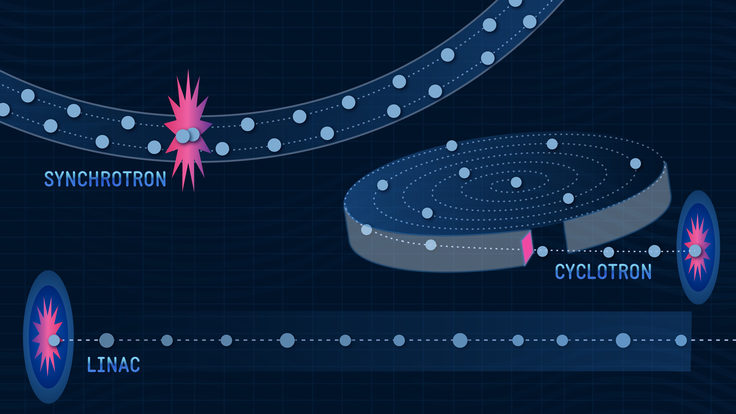
Research in high-energy physics takes many forms. But most experiments in the field rely on accelerators that create and speed up particles on demand.
What follows is a primer on three different types of particle accelerators: synchrotrons, cyclotrons and linear accelerators, called linacs.
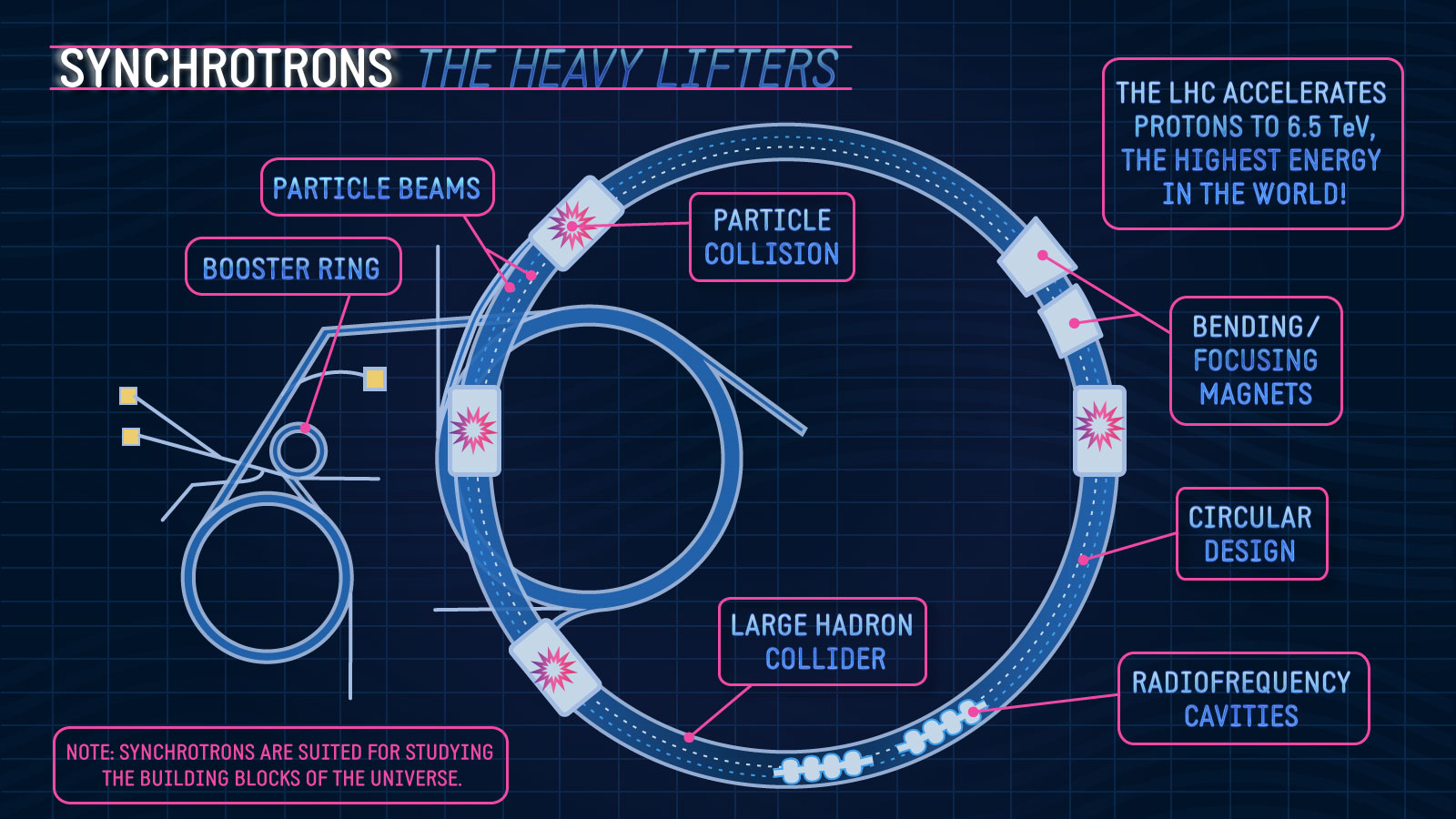
Synchrotrons: the heavy lifters
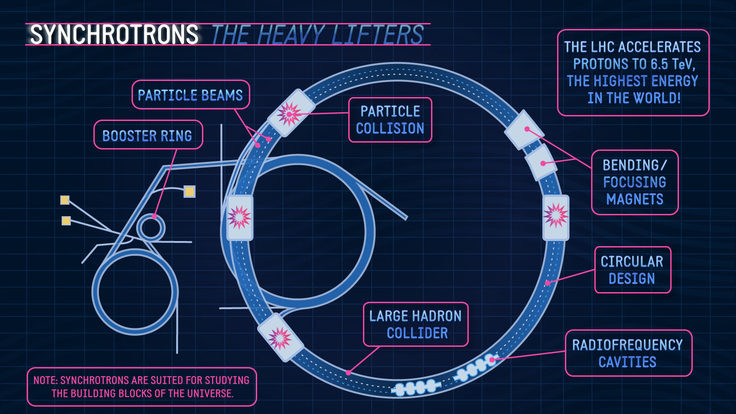
Synchrotrons are the highest-energy particle accelerators in the world. The Large Hadron Collider currently tops the list, with the ability to accelerate particles to an energy of 6.5 trillion electronvolts before colliding them with particles of an equal energy traveling in the opposite direction.
Synchrotrons typically feature a closed pathway that takes particles around a ring. Other variants are created with straight sections between the curves (similar to a racetrack or in the shape of a triangle or hexagon). Once particles enter the accelerator, they travel around the circular pathway over and over again, always enclosed in a vacuum pipe.
Radiofrequency cavities at intervals around the ring increase their speed. Several different types of magnets create electromagnetic fields, which can be used to bend and focus the particle beams. The electromagnetic fields slowly build up as the particles are accelerated. Particles pass around the LHC about 14 million times in the 20 minutes they need to reach their intended energy level.
Researchers send beams of accelerated particles through one another to create collisions in locations surrounded by particle detectors. Relatively few collisions happen each time the beams meet. But because the particles are constantly circulating in a synchrotron, researchers can pass them through one another many times over—creating a large number of collisions over time and more data for observing rare phenomena.
“The LHC detectors ATLAS and CMS reached about 400 million collisions a second last year,” says Mike Lamont, head of LHC operations at CERN. “This is why this design is so useful.”
Synchrotrons’ power makes them especially suited to studying the building blocks of our universe. For example, physicists were able to witness evidence of the Higgs boson among the LHC’s collisions only because the collider could accelerate particles to such a high energy and produce such high collision rates.
The LHC primarily collides protons with protons but can also accelerate heavy nuclei such as lead. Other synchrotrons can also be customized to accelerate different types of particles. At Brookhaven National Laboratory in New York, the Relativistic Heavy Ion Collider can accelerate everything from protons to uranium nuclei. It keeps the proton beams polarized with the use of specially designed magnets, according to RHIC accelerator physicist Angelika Drees. It can also collide heavy ions such as uranium and gold to create quark-gluon plasma—the high-temperature soup that made up the universe just after the Big Bang.
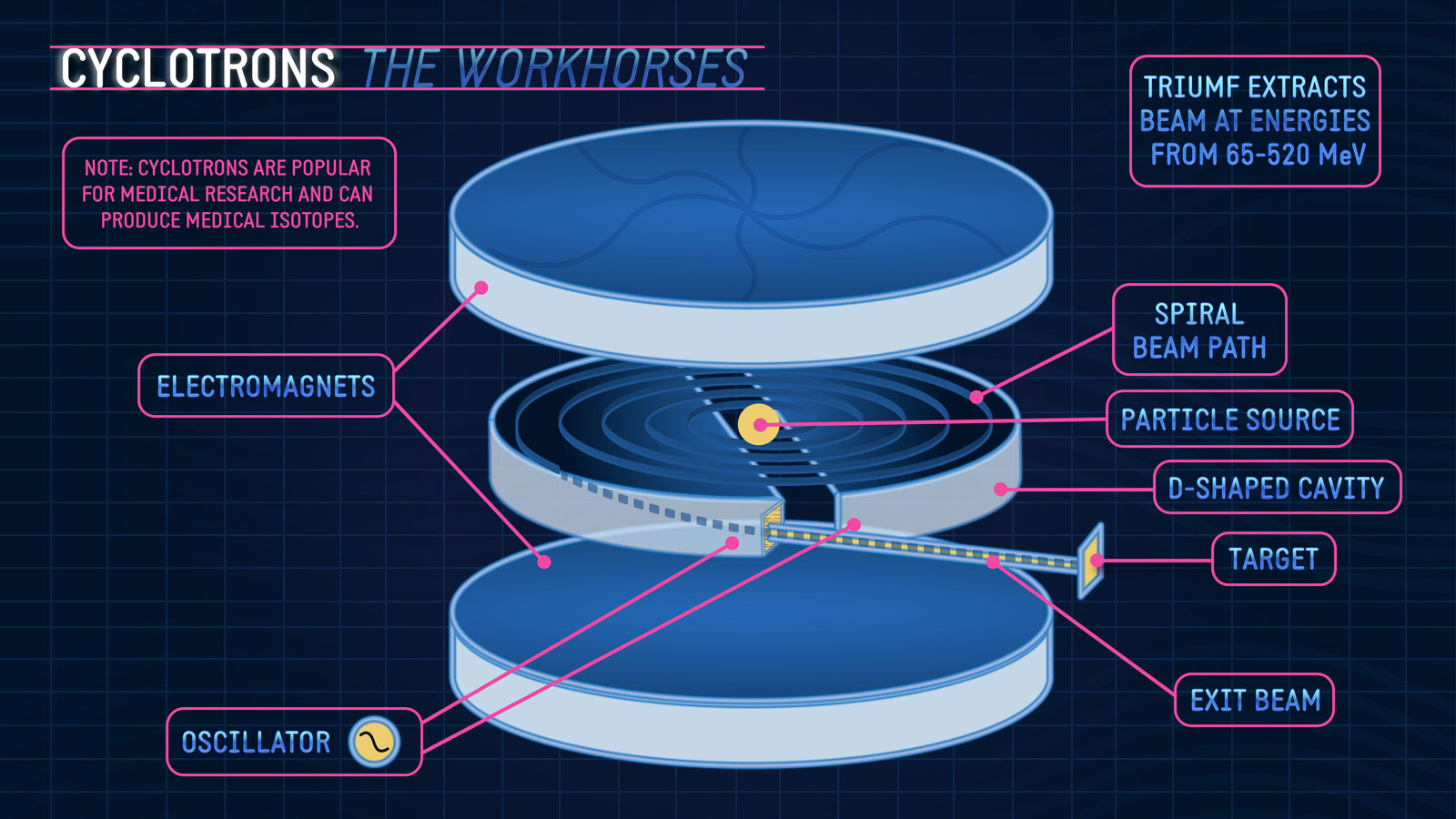
Cyclotrons: the workhorses
Synchrotrons are the descendants of another type of circular collider called cyclotrons. Cyclotrons accelerate particles in a spiral pattern, starting at their center.
Like synchrotrons, cyclotrons use a large electromagnet to bend the particles in a circle. However, they use only one magnet, which limits how large they can be. They use metal electrodes to push particles to travel in increasingly large circles, creating a spiral pathway.
Cyclotrons are often used to create large amounts of specific types of particles, such as muons or neutrons. They are also popular for medical research because they have the right energy range and intensity to produce medical isotopes.
The world’s largest cyclotron is located at the TRIUMF laboratory in Vancouver, Canada. At the TRIUMF cyclotron, physicists regularly accelerate particles to 520 million electronvolts. They can draw particles from different parts of their accelerator for experiments that require particles at different energies. This makes it an especially adaptable type of accelerator, says physicist Ewart Blackmore, who helped to design and build the TRIUMF accelerator.
“We certainly make use of that facility every day when we’re running, when we’re typically producing a low-energy but high-current beam for medical isotope production,” Blackmore says. “We’re extracting at fixed energies down one beam for producing pions and muons for research, and on another beam line we’re extracting beams of radioactive nuclei to study their properties.”

Linacs: straight and to the point
For physics experiments or applications that require a steady, intense beam of particles, linear accelerators are a favored design. SLAC National Accelerator Laboratory hosts the longest linac in the world, which measures 2 miles long and at one point could accelerate particles up to 50 billion electronvolts. Fermi National Accelerator Laboratory uses a shorter linac to speed up protons before sending them into a different accelerator, eventually running the particles into a fixed target to create the world’s most intense neutrino beam.
While circular accelerators may require many turns to accelerate particles to the desired energy, linacs get particles up to speed in short order. Particles start at one end at a low energy, and electromagnetic fields in the linac accelerate them down its length. When particles travel in a curved path, they release energy in the form of radiation. Traveling in a straight line means keeping their energy for themselves. A series of radiofrequency cavities in SLAC’s linac are used to push particles on the crest of electromagnetic waves, causing them to accelerate forward down the length of the accelerator.
Like cyclotrons, linacs can be used to produce medical isotopes. They can also be used to create beams of radiation for cancer treatment. Electron linacs for cancer therapy are the most common type of particle accelerator.
Scientists salvage insights from lost satellite
Before Hitomi died, it sent X-ray data that could explain why galaxy clusters form far fewer stars than expected.
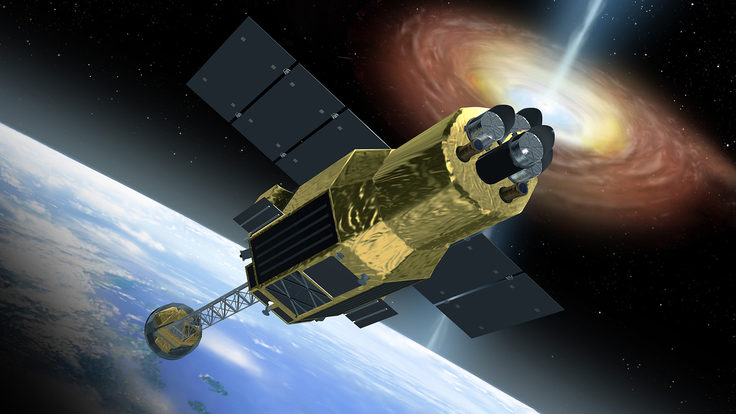
Working with information sent from the Japanese Hitomi satellite, an international team of researchers has obtained the first views of a supermassive black hole stirring hot gas at the heart of a galaxy cluster. These motions could explain why galaxy clusters form far fewer stars than expected.
The data, published today in Nature, were recorded with the X-ray satellite during its first month in space earlier this year, just before it spun out of control and disintegrated due to a chain of technical malfunctions.
“Being able to measure gas motions is a major advance in understanding the dynamic behavior of galaxy clusters and its ties to cosmic evolution,” said study co-author Irina Zhuravleva, a postdoctoral researcher at the Kavli Institute for Particle Astrophysics and Cosmology. “Although the Hitomi mission ended tragically after a very short period of time, it’s fair to say that it has opened a new chapter in X-ray astronomy.” KIPAC is a joint institute of Stanford University and the Department of Energy’s SLAC National Accelerator Laboratory.
Galaxy clusters, which consist of hundreds to thousands of individual galaxies held together by gravity, also contain large amounts of gas. Over time, the gas should cool down and clump together to form stars. Yet there is very little star formation in galaxy clusters, and until now scientists were not sure why.
“We already knew that supermassive black holes, which are found at the center of all galaxy clusters and are tens of billions of times more massive than the sun, could play a major role in keeping the gas from cooling by somehow injecting energy into it,” said Norbert Werner, a research associate at KIPAC involved in the data analysis. “Now we understand this mechanism better and see that there is just the right amount of stirring motion to produce enough heat.”
Plasma bubbles stir and heat intergalactic gas
About 15 percent of the mass of galaxy clusters is gas that is so hot – tens of millions of degrees Fahrenheit – that it shines in bright X-rays. In their study, the Hitomi researchers looked at the Perseus cluster, one of the most massive astronomical objects and the brightest in the X-ray sky.
Other space missions before Hitomi, including NASA’s Chandra X-ray Observatory, had taken precise X-ray images of the Perseus cluster. These snapshots revealed how giant bubbles of ultrahot, ionized gas, or plasma, rise from the central supermassive black hole as it catapults streams of particles tens of thousands of light-years into space. At the same time, streaks of cold gas appear to be pulled away from the center of the galaxy cluster, according to additional images of visible light. Until now, it has been unclear whether these two actions were connected.
To find out, the researchers pointed one of Hitomi’s instruments – the soft X-ray spectrometer (SXS) – at the center of the Perseus cluster and analyzed its X-ray emissions.
“Since the SXS had 30 times better energy resolution than the instruments of previous missions, we were able to resolve details of the X-ray signals that weren’t accessible before,” said co-principal investigator Steve Allen, a professor of physics at Stanford and of particle physics and astrophysics at SLAC. “These new details resulted in the very first velocity map of the cluster center, showing the speed and turbulence of the hot gas.”
By superimposing this map onto the other images, the researchers were able to link the observed motions of the cold gas to the hot plasma bubbles.
According to the data, the rising plasma bubbles drag cold gas away from the cluster center. Researchers see this in the form of stretched filaments in the optical images. The bubbles also transfer energy to the gas, which causes turbulence, Zhuravleva said.
“In a way, the bubbles are like spoons that stir milk into a cup of coffee and cause eddies,” she said. “The turbulence heats the gas, and it appears that this is enough to work against star formation in the cluster.”
Hitomi’s legacy
Astrophysicists can use the new information to fine-tune models that describe how galaxy clusters change over time.
One important factor in these models is the mass of galaxy clusters, which researchers typically calculate from the gas pressure in the cluster. However, motions cause additional pressure, and before this study it was unclear if the calculations need to be corrected for turbulent gas.
“Although the motions heat the gas at the center of the Perseus cluster, their speed is only about 100 miles per second, which is surprisingly slow considering how disturbed the region looks in X-ray images,” said co-principal investigator Roger Blandford, the Luke Blossom Professor of Physics at Stanford and a professor for particle physics and astrophysics at SLAC. “One consequence is that corrections for these motions are only very small and don’t affect our mass calculations much.”
Although the loss of Hitomi cut most of the planned science program short – it was supposed to run for at least three years – the researchers hope their results will convince the international community to plan another X-ray space mission.
“The data Hitomi sent back to Earth are just beautiful,” Werner said. “They demonstrate what’s possible in the field and give us a taste of all the great science that should have come out of the mission over the years.”
Hitomi is a joint project, with the Japan Aerospace Exploration Agency (JAXA) and NASA as the principal partners. Led by Japan, it is a large-scale international collaboration, boasting the participation of eight countries, including the United States, the Netherlands and Canada, with additional partnership by the European Space Agency (ESA). Other KIPAC researchers involved in the project are Tuneyoshi Kamae, Ashley King, Hirokazu Odaka and co-principal investigator Grzegorz Madejski.
A version of this article originally appeared as a Stanford University press release.
Incredible hulking facts about gamma rays
From lightning to the death of electrons, the highest-energy form of light is everywhere.
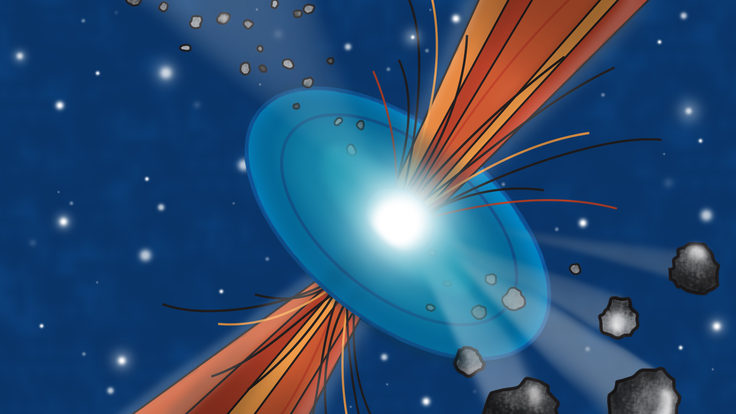
Gamma rays are the most energetic type of light, packing a punch strong enough to pierce through metal or concrete barriers. More energetic than X-rays, they are born in the chaos of exploding stars, the annihilation of electrons and the decay of radioactive atoms. And today, medical scientists have a fine enough control of them to use them for surgery. Here are seven amazing facts about these powerful photons.
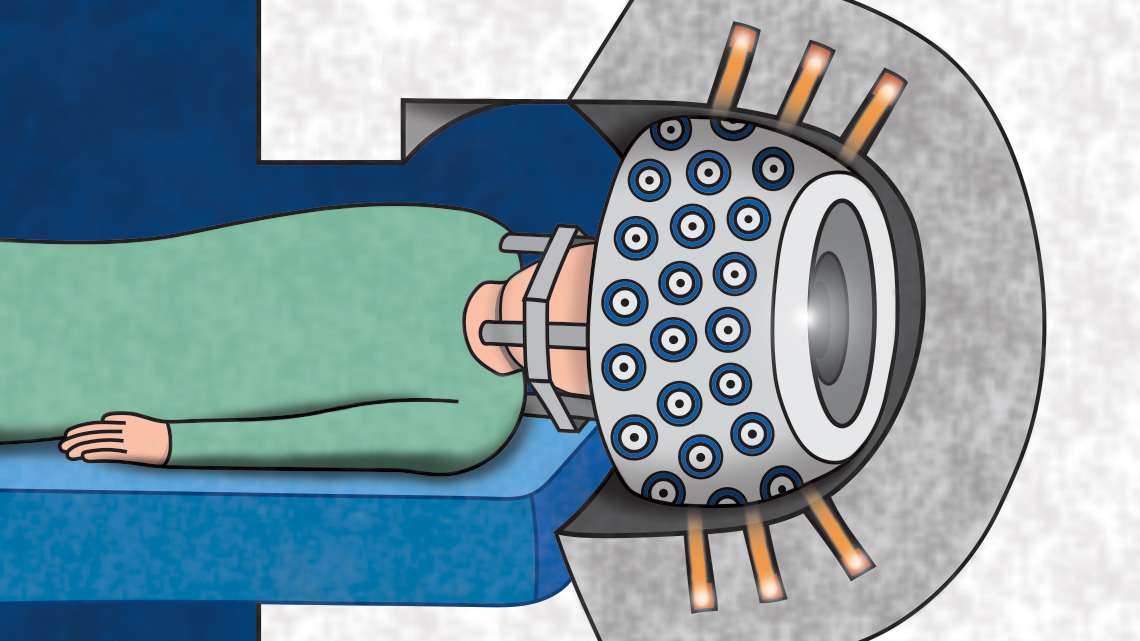
Doctors conduct brain surgery using “gamma ray knives.”
Gamma rays can be helpful as well as harmful (and are very unlikely to turn you into the Hulk). To destroy brain cancers and other problems, medical scientists sometimes use a "gamma ray knife." This consists of many beams of gamma rays focused on the cells that need to be destroyed. Because each beam is relatively small, it does little damage to healthy brain tissue. But where they are focused, the amount of radiation is intense enough to kill the cancer cells. Since brains are delicate, the gamma ray knife is a relatively safe way to do certain kinds of surgery that would be a challenge with ordinary scalpels.

The name “gamma rays” came from Ernest Rutherford.
French chemist Paul Villard first identified gamma rays in 1900 from the element radium, which had been isolated by Marie and Pierre Curie just two years before. When scientists first studied how atomic nuclei changed form, they identified three types of radiation based on how far they penetrated into a barrier made of lead. Ernest Rutherford named the radiation for the first three letters of the Greek alphabet. Alpha rays bounce right off, beta rays went a little farther, and gamma rays went the farthest. Today we know alpha rays are the same thing as helium nuclei (two protons and two neutrons), beta rays are either electrons or positrons (their antimatter versions), and gamma rays are a kind of light.

Nuclear reactions are a major source of gamma rays.
When an unstable uranium nucleus splits in the process of nuclear fission, it releases a lot of gamma rays in the process. Fission is used in both nuclear reactors and nuclear warheads. To monitor nuclear tests in the 1960s, the United States launched gamma radiation detectors on satellites. They found far more explosions than they expected to see. Astronomers eventually realized these explosions were coming from deep space—not the Soviet Union—and named them gamma-ray bursts, or GRBs. Today we know GRBs come in two types: the explosions of extremely massive stars, which pump out gamma rays as they die, and collisions between highly dense relics of stars called neutron stars and something else, probably another neutron star or a black hole.

Gamma rays played a key role in the discovery of the Higgs boson.
Most of the particles in the Standard Model of particle physics are unstable; they decay into other particles almost as soon as they come into existence. The Higgs boson, for example, can decay into many different types of particles, including gamma rays. Even though theory predicts that a Higgs boson will decay into gamma rays just 0.2 percent of the time, this type of decay is relatively easy to identify and it was one of the types that scientists observed when they first discovered the Higgs boson.
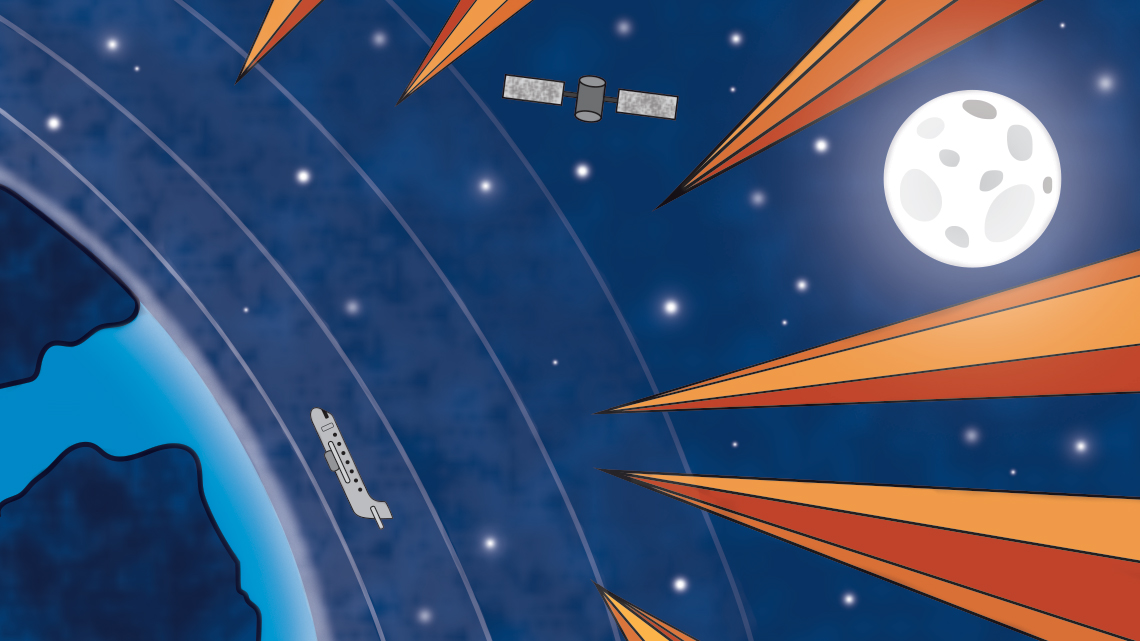
To study gamma rays, astronomers build telescopes in space.
Gamma rays heading toward the Earth from space interact with enough atoms in the atmosphere that almost none of them reach the surface of the planet. That's good for our health, but not so great for those who want to study GRBs and other sources of gamma rays. To see gamma rays before they reach the atmosphere, astronomers have to build telescopes in space. This is challenging for a number of reasons. For example, you can't use a normal lens or mirror to focus gamma rays, because the rays punch right through them. Instead an observatory like the Fermi Gamma-ray Space Telescope detects the signal from gamma rays when they hit a detector and convert into pairs of electrons and positrons.

Some gamma rays come from thunderstorms.
In the 1990s, observatories in space detected bursts of gamma rays coming from Earth that eventually were traced to thunderclouds. When static electricity builds up inside clouds, the immediate result is lightning. That static electricity also acts like a giant particle accelerator, creating pairs of electrons and positrons, which then annihilate into gamma rays. These bursts happen high enough in the air that only airplanes are exposed—and they’re one reason for flights to steer well away from storms.

Gamma rays (indirectly) give life to Earth.
Hydrogen nuclei are always fusing together in the core of the sun. When this happens, one byproduct is gamma rays. The energy of the gamma rays keeps the sun’s core hot. Some of those gamma rays also escape into the sun's outer layers, where they collide with electrons and protons and lose energy. As they lose energy, they change into ultraviolet, infrared and visible light. The infrared light keeps Earth warm, and the visible light sustains Earth’s plants.

 Frascati Scienza
 Buco Nero
 Io Non Faccio Niente
 Tommaso Dorigo
 Giovanni Mazzitelli
 Barbara Gallavotti
 Keplero Blog
 Research Gate