
Dark matter hopes dwindle with X-ray signal
A previously detected, anomalously large X-ray signal is absent in new Hitomi satellite data, setting tighter limits for a dark matter interpretation.
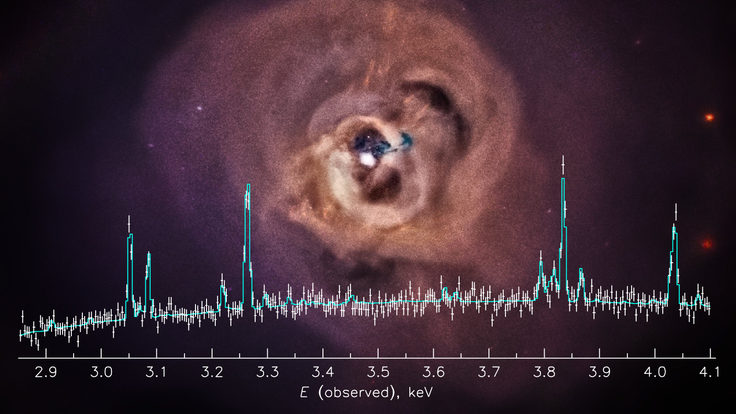
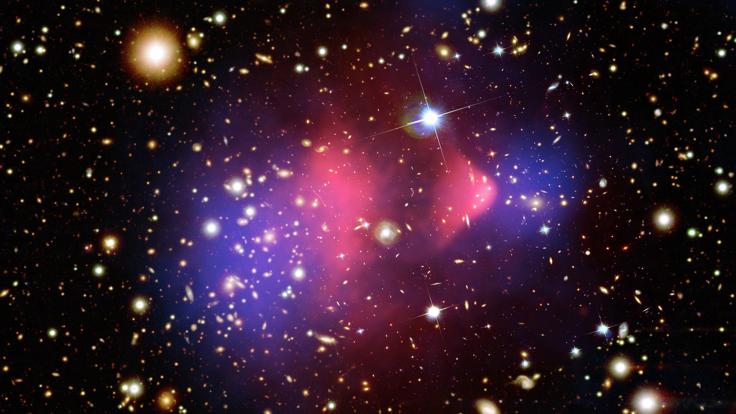
In the final data sent by the Hitomi spacecraft, a surprisingly large X-ray signal previously seen emanating from the Perseus galaxy cluster did not appear. This casts a shadow over previous speculation that the anomalously bright signal might have come from dark matter.
“We would have been able to see this signal much clearer with Hitomi than with other satellites,” says Norbert Werner from the Kavli Institute for Particle Astrophysics and Cosmology, a joint institute of Stanford University and the Department of Energy’s SLAC National Accelerator Laboratory.
“However, there is no unidentified X-ray line at the high flux level found in earlier studies.”
Werner and his colleagues from the Hitomi collaboration report their findings in a paper submitted to The Astrophysical Journal Letters.
The mysterious signal was first discovered with lower flux in 2014 when researchers looked at the superposition of X-ray emissions from 73 galaxy clusters recorded with the European XMM-Newton satellite. These stacked data increase the sensitivity to signals that are too weak to be detected in individual clusters.
The scientists found an unexplained X-ray line at an energy of about 3500 electronvolts (3.5 keV), says Esra Bulbul from the MIT Kavli Institute for Astrophysics and Space Research, the lead author of the 2014 study and a co-author of the Hitomi paper.
“After careful analysis we concluded that it wasn’t caused by the instrument itself and that it was unlikely to be caused by any known astrophysical processes,” she says. “So we asked ourselves ‘What else could its origin be?’”
One interpretation of the so-called 3.5-keV line was that it could be caused by hypothetical dark matter particles called sterile neutrinos decaying in space.
Yet, there was something bizarre about the 3.5-keV line. Bulbul and her colleagues found it again in data taken with NASA’s Chandra X-ray Observatory from just the Perseus cluster. But in the Chandra data, the individual signal was inexplicably strong—about 30 times stronger than it should have been according to the stacked data.
Adding to the controversy was the fact that some groups saw the X-ray line in Perseus and other objects using XMM-Newton, Chandra and the Japanese Suzaku satellite, while others using the same instruments reported no detection.
Astrophysicists highly anticipated the launch of the Hitomi satellite, which carried an instrument—the soft X-ray spectrometer (SXS)—with a spectral resolution 20 times better than the ones aboard previous missions. The SXS would be able to record much sharper signals that would be easier to identify.

Hitomi recorded the X-ray spectrum of the Perseus galaxy cluster with the protective filter still attached to its soft X-ray spectrometer.
The new data were collected during Hitomi’s first month in space, just before the satellite was lost due to a series of malfunctions. Unfortunately during that time, the SXS was still covered with a protective filter, which absorbed most of the X-ray photons with energies below 5 keV.
“This limited our ability to take enough data of the 3.5-keV line,” Werner says. “The signal might very well still exist at the much lower flux level observed in the stacked data.”
Hitomi’s final data at least make it clear that, if the 3.5-keV line exists, its X-ray signal is not anomalously strong. A signal 30 times stronger than expected would have made it through the filter.
The Hitomi results rule out that the anomalously bright signal in the Perseus cluster was a telltale sign of decaying dark matter particles. But they leave unanswered the question of what exactly scientists detected in the past.
“It’s really unfortunate that we lost Hitomi,” Bulbul says. “We’ll continue our observations with the other X-ray satellites, but it looks like we won’t be able to solve this issue until another mission goes up.”
Chances are this might happen in a few years. According to a recent report, the Japan Aerospace Exploration Agency and NASA have begun talks about launching a replacement satellite.
The contents of the universe
How do scientists know what percentages of the universe are made up of dark matter and dark energy?
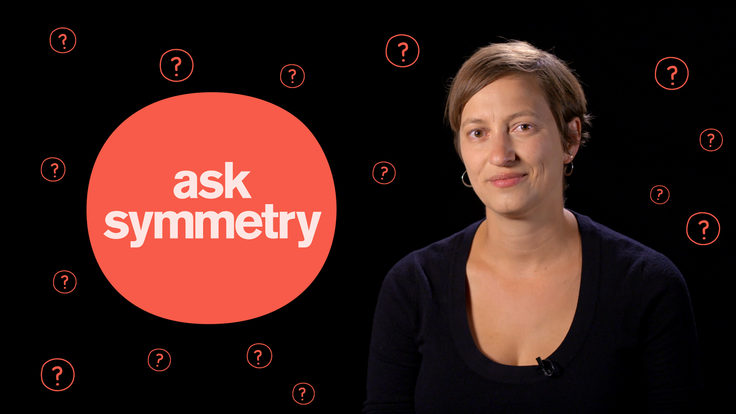
Cosmologist Risa Wechsler of the Kavli Institute for Particle Astrophysics and Cosmology explains.
Have a burning question about particle physics? Let us know via email or Twitter (using the hashtag #AskSymmetry). We might answer you in a future video!
You can watch a playlist of the #AskSymmetry videos here.
Sterile neutrinos in trouble
The IceCube experiment reports ruling out to a high degree of certainty the existence of a theoretical low-mass sterile neutrino.
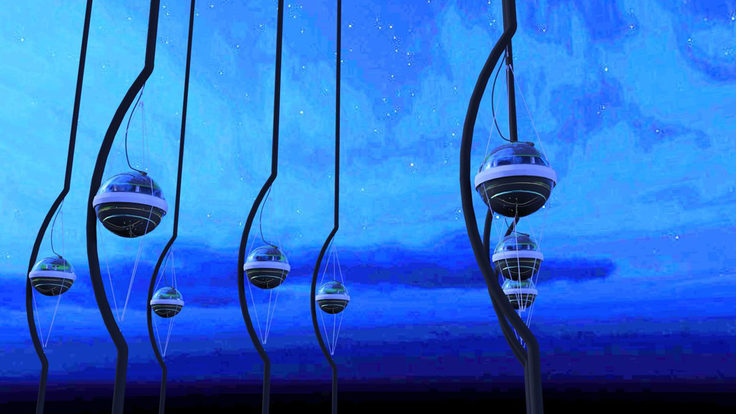
This week scientists on the world’s largest neutrino experiment, IceCube, dealt a heavy blow to theories predicting a new type of particle—and left a mystery behind.
More than two decades ago, the LSND neutrino experiment at Los Alamos National Laboratory produced a result that challenged what scientists knew about neutrinos. The most popular theory is that the LSND anomaly was caused by the hidden influence of a new type of particle, a sterile neutrino.
A sterile neutrino would not interact with other matter through any of the forces of the Standard Model of particle physics, save perhaps gravity.
With their new result, IceCube scientists are fairly certain the most popular explanation for the anomaly is incorrect. In a paper published in Physical Review Letters, they report that after searching for the predicted form of the stealthy particle, they excluded its existence at approximately the 99 percent confidence level.
“The sterile neutrino would’ve been a profound discovery,” says physicist Ben Jones of the University of Texas, Arlington, who worked on the IceCube analysis. “It would really have been the first particle discovered beyond the Standard Model of particle physics.”
It’s surprising that such a result would come from IceCube. The detector, buried in about a square kilometer of Antarctic ice, was constructed to study very different neutrinos: high-energy ones propelled toward Earth by violent events in space. But by an accident of nature, IceCube happens to be in just the right position to study low-mass sterile neutrinos as well.
There are three known types of neutrinos: electron neutrinos, muon neutrinos and tau neutrinos. Scientists have caught all three types, but they have never built a detector that could catch a sterile neutrino.
Neutrinos are shape-shifters; as they travel, they change from one type to another. The likelihood that a neutrino has shifted to a new type at any given point depends on its mass and the distance it has traveled.
It also depends on what the neutrino has traveled through. Neutrinos very rarely interact with other matter, so they can travel through the entire Earth without hitting any obstacles. But they are affected by all of the electrons in the Earth’s atoms along the way.
“The Earth acts like an amplifier,” says physicist Carlos Argüelles of MIT, who worked on the IceCube analysis.
Traveling through that density of electrons raises the likelihood that a neutrino will change into the predicted sterile neutrino quite significantly—to almost 100 percent, Argüelles says. At a specific energy, the scientists on IceCube should have noticed a mass disappearance of neutrinos as they shifted identities into particles they could not see.
“The position of the dip [in the number of neutrinos found] depends on the mass of sterile neutrinos,” says theorist Joachim Kopp of the Johannes Gutenberg University Mainz. “If they were heavier, the dip would move to a higher energy, a disadvantage for IceCube. At a lower mass, it would move to a lower energy, at which IceCube cannot see neutrinos anymore. IceCube happens to be in a sweet spot.”
And yet, the scientists found no such dip.
This doesn’t mean they can completely rule out the existence of low-mass sterile neutrinos, Jones says. “But it’s also true to say that the likelihood that a sterile neutrino exists is now the lowest it has ever been before.”
The search for the sterile neutrino continues. Kopp says the planned Short Baseline Neutrino program at Fermilab will be perfectly calibrated to investigate the remaining mass region most likely to hold low-mass sterile neutrinos, if they do exist.
The IceCube analysis was based on data taken over the course of a year starting in 2011. The IceCube experiment has since collected five times as much data, and scientists are already working to update their search.
In the end, if these experiments throw cold water on the low-mass sterile neutrino theory, they will still have another question to answer: If sterile neutrinos did not cause the anomaly at Los Alamos, what did?
LHC bump fades with more data
Possible signs of new particle seem to have washed out in an influx of new data.
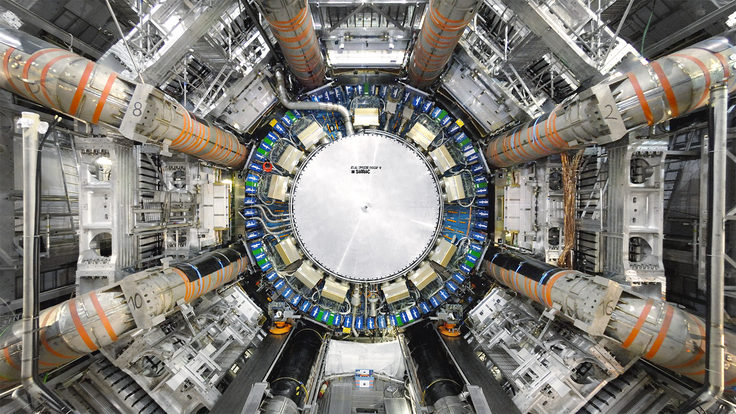
A curious anomaly seen by two Large Hadron Collider experiments is now looking like a statistical fluctuation.
The anomaly—an unanticipated excess of photon pairs with a combined mass of 750 billion electronvolts—was first reported by both the ATLAS and CMS experiments in December 2015.
Such a bump in the data could indicate the existence of a new particle. The Higgs boson, for instance, materialized in the LHC data as an excess of photon pairs with a combined mass of 125 billion electronvolts. However, with only a handful of data points, the two experiments could not discern whether that was the case or if it were the result of normal statistical variance.
After quintupling their 13-TeV dataset between April and July this year, both experiments report that the bump has greatly diminished and, in some analyses, completely disappeared.
What made this particular bump interesting is that both experiments saw the same anomaly in completely independent data sets, says Wade Fisher, a physicist at Michigan State University.
“It’s like finding your car parked next to an identical copy,” he says. “That’s a very rare experience, but it doesn’t mean that you’ve discovered something new about the world. You’d have to keep track of every time it happened and compare what you observe to what you’d expect to see if your observation means anything.”
Theorists predicted that a particle of that size could have been a heavier cousin of the Higgs boson or a graviton, the theoretical particle responsible for gravity. While data from more than 1000 trillion collisions have smoothed out this bump, scientists on the ATLAS experiment still cannot completely rule out its existence.
“There’s up fluxes and down fluxes in statistics,” Fisher says. “Up fluctuations can sometimes look like the early signs of a new particles, and down fluctuations can sometimes make the signatures of a particle disappear. We’ll need the full 2016 data set to be more confident about what we’re seeing.”
Scientists on both experiments are currently scrutinizing the huge influx of data to both better understand predicted processes and look for new physics and phenomena.
"New physics can manifest itself in many different ways—we learn more if it surprises us rather than coming in one of the many many theories we're already probing," says Steve Nahn, a CMS researcher working at Fermilab. "So far the canonical Standard Model is holding up quite well, and we haven't seen any surprises, but there's much more data coming from the LHC, so there's much more territory to explore."
Higgs boson resurfaces in LHC data
The Higgs appeared in the second run of the LHC about twice as fast as it did in the first.
The Higgs boson is peeking out of the new data collected during the second run of the Large Hadron Collider, scientists reported today at the International Conference on High Energy Physics in Chicago.
The Higgs boson is a short-lived particle that transforms into a cascade of more stable particles immediately after it is produced. Because scientists cannot measure the Higgs directly, they look instead at the more stable particles it leaves behind.
In 2012, during the LHC’s first run, scientists discovered the Higgs boson based on its decay into three different types of particles: photons, W bosons and Z bosons. In the data from the second run, which began in 2015, scientists have reconfirmed its decay into photons and Z bosons.
The Standard Model predicts that the Higgs boson can transform into at least eight different pairs of particles. The most common transformation should be the Higgs transforming into bottom quarks; this has not yet been observed.
Particle collisions during the LHC’s second run have been 1.6 times more energetic than those produced during the first run. The higher-energy collisions produce Higgs bosons more than twice as fast. This rediscovery in the new data looked at around 1500 trillion collisions recorded during 2015 and 2016 and saw the Higgs re-emerge exactly where expected with unmistakable significance.
But finding the Higgs boson is only the beginning. Now that scientists have re-established its existence, they want to use the new data to study its properties more in depth.
“The particle itself is just one of the little elements,” says Ivan Pogrebnyak, a graduate student at Michigan State University who worked on the ATLAS two-photon rediscovery analyses. “The ultimate goal is to understand the laws of nature—not just discover a particle but measure its properties and how it fits inside the whole scheme.”
The Higgs boson helps explain the masses of certain elementary particles and is a cornerstone of the Standard Model of particle physics, the best model scientists have to explain the fundamental interactions of the subatomic universe.
In addition to measuring its predicted properties, physicists want to push beyond the Standard Model and see if the Higgs holds any clues to new physics.
“We can use the Higgs as a key to look beyond the Standard Model,” says Andrea Massironi, a postdoctoral researcher at Northeastern University who presented some of the CMS experiment’s latest Higgs results today at ICHEP. “We’ve only begun to study the Higgs, and don’t know what secrets it might hold.”
Q&A: The future of CERN
CERN’s Director General is enthusiastic about the progress and prospects of the LHC research program, but it’s not the only thing on her plate.
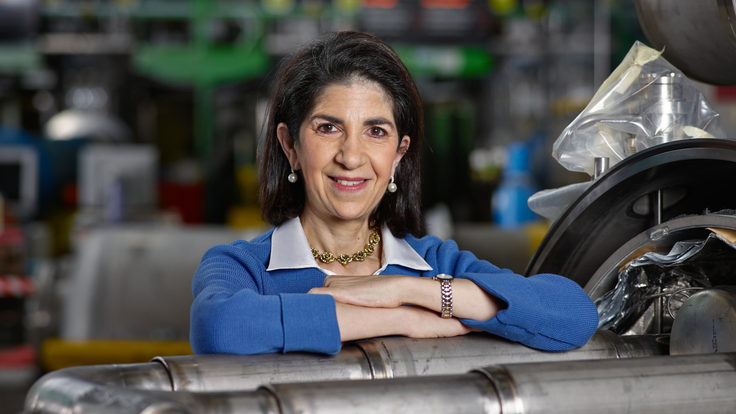
Physicist Fabiola Gianotti started her mandate as the fifteenth Director General of CERN on January 1. She recently answered a few questions for Symmetry about what her biggest priorities and challenges are moving forward.
LHC Run 2 is in full swing. What does the scientific program promise for this year?
This year is going to be very important. Last year we made a big step in energy, a factor 1.7, and it will be a long time before another such step will be made in the future.
This year is going to be the year of ‘luminosity production,’ as we call it. The goal is to deliver to the experiments at least a factor of five to six times more data than last year. With these data the experiments will be able to perform more precise measurements of Standard Model processes and particles, including the Higgs boson. We need to know this very special and relatively newly discovered particle with a much higher precision than today, also because it is a door into new physics. The experiments will also measure rare processes and look for new particles with increased opportunities to discover new physics, if nature is kind enough to have put new physics at the energy scale explored by LHC.
What are the main priorities and objectives in your plan of work for CERN during your mandate?
The priorities are to maintain and expand CERN’s excellence in all its components.
Research in fundamental physics is our first mission. We are operating and upgrading the most powerful accelerator in the world. We have a compelling scientific diversity program. And we are preparing for the future.
Our field requires very complex, high-tech instruments, so another essential component of our activity is to develop the needed cutting-edge technologies, which are transferred to society. They cover a variety of domains, including superconducting magnets, vacuum, cryogenics, electronics, computing. Another important element is training young people—not only tomorrow’s scientists but also school kids and school teachers. Last but not least, peaceful collaboration, i.e. maintaining CERN as a place where people from around the world can work together in the name of science.
And the main challenges for the next five years?
Every day brings new challenges. In my opinion, the most important challenge for our community in the years to come is to prepare the future for CERN and the discipline in Europe, within the worldwide context. Between 2019 and 2020 we will update the European Strategy for Particle Physics and define the roadmap of the field for future years. It will be a very important and intense time for the community. We will have to build on what we’ve learned since the previous ESPP in 2013. A big role will be played by the LHC results—what we find at the LHC and what we don’t find.
Is CERN already making plans for a successor to the LHC?
We are already preparing for the future. It’s not too early; first discussions of the LHC took place at the beginning of the ’80s, and the LHC started operation in 2010. This project required 25 to 30 years from first ideas through first operation.
Preparation for the future proceeds along three lines: a vigorous accelerator R&D program; design studies of future high-energy colliders, including CLIC and FCC; and exploration of additional opportunities offered by the CERN accelerator complex—complementary to high-energy colliders. Indeed, the outstanding questions in today’s particle physics are so numerous and difficult that a single approach is not sufficient.
How do you see CERN and its role in the global picture of big science today?
The open questions in fundamental physics cover a broad range of issues, from dark matter to dark energy, from the matter-antimatter asymmetry to the flavor problem, etc. There is no single project, no single smoking gun that allows us to answer them all. The only way to address them successfully is to deploy the full set of approaches that the field has developed. These include high-energy accelerators, underground detectors looking for dark matter or proton decay, cosmic surveys, neutrino experiments, etc.
No single country, no single region can build and run all these projects. That’s why particle and astroparticle physics are becoming more and more global. We have to share the facilities in order to optimize the human, technological and financial resources. We have to collaborate, still maintaining a little bit of competition, which is always very healthy and very stimulating.
The deconstructed Standard Model equation
The Standard Model is far more than elementary particles arranged in a table.
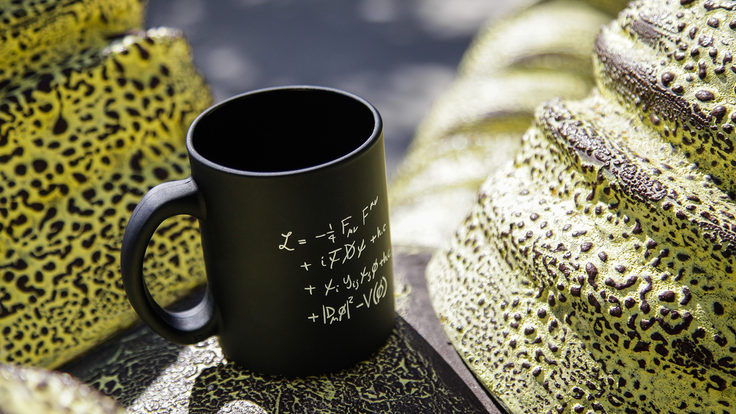
The Standard Model of particle physics is often visualized as a table, similar to the periodic table of elements, and used to describe particle properties, such as mass, charge and spin. The table is also organized to represent how these teeny, tiny bits of matter interact with the fundamental forces of nature.
But it didn’t begin as a table. The grand theory of almost everything actually represents a collection of several mathematical models that proved to be timeless interpretations of the laws of physics.
Here is a brief tour of the topics covered in this gargantuan equation.
The whole thing
This version of the Standard Model is written in the Lagrangian form. The Lagrangian is a fancy way of writing an equation to determine the state of a changing system and explain the maximum possible energy the system can maintain.
Technically, the Standard Model can be written in several different formulations, but, despite appearances, the Lagrangian is one of the easiest and most compact ways of presenting the theory.
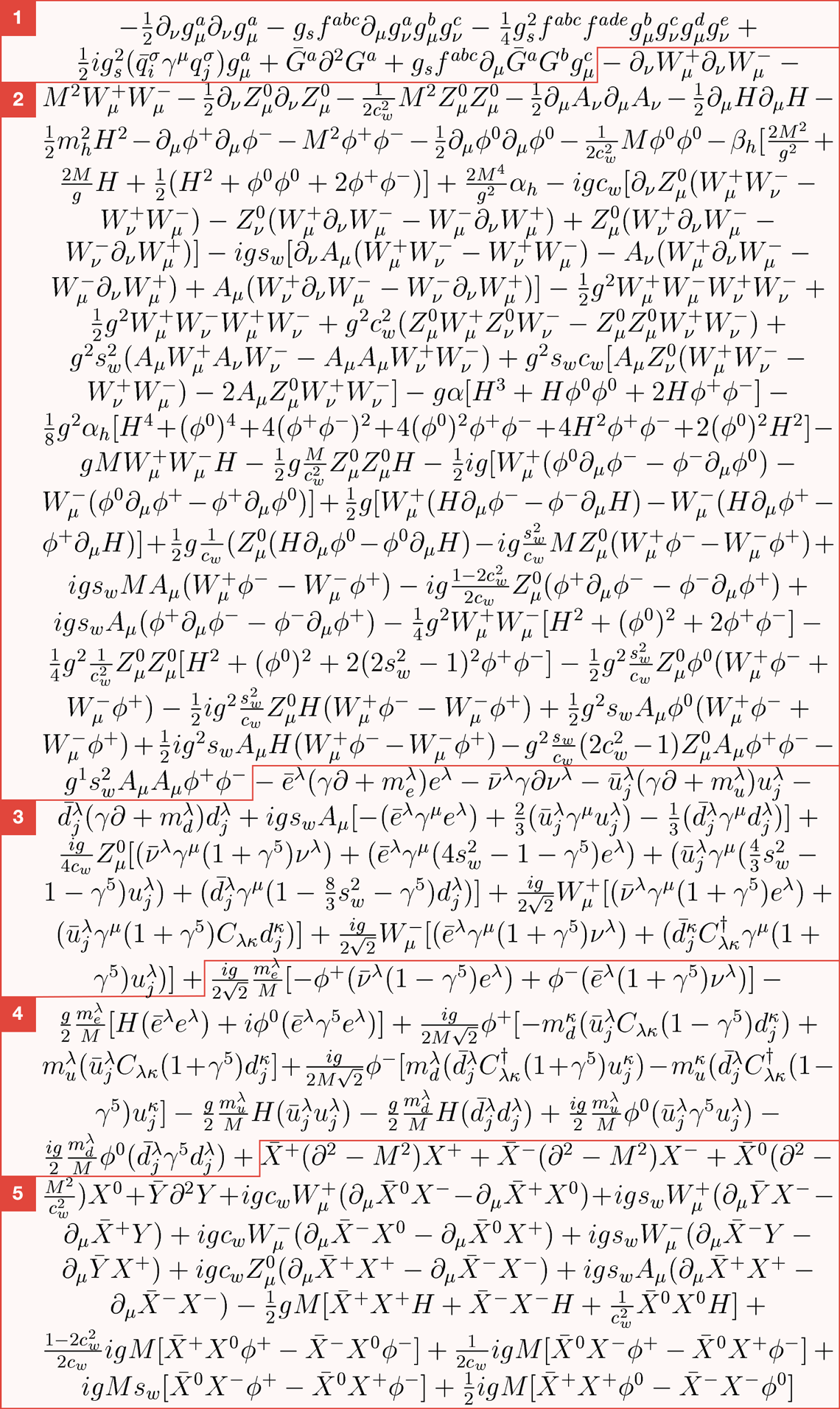
Lagrangian standard model
Section 1
These three lines in the Standard Model are ultraspecific to the gluon, the boson that carries the strong force. Gluons come in eight types, interact among themselves and have what’s called a color charge.

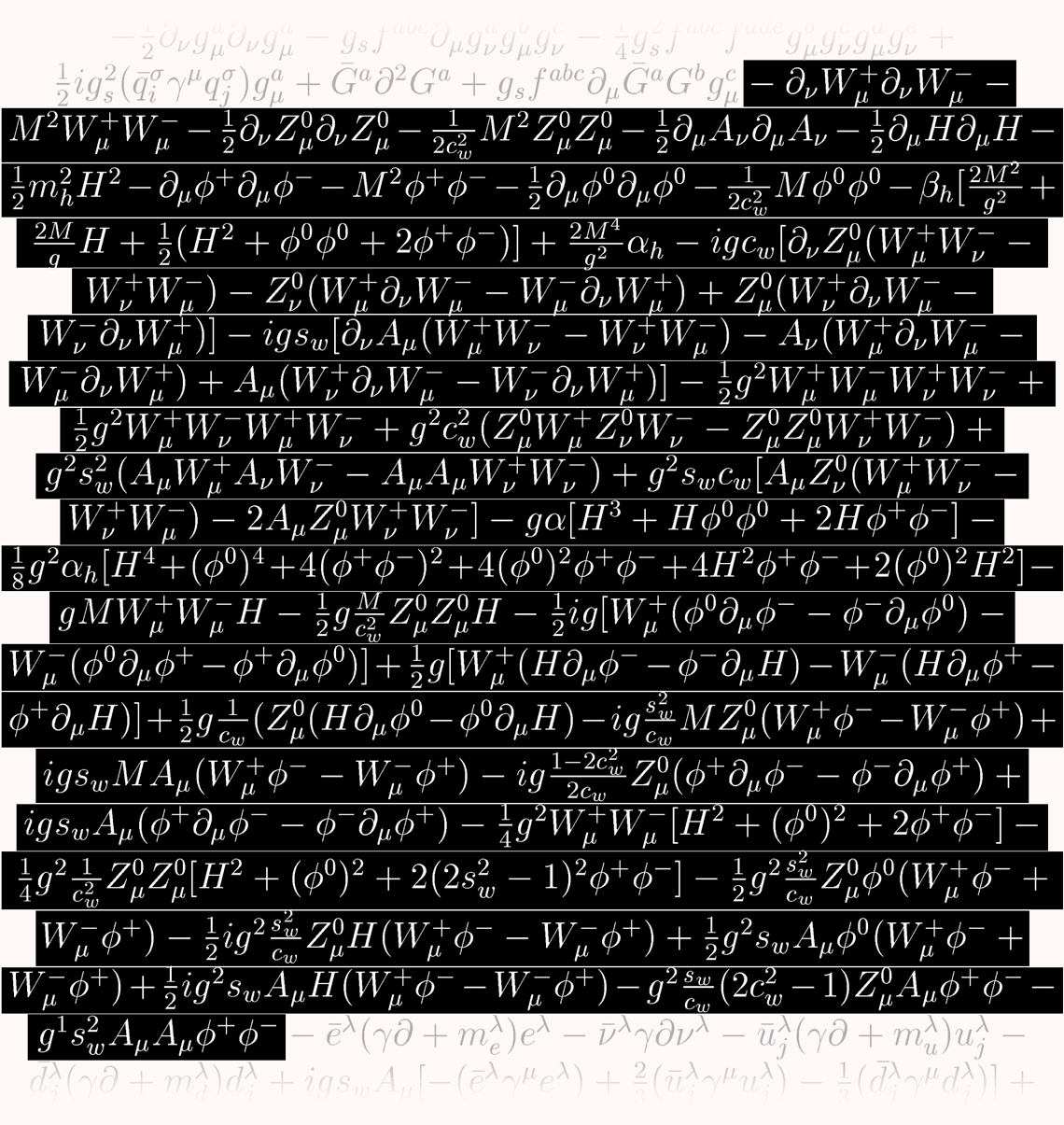
Section 2
Almost half of this equation is dedicated to explaining interactions between bosons, particularly W and Z bosons.
Bosons are force-carrying particles, and there are four species of bosons that interact with other particles using three fundamental forces. Photons carry electromagnetism, gluons carry the strong force and W and Z bosons carry the weak force. The most recently discovered boson, the Higgs boson, is a bit different; its interactions appear in the next part of the equation.
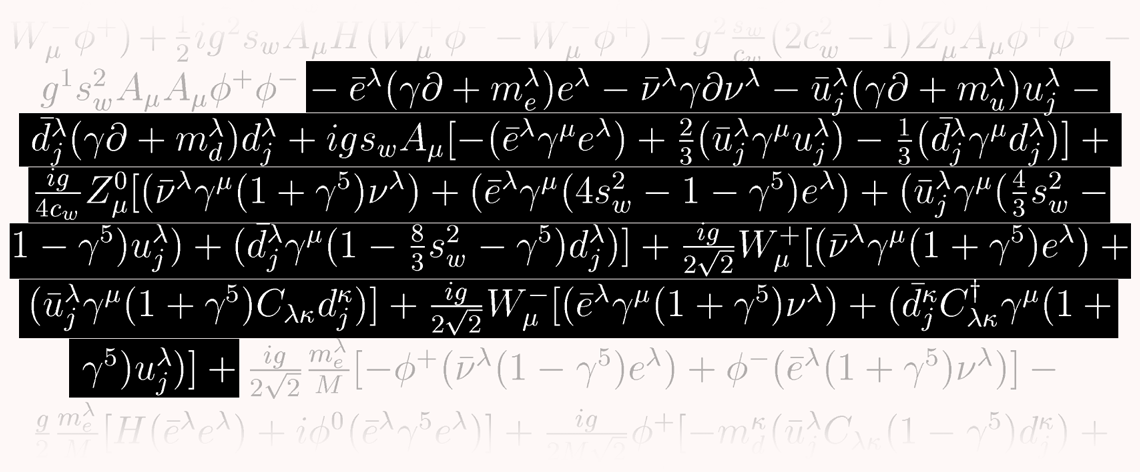
Section 3
This part of the equation describes how elementary matter particles interact with the weak force. According to this formulation, matter particles come in three generations, each with different masses. The weak force helps massive matter particles decay into less massive matter particles.
This section also includes basic interactions with the Higgs field, from which some elementary particles receive their mass.
Intriguingly, this part of the equation makes an assumption that contradicts discoveries made by physicists in recent years. It incorrectly assumes that particles called neutrinos have no mass.
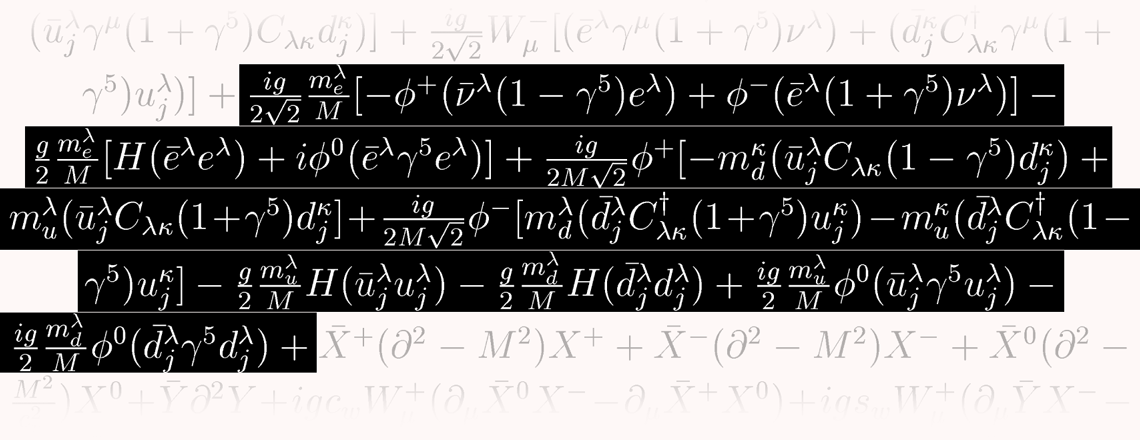
Section 4
In quantum mechanics, there is no single path or trajectory a particle can take, which means that sometimes redundancies appear in this type of mathematical formulation. To clean up these redundancies, theorists use virtual particles they call ghosts.
This part of the equation describes how matter particles interact with Higgs ghosts, virtual artifacts from the Higgs field.
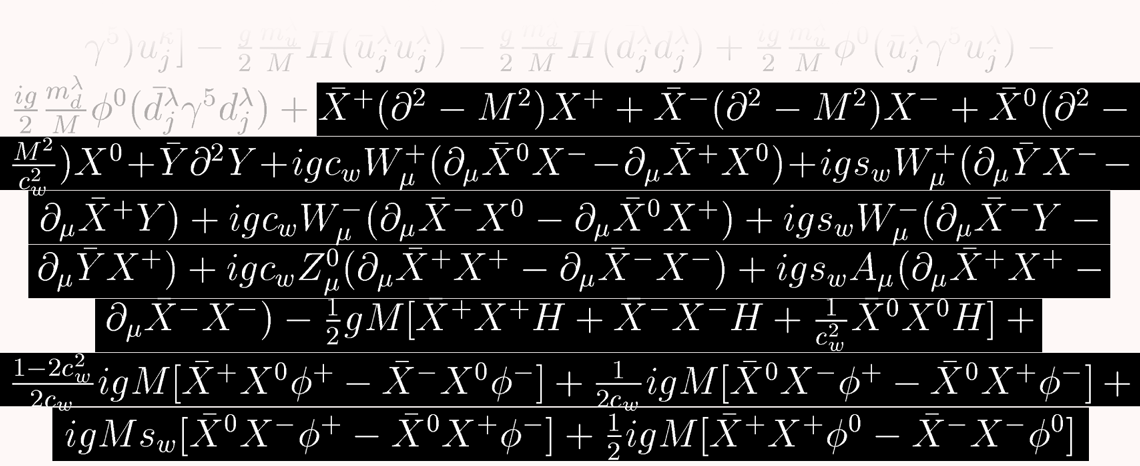
Section 5
This last part of the equation includes more ghosts. These ones are called Faddeev-Popov ghosts, and they cancel out redundancies that occur in interactions through the weak force.
Note: Thomas Gutierrez, an assistant professor of Physics at California Polytechnic State University, transcribed the Standard Model Lagrangian for the web. He derived it from Diagrammatica, a theoretical physics reference written by Nobel Laureate Martinus Veltman. In Gutierrez’s dissemination of the transcript, he noted a sign error he made somewhere in the equation. Good luck finding it!
The Atomki anomaly
A result from an experiment in Hungary catches the attention of a group of theorists in the United States.
Scientists at the Large Hadron Collider aren’t the only ones investigating a possible sign of a new particle.
In a result published in Physical Review Letters earlier this year, scientists on the Atomki nuclear physics experiment in Hungary claimed to have turned up potential evidence of a particle that could point to an entirely new fundamental force of nature.
"If it is a particle, it's an exotic one that's never been seen before," says Jonathan Feng of the University of California at Irvine. Feng and a small group of fellow theorists at UCI wrote a paper, soon also to be published in PRL, examining what kind of particle it might be.
Scientists have already discovered the elementary particles predicted by the Standard Model of particle physics. Any additions would go beyond physicists’ best model of the particles and forces that make up the universe.
The implications of such a discovery rightly provoke uncertainty about the experiment and the Hungarian scientists’ interpretation of the result, says physicist Flip Tanedo, a former postdoc in Feng’s group who recently become an assistant professor at University of California, Riverside. But UCI particle physicists, along with visiting nuclear physicist Susan Gardner of the University of Kentucky, found it worth exploring.
The experiment
Researchers at Atomki, the Institute for Nuclear Research at the Hungarian Academy of Sciences, took a thin foil of lithium atoms and bombarded it with protons to induce nuclear reactions.
The bombardment turned some of the lithium nuclei into an extremely unstable isotope called beryllium-8, which has four protons and four neutrons. The reaction left the beryllium-8 nuclei in an "excited state," with extra energy deposited in the configuration of the protons and neutrons.
That excited state is unstable and decays by giving up the extra energy. Sometimes the nucleus decays by emitting an electron and its antimatter partner, a positron.
The Atomki researchers measured the energy of the electron-positron pairs and the angles of their motion. In the simplest case, the electromagnetic force should send the particles along paths very close to each other. But the researchers found some of electrons and positrons flew away at a much wider angle. This could happen, the physicists hypothesized, if they were born from the decay of an invisible particle with a mass 34 times that of an electron.
The UCI group built out a model of this particle and found that it fit the description of an unusual version of a dark photon, the particle related to a hypothetical force that would govern how dark matter and matter interact.
Excited over nothing?
Skeptics of the result are out in force. Feng and company showed the particle would have to interact much more strongly with neutrons than with protons, an unexpected characteristic for a new low-mass force-carrying particle.
"It's a bit contrived," says Rouven Essig, a particle physicist at Stony Brook University. "The kind of interactions you need between this new particle [and] Standard Model particles are not particularly simple or natural. Because of that, it puts a strong theory bias against this result being explained by a new particle."
Frank Calaprice, a nuclear physicist at Princeton University, says he is impressed by the experiment itself but that he questions the nuclear physics that underlies the analysis.
The next step is to double-check the result using other experiments. The LHCb experiment at the Large Hadron Collider or the upcoming Belle II detector in Japan could be good candidates, as could the Mu3e experiment in Switzerland and the DarkLight experiment in the United States, which are hunting for new particles around the same energy.
The verdict should come within the next few years, Feng says. Despite the odds stacked against a new discovery, he’s hopeful.
“It’s us against the Standard Model,” he says. “We know there’s something more out there, we just haven’t gotten to it yet. This could be it.”
Editor’s note: Additional reporting and writing provided by Matthew Francis.

 Frascati Scienza
 Buco Nero
 Io Non Faccio Niente
 Tommaso Dorigo
 Giovanni Mazzitelli
 Barbara Gallavotti
 Keplero Blog
 Research Gate